













Why middle managers will decide whether enterprise AI actually scales
Most AI strategies will stall if middle managers are expected to drive change without the authority, incentives or capacity to redesign work.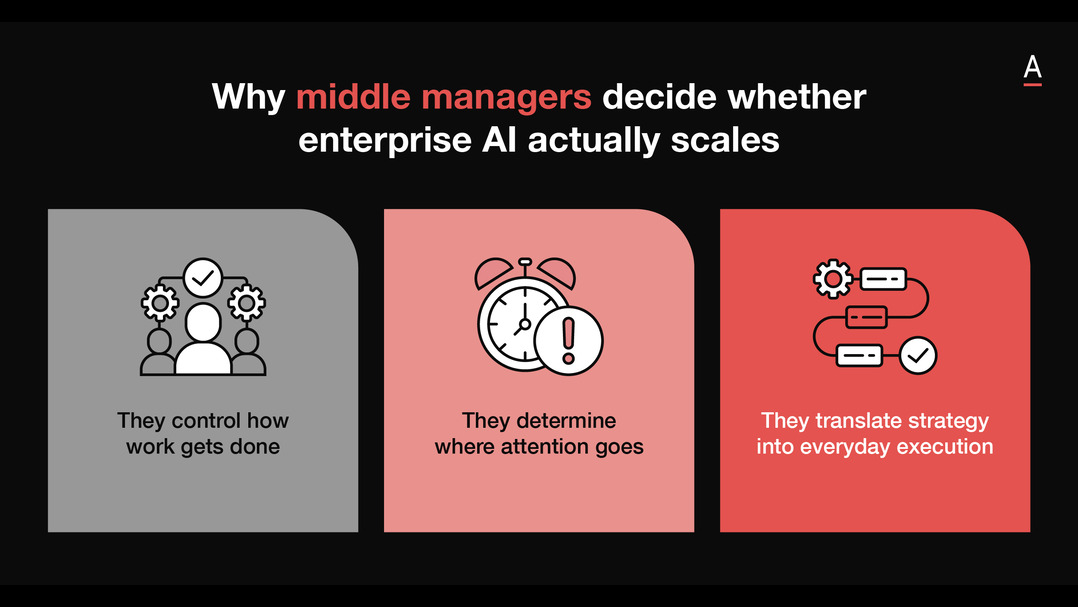


 Published Jun 25, 2026 in
Articles
Data & AI Strategy
Contributors
Justina Uy
Published Jun 25, 2026 in
Articles
Data & AI Strategy
Contributors
Justina Uy
AI scale is decided where delivery pressure, team behaviour, risk, customer expectations and process reality meet.
Strategy, platforms, training and risk guidance can create the conditions for adoption.
The work changes when teams alter how they review output, handle exceptions, measure quality and decide what still requires human judgement.
Middle managers sit closest to those decisions.
They control workflow design, team attention, informal norms, resource allocation, risk escalation and the local interpretation of safe use.
They also know the parts of the business that rarely appear in transformation plans: the workarounds that keep delivery moving, the approvals nobody trusts, the reports nobody reads and the tasks everyone knows are low value but nobody has removed.
Stanford HAI’s 2025 AI Index shows business AI use has accelerated, with 78% of organisations reporting AI use in 2024, up from 55% the year before.
The report also points to growing evidence that AI improves productivity and narrows some workforce skill gaps.
The harder question for enterprise leaders is whether those gains can become repeatable performance across teams.
Tool access only proves employees can use AI. It does not prove the operating model has changed.
Reason 1: They translate AI strategy into operating conditions
Enterprise leaders often treat AI scale like a rollout: approve the strategy, fund the platform, train employees, measure usage.
Actual scale requires managers to alter the operating conditions around the work: targets, quality standards, review points, escalation paths and team routines.
If those stay fixed, AI becomes another tool layered onto the same constraints.
CommBank’s experience shows how quickly scale becomes a people problem.
Jen French, General Manager, AI Acceleration at CommBank, described how the bank is enabling 50,000 employees to use AI safely and productively.
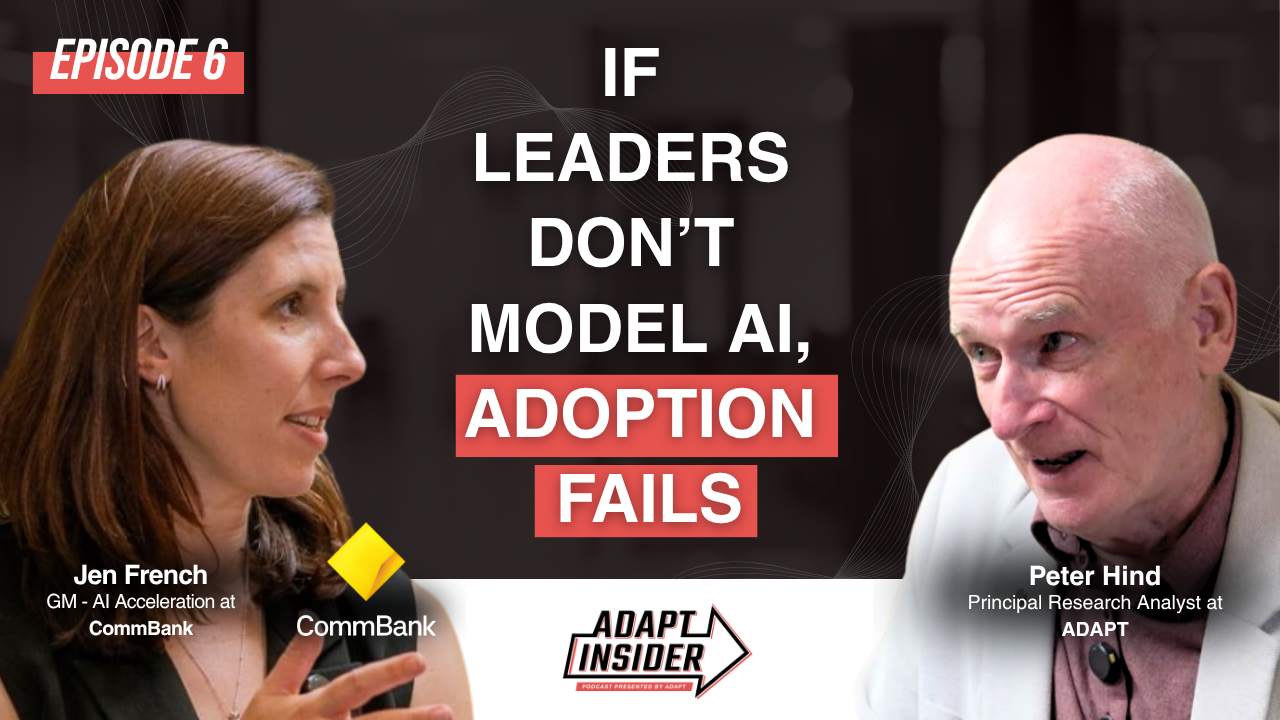
The approach combines leader led adoption, responsible AI frameworks, practical skill building and adoption data to understand where confidence is taking hold.
A responsible AI framework has limited value if managers cannot apply it inside lending, service, compliance, operations and customer workflows.
The manager close to the work has to decide which tasks AI can support, which outputs need validation, which risks are unacceptable and which use cases deserve more investment.
Leadership move: Give middle managers authority to adapt workflows, define safe use, surface blockers and feed local learning back into AI, data, risk and HR teams.
Reason 2: They control the attention AI needs
Attention is where many AI programmes lose momentum.
Middle managers decide what gets discussed in team meetings, what gets coached, what gets treated as optional and what survives delivery pressure.
In lean ANZ teams, many already carry delivery targets, escalations, reporting, people management and change fatigue. AI competes for time unless leaders remove work or reset priorities.
Work Futurist Dom Price frames modern work as something leaders must act on rather than keep forecasting.
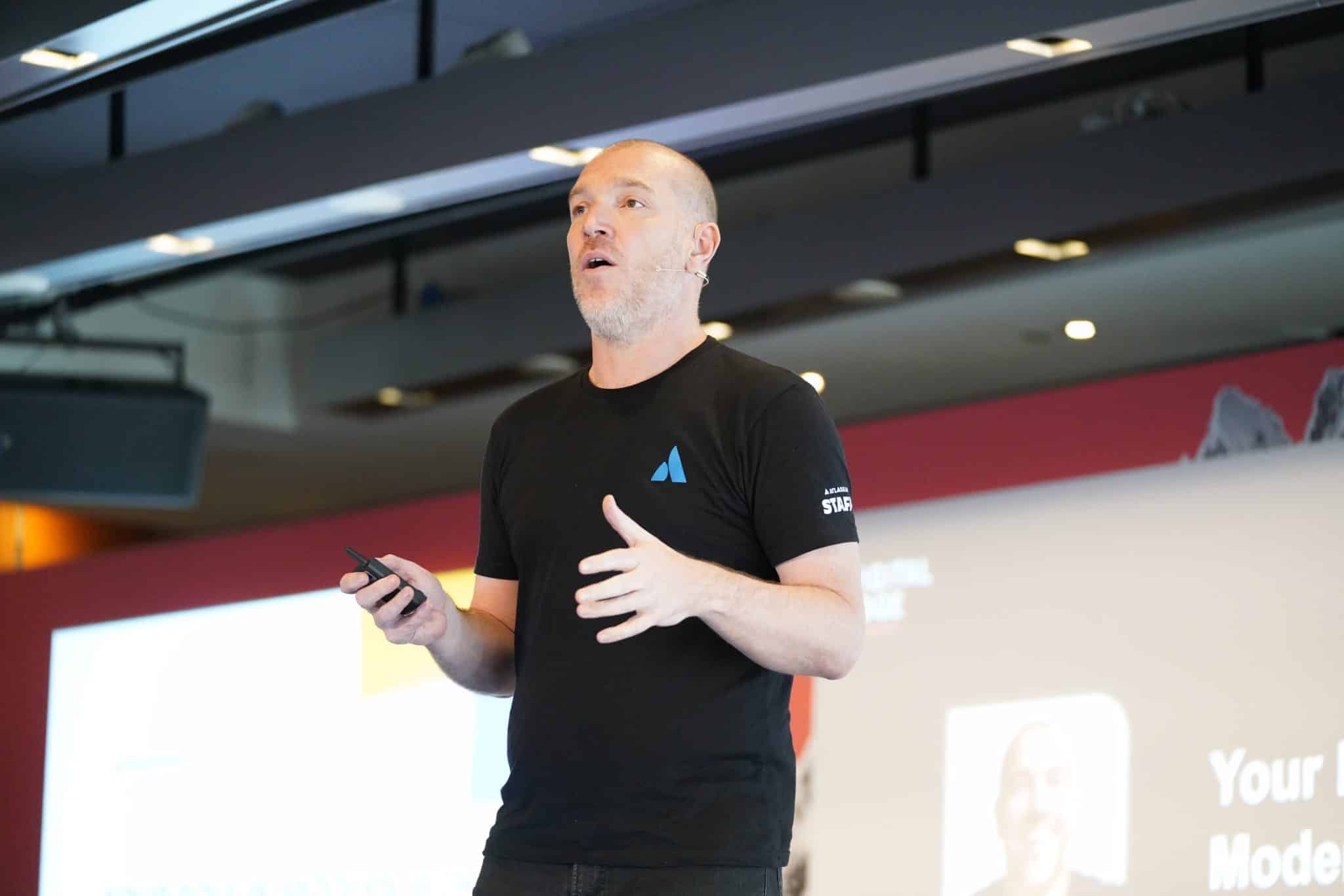
According to him, organisations need to examine whether their values, habits and operating norms still fit the work they are asking people to do.
That lens matters for AI adoption because the middle layer decides whether AI is a genuine change to work or another priority added to the queue.
A stretched manager will protect the current operating rhythm.
A manager with time, permission and practical support can remove low value activity, redesign approvals and make AI part of how the team delivers.
Executive enthusiasm becomes useful only when managers have capacity to change routines, rather than absorb another initiative.
Leadership move: Free up managerial capacity before asking managers to lead AI adoption. Remove lower value reporting, pause competing change activity and protect time for workflow redesign.
Reason 3: They carry the risk of failed adoption
Calling managers resistant usually misses the risk equation.
The upside of AI adoption is often abstract: productivity, future capability, enterprise value.
The downside lands quickly and locally: failed experiments, poor quality outputs, confused employees, customer friction, audit exposure and missed delivery targets.
Managers are expected to champion change while carrying the consequences if the change lands badly.
ADAPT’s interview with Bri Williams, Founder of People Patterns, reinforces the behavioural reality.
Bri argues that what people say they will do often differs from what they actually do, and that behavioural science is needed to influence action across individuals, teams and cultures.
BearingPoint’s research addresses the middle management layer.
It positions middle managers as translators, connectors, navigators and coaches in AI driven transformation, with a critical role in bridging leadership vision and real world execution.
AI adoption can look supported in town halls, then fade inside old routines.
Managers may agree with the strategy while avoiding changes that expose the team to delivery risk, reputation risk or employee anxiety.
Leadership move: Reward controlled experimentation and documented learning, not only successful deployments. Make early failure cheap, visible and useful.
Reason 4: They know where work actually breaks
AI does not fix weak work design.
It can speed up the same broken handoffs, document the same approval bottlenecks and make low value reporting easier to produce.
Without redesign, the organisation gets more output from processes that should have been questioned first.
ADAPT’s CHRO research frames work redesign as the operating model battleground.
Australian CHROs are gaining board level influence because AI is changing how work gets measured, how teams collaborate, and how roles and skills need to evolve.
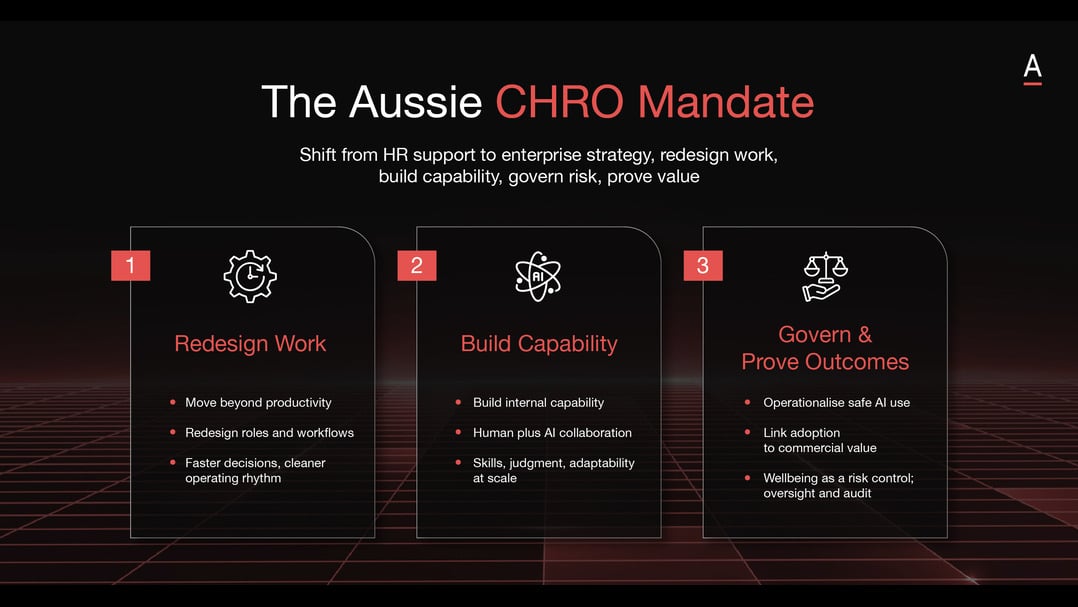
Workforce capability weakens when AI is introduced into decision cycles, reporting rhythms and manager expectations built for slower, more manual work.
Middle managers see the approval steps that protect quality, the spreadsheets hiding system gaps and the informal expertise that keeps customer issues moving despite the formal process.
That knowledge should shape AI prioritisation.
Too many enterprise programmes source use cases from central teams, vendors or executive workshops, then ask managers to implement decisions made too far from the workflow.
A better approach starts with manager led diagnosis of where work slows down, where quality varies, where judgement matters and where AI can reduce friction without weakening control.
Leadership move: Build AI use case discovery around manager led workflow reviews, covering handoffs, rework, approval delays, customer friction, risk points and judgement intensive tasks.
Reason 5: They turn AI literacy into workflow capability
Generic AI literacy rarely changes how work gets done because the judgement required is specific to the workflow.
Managers need to know where AI can safely assist, what quality standard the output must meet, when human review is required, and how the work changes once AI removes part of the manual load.
Without that role specific context, training stays theoretical and teams revert to the old process.
Dr Kristine Dery, Research Scientist at MIT Sloan School of Management, argues that future-ready enterprises need future ready people.
Her focus is the connection between technology, human capability, IT, HR and learning, with organisations needing to create time and space for people to build the skills required to use technology effectively.
ADAPT’s interview with Sarah Morris, GM, People and Capability at Palmerston North City Council, and Peyton Caffey, Director of Global People at ServiceNow A/NZ, shows how specific the capability question has become.
Palmerston North City Council is using AI for HR policy support, onboarding consistency and workforce planning.
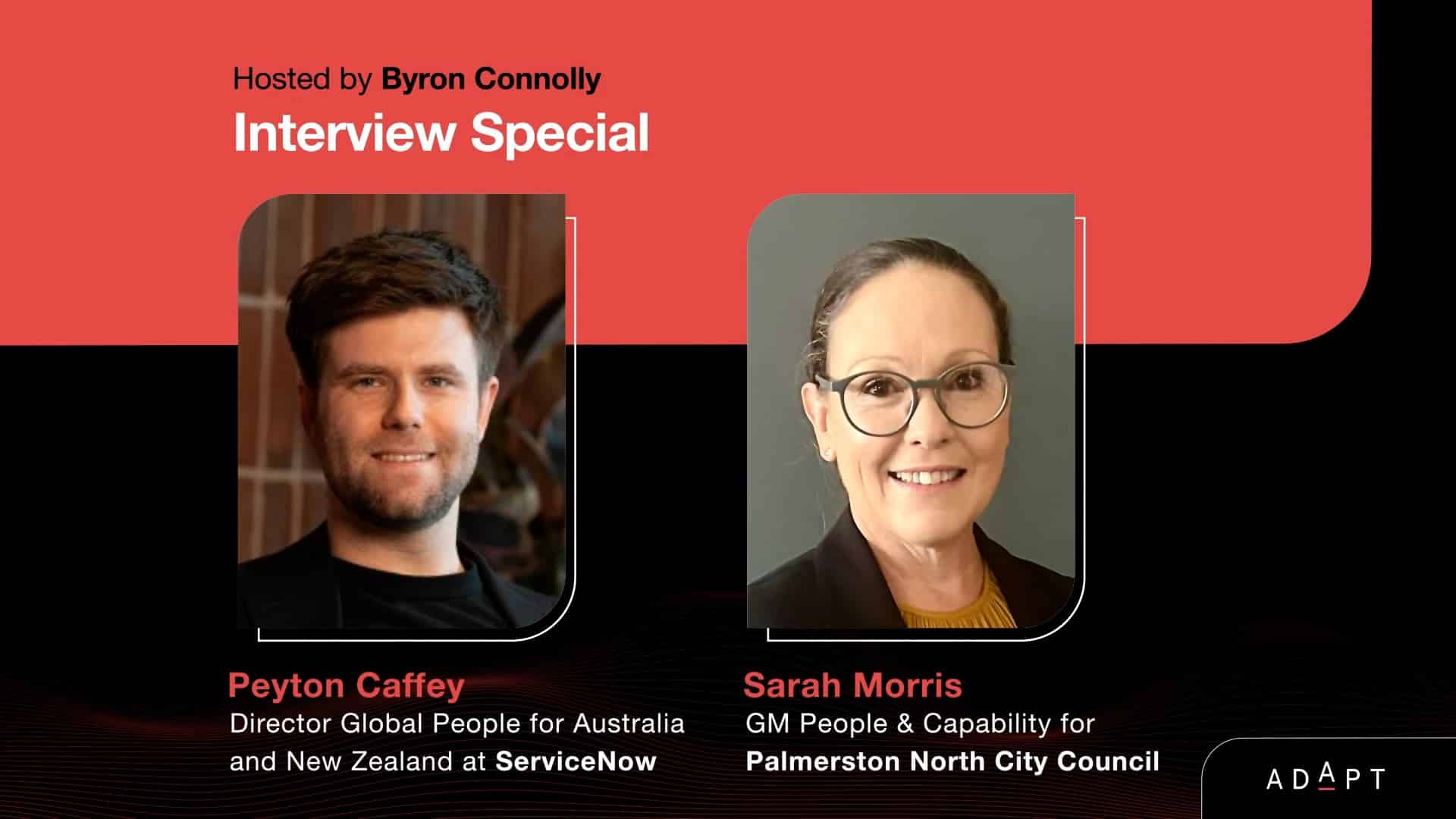
Peyton said AI is changing organisational design, with AI augmentation expected to provide a 20% capacity improvement within five years.
Managers need role specific practice, evaluation criteria and coaching support tied to their actual workflows.
Training completion tells leaders very little. The stronger signal is whether managers can judge output quality, redesign team routines and explain how roles change without creating anxiety or confusion.
Leadership move: Replace broad AI awareness programmes with workflow specific practice.
Give managers examples, coaching and quality standards for the work their teams own.
Reason 6: Their role is being rewritten by workforce pressure
The management role is shifting through the workforce before it is rewritten in job descriptions.
Managers are being asked to hold together productivity, trust, skills development, employee anxiety, risk escalation and output quality while AI changes the shape of work.
That is a different job from supervising activity and passing information up the chain.
AI and automation are pushing people leaders closer to board level workforce decisions because role design, collaboration, wellbeing, governance and capability measurement are all changing at once.
Middle managers carry that shift into the team environment, where it has to become clearer routines, better coaching, safer escalation and stronger judgement about how work should change.
Founder and Managing Director of Imperative Advisory Florian Pecher’s CFO Edge session adds a useful leadership angle.
He argued that performance under pressure is becoming more human, with leaders needing to manage energy, decision quality and emotional load rather than treat productivity as a mechanical output.
AI will strip away some coordination work, but the manager’s judgement becomes more important.
Managers need to decide when AI output is acceptable, when human review is required, where employees need support and when the workflow has to change instead of asking people to move faster.
Leadership move: Update middle management expectations around workflow redesign, AI governance, coaching, adoption quality, risk escalation and measurable productivity outcomes.
Reason 7: They reveal whether AI adoption is generating value
Failed AI scale often appears as polite compliance.
The warning signs appear early. A pilot moves from the innovation team to BAU with no clear owner.
Managers repeat the strategy but leave review habits, quality checks and escalation paths untouched.
Usage improves, yet cycle time, customer outcomes, cost, risk and output quality barely move.
Training completion becomes the adoption metric, even though managers still do not have guidance they can use when the work gets messy.
Adoption should be measured through trust, transparency and business outcomes, not tool activity.
Stronger reporting links AI use to productivity, resilience, operational performance and workforce confidence, so leaders can see whether behaviour is actually changing.
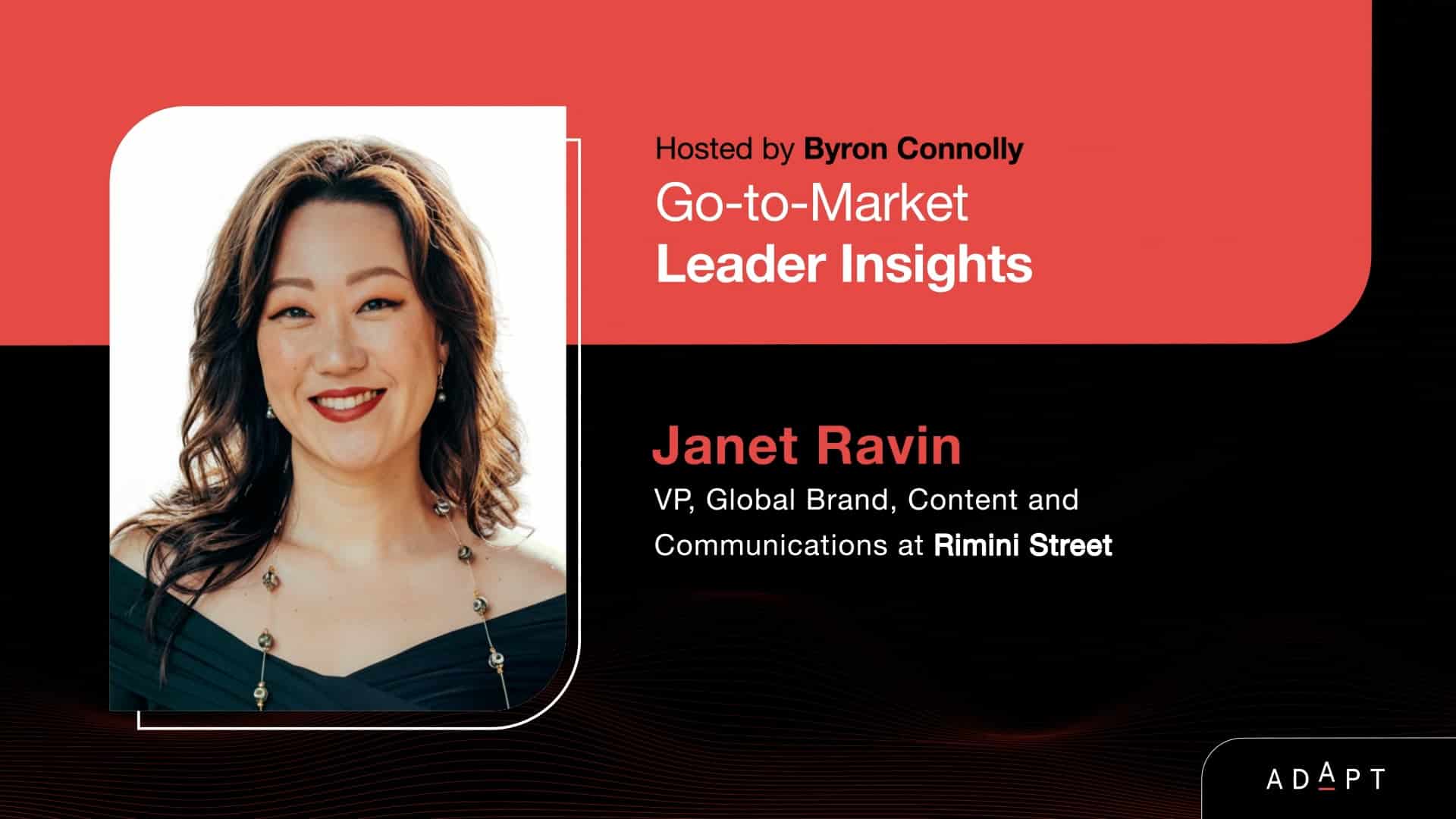
Rimini Street’s Janet Ravin, Vice President of Global Brand, Content and Communications, brings the workforce risk into focus.
She argues enterprises must put people before technology as AI changes skills expectations, and Rimini Street’s survey of more than 4,300 executives found 98% believe the skills shortage is hindering digital transformation.
Managers absorb the practical consequences of that skills gap.
If they receive pressure, policy and training links without authority or capacity, the workforce will read AI as another transformation imposed from above.
Cynicism compounds after every programme that asks for new behaviour without changing the conditions around that behaviour.
Leadership move: Track manager level adoption quality, including workflow changes, coaching activity, employee confidence, exception handling, output quality and sustained use after pilot funding ends.
Why the middle layer determines scale
Middle managers determine whether enterprise AI scales because they control the layer where adoption becomes behaviour:
- Operating translation: They turn enterprise guidance into workflow decisions.
- Attention: They decide what gets time, coaching and reinforcement.
- Risk: They carry the local consequences when experiments fail.
- Work redesign: They know where handoffs, approvals, rework and informal workarounds slow performance.
- Capability: They turn generic AI literacy into role specific practice.
- Trust: They shape whether teams see AI as useful, risky, optional or imposed.
- Sustained adoption: They reveal whether AI has changed routines or simply lifted usage dashboards.
The strategic stakes sit in the middle
Competitors will pull ahead because their managers learn faster.
They will identify better use cases, remove more friction, build team confidence, raise output standards and turn governance into daily practice.
Their teams will learn where AI helps, where it weakens judgement, where it changes customer outcomes and where human expertise needs to stay close to the decision.
The C-suite can mandate AI. Middle managers operationalise it.
Middle managers need to be built into the AI scale plan from the start, with time, authority, incentives, capability and protection while work changes.
Leave them as recipients of transformation, and AI will keep looking successful in pilots while failing to change the routines that run the business.
 Justina Uy
Content Marketing Manager
Justina Uy
Content Marketing Manager
Justina Uy is a data-driven content marketer that thrives on democratising elite know-how to empower Australia’s underdogs.
Skilled at translating complex ideas into a compelling story across formats and channels, she shifts seamlessly between writing long-form articles, creating viral social media posts, and producing thumb-stopping videos.
Since 2015, Justina executes her vision through a sophisticated understanding of the rapidly evolving digital and business landscape to serve entertaining and educational insights to the executive community.
Less Join the ADAPT
 Insider Community
Get the latest A/NZ market research and insights on the core trends impacting leaders.