














How CHROs are leading the shift from AI ambition to workforce capability
Australia's CHROs are gaining board-level influence by redesigning work for AI, strengthening governance, and proving workforce impact through outcomes.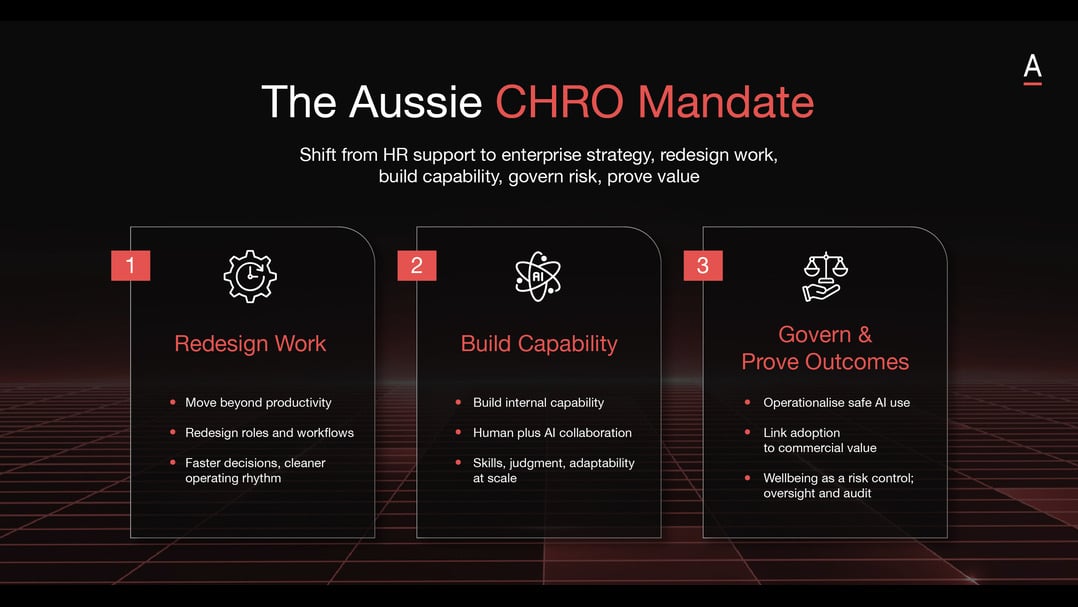


 Published Feb 26, 2026 in
Articles
People
Contributors
Justina Uy
Published Feb 26, 2026 in
Articles
People
Contributors
Justina Uy
Work redesign is becoming the operating model battleground
Role design is where AI programmes either scale or stall.
People leaders described a growing gap between what tools can automate and what organisations have actually rebuilt around them.
Processes still assume human paced decision cycles, reporting rhythms still reflect old data flows, and manager expectations often remain unchanged.
Several leaders pushed the conversation beyond productivity.
The priority is building capabilities that compound over time, judgement, adaptability, collaboration with AI outputs, and continuous unlearning as policies, systems, and workflows evolve.
Across the community, the challenge is being framed as an enterprise redesign question that touches job architecture, leadership capability, and how work moves between teams.
Talent constraints make this harder, particularly for mid sized organisations.
Many leaders pointed to the same constraint, competing for scarce AI talent against larger employers remains difficult, especially for mid sized organisations.
The more sustainable path discussed leaned on internal development, clearer pathways for progression, and a realistic view of retention.
When roles are redesigned with growth built in, organisations rely less on external hiring markets to create capability.
CHROs are being judged on whether they can build internal supply of critical skills rather than relying on a hiring strategy that does not scale.
Vendor takeaway: Anchor your value in workflow and role redesign, show how your product supports capability uplift, and prove adoption outcomes through measurable changes in cycle time, decision quality, and manager effectiveness.
Adoption rises or falls on trust, transparency, and outcomes that executives recognise
Employees adopt tools when the intent is clear, the change feels fair, and the skills gap is actively addressed.
Leaders repeatedly pointed to trust as the critical factor, particularly when AI outputs influence work allocation, customer outcomes, or decisions that affect careers.
One people and culture leader described the need to bring teams along gradually as familiarity grows, supported by clear communication and practical training.
Capability uplift sat at the centre of adoption.
Senior people leaders emphasised training that fits real work, not generic sessions.
People need clarity on how roles will evolve, what new expectations exist, and where support will show up when work changes fast.
Without that, AI becomes a source of anxiety rather than acceleration.
Measurement is where influence consolidates.
Leaders pushed for success metrics anchored in business outcomes, not technology activity.
One HR executive focused on the need for clearer success measures that can stand up in executive reviews.
Another people and culture leader highlighted the importance of influencing executives to treat AI as a structural workforce shift, with outcomes defined in commercial and organisational terms.
Vendor takeaway: Provide change enablement assets and training paths that drive trust and proficiency, then equip leaders with reporting that links adoption to measurable business outcomes, productivity, resilience, and operational performance.
Recommended actions for technology vendors
ADAPT research shows CHROs are open to partnership, but they expect workforce impact to be proven and defensible across executives, risk teams, and the board.
To build credibility with the people function:
Australia’s CHROs are gaining influence because workforce execution now determines whether transformation delivers.
Vendors that win with this audience will back claims with measurable adoption, defensible governance, and clear links to business outcomes.
As CHROs prove capability uplift and control, they earn the mandate to shape operating models and performance at enterprise scale.
At People Edge, 130+ top Australian CHROs and Heads of People & Change will come together to uplift engagement, productivity and talent, and to strengthen the workforce strategies shaping enterprise performance.
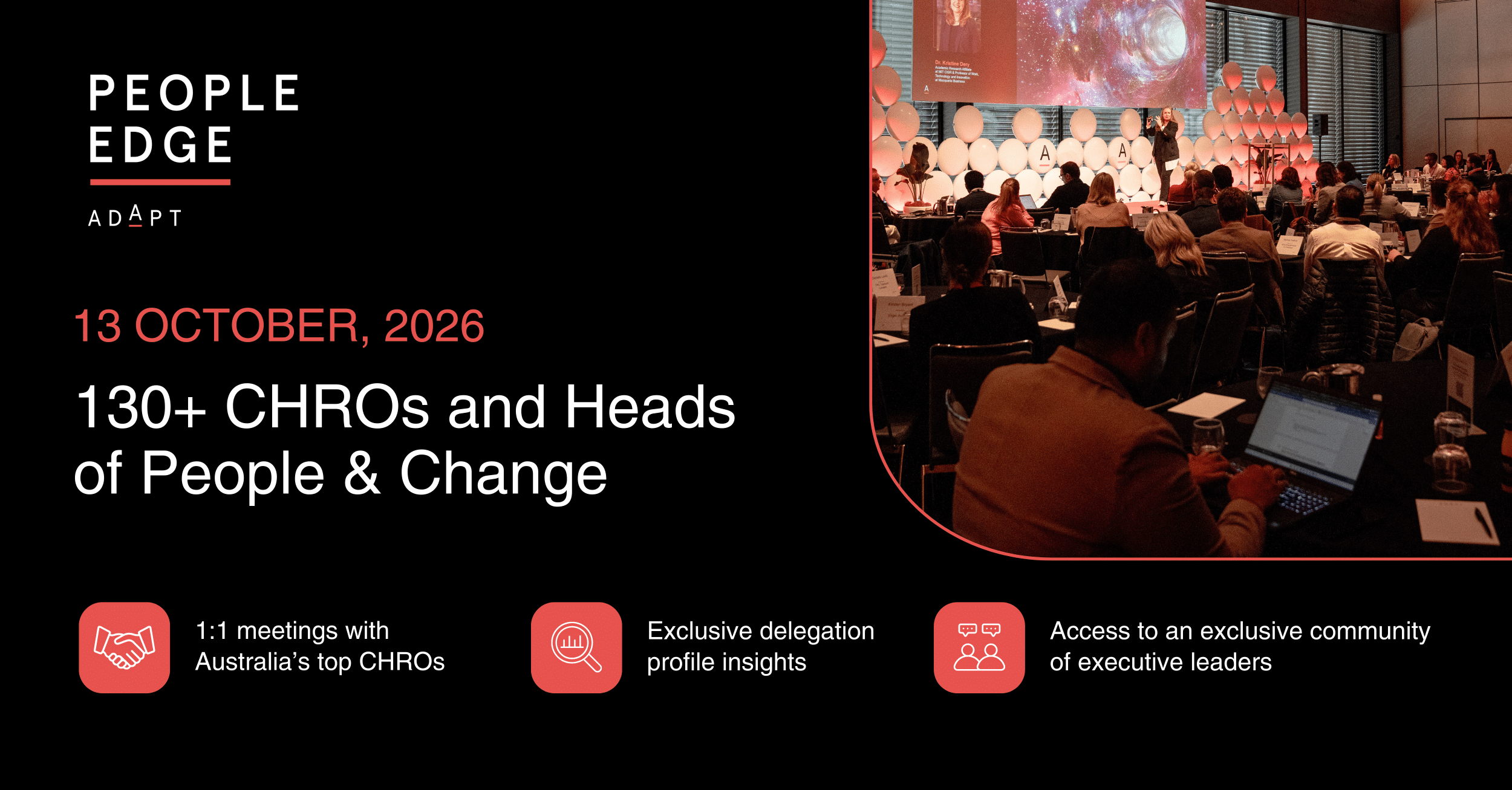
As a sponsor, you will access exclusive 1:1 meetings, detailed delegation profiles, and opportunities to showcase your expertise through keynotes and strategic sessions. Register your interest or explore tailored sponsorship options for People Edge.
 Justina Uy
Content Marketing Manager
Justina Uy
Content Marketing Manager
Justina Uy is a data-driven content marketer that thrives on democratising elite know-how to empower Australia’s underdogs.
Skilled at translating complex ideas into a compelling story across formats and channels, she shifts seamlessly between writing long-form articles, creating viral social media posts, and producing thumb-stopping videos.
Since 2015, Justina executes her vision through a sophisticated understanding of the rapidly evolving digital and business landscape to serve entertaining and educational insights to the executive community.
Less Join the ADAPT
 Insider Community
Get the latest A/NZ market research and insights on the core trends impacting leaders.