


















Occubuy CEO and Co-founder on the access that turns talent into opportunity
Dr. Amy Shi Nash, Professor at Monash University, CEO & Co-founder at Occubuy, and former Chief Analytics & Data Officer at Tabcorp, explains why progression accelerates when leaders publicly sponsor talent, and why the access gap can stall even the strongest performers.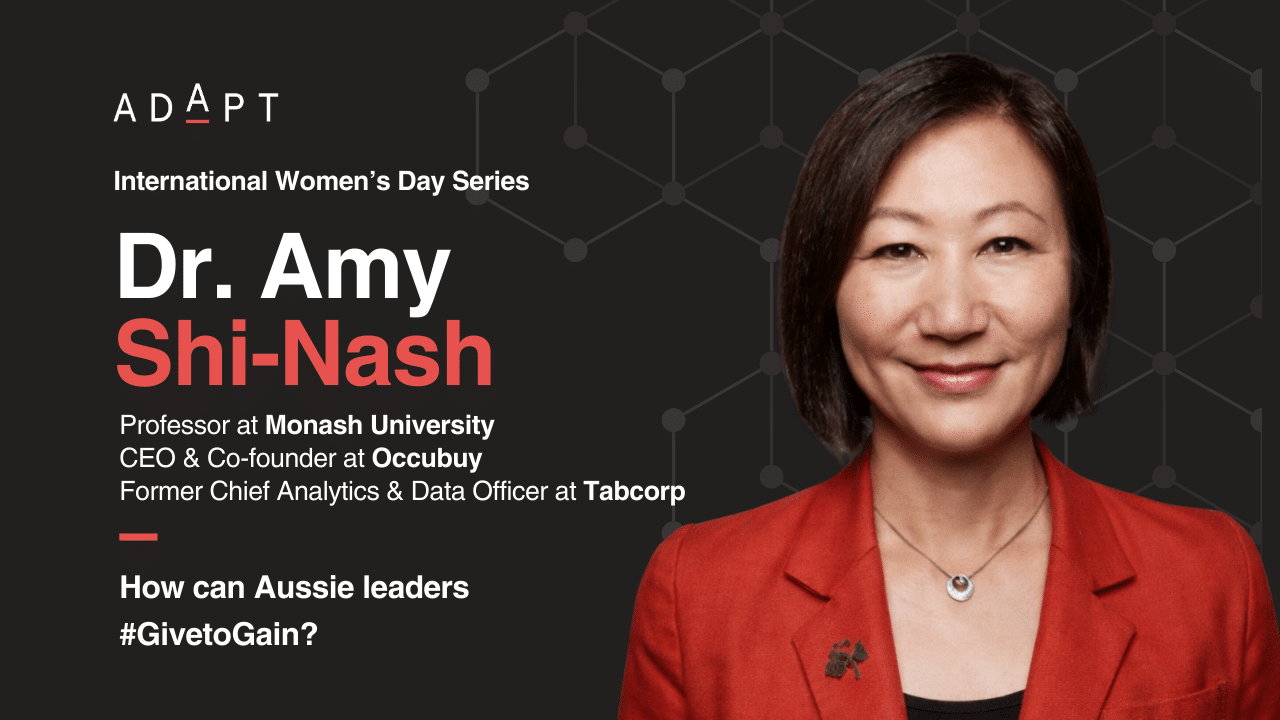


 Published Mar 3, 2026 in
Peer Insights
People
Contributors
Dr. Amy Shi-Nash
Justina Uy
Published Mar 3, 2026 in
Peer Insights
People
Contributors
Dr. Amy Shi-Nash
Justina Uy
Dr. Amy Shi Nash, Professor at Monash University, CEO & Co-founder at Occubuy, and former CDAOat Tabcorp, explains why progression accelerates when leaders publicly sponsor talent.
She has led data and analytics in high pressure enterprise environments, then moved into building a business of her own as a founder.
Across that journey, she has learned that capability is only part of the equation.
The bigger determinant is whether leaders create access early enough, and whether they are willing to put real weight behind someone’s name when it counts.
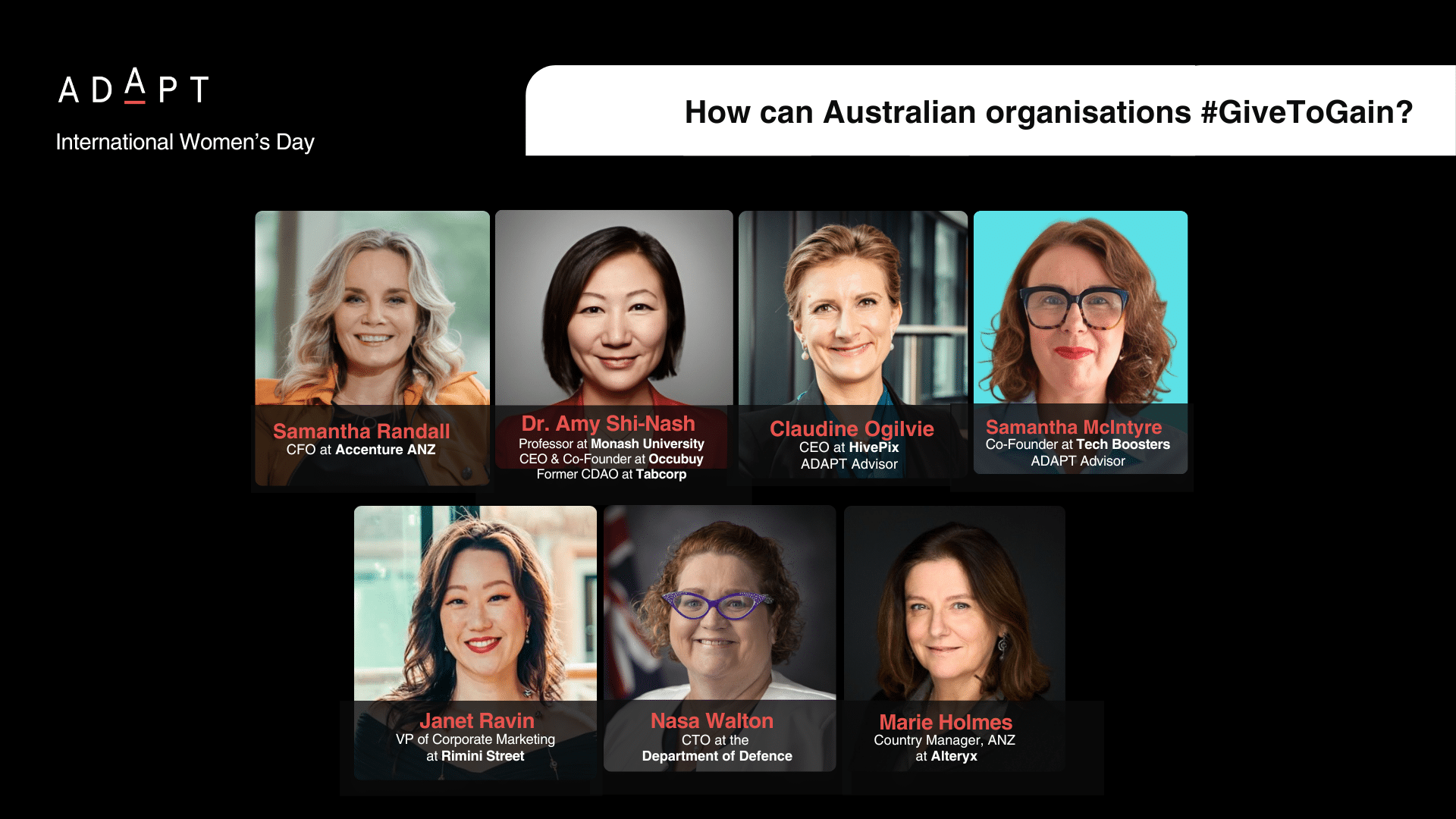
With this year’s International Women’s Day theme #GiveToGain, ADAPT’s Content Marketing Manager Justina Uy spoke with Amy about the sponsorship moment that shifted her trajectory, the access gap that quietly pushes women out, and what leaders can do to build momentum before disengagement sets in.
When sponsorship changes everything
Amy’s clearest example of sponsorship came early in her time at Tabcorp, at a moment when visibility and credibility were being set in front of the market.
Less than six months into her role, Tabcorp held an investor day with around 150 investors in the room, focused on the turnaround strategy.
Amy explained that her manager, Chief Customer Officer Jenni Barnett, advocated for her to present the data analytics strategy as part of the turnaround thesis, with support from the CEO.
For Amy, the significance was in what that decision signalled.
“It’s just the level of belief and the trust that placed in me at that stage was significant.”
She described it as a public endorsement that she could not have created alone, one that positioned data and AI as central to enterprise value, and positioned her as accountable for delivering it.
“So they, you know, put data and AI as the centre of the value engine and… position me as the accountable leader.”
The signal did not end on stage. Amy described the immediate follow up as reinforcing what the organisation was choosing to back.
“Immediately after the session, the chair messaged me to say, terrific, you know, that just the immediate feedback really matter.”
To Amy, sponsorship is most powerful when it is visible, it reduces ambiguity, sharpens alignment, and gives people permission to move faster.
The blind spot leaders miss in progression decisions
When asked what quietly pushes capable women out, Amy named it plainly.
“It’s not the capability gap. It’s the access gap.”
In her view, the access gap is created when sponsorship stays informal and relationship driven.
It shows up in who gets exposure, who is included in the conversations that shape trust, and who is framed as ready for expansion opportunities.
Amy linked this directly to leadership habits that feel small in the moment, but compound over time.
When decision making happens through inner circle dynamics and unspoken rules, women who are outside those networks are forced to work harder for the same visibility, and may never get the same runway to prove readiness.
She also tied it to what she called “the lack of that intentional kind of sponsorship.
When leaders give differently, momentum follows
Amy’s view of what leaders can give is practical and specific. It starts with deliberate identification.
“Well I think senior leaders really need to deliberately… identify the critical talent.”
She described critical talent as the people who can drive capability forward through change, including people who may not be the loudest voice in the room, but who can create clarity, shape direction, and execute through ambiguity.
Amy also stressed that identifying talent is not enough if it stays private.
“I think it’s just not enough to, you know, quietly recognise this is an important talent we need to retain.”
What changes outcomes is what happens next, leaders putting names forward, framing people as ready, and doing it in forums where that framing carries weight.
“And then the leaders really need to put their name forward, just to frame them as ready.”
In Amy’s experience, this is where the #GiveToGain idea becomes real.
Advocacy creates opportunity, and the organisation gains speed, confidence, and stronger execution because talent is positioned to lead.
When the cost of navigating politics becomes too high
Amy also spoke candidly about the strain that builds when progression depends on power dynamics rather than transparent pathways.
“This is just a power dynamics and the politics and, you know, it’s really hard to navigate… all these relationships and unspoken rules.”
When that becomes the dominant experience, even high performing women can start to question whether the effort is worth it, especially if they cannot see a credible trajectory.
Amy linked this to how ambition is sometimes misread, particularly when self promotion norms shape perception.
“Women tend not to be… very-aggressively self promoting. And it just, it seems the results will speak for themselves. But sometimes that’s not the case.”
When leaders interpret quiet delivery as a lack of ambition, the access gap widens again. Amy’s message to leaders is that assumptions about ambition are often wrong, and they are costly.
Flexibility as a retention lever
On flexibility, Amy put weight on the role of managers, because managers shape whether support is felt in the day to day.
“The manager’s role in this sort of situation really matters a lot.”
She described women as highly capable of juggling competing demands, but she framed the retention lever as leaders caring enough to notice the real strain, then making practical adjustments within their control.
“So you need to, care about what is happening, you know, with your team members and what is the real challenge, why people feel a struggle.”
“Even just acknowledge and really understand what’s going on and try what you have in your power… people would really appreciate the effort.”
For Amy, flexibility is not a policy statement. It is a leadership behaviour that signals respect, trust, and long term intent.
At Data and AI Edge, Dr. Amy Shi-Nash shared her expertise on building enterprise AI capability, separating real progress from hype through early experimentation, and aligning strategy, governance, and talent so AI can move from ideas to operational outcomes.
 Dr. Amy Shi-Nash
Professor at Monash University | CEO & Co-founder at Occubuy | Former Chief Analytics & Data Officer at Tabcorp
Dr. Amy Shi-Nash
Professor at Monash University | CEO & Co-founder at Occubuy | Former Chief Analytics & Data Officer at Tabcorp
Amy is a purpose-driven executive, focused on creating value and competitive advantage through customer obsession and future ready capabilities. She has 25 years’ experience in Gaming, Banking, Telecoms, Retail, Technology across three continents. Her career is grounded in deep technical expertise, strong commercial acumen, and a passion for delivering meaningful, scalable outcomes for both Customers and Organisations.
As former Chief Analytics and Data Officer at Tabcorp, Amy led its analytics and AI strategy and execution, drove significant business transformation and profitability growth, next-gen customer experience while upholding regulatory compliance and player safety. Previously, Amy held senior leadership positions at CBA, HSBC, and NAB, leading large-scale analytics and data science functions, driving strategic initiatives such as data management modernisation, data-driven decision making and advanced risk practice across complex and highly regulated environments. Amy also co-founded DataSpark, a pioneering data monetisation spin-off, taking it from inception to commercial success, scaling the business into five countries. Through these roles, Amy has demonstrated significant leadership in strategy and innovation, building positive culture and delivering commercial success.
Amy serves in various external roles, such as a Data Board member at MIT Sloan Management School’s CISR and a Board Member at Mental Health Innovations. She was appointed as independent member of AI Public Private Forum by Bank of England and Financial Conduct Authority. Amy is named one of the Top 30 Women Tech Leaders in Australia and Global Top 100 Innovators in Data and Analytics. Her commitment to promoting positive social impact and data-driven innovation continues to make a significant impact both within and outside her professional endeavors.
Amy has a Ph.D in Data Mining, a MSc in AI, a BSc in Computer Science and an MBA. She is also a Graduate member of the Australian Institute of Company Directors (GAICD). She was awarded an Honorary Doctorate for her leadership and contributions in the field of data science.
Less Justina Uy
Content Marketing Manager
Justina Uy
Content Marketing Manager
Justina Uy is a data-driven content marketer that thrives on democratising elite know-how to empower Australia’s underdogs.
Skilled at translating complex ideas into a compelling story across formats and channels, she shifts seamlessly between writing long-form articles, creating viral social media posts, and producing thumb-stopping videos.
Since 2015, Justina executes her vision through a sophisticated understanding of the rapidly evolving digital and business landscape to serve entertaining and educational insights to the executive community.
Less Join the ADAPT
 Insider Community
Get the latest A/NZ market research and insights on the core trends impacting leaders.
Join the ADAPT Insider Community
Get the latest A/NZ market research and insights on the core trends impacting leaders.