
















Rimini Street’s VP of Corporate Marketing on turning “yes” into pathways for women to lead
Janet Ravin, Vice President of Corporate Marketing at Rimini Street, shares how belief, career breaks, and real support shape women’s progression.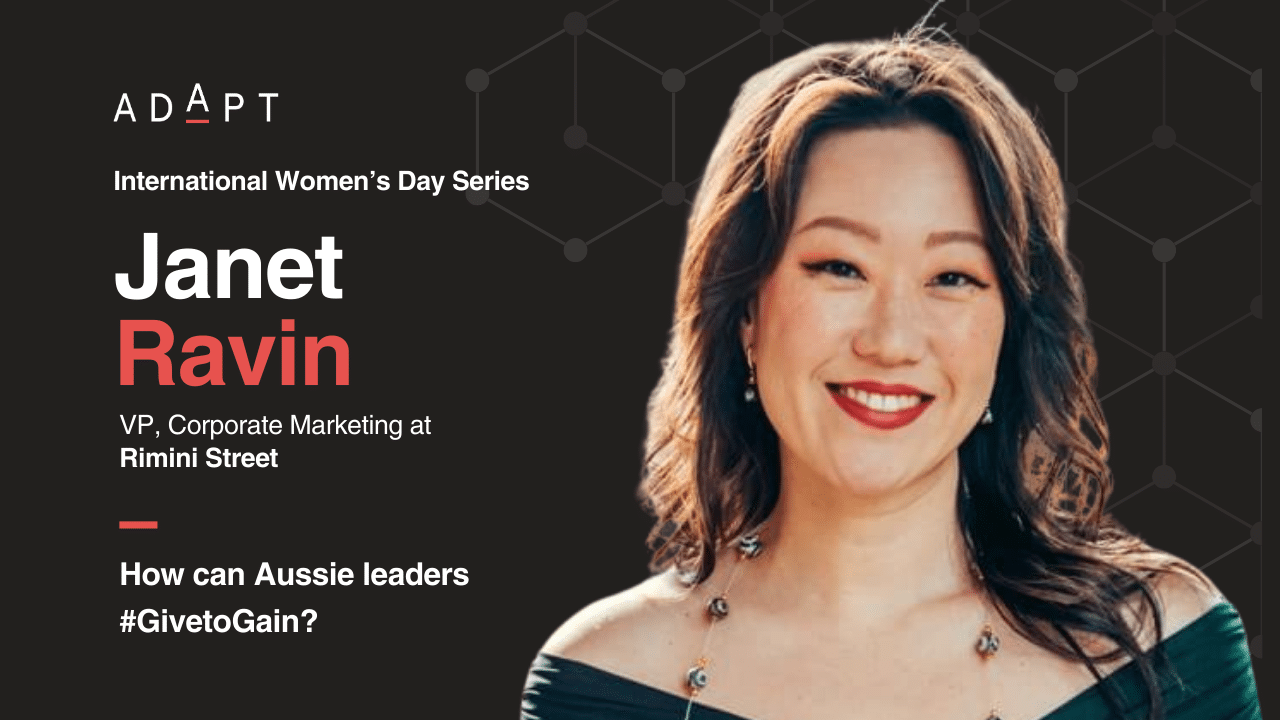


 Published Mar 3, 2026 in
Peer Insights
People
Contributors
Janet Ravin
Justina Uy
Published Mar 3, 2026 in
Peer Insights
People
Contributors
Janet Ravin
Justina Uy
Janet Ravin, Vice President of Corporate Marketing at Rimini Street, shares how belief, career breaks, and real support shape women’s progression.
She still remembers the pitch that changed her trajectory at Rimini Street.
She walked into an executive conversation with an idea to formalise the company’s community work into a foundation, and leadership said yes.
That yes became the start of an 11 year journey, one built on trust, proof, and repeated opportunities to lead.
For International Women’s Day 2026 and the #GiveToGain theme, Janet joined ADAPT’s Content Marketing Manager Justina Uy to unpack what leaders are really giving when they back someone early, and what organisations gain when they stop treating non linear careers, especially motherhood and career breaks, as a risk signal.
When belief creates momentum
Janet is clear that advocacy is part of the equation, but she frames it as a partnership, not a gift.
“One of the major things about those yeses is that, yes, you do need an advocate. You do need executives who believe in you and support you along the way.”
She credits the senior leaders who repeatedly backed her ideas and gave her room to grow, including the CEO, CMO, and CHRO. She also adds the other half of the deal.
“You as an individual have to also prove that you’re capable and that you’re learning and you’re growing and you have the passion… you bring the best self to your table as well as they bring the opportunities to you.”
In Janet’s view, leaders who keep saying yes to capable people are not taking a risk, they are investing in a track record of learning and delivery that compounds over time.
Why hiring managers should stop treating career gaps as a negative
Janet’s strongest warning is aimed at a common filter used in hiring and promotion decisions, especially in tech, judging women’s CVs through a narrow lens.
“When you’re looking, especially as a hiring manager, you do see that there are some women that have big gaps… out on maternity leave, or… writing a book or taking a sabbatical.”
To her, those gaps should not be treated as a flaw.
“I don’t think that we should be seeing those gaps as negatives… especially mothers, they balance so much. So we should be seeing it almost as a superpower.”
Keep women in the hiring cycle, stay curious about what they learned in that time, and assess capability with a wider lens than narrow product or technical depth.
“You should definitely keep them in the cycle of interviews… you should not see that as a negative… I think it’s really, really important to have… a 360 scope of the world.”
Janet links this to business performance, too.
People who have lived more life, navigated complexity, and expanded their worldview often bring stronger judgement, resilience, and empathy into leadership.
The future state she wants to see, women leading with empathy and power
Janet places women’s leadership in a longer timeline.
She argues that women’s presence in the workforce, especially in tech, is still relatively recent, and that progress is accelerating.
“When you look at the timeline of women in the workforce, it hasn’t really been that long, especially in the world of tech.”
She is optimistic about what comes next, and she ties it to the distinct strengths women bring into senior roles.
“Women leaders bring a certain empathy and capability that is very unique to them.”
Her view is that the next generation of women leaders will be even more influential, and organisations that recognise and amplify that now will build stronger cultures and better outcomes.
How one leader can trigger a culture shift
Janet shared a story that captures her belief that culture changes faster through lived example than through boardroom statements.
A senior executive at Rimini Street experienced breast cancer, and with support from the CEO, she was given time to heal. What happened next became a company wide movement.
“She wanted to turn this into something much larger than just herself… we came together and we developed something called Team Pink.”
Janet described what Team Pink became, a sustained, annual cultural shift built around community and support.
“We do large donations. We do webinars about breast health. We also partner with different breast health organisations… we call them Team Pink Warriors. We do big pink walks.”
When leaders bring humanity into the workplace, it becomes permission for others to do the same, and that is how belonging and loyalty scale.
Supporting family life is a leadership responsibility
Janet’s approach to supporting women and families is grounded in a personal philosophy about work, energy, and performance.
“Work is fun… we have to bring the best selves to work every single day for it to be fun. I think once you stop paying attention to the things outside of work, then you know your happiness gets impacted.”
She describes the standard she sets with her teams, accountability stays high, but life outside work is treated as part of sustainable performance.
“I always advocate for my team members to focus on their health, focus on their family as much as they focus on work. They’re still, of course, accountable and responsible for delivering high quality.”
She also gave practical examples of what support looks like, especially for mothers.
“I’ve actually had a few of my team members go out on maternity leave, welcome them back with open arms, and even while they’re on maternity leave, check in on them, send them little gifts or just make sure that they feel welcome.”
For Janet, this is what leaders can give, consistent human signals that people are valued as individuals, and that their lives outside work are respected.
What organisations gain is stronger retention, stronger discretionary effort, and a culture people want to be part of.
Janet previously spoke with ADAPT’s Head of Programs and Value Engagement, Byron Connolly, on why enterprises must put people before technology as AI disrupts jobs and widens skills gaps.
 Janet Ravin
VP, Global Brand, Content and Communications at Rimini Street
Janet Ravin
VP, Global Brand, Content and Communications at Rimini Street
Janet Ravin serves as VP, Global Brand, Content and Communications, as well as committee chair of the Rimini Street Foundation. In these roles, she is responsible for amplifying Rimini Street’s extraordinary story through expert strategy, execution, and management of all brand expression, communications, and global events.
This mission includes brand experience, content and creative services, public and analyst relations, client storytelling, web strategy and the engagement of employees through the creation of culture-rich programs.
Less Justina Uy
Content Marketing Manager
Justina Uy
Content Marketing Manager
Justina Uy is a data-driven content marketer that thrives on democratising elite know-how to empower Australia’s underdogs.
Skilled at translating complex ideas into a compelling story across formats and channels, she shifts seamlessly between writing long-form articles, creating viral social media posts, and producing thumb-stopping videos.
Since 2015, Justina executes her vision through a sophisticated understanding of the rapidly evolving digital and business landscape to serve entertaining and educational insights to the executive community.
Less Join the ADAPT
 Insider Community
Get the latest A/NZ market research and insights on the core trends impacting leaders.
Join the ADAPT Insider Community
Get the latest A/NZ market research and insights on the core trends impacting leaders.