

















Defence CTO on why women leave when leadership stops backing their voice
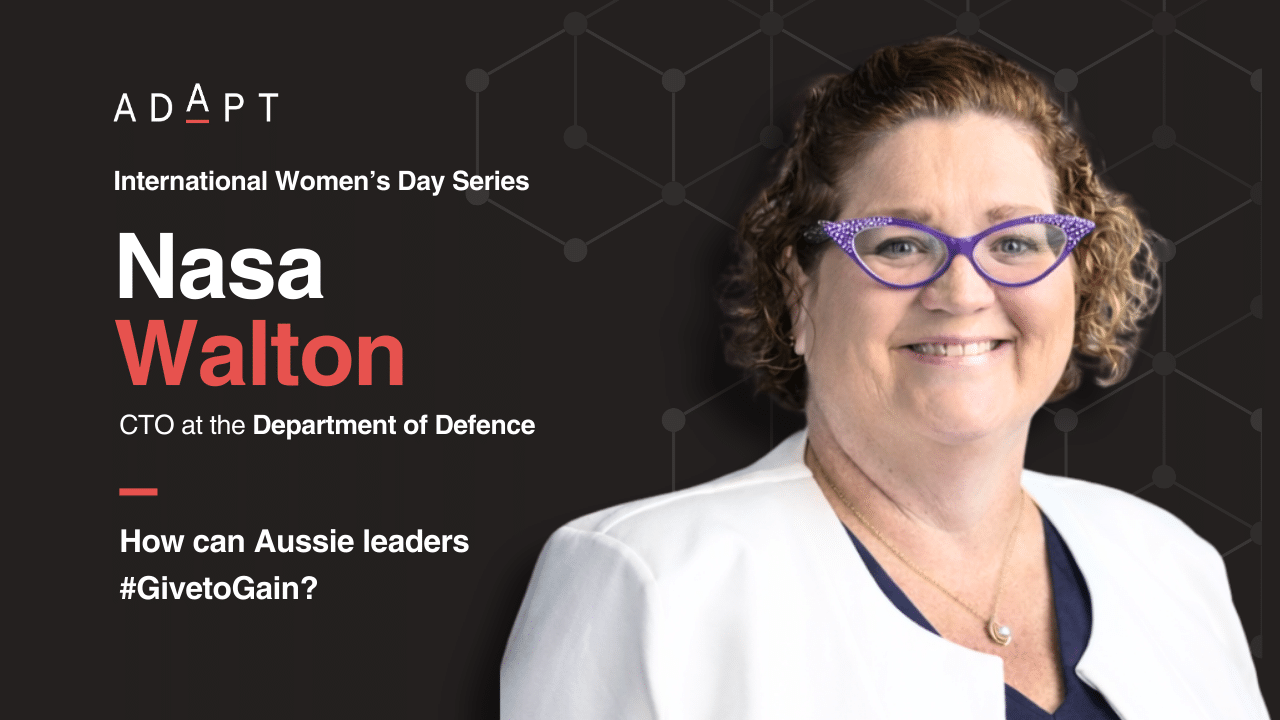
Nasa Walton, CTO at the Department of Defence, talked about why women stay when leaders protect their voice, and why silence is often the moment they decide to move on.


 Published Mar 5, 2026 in
Peer Insights
People
Contributors
Published Mar 5, 2026 in
Peer Insights
People
Contributors
Nasa Walton, CTO at the Department of Defence, talked about why women stay when leaders protect their voice, and why silence is often the moment they decide to move on.
Nasa didn’t set out to build a career in ICT.
She studied human resources and industrial relations, then found herself learning technology through responsibility, curiosity, and mentors who taught her the foundations of infrastructure and delivery.
For International Women’s Day 2026, Nasa joined ADAPT ‘s Content Marketing Manager Justina Uy to talk about what leaders choose to give when they back women’s voices, and what organisations lose when they rely on resilience instead of support.
When advocacy changes everything
Nasa’s first Chief Information Officer role came from advocacy that happened before she even entered the room.
“I had one of those moments that you get occasionally in your career where you get a phone call, and the phone call was the CFO of an organisation and he said, I’ve heard good things about you and I’d like to talk to you about the CIO of our organisation.”
“A staff member who I was working with, actually advocated for me.”
Allies are not only senior executives.
They can be peers, mentors, and the people in your own team who have experienced your leadership up close.
Leaders who create inclusive environments earn advocates who will speak when opportunities appear.
Why her pathway started outside ICT, and why it mattered
Nasa is direct about her non traditional entry into technology.
Instead of treating it as a gap, she frames it as an advantage, because it shaped how she leads, how she communicates risk, and how she connects decisions to outcomes.
“I don’t have formal education in ICT. I studied to be a human resource manager and an industrial relations leader.”
“They taught me everything that I know now about technology and infrastructure.”
That foundation built a leadership style anchored in people, accountability, and clarity.
In environments where delivery pressure is constant, that combination can be the difference between a technology decision and an enterprise decision.
The leadership habit that pushes women out
Nasa describes a clear threshold.
Women will keep contributing ideas, challenging constructively, and advocating for their voice, as long as leadership keeps that avenue open.
“We will bring our thought leadership, we will bring our diversity, we will bring our views to the table.”
“When women go silent in the organisation, trust me, they’re dusting off their CVs and they’re going to the next promotion.”
Her message to leaders is that silence is rarely contentment.
It is often a decision forming.
Once a high performer stops spending energy pushing ideas into the room, retention conversations become far harder, because the person has already moved on mentally.
What leaders need to give differently
Nasa challenges the assumption that strong women will rise without active support.
In her view, leadership has to be deliberate, especially when talent is already carrying complex work.
“There’s still this expectation that women in particular will just naturally rise.”
“When you recognise your shining star, you actually need to lean in more around that person.”
She encourages leaders to intervene early with sponsorship, mentoring, and practical coaching on how to convey strategic intent, so ambition is visible and mapped to a credible pathway.
That is where belief becomes opportunity, and where organisations keep capability instead of replacing it.
Mentoring returners, and reframing career breaks
Nasa has made return to work mentoring a consistent commitment, and she has seen what happens when organisations stop treating breaks as a risk label.
“I have, throughout my career, now mentored 19 women to come back into the workforce after taking a career break. And two men.”
“When someone’s on a career break, it doesn’t mean their skill sets are stale. It doesn’t mean they don’t have value to give.”
Her wider point is that career breaks happen for many reasons, and the experience gained during that time often strengthens judgement, resilience, and empathy.
Leaders who assess capability with curiosity, and who design supported re entry pathways, widen the senior talent pool fast.
What leaders still underestimate about women in technology
Nasa points to subtle pigeonholing that still shapes careers, women being expected to organise, coordinate, and carry the hidden workload, even when their remit is strategic leadership.
“We give an assumption that women are organisers and coordinators, and we pigeonhole them into those careers.”
“With AI now coming on, I think women are actually poised to take AI to the next level in their careers because we are naturally curious.”
Her view is that the next wave of technology leadership will reward curiosity, critical thinking, and the ability to refine questions until teams get to the truth.
Organisations that widen opportunity now will be better positioned to lead through the AI transition.
Wearing pink on Wednesdays, and making the pay gap discussable
Nasa also shared a simple habit she uses to make gender equity visible in everyday workplace conversations.
“I wear pink on Wednesdays because I’m highlighting the gender pay gap.”
“If you think that there is still a gender pay gap, wear pink on Wednesdays.”
It is a small, repeatable act that creates a prompt for discussion, invites allies in, and keeps the issue present without waiting for an annual moment.
Nasa Walton will join the Government Edge panel in Canberra on 10 June to debate how the APS can unlock productivity through interoperability, modular modernisation, and shared talent.
 Join the ADAPT
 Insider Community
Get the latest A/NZ market research and insights on the core trends impacting leaders.
Join the ADAPT Insider Community
Get the latest A/NZ market research and insights on the core trends impacting leaders.