















Leaders need to use AI before they can scale it, according to Pathfindr’s CEO
Pathfindr CEO Dawid Naude discusses lwhy leaders need to become AI power users before their organisations can unlock meaningful value from the technology.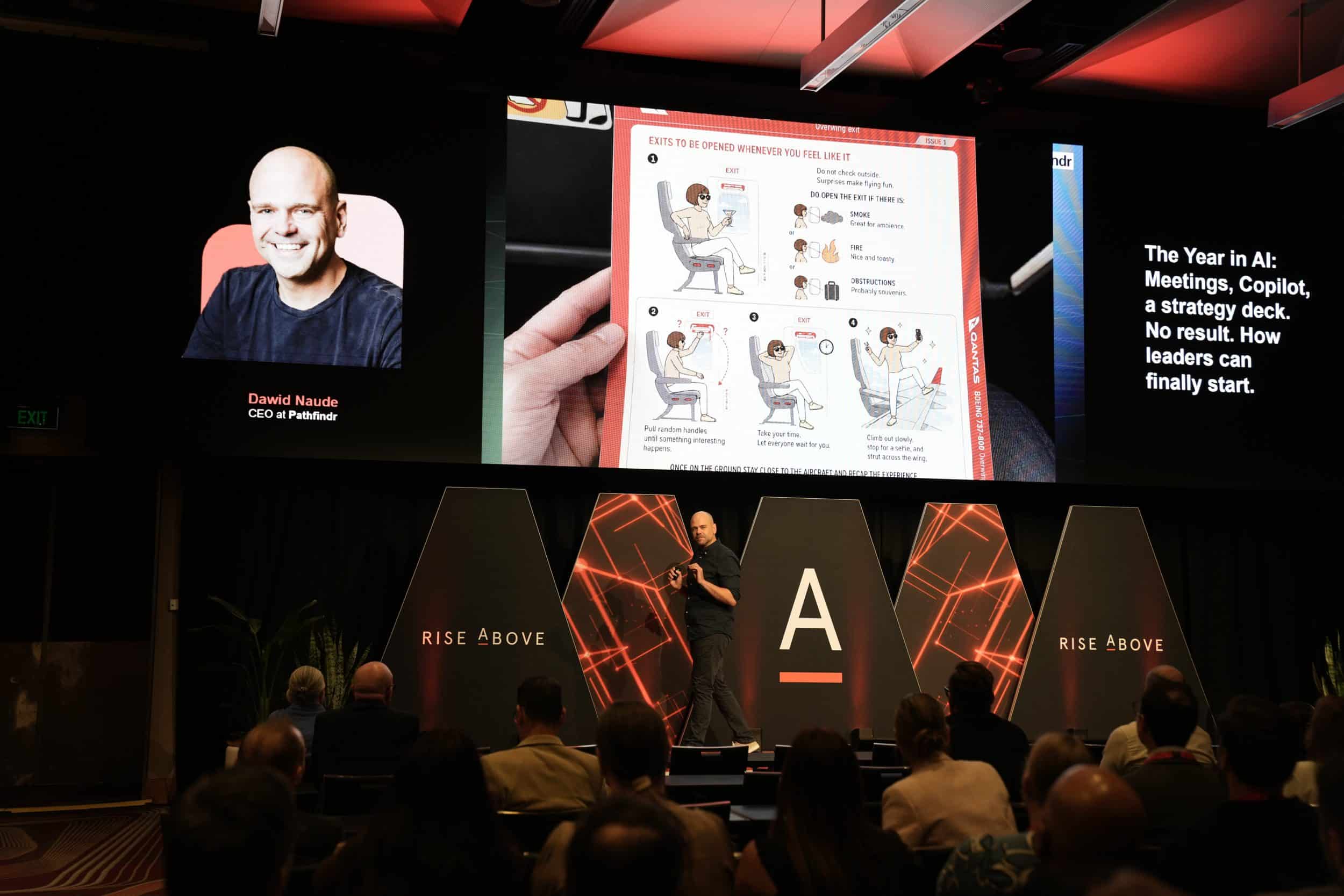


 Published Jun 25, 2026 in
Expert Presentations
Data & AI Strategy
Contributors
Dawid Naude
Published Jun 25, 2026 in
Expert Presentations
Data & AI Strategy
Contributors
Dawid Naude
Three years after ChatGPT entered the mainstream, many organisations are still struggling to turn AI investment into measurable business outcomes.
At Digital & AI Edge, Pathfindr CEO Dawid Naude argued that the problem is rarely the technology itself.
AI is becoming more capable, more affordable and easier to deploy every year. The bigger challenge is leadership engagement.
Organisations generate the most value when leaders use AI directly, understand its capabilities firsthand and apply it to their own business priorities.
For Dawid, AI is most powerful when it is applied to existing business goals rather than treated as a separate transformation program.
Key takeaways:
- AI adoption accelerates when business leaders become active users rather than relying on others to define the opportunities.
- Valuable applications emerge through experimentation, exploration and real world usage.
- Data quality, governance and cost management remain important, but they should not prevent organisations from getting started.
Leadership engagement shapes AI outcomes
AI strategies often lose momentum when responsibility sits exclusively with technology teams.
Unlike previous technology transformations, AI is a capability that leaders need to experience directly.
Business leaders understand the challenges, opportunities and outcomes they are responsible for delivering.
Without firsthand exposure to AI, it becomes difficult to identify where it can create meaningful value.
Dawid challenged the idea that organisations need a standalone AI strategy. Leaders already have strategies, objectives and priorities.
The role of AI is to help achieve those goals faster, better or in entirely new ways.
The organisations seeing the greatest impact are creating leadership teams that actively use AI, share examples and encourage experimentation throughout the business.
AI adoption becomes easier when leaders demonstrate how they are applying it themselves.
Exploration uncovers opportunities that planning cannot
Many organisations approach AI through predefined use cases and business cases.
Dawid believes this limits what AI can deliver.
He compared AI to technologies such as Excel, the internet and smartphones.
Their most valuable applications were not fully understood at launch. People discovered them through experimentation and practical use.
The same pattern is emerging with AI.
Leaders who spend time exploring the technology often uncover opportunities that would never appear in a traditional planning exercise.
They use AI to test assumptions, challenge thinking, prepare for board discussions, analyse risks and rapidly prototype new ideas.
Rather than starting with a list of approved use cases, organisations benefit from creating environments where employees can explore, share successes and learn from each other.
AI changes how work gets done
The most significant impact of AI may be the way it reshapes workflows rather than the tasks it automates.
During the session, Dawid demonstrated how AI can move from research to strategy development, prototype creation and presentation design with minimal human intervention.
The exercise highlighted how quickly ideas can be tested and refined when AI becomes part of everyday work.
This creates opportunities to rethink how teams collaborate, make decisions and develop solutions.
Rather than spending weeks gathering requirements and preparing presentations, organisations can use AI to create working concepts and explore options in real time.
The technology rewards organisations that are willing to adapt their workflows rather than forcing AI into existing ways of working.
Progress starts before the data is perfect
Concerns about data quality continue to delay many AI initiatives.
Dawid challenged the assumption that organisations must solve every data problem before adopting AI.
Many have spent years pursuing perfect data foundations while struggling to generate business value.
AI allows organisations to make progress while improving data quality over time.
In some cases, it can even help identify, reconcile and improve data issues as part of the adoption journey.
The focus should remain on solving meaningful business problems and creating momentum.
Waiting for perfect conditions often means missing opportunities to build capability, learn faster and generate value sooner.
The organisations creating the most value are building cultures where leaders use the technology themselves, learn continuously and help their teams discover new ways of working.
 Dawid Naude
Founder & CEO at Pathfindr
Dawid Naude
Founder & CEO at Pathfindr
Dawid Naude is a trailblazer in business, disruption, and innovation, shaping the future by translating AI’s potential into real world impact. Committed to making AI exciting, accessible, and impossible to ignore, he helps organisations to make every employee more productive, reimagine what’s possible, and achieve breakthrough innovation.
With a dynamic CV spanning consulting and leadership roles across digital, technology and innovation, Dawid is the proud Founder & CEO of Pathfindr. Named one of AFR BOSS’ Most Innovative Companies in its founding year, Pathfindr’s is now the fastest growing AI Accelerator in Australia.
An advisor to Government and industry bodies across APAC, Dawid is one of the region’s foremost AI innovators, educators, and implementers. With an infectious energy and a gift for making the complex feel simple, his keynotes have built a reputation for exciting audiences into action.
Less Join the ADAPT
 Insider Community
Get the latest A/NZ market research and insights on the core trends impacting leaders.
Join the ADAPT Insider Community
Get the latest A/NZ market research and insights on the core trends impacting leaders.