









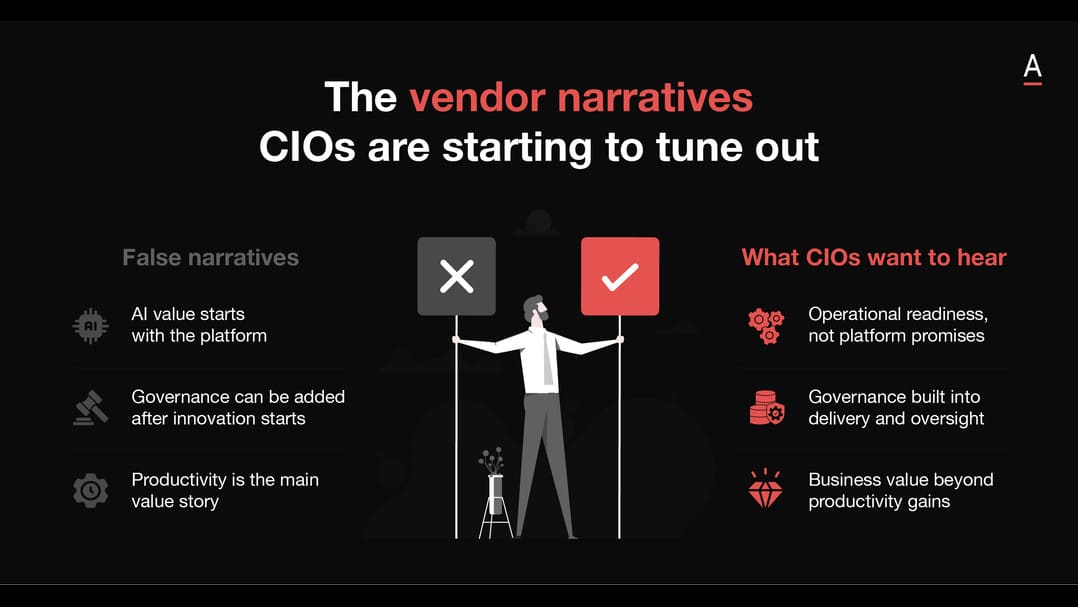





How Australian government agencies can get more from AI through smaller bets than big programs
In this ADAPT Insider episode, ADAPT Executive Advisor, former Chief Digital Innovation Officer and BCG Partner David Heacock explains why government should stay cautious on AI, build more capability internally, and focus on smaller, lower-risk delivery.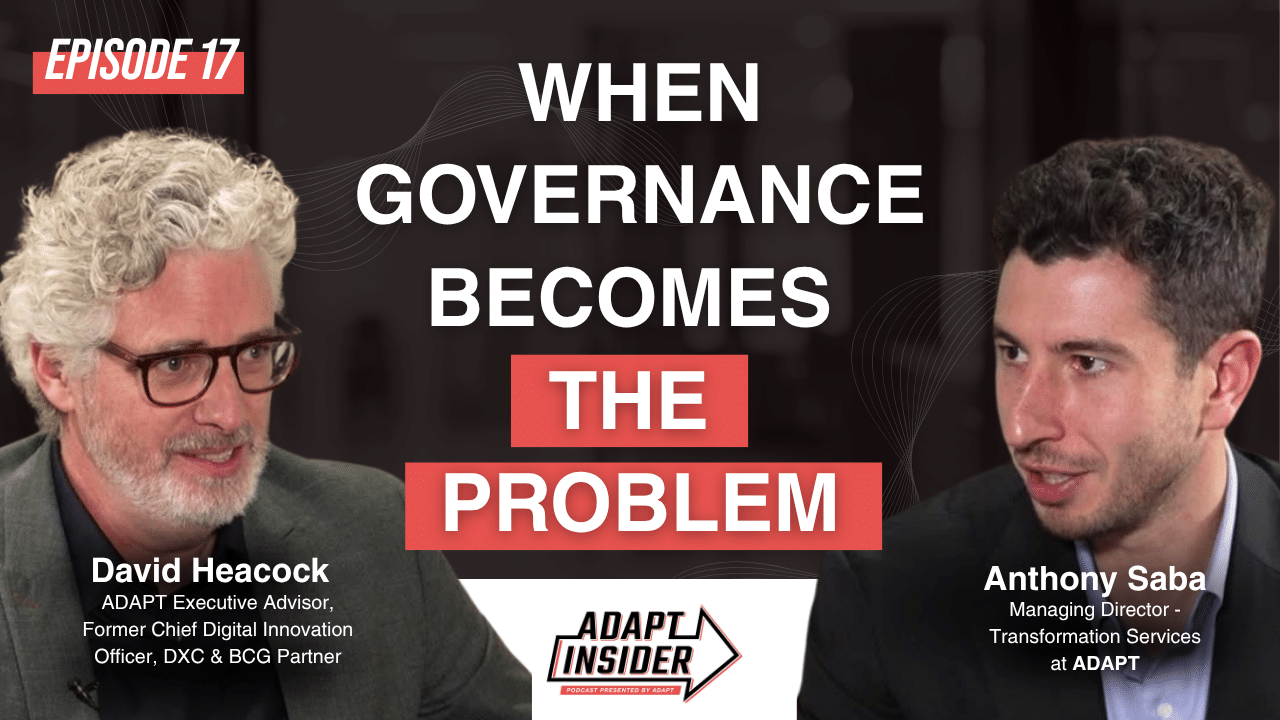


 Published Aug 4, 2026 in
Podcast
Data & AI Strategy
Contributors
David Heacock
Anthony Saba
Published Aug 4, 2026 in
Podcast
Data & AI Strategy
Contributors
David Heacock
Anthony Saba
Government is under pressure to do more with less, and AI is now part of that conversation. That does not mean moving fast.
In government, the cost of getting AI wrong is higher, which makes caution a strength rather than a weakness.
In this ADAPT Insider conversation with Anthony Saba, Managing Director – Transformation Services at ADAPT, David Heacock, ADAPT Executive Advisor, former Chief Digital Innovation Officer and BCG Partner, argues that public sector leaders are right to take a measured approach.
The gap between vendor hype and real-world performance is still too wide, and in government that gap can damage trust, disrupt services, and create harm.
Listen to the full episode on Apple Podcasts, Spotify, or YouTube.
Key takeaways:
- Move carefully where the risk of AI failure is high.
- Treat governance and decision-making as the main delivery challenge, not the technology alone.
- Break large programs into smaller, outcome-driven pieces and build more capability internally.
Government is right to be cautious on AI
He argues that AI should be introduced carefully in public sector settings.
Unlike traditional systems, generative AI is probabilistic, which means it does not always produce the same answer in the same way.
That creates a different risk profile, especially in government environments where decisions can affect people’s lives.
This is why a slower pace makes sense. Government does not need to lead the market on AI adoption.
It needs to understand where the tools are useful, where precision matters, and where experimentation is safe.
The bigger problem is organisational friction
He is clear that technology is no longer the main constraint. The harder problem sits in governance, decision-making, and organisational design.
Faster tools do not remove those bottlenecks. They hit them sooner.
He points to executive choke points, where delivery teams move quickly but decisions still stall further up the chain.
He also warns that uncertainty often leads to more governance, more scrutiny, and more delay. In practice, that usually makes delivery slower rather than safer.
Smaller internal bets will work better than large programs
He also argues for a different delivery model. Rather than packaging large problems into single vendor-led programs, agencies should break work into smaller pieces with tighter accountability and clearer outcomes.
He sees strong potential in building more capability internally and focusing on use cases that sit between personal productivity tools and large enterprise systems.
Areas like policy analysis, legislative synthesis, and information-heavy work are a better fit for small, targeted AI projects that can prove value early without creating unnecessary risk.
 David Heacock
Former Chief Digital Innovation Officer, DXC & BCG Partner
David Heacock
Former Chief Digital Innovation Officer, DXC & BCG Partner
David is a digital strategist and design leader known for delivering innovative, human-centred digital solutions across public and private sectors. With experience at DXC Technology, BCG, and various start-ups, he blends creativity with strategic thinking to drive transformation that is technically feasible, commercially viable, and deeply user-focused.
- Former APAC design leader at BCG and Head of Digital Innovation at DXC Technology.
- Specialist in digital strategy, service design, UX architecture, and transformation delivery.
- Experience spans government, tourism, mining, telecoms, energy, and consumer goods.
- Founder of start-ups in e-commerce and travel, with strong product leadership credentials.
- Mentor with ANU’s TechLauncher programme, supporting future entrepreneurs.
- Currently helping scale a premium consumer brand in the pet care industry.
 Anthony Saba
Partner & Managing Director, Transformation Services at ADAPT
Anthony Saba
Partner & Managing Director, Transformation Services at ADAPT
Anthony leads the growth, strategy, and delivery of ADAPT’s Transformation Services and Go-to-Market Services Business Units.
He is driven by a core belief that we are experiencing a modern industrial revolution, one that will fundamentally reshape how business is done and pose serious challenges to the future of many Australian organisations and industries.
In this environment, success will not necessarily favour incumbents, or those with the deepest pockets or broadest resources, but rather organisations who are most able to ADAPT quickly and effectively to the evolving needs of their customers, employees and ecosystems.
With this belief, ADAPT is evolving into a critical platform that Australia’s enterprise leaders, local solution providers, and trusted advisors can rely on to succeed over the next decade.
By removing barriers, democratising access to proven expertise, promoting local ANZ innovation, and enabling rapid, meaningful connections between leaders and experts, ADAPT is committed to helping Australia not just survive, but thrive in the complex and uncertain times ahead.
Less Join the ADAPT
 Insider Community
Get the latest A/NZ market research and insights on the core trends impacting leaders.
Join the ADAPT Insider Community
Get the latest A/NZ market research and insights on the core trends impacting leaders.