

















Australia’s AI ambitions depend on trusted data centre infrastructure, says Data Centres Australia CEO
In this ADAPT Insider episode, Belinda Dennett explains why trusted data centre infrastructure is critical to Australia’s AI ambitions.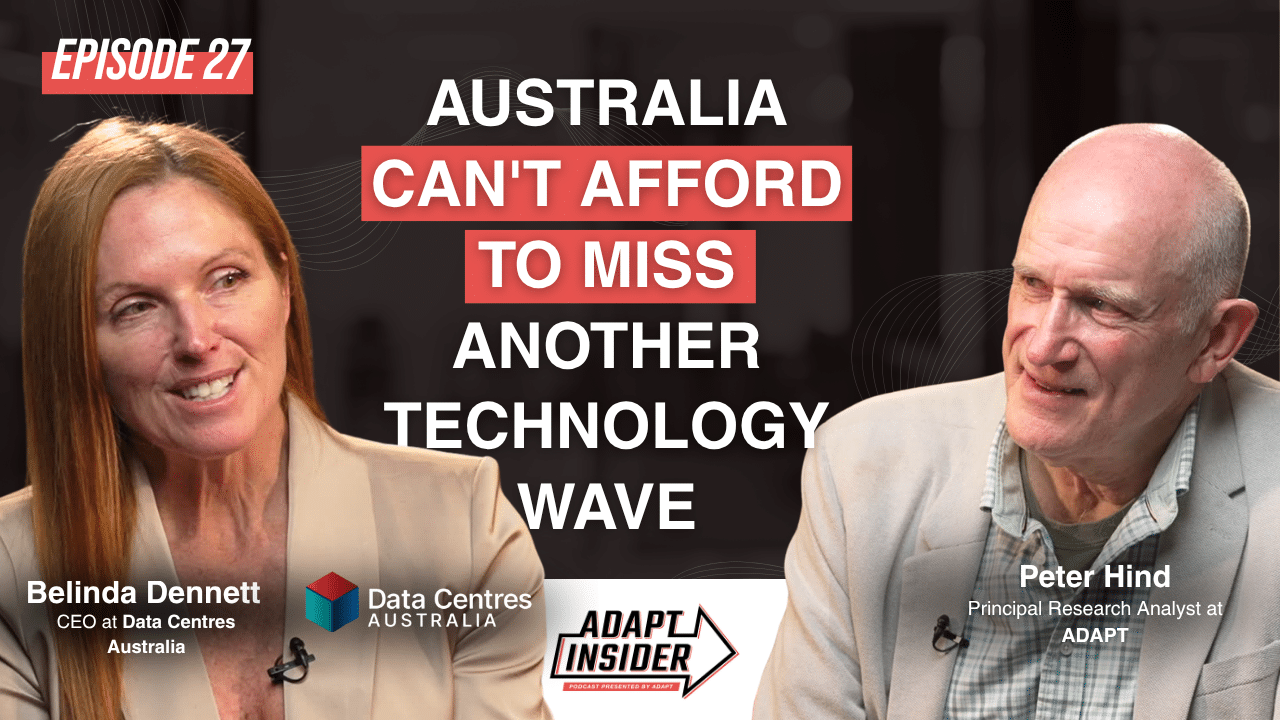


 Published Oct 13, 2026 in
Podcast
Cloud & Infrastructure
Contributors
Belinda Dennett
Peter Hind
Published Oct 13, 2026 in
Podcast
Cloud & Infrastructure
Contributors
Belinda Dennett
Peter Hind
Australia’s data centre sector has moved from the margins of policy to the centre of the AI economy.
Belinda Dennett, CEO at Data Centres Australia, explains why the country’s ability to attract investment will depend on public trust, clear policy settings, and a stronger account of the sector’s national value.
She examines how industry can strengthen its social licence, correct misconceptions about resource use, and position Australia as a secure regional hub for AI inference.
Listen to the full episode on Apple Podcasts, Spotify or YouTube.
Key takeaways:
- Policy certainty gives investors the confidence to commit capital, while clear public communication helps communities understand the value of data centre infrastructure.
- Modern facilities can limit their environmental impact through efficient closed-loop systems, non-potable water sources, and purpose-built infrastructure.
- Australia can build sovereign AI capability by hosting secure inference workloads powered by renewable energy, creating a potential export market for low-emissions compute.
Public trust will determine whether infrastructure investment can scale
Data centres now underpin digital services, AI capability, and national competitiveness, yet their role is not always well understood.
Belinda says Data Centres Australia was established to give the sector a coordinated voice after years of explaining its importance to government.
She points to the NBN era as a warning that uncertainty, politicisation, and weak public communication can derail major infrastructure programs.
This buildout is led by private capital, making coordination between industry and government essential to maintaining investor confidence.
The sector also needs to explain its community impact before misinformation fills the gap.
A credible public narrative can show why facilities are being built, what value they create, and how local concerns will be managed.
Environmental scrutiny requires evidence from modern facilities
Concerns about water consumption often rely on outdated assumptions.
Belinda says most modern data centres use air cooling for much of the year, drawing on water only when temperatures require it.
Operators are also exploring recycled supplies, sewer mining, and other non-potable sources.
These approaches can reduce pressure on drinking water while encouraging better coordination of local infrastructure planning.
For leaders, the lesson is to address environmental concerns with transparent operating data.
Purpose-built facilities can deliver greater efficiency than fragmented technology environments while supporting the redesign of Australia’s grid for a more digital economy.
Sovereign inference can become Australia’s next digital export
Australia’s AI opportunity extends beyond training large models.
Belinda argues that the country can become a secure hub for inference workloads, regional digital services, and sovereign AI capability.
Renewable energy could be converted into AI tokens through locally hosted compute, creating a new low-emissions export class.
This would allow Australia to capture more value from its energy advantage, meet growing regional demand and gain greater control over critical AI infrastructure.
Building that position will require clear governance, dependable policy, and public confidence in the facilities that make AI services possible.
 Belinda Dennett
CEO at Data Centres Australia
Belinda Dennett
CEO at Data Centres Australia
Belinda Dennett is a highly respected public policy specialist with more than 20 years experience at the forefront of Australia’s digital economy and technology ecosystem. Most recently Belinda was Head of Government Relations at AirTrunk and previously spent more than a decade leading Microsoft’s Corporate Affairs and Policy team in Australia. Belinda is a former Federal ministerial advisor with a focus on digital economy policy. She has qualifications in law and business.
 Peter Hind
Principal Research Analyst at ADAPT
Peter Hind
Principal Research Analyst at ADAPT
Peter Hind has spent the last 25 years as an analyst and commentator on the ICT industry.
His primary areas of interest are the potential of technology to transform the way organisations operate, the change management obstacles executives encounter in realising this potential, as well as the tactics and techniques leaders have deployed to overcome these difficulties.
Peter now takes on multiple roles within ADAPT including the moderation of private events and roundtables, interviewing business executives about the strategies they are pursuing and assisting with the structuring of delegate surveys.
He also interrogates and analyses ADAPT’s treasure trove of end-user and C-suite data.
Less Join the ADAPT
 Insider Community
Get the latest A/NZ market research and insights on the core trends impacting leaders.
Join the ADAPT Insider Community
Get the latest A/NZ market research and insights on the core trends impacting leaders.