














Incremental AI wins turn infrastructure investment into business value
In this ADAPT Insider episode, Infrastructure Masons Founder & Chairman Dean Nelson explains why AI adoption needs a clear business problem, secure infrastructure and measurable outcomes.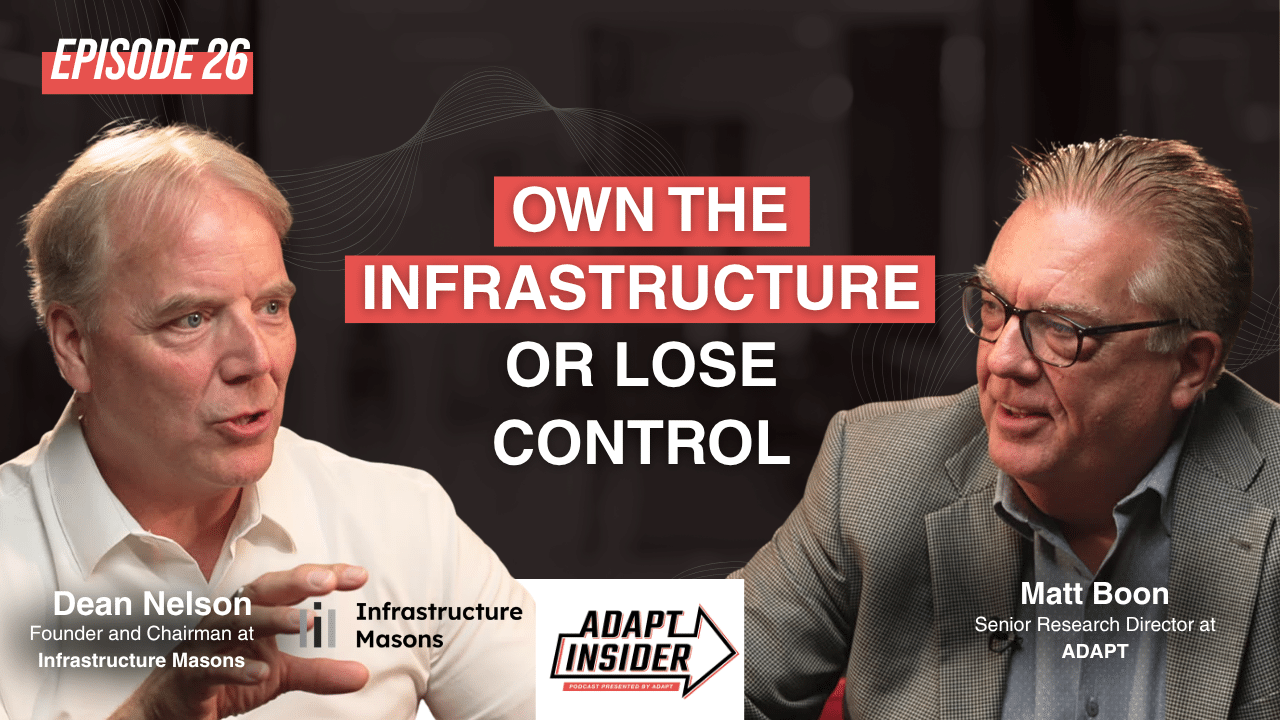


 Published Oct 6, 2026 in
Podcast
Cloud & Infrastructure
Contributors
Dean Nelson
Matt Boon
Published Oct 6, 2026 in
Podcast
Cloud & Infrastructure
Contributors
Dean Nelson
Matt Boon
Most AI initiatives stall when ambition outruns clarity.
Dean Nelson outlines how leaders can reduce that risk by applying first principles, proving value through targeted use cases, then using each result to guide the next investment.
His perspective links practical AI adoption to the infrastructure choices required for sovereignty, sustainability and public trust.
Listen to the full episode on Apple Podcasts, Spotify or YouTube.
Key takeaways:
- Define the outcome before choosing the technology: A narrow operational problem gives teams a shared target, makes progress measurable and creates a credible path to scale.
- Design for control from the outset: Private models, secure data environments and locally hosted infrastructure allow organisations to pursue AI without surrendering sovereignty.
- Earn confidence through visible proof: Clear evidence of efficiency, sustainability and community value helps digital infrastructure retain public trust.
Start with one business problem
The strongest AI programs begin with a specific operational constraint rather than a broad transformation mandate.
Dean says many pilots fail because teams select the technology before agreeing on the result the organisation needs.
A first-principles approach brings business, technology and security leaders around one measurable objective.
It also creates a practical sequence: solve the immediate problem, validate the outcome, then expand from evidence.
Dean points to an organisation in Mexico that built a secure private AI environment for field teams.
By focusing on one defined need, it achieved meaningful productivity gains without making enterprise-wide transformation the starting condition.
Build infrastructure that keeps AI under control
AI workloads are changing the physical design of data centres.
GPU-dense environments require new cooling methods, with liquid cooling and closed-loop water systems supporting greater computing density while reducing water use.
The same infrastructure decisions shape sovereignty.
Dean argues that governments and enterprises need locally hosted capacity, private models and Australian-controlled digital capabilities so critical data and services remain within national control.
Sustainable AI therefore depends on architecture that can support intensive workloads without weakening security, operational resilience or accountability.
Public trust determines whether AI can scale
Technical progress alone will not secure the future of AI infrastructure.
Communities increasingly scrutinise the environmental impact of data centres, yet the industry often struggles to explain improvements in renewable energy, efficient cooling and resource use.
Dean calls for open engagement backed by tangible local benefits.
A stronger public narrative must show how infrastructure supports economic activity, improves efficiency and responds to legitimate community concerns.
Inside the organisation, that trust starts with disciplined governance.
Leaders should manage workloads deliberately, use AI to strengthen oversight where appropriate, then measure progress against business outcomes rather than market hype.
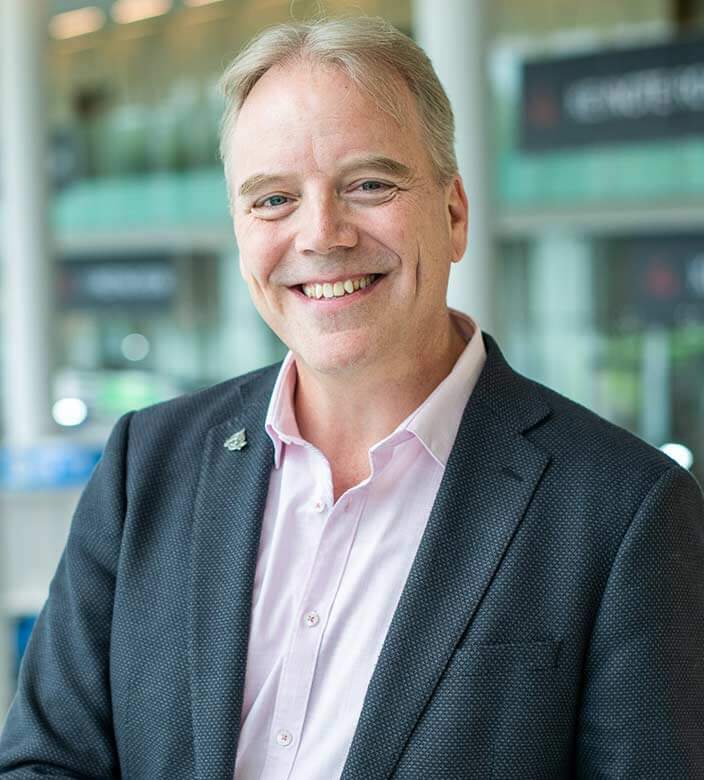 Dean Nelson
Chairman & Founder of Infrastructure Masons
Dean Nelson
Chairman & Founder of Infrastructure Masons
Dean Nelson is the Founder and Chairman of Infrastructure Masons, an independent industry group of executive and technology professionals entrusted with building and operating the physical and logical structures of the Digital Age.
Dean has led $10B in infrastructure projects in 9 countries. His extensive architecture, engineering and operations experience includes 29 years in Hardware, 22 years in Network, 17 years in Infrastructure Software and 17 years in Data Centers. He has produced numerous award winning innovations in mission critical facilities and compute environments. He also holds four US patents.
Until 2019, Dean was Head of Uber Compute, at Uber. His team is responsible for Metal as a Service (MaaS) technical infrastructure (data center, compute, storage, network and infrastructure software) and business functions serving Uber’s global leading ridesharing business, as well as UberEats, UberFreight, UberHealth, UberForBusiness, and Autonomous vehicle and UberAir development.
Prior to Uber, Dean worked at Ebay Inc for 6 ½ years as the Vice President of Global Foundation Services, which served over 300 million active users enabling over $250Bn of enabled commerce volume annually. At end of his tenure at ebay, his team successfully integrated, then split ebay and paypal infrastructures into two independent internet companies. Prior to ebay, Dean worked at Sun Microsystems for 17 years in various technical, management and executive leadership roles in Manufacturing, Engineering, IT and Real Estate. His final project was the consolidation of Sun’s multi-billion dollar global technical infrastructure portfolio of over 1,000 facilities.
Dean is creator of the Digital Service Efficiency methodology, the first miles per gallon measurement for technical infrastructure, used to measure ebay.com as a single system. He served as the Chair of the Technology Business Management Council High Tech Workgroup, and Chairman & Founder of Data Center Pulse in 2009 – an exclusive datacenter owner community with over 9,000 members in 100 countries. In 2016, Dean founded Infrastructure Masons, an industry association where infrastructure professionals connect, grow and give back. Dean was identified by SearchDatacenter.com as one of the top five people who changed the data center. Dean is also the recipient of Sun’s prestigious Innovation Award, Modular DC Deployment award and Best DC Design award from Uptime Institute as well as the Operational Excellence and Infrastructure Trailblazer awards from The TBM Council and Outstanding Contributions to the Data Center Industry award from Data Center Dynamics.
In his personal time he gives back by building schools and dorms providing access to education for impoverished children through his Mother and Son Just Let Me Learn Foundation. He also enjoys spending time with his wife and performing with his daughter.
 Matt Boon
Senior Research Director at ADAPT
Matt Boon
Senior Research Director at ADAPT
Matt Boon is the Senior Director for Strategic Research at ADAPT, responsible for directing and developing research content and positions.
For over 30 years, Matt has worked in research and advisory, including senior leadership roles at Gartner as Principal Analyst, Research Director, and Managing Vice President, where his 18 year history included working with Dell, Microsoft, and many others.
Throughout his career, Matt has been a sought after and highly respected authority on the local and global IT landscape. He interacts with executives daily, bringing together groups of C-suite leaders to discuss and prepare for the challenges and opportunities they face.
At ADAPT, Matt hosts numerous industry-leading business and technology events which Matt chairs, including the yearly Security Edge conference, delivering unique market trends and white-papers, advising executives across the technology provider landscape to make informed IT decisions.
When he is not working, Matt enjoys walking the many trails of the NSW Southern Highlands, travelling and listening to music. He is also partial to a good steak and nice glass of red wine.
Less Join the ADAPT
 Insider Community
Get the latest A/NZ market research and insights on the core trends impacting leaders.
Join the ADAPT Insider Community
Get the latest A/NZ market research and insights on the core trends impacting leaders.