












How Uniting is helping care providers adopt AI faster
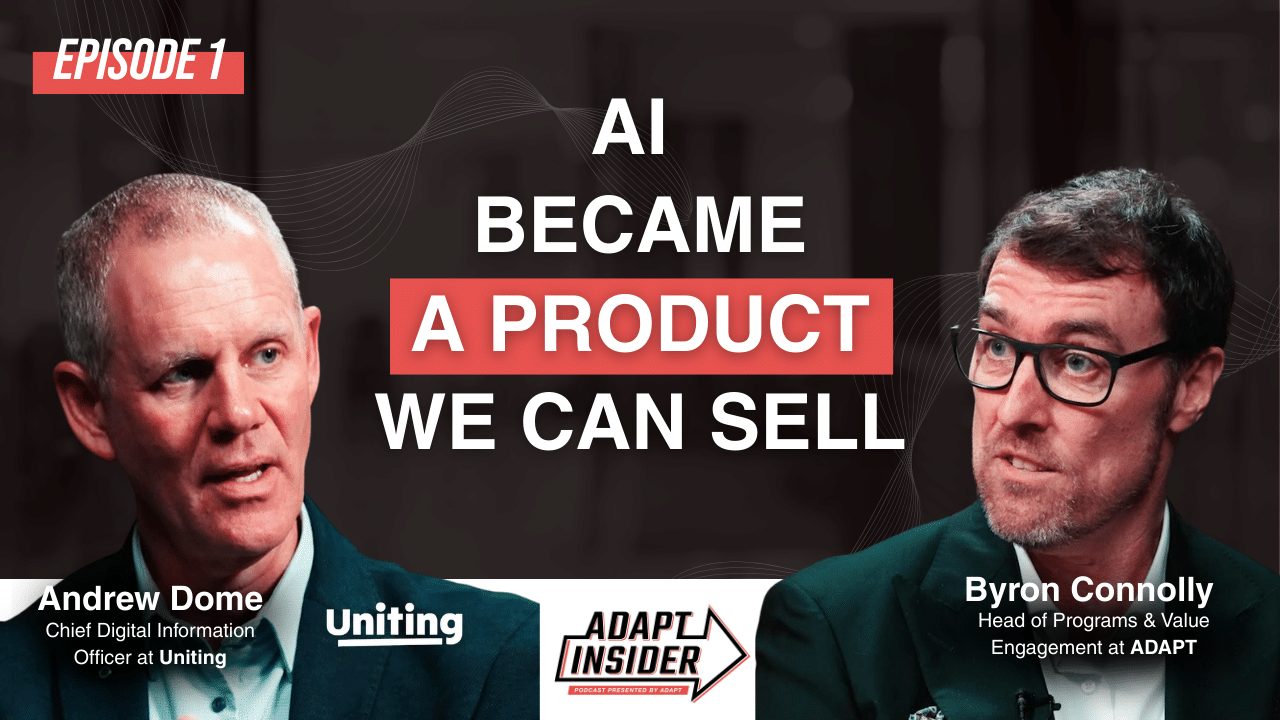
In this interview, Andrew Dome, Chief Digital Information Officer at Uniting, explains why the organisation is commercialising its AI tools, building in-house capability and helping aged care providers adopt AI faster.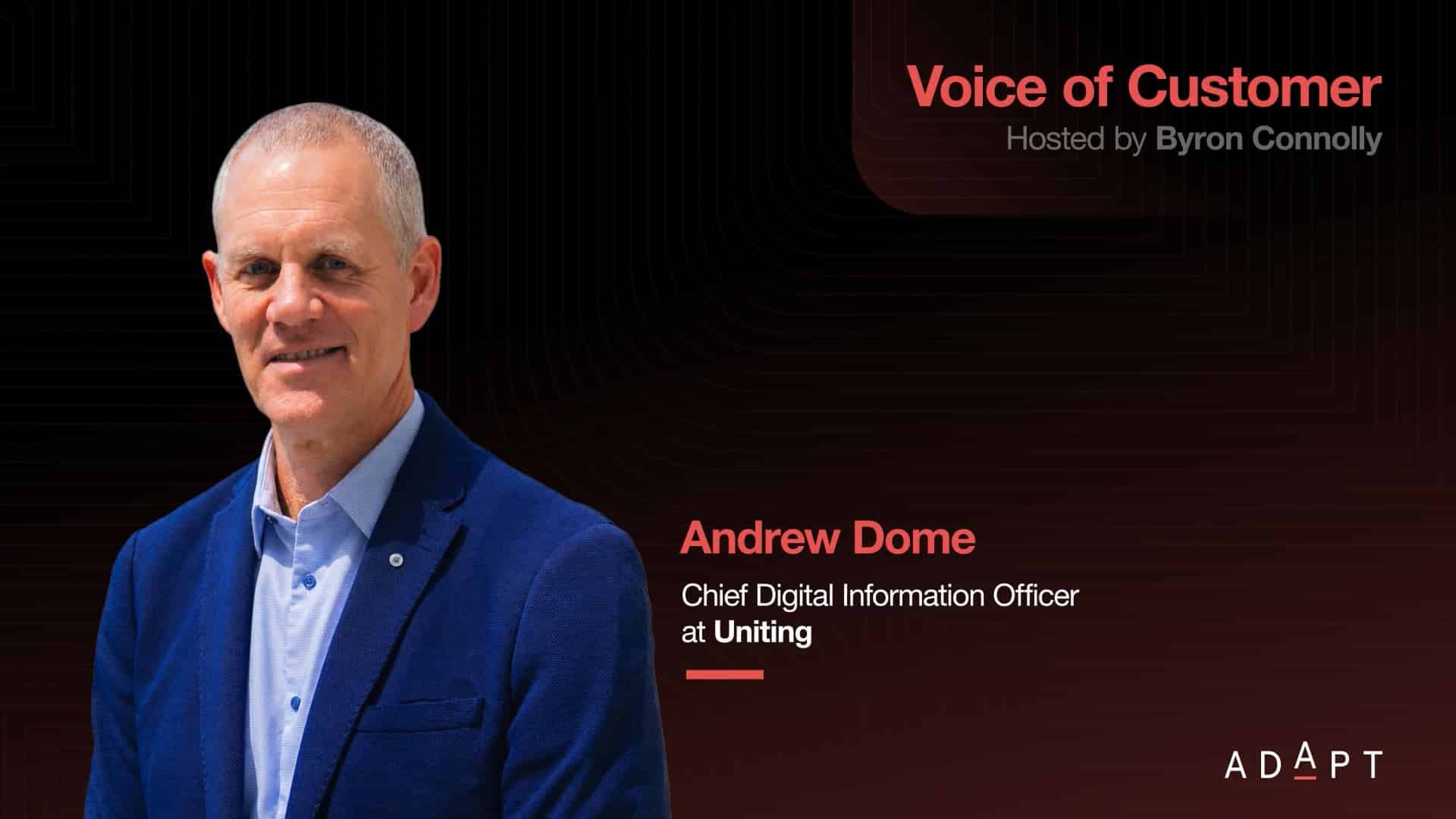


 Published Jul 27, 2026 in
Peer Insights
Data & AI Strategy
Contributors
Andrew Dome
Byron Connolly
Published Jul 27, 2026 in
Peer Insights
Data & AI Strategy
Contributors
Andrew Dome
Byron Connolly
Uniting has licensed the code for Buddy, its generative AI assistant for frontline care workers, to Catholic Healthcare and Calvary Health Care.
Buddy is a voice-to-text transcription tool, which eliminates the need for staff to manually type up progress notes after visiting clients in their homes.
John Sutherland, Chief Digital Information Officer at Calvary, announced on LinkedIn that the healthcare provider had built a product called Cally.
This is a secure AI-enabled digital assistant for its 20,000 staff and volunteers across its hospitals, home care, residential aged care and retirement living services.
“Cally is a single digital front door, sitting in front of and integrated to our core systems, enabling the provision of quality care, better access to information, and reducing administrative burdens so staff spend more time on what matters most: caring for others”, Sutherland said in his post.
Catholic Healthcare confirmed that it is developing a solution that leverages components of Buddy’s code but couldn’t comment further.
Andrew Dome, Chief Digital Information Officer at Uniting, tells ADAPT that Catholic Healthcare runs the same clinical system as Uniting, making integration straightforward, while Calvary has integrated the code into a different back-end clinical system.
He says that Uniting will sell the code to other external healthcare providers and once a certain number jump on board, the organisation will look at developing pathways for smaller non-profits and aged care providers to consume the tool as a service.
“We’re a little way off that yet but certainly, that’s a pathway we’ll look to. We’ve actually demonstrated this to about 15 other organisations now”, he says.
Dome says organisations that have licensed the code can create their own version of Buddy to take to market within about 8 weeks, compared to around 12 months if they are starting from scratch, which lowers costs.
“There are very small providers out there [that are] very interested that wouldn’t be able to invest the amount [required] to build [a solution] themselves, so looking forward to that if we can set that up and run it as a pathway”, he says.
A digital twin: From fall detection to prevention
Last year, Uniting also set up a digital twin facility at a former residential aged care site in Waverley, Sydney. The facility replicates three environments in which Uniting delivers services: a residential aged care room, an individual independent living unit, and a typical home-care setting.
The purpose of the digital twin is to trial technology, particularly wearable sensors and ambient monitoring devices aimed at predicting and eventually, preventing falls without being tied to a single hardware vendor.
“The key bit is the underlying platform that we’ve already got and the idea being that it will negate the need for our current legacy platforms and technology to remain in-situ”, he says.
Andrew points to the humble DECT phone, the ageing handset frontline workers carry to receive nurse-call notifications, as the clearest example of what’s being phased out.
Under the new model, those notifications will be routed through Buddy on a rugged smartphone, which will also handle voice-to-text note-taking and give workers access to policies and procedures, consolidating several devices into one.
Uniting is close to completing this integration, and radar-based sensors in the digital twin rooms are being trialled to detect when a resident is in a horizontal position where they shouldn’t be, such as in a bathroom or living room.
These sensors trigger an alert even if a person is unconscious and unable to activate a wearable themselves.
Expanding Genie: From appointment checks to full booking
Genie, Uniting’s first agentic AI tool in production, was launched as a proof of concept in the home and community care contact centre. It allows customers to call a dedicated number at any time and speak with the AI agent in natural language to manage upcoming appointments.
While Genie was designed partly to handle cancellations, Andrew says the majority of callers are using it simply to check on upcoming services rather than cancel them, largely because cancelling requires an explicit instruction to the agent.
Customers have also taken advantage of the around-the-clock availability, with some calling as early as 5am or 6am, well outside standard contact centre hours. Customer satisfaction surveys have returned a score of 4 out of 5, says Dome.
Uniting’s next step is expanding Genie’s capabilities to include rescheduling and new bookings, reducing the need to speak with a human agent for routine transactions.
The organisation also plans to roll Genie out beyond home and community care to its other five contact centres, including residential aged care, and to apply it to common IT workflows such as password resets. This will free up human agents to focus on more complex enquiries.
Ethics, cost control and building skills in-house
Underpinning all of this is a deliberate governance process. Each year, Uniting’s executive team and board hold a dedicated discussion on what AI should be permitted to do.
Three years ago, when Buddy was still an unnamed chat function, the board declined to allow AI to draft resident care plans, a use case now being reconsidered as the technology and its demonstrated benefits have matured.
“We’re constantly talking with our executives and our board around what we’ll be allowed to do, but more importantly, we need to show [them] the guardrails, security and the controls and governance that we’ve got in place.
“Once we explain those controls we’ve got in place, how we’re dealing with data ethically and how it’s only within our data ecosystem. That’s when we get the green light to go ahead.
“We do not go out and use a large language model. No one can go and put clinical information into an LLM outside of our ecosystem”, says Dome.
He says the organisation is exploring a partnership with a non-US-based LLM provider to strengthen data and AI sovereignty, but this is a project that is still in the early stages.
Caution on token costs, skills a work in progress
Dome offers a caution to organisations around the cost of AI. He highlights that many vendors have shifted from subscription to token-based pricing, which means that AI costs can escalate quickly.
His advice is to start with a small user base, monitor usage weekly and monthly, and use that data to forecast costs before scaling up.
“We do track it [token costs] and it’s manageable at the moment and we are conscious as we build out the use cases, particularly on agentic AI. It’s going to add some real value to our customers who will be able to engage [with us] and start consuming services faster than ever before, but there is a cost to that.”
Skills are also a work in progress. Dome says Uniting is pursuing three parallel paths: partnering with vendors to build agentic AI agents, upskilling existing staff who want to move into AI development, and hiring dedicated agentic AI developers.
While third-party partnerships carry ongoing licensing and operational costs, he says the long-term aim is to build enough internal capability that Uniting relies less on outside vendors, trading recurring costs for durable, in-house expertise.
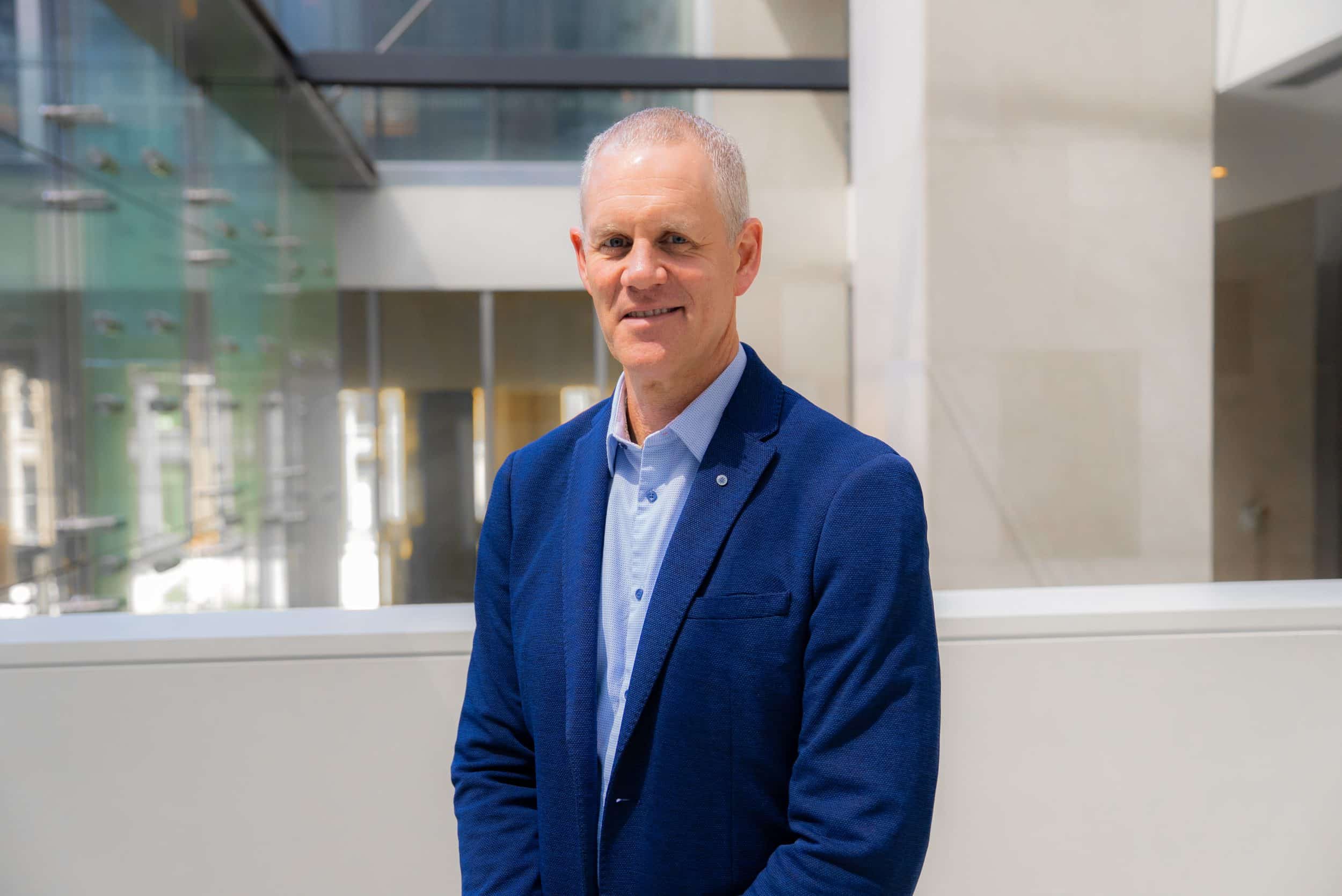 Andrew Dome
Chief Digital Information Officer at Uniting
Andrew Dome
Chief Digital Information Officer at Uniting
 Byron Connolly
Head of Programs & Value Engagement at ADAPT
Byron Connolly
Head of Programs & Value Engagement at ADAPT
Byron is a highly experienced technology and business journalist, editor, corporate writer, and event producer.
Prior to joining ADAPT, he was the editor-in-chief at CIO Australia and associate editor at CSO Australia. He also created and led the well-known CIO50 awards program in Australia and The CIO Show podcast.
Byron creates valuable insights for our community of senior technology and business professionals that help them reach their organisational and professional goals. He has a passion for uncovering stories about the careers and personal philosophies of Australia’s top technology and digital executives.
When he is not working, Byron enjoys hot yoga, swimming, running and spending time with his family. He completed the North Face 100km ultra marathon in the NSW Blue Mountains in 2012 and 2013.
Less Join the ADAPT
 Insider Community
Get the latest A/NZ market research and insights on the core trends impacting leaders.
Join the ADAPT Insider Community
Get the latest A/NZ market research and insights on the core trends impacting leaders.