









Why the real cost of AI emerges when pilots move into production
In the second episode of ADAPT Insider’s AI Economics Series, The Pilot Trap author Vijayan Seenisamy discusses why uptime can hide rising costs and quality drift.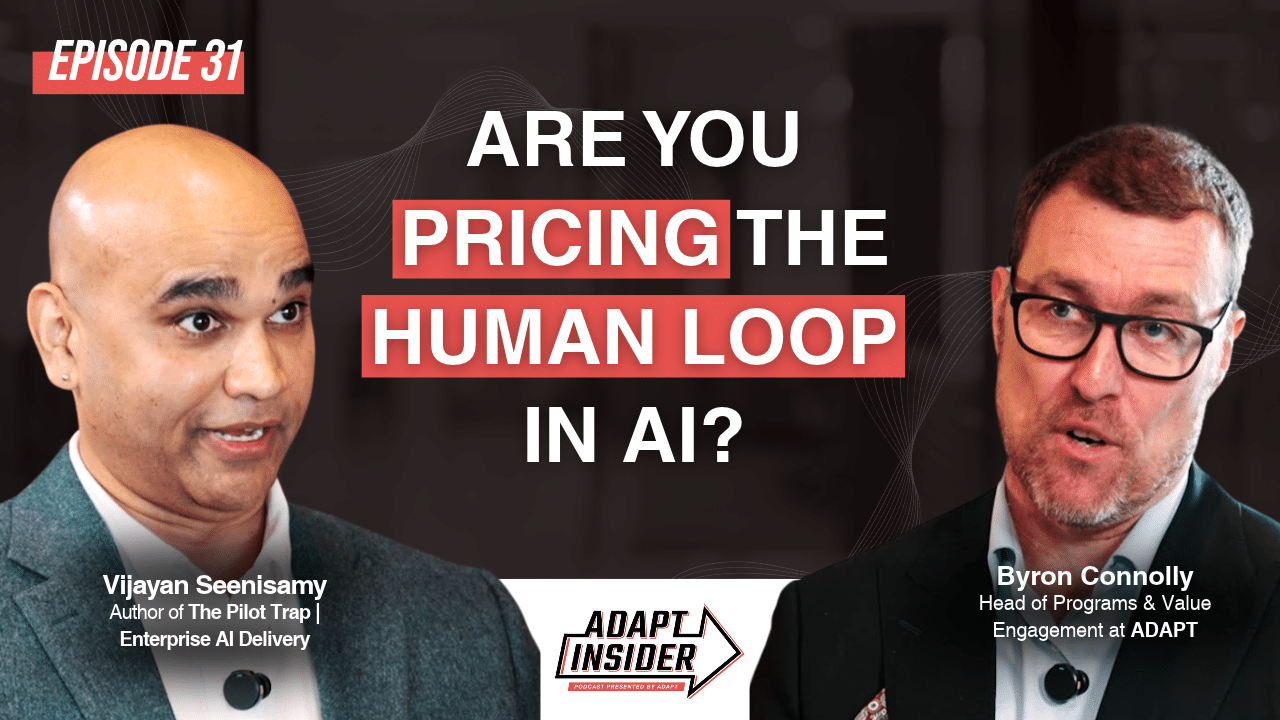


 Published Nov 2, 2026 in
Podcast
Data & AI Strategy
Contributors
Vijayan Seenisamy
Byron Connolly
Cost per successful outcome determines whether an AI agent creates value or quietly consumes it.
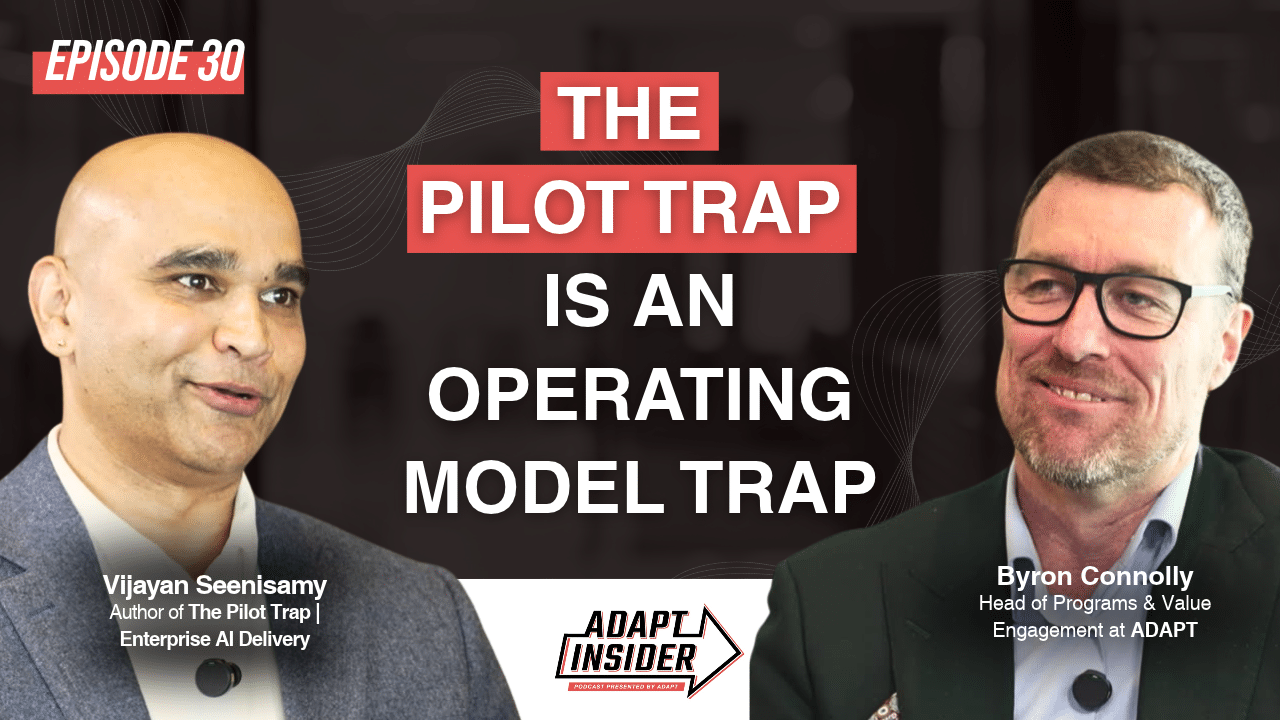
In Episode 2 of ADAPT Insider’s AI Economics Series, “Negative unit economics and the silent drift”, Vijayan Seenisamy, Author of The Pilot Trap| Enterprise AI Delivery, joins ADAPT’s Byron Connolly to reveal the costs and performance decline hidden by conventional monitoring.
Catch up on Episode 1 to learn why polished AI pilots fail when they reach production.
Listen to the full Episode 2 on Apple Podcasts, Spotify or YouTube.
Key takeaways:
- Cost per successful outcome includes retries, corrections, human review, escalations and oversight excluded from token pricing.
- Higher transaction volumes multiply weak unit economics, turning an apparently efficient pilot into an expensive production system.
- Quality-over-time monitoring detects performance drift that uptime, latency and error rates miss.
Successful outcomes expose the true cost
Token pricing captures only one component of AI economics.
The full cost extends from the initial request to the successful outcome.
Every retry, correction, escalation and manual review adds expense to the transaction.
Vijayan illustrates the gap through a human process costing $1 per completed outcome.
During the pilot, an AI agent appears to complete the same task for 30 cents.
Production introduces failures, rework and oversight. The cost rises to $1.40 per successful outcome.
The pilot presents a 70% saving. Production delivers a 40% cost increase.
Measuring cost per successful outcome gives leaders a direct comparison between an AI agent and the process it replaces.
Volume multiplies weak unit economics
Higher transaction volumes amplify every unresolved weakness in an AI agent.
Probabilistic outputs create retries, escalations and human intervention, with pilot teams manually correcting failures that reported costs exclude.
In production, those failures repeat across thousands of transactions and expenditure grows faster than value.
Measuring unit economics before wider deployment reveals whether scale will improve returns or multiply losses.
Quality drift erodes value over time
Traditional software monitoring tracks availability, latency and errors.
AI agents also require outcome-level monitoring that tests accuracy, relevance and commercial value as source data, customer behaviour and language change.
Quality-over-time monitoring measures each response against a defined business standard.
Combined with cost per successful outcome, it shows whether the agent delivers value after launch.
See what each successful AI outcome really costs
Based on the AI Economics Iceberg in Vijayan Seenisamy’s The Pilot Trap, the AI Economics Calculator reveals the full cost of one agent in three minutes.
 Vijayan Seenisamy
Author of The Pilot Trap| Enterprise AI Delivery
Vijayan Seenisamy is a transformation leader focused on building the discipline of Enterprise Agentic AI Systems Delivery, the methodology, governance, and role clarity required to move AI agents from pilot to reliable production at enterprise scale. His work is grounded in two proprietary frameworks: AI ROF, which redesigns role accountability so humans and AI agents operate with clear ownership, decision rights, and escalation paths, and ICE, or Intelligence Centred Enterprise, an operating model that treats intelligence as a practice rather than a product, built around the loop of Sense, Reason, Act, Learn.
He is the author of The Pilot Trap which examines why most enterprise AI pilots fail to reach production and identifies the category errors and operating disciplines behind that gap. He also wrote The AI Delivery Manager Blueprint, the first book to define the role between AI engineering and business outcomes. Alongside two white papers on enterprise AI role evolution and intelligence centred operating models, he has introduced concepts such as Agent Coaching, System Stewardship, the Demo God Curse, and Negative Unit Economics.
Vijayan publishes ongoing thinking through The AI Delivery Discipline, a biweekly newsletter read by more than 2,000 senior practitioners, and works as Group Transformation Lead at Woolworths Group, one of Australia’s largest organisations.
Less Byron Connolly
Head of Programs & Value Engagement at ADAPT
Byron is a highly experienced technology and business journalist, editor, corporate writer, and event producer.
Prior to joining ADAPT, he was the editor-in-chief at CIO Australia and associate editor at CSO Australia. He also created and led the well-known CIO50 awards program in Australia and The CIO Show podcast.
Byron creates valuable insights for our community of senior technology and business professionals that help them reach their organisational and professional goals. He has a passion for uncovering stories about the careers and personal philosophies of Australia’s top technology and digital executives.
When he is not working, Byron enjoys hot yoga, swimming, running and spending time with his family. He completed the North Face 100km ultra marathon in the NSW Blue Mountains in 2012 and 2013.
Less Join the ADAPT
Insider Community
Get the latest A/NZ market research and insights on the core trends impacting leaders.
Join the ADAPT Insider Community
Get the latest A/NZ market research and insights on the core trends impacting leaders.