









Enterprise AI requires an operating model built for uncertainty
In the first episode of ADAPT Insider’s AI Economics series, Vijayan Seenisamy shows why strong AI pilots fail under real-world conditions.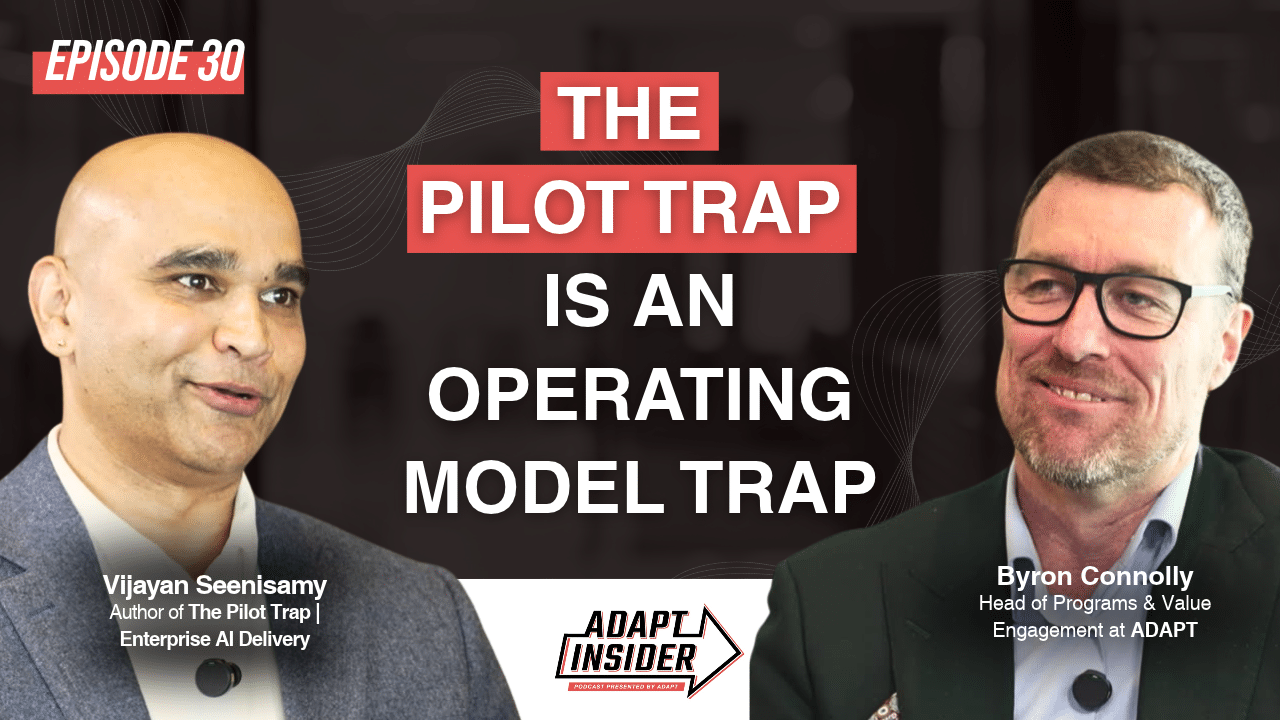


 Published Oct 29, 2026 in
Podcast
Data & AI Strategy
Contributors
Vijayan Seenisamy
Byron Connolly
Enterprise AI pilots often succeed under controlled conditions, then break when messy data, edge cases and dependent systems enter the journey.
In this first episode of ADAPT Insider’s AI Economics Series, Escaping the Pilot Trap and the Demo God Curse, Vijayan Seenisamy, Author of The Pilot Trap | Enterprise AI Delivery, joins ADAPT’s Byron Connolly to explore why organisations manage probabilistic AI through operating models designed for deterministic software.
The gap surfaces when a successful demonstration reaches production.
AI systems change with data, context and user behaviour, requiring continuous monitoring, clear ownership and business cases that account for reliability across the entire journey.
Listen to the full episode on Apple Podcasts, Spotify or YouTube.
Key takeaways:
- Treat AI readiness as a continuous management responsibility rather than a gate the organisation passes once.
- Test the messy end-to-end journey instead of relying on an individual agent or carefully curated demonstration.
- Fund experiments as experiments and assign one owner to the reliability of the entire chain.
AI requires an operating model built for change
Many enterprise AI experiments run through operating models designed for traditional software.
Code is tested, defects are fixed and the system is expected to behave consistently in production.
AI behaves differently. Its performance shifts as data, context and user behaviour change.
Vijayan describes the distinction as construction versus weather. A building can be completed and signed off.
An AI system requires ongoing observation, correction and governance.
Without that operating discipline, a pilot may perform well in controlled conditions while remaining unprepared for production.
A perfect demo proves potential, not resilience
A polished demonstration can create false confidence when its conditions are mistaken for evidence of production readiness.
Demo data is clean, prompts follow a happy path and the environment is arranged to help the agent succeed.
Production introduces messy data, unscripted questions, edge cases and failures in surrounding systems.
The environment has become honest.
Before approving the business case, executives should ask what the test actually covered.
A curated demonstration shows potential. Production readiness requires evidence that the system can perform under real operating conditions.
Reliability belongs to the entire chain
Multi-agent journeys expose how quickly reliability falls across connected steps.
Five agents with 92% reliability each produce an end-to-end success rate of about 66% when every agent must perform correctly in sequence.
Each component can pass its own test while the customer journey still fails around one time in three.
Measuring agents individually conceals the reliability of the outcome experienced by the customer.
The business case should price that end-to-end result and assign one person accountability for the entire journey.
Five owners focused on five agents leave no one responsible for whether the chain works.
 Vijayan Seenisamy
Author of The Pilot Trap and Founder at Enterprise Agentic AI Delivery Publishing
Vijayan Seenisamy is a transformation leader focused on building the discipline of Enterprise Agentic AI Systems Delivery, the methodology, governance, and role clarity required to move AI agents from pilot to reliable production at enterprise scale. His work is grounded in two proprietary frameworks: AI ROF, which redesigns role accountability so humans and AI agents operate with clear ownership, decision rights, and escalation paths, and ICE, or Intelligence Centred Enterprise, an operating model that treats intelligence as a practice rather than a product, built around the loop of Sense, Reason, Act, Learn.
He is the author of The Pilot Trap which examines why most enterprise AI pilots fail to reach production and identifies the category errors and operating disciplines behind that gap. He also wrote The AI Delivery Manager Blueprint, the first book to define the role between AI engineering and business outcomes. Alongside two white papers on enterprise AI role evolution and intelligence centred operating models, he has introduced concepts such as Agent Coaching, System Stewardship, the Demo God Curse, and Negative Unit Economics.
Vijayan publishes ongoing thinking through The AI Delivery Discipline, a biweekly newsletter read by more than 2,000 senior practitioners, and works as Group Transformation Lead at Woolworths Group, one of Australia’s largest organisations.
Less Byron Connolly
Head of Programs & Value Engagement at ADAPT
Byron is a highly experienced technology and business journalist, editor, corporate writer, and event producer.
Prior to joining ADAPT, he was the editor-in-chief at CIO Australia and associate editor at CSO Australia. He also created and led the well-known CIO50 awards program in Australia and The CIO Show podcast.
Byron creates valuable insights for our community of senior technology and business professionals that help them reach their organisational and professional goals. He has a passion for uncovering stories about the careers and personal philosophies of Australia’s top technology and digital executives.
When he is not working, Byron enjoys hot yoga, swimming, running and spending time with his family. He completed the North Face 100km ultra marathon in the NSW Blue Mountains in 2012 and 2013.
Less Join the ADAPT
Insider Community
Get the latest A/NZ market research and insights on the core trends impacting leaders.
Join the ADAPT Insider Community
Get the latest A/NZ market research and insights on the core trends impacting leaders.