








What separates the 1 in 10 government agencies achieving measurable AI productivity gains?
At Government Edge, ADAPT Head of Analytics & Insights Gabby Fredkin shares 2026 research on AI productivity, workforce capability and data across government.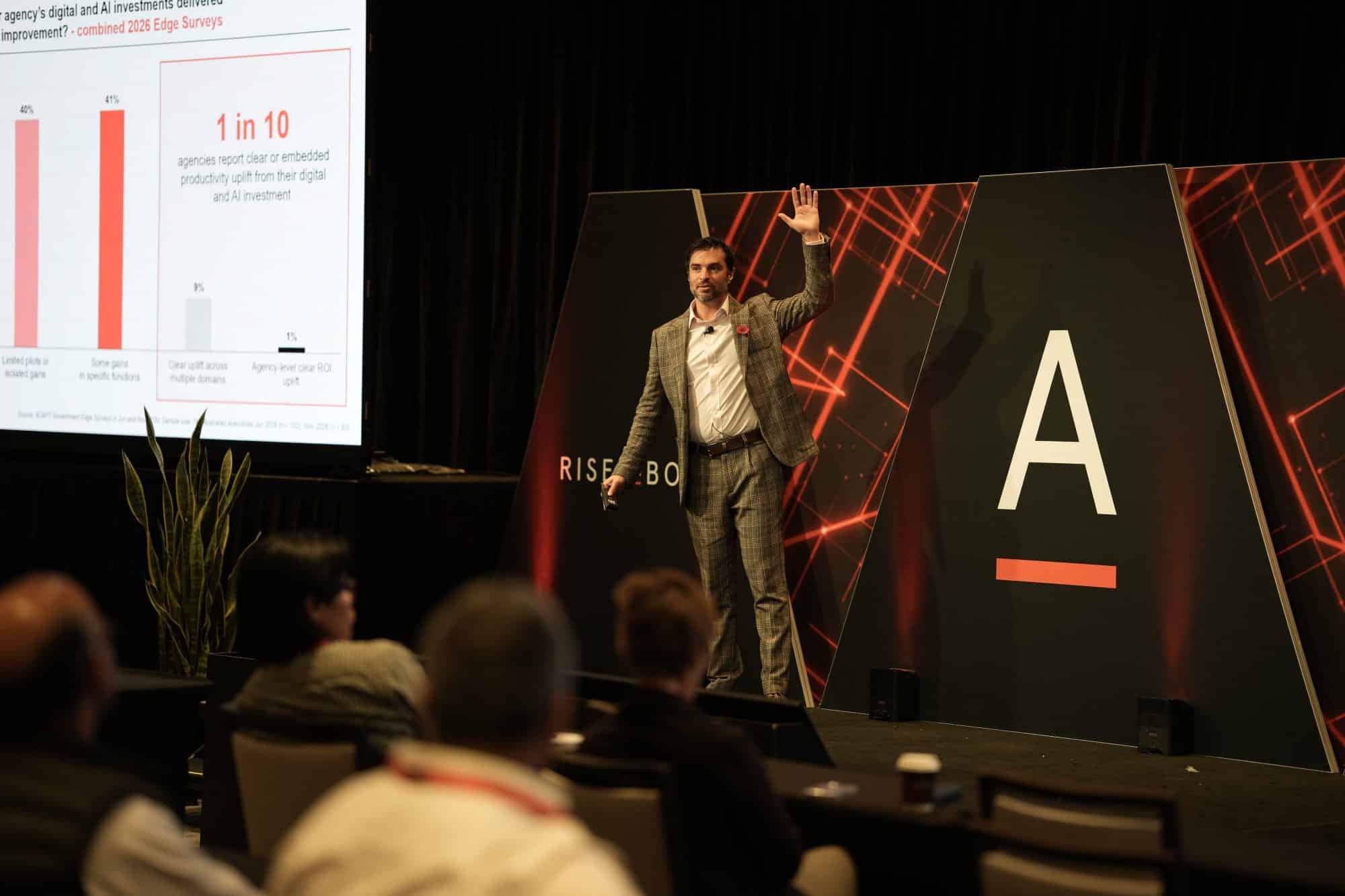


 Published Nov 16, 2026 in
Expert Presentations
Data & AI Strategy
Contributors
Gabby Fredkin
Measurable AI productivity gains remain concentrated among a small group of government agencies.
At Government Edge, Gabby Fredkin, Head of Analytics & Insights at ADAPT, shared a decision-tree model to identify the characteristics associated with stronger productivity outcomes: the ability to absorb change, practical workforce training and champions, and reusable data.
Key takeaways:
-
- Build the organisation’s capacity to absorb change before expecting productivity gains.
- Combine mandatory training with champions who can apply AI in the context of specific teams.
- Make data reusable so each new use case can build on existing foundations.
Leadership builds the capacity to absorb change
Around one in 10 government agencies in Gabby reports measurable productivity gains from AI.
His decision-tree model identifies an organisation’s ability to absorb change as an important predictor of performance.
Leaders shape that capacity by understanding the context of AI, explaining why change is happening and giving teams room to adapt.
Among organisations that rated poorly on their ability to absorb change, only around 6% achieved measurable productivity gains, compared with the broader one in 10 benchmark.
Training and champions build capability
Mandatory training creates a shared foundation, while champions help employees apply AI within the context of their own work.
Teams need that local support because finance, sales, marketing and other functions use the technology differently.
Gabby’s model shows a significant uplift when organisations combine both approaches, with the share achieving productivity gains rising from around 10% to 40%.
Together, change capacity and the use of training and champions account for around 30% of the variation in productivity performance captured by the model.
Government agencies still rely heavily on formal guidance to enable employees.
Almost half (46%) of government organisations in the survey primarily use guidelines or usage policies.
These provide a compliance and risk-control baseline, but create limited practical capability on their own.
Reusable data supports value at scale
Reusable data gives organisations a stronger foundation for moving beyond individual tools and pilots.
Across the combined government and commercial data, 38% of organisations with reusable data capture high value from their generative AI initiatives.
Gabby also links stronger outcomes to capable architecture and a more deliberate approach to how data is managed across the organisation.
Government agencies also report higher levels of formal governance across AI pilots and production systems, alongside lower levels of AI in production.
Stronger oversight can support safer adoption, and leadership capability, workforce support and reusable data then help agencies turn governed experimentation into measurable value.
 Gabby Fredkin
Head of Analytics & Insights at ADAPT
As the Head of Analytics and Insights at ADAPT, Gabby Fredkin’s primary role is managing analysis to produce ADAPT’s actionable insights to identify trends supporting organisations in Australia.
With a passion for creating stories with data, Gabby is consistently rated as one of the top speakers at ADAPT’s events. In roundtable discussions, he specialises in using statistics to initiate thought-provoking discussions, enabling ADAPT’s customers to become more data-driven.
Using modern data science techniques, he provides ADAPT and its customers with confidence in the accuracy and validity of the information used for ADAPT’s research, advisory and events.
Working across artificial intelligence, machine learning, AI ethics, DevSecOps, end-user behaviour, and human-centred design, Gabby’s vast experience continues to grow, supported in part by a Master of Business Analytics from Deakin University.
Less Join the ADAPT
Insider Community
Get the latest A/NZ market research and insights on the core trends impacting leaders.
Join the ADAPT Insider Community
Get the latest A/NZ market research and insights on the core trends impacting leaders.