








Funding should follow evidence of AI cost and ownership
In Episode 3 of ADAPT Insider’s AI Economics Series, Vijayan Seenisamy sets out a control tower for governing agents in production.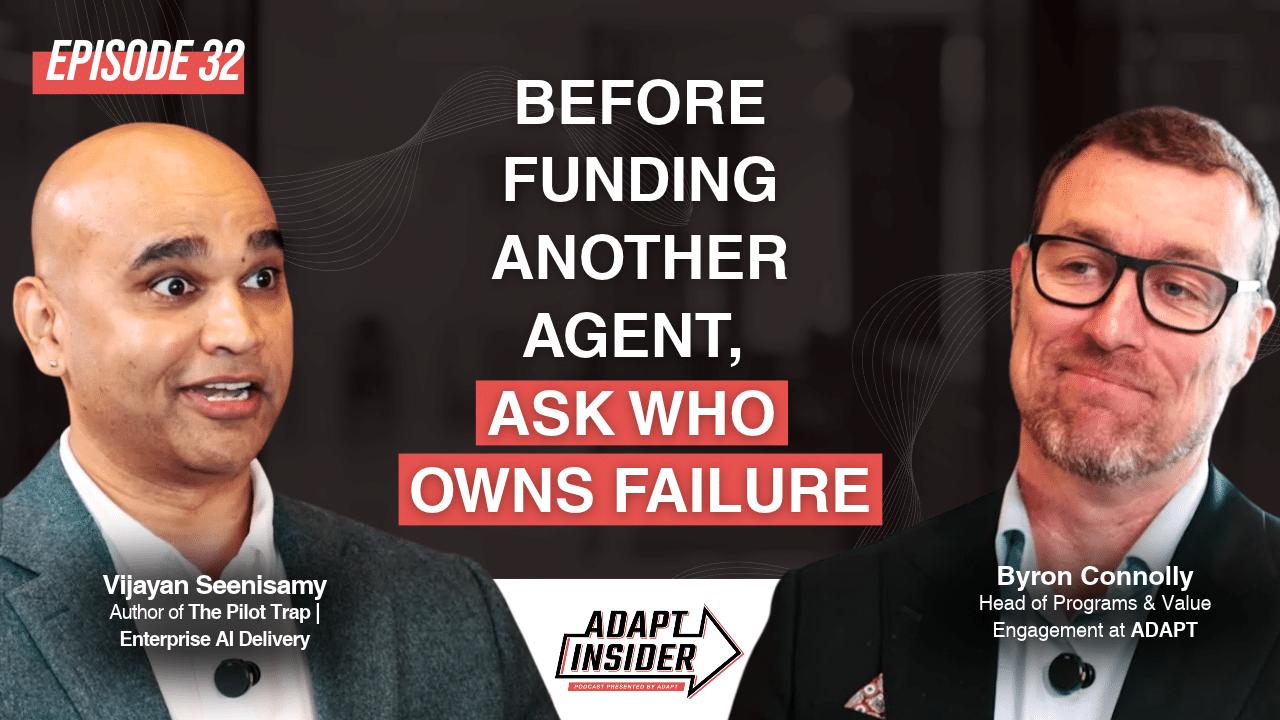


 Published Nov 9, 2026 in
Podcast
Data & AI Strategy
Contributors
Byron Connolly
Vijayan Seenisamy
Every production agent should report its outcomes, costs, quality drift, failures and owner into one operational view.
In Episode 3 of ADAPT Insider’s AI Economics Series, The Control Tower and Monday Morning Questions, Vijayan Seenisamy, Author of The Pilot Trap | Enterprise AI Delivery, continues his conversation with ADAPT’s Head of Programs and Value Engagement Byron Connolly to outline a practical model for governing AI agents in production.
The final episode covers the control tower, the questions every agent must answer before launch and the evidence required for continued funding.
Catch up on Episode 1 to understand the pilot trap, then Episode 2 for the negative unit economics and silent drift that follow in production.
Listen to the full Episode 3 on Apple Podcasts, Spotify or YouTube.
Key takeaways:
- A control tower shows how agents perform across outcomes, costs, quality drift, failures, handoffs and ownership.
- Production approval requires clear answers on value, cost, drift, failure recovery and ownership, signed off by business, technology and risk.
- Cost per successful outcome and production ownership determine whether an initiative receives product or experimental funding.
The control tower shows the whole agent fleet
Individual teams see the agents operating inside their own workflows.
They lose sight of the wider system once agents exchange work, drift at different rates and produce different costs.
Vijayan compares the environment to aircraft moving through changing weather.
Air traffic control sees each path, monitors changing conditions and intervenes before routes collide.
An AI control tower serves the same operational purpose.
It brings each agent’s outcomes, costs, drift, failures, handoffs and owner into one view so problems can be traced across the fleet.
The owner then has the information and authority to act when performance changes.
Five questions set the production gate
Every agent entering production must answer five questions:
- What outcome does the agent deliver?
- What does each successful outcome cost?
- How will quality drift be detected?
- What happens when the agent fails?
- Who owns the agent in production?
Three people then sign off on the answers.
The business owner accepts responsibility for value, the technical owner for reliability and the risk or governance owner for controls.
Missing answers expose work that remains unready for production.
Missing signatures expose accountability that has not been assigned.
Two Monday questions guide funding
Every Monday funding decision should begin with two questions: what does a successful outcome cost, and who owns the agent in production?
An initiative with evidence for both belongs in the production portfolio.
Missing evidence places it in the experiment portfolio, with funding tied to a defined question and time limit.
Experiments have value when they produce evidence.
Problems arise when organisations fund them as production systems before establishing cost, reliability and ownership.
Managing AI as a portfolio gives leaders a consistent basis for continuing, redesigning or stopping each investment.
Test the economics before funding another AI agent
Use the ADAPT AI Economics Calculator to estimate the cost per successful outcome, including build, run, retry and human intervention costs. Calculate now.
 Byron Connolly
Head of Programs & Value Engagement at ADAPT
Byron is a highly experienced technology and business journalist, editor, corporate writer, and event producer.
Prior to joining ADAPT, he was the editor-in-chief at CIO Australia and associate editor at CSO Australia. He also created and led the well-known CIO50 awards program in Australia and The CIO Show podcast.
Byron creates valuable insights for our community of senior technology and business professionals that help them reach their organisational and professional goals. He has a passion for uncovering stories about the careers and personal philosophies of Australia’s top technology and digital executives.
When he is not working, Byron enjoys hot yoga, swimming, running and spending time with his family. He completed the North Face 100km ultra marathon in the NSW Blue Mountains in 2012 and 2013.
Less Vijayan Seenisamy
Author of The Pilot Trap | Enterprise AI Delivery
Vijayan Seenisamy is a transformation leader focused on building the discipline of Enterprise Agentic AI Systems Delivery, the methodology, governance, and role clarity required to move AI agents from pilot to reliable production at enterprise scale. His work is grounded in two proprietary frameworks: AI ROF, which redesigns role accountability so humans and AI agents operate with clear ownership, decision rights, and escalation paths, and ICE, or Intelligence Centred Enterprise, an operating model that treats intelligence as a practice rather than a product, built around the loop of Sense, Reason, Act, Learn.
He is the author of The Pilot Trap which examines why most enterprise AI pilots fail to reach production and identifies the category errors and operating disciplines behind that gap. He also wrote The AI Delivery Manager Blueprint, the first book to define the role between AI engineering and business outcomes. Alongside two white papers on enterprise AI role evolution and intelligence centred operating models, he has introduced concepts such as Agent Coaching, System Stewardship, the Demo God Curse, and Negative Unit Economics.
Vijayan publishes ongoing thinking through The AI Delivery Discipline, a biweekly newsletter read by more than 2,000 senior practitioners, and works as Group Transformation Lead at Woolworths Group, one of Australia’s largest organisations.
Less Join the ADAPT
Insider Community
Get the latest A/NZ market research and insights on the core trends impacting leaders.
Join the ADAPT Insider Community
Get the latest A/NZ market research and insights on the core trends impacting leaders.