








What Australian leaders are really saying about AI governance
ADAPT’s Head of Product Lisa Drum shares key takeaways from two executive roundtables hosted by IBM and ADAPT in Canberra and Sydney in 2026.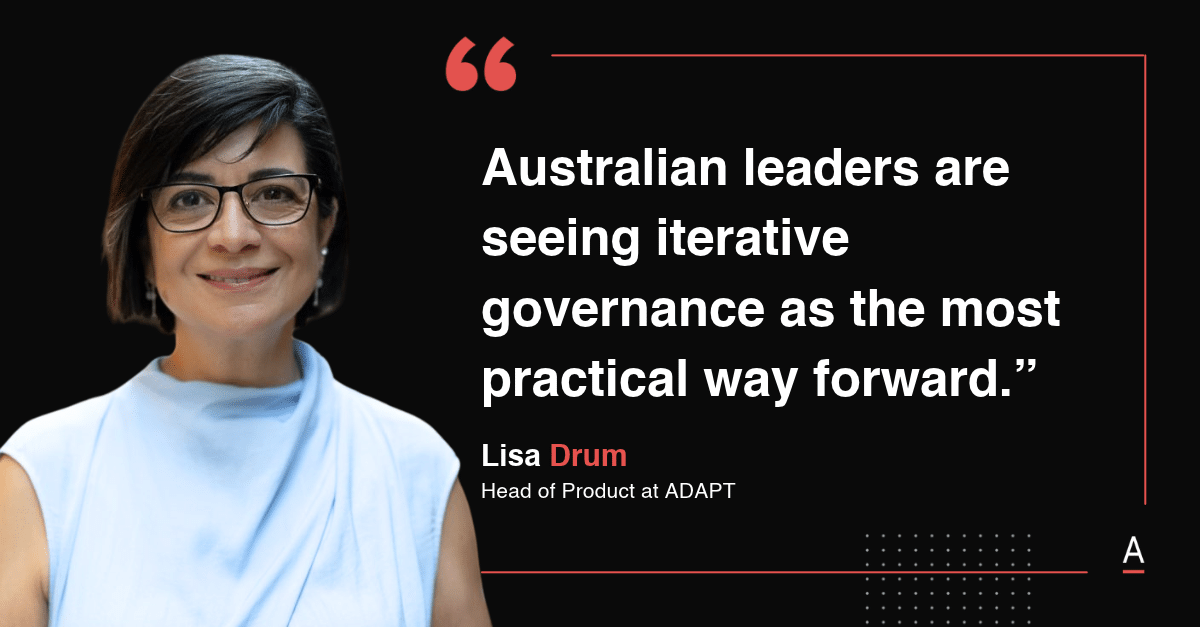


 Published Nov 19, 2026 in
Articles
Data & AI Strategy
Contributors
Lisa Drum
Across two private roundtables with senior Australian leaders, one consistent message emerged: AI governance frameworks need to keep pace with the technology, not the committee.
Both sessions were held under Chatham House rules, so this summary reflects the discussion themes, rather than specific comments.
Sovereignty is more than where your compute sits
In both Canberra and Sydney, participants challenged the narrow view that sovereignty starts and ends with data residency.
Leaders mapped the challenge across six layers: infrastructure, models, agentic AI, control and observability, applications, and regulation.
The conversation kept returning to model provenance, hosting jurisdiction and regional availability.
A pragmatic consensus emerged: use frontier models for general productivity, while investing in locally trained models for domain-specific work where Australian context, compliance and data sensitivity matter.
Minimum viable governance beats maximum viable policy
In Canberra, participants highlighted the gap between responsible AI frameworks on paper and the practical guidance development teams need.
Sydney sharpened the point: heavyweight governance can create the shadow AI and shadow IT it is meant to prevent.
Models and tools are changing so quickly that rigid frameworks become obsolete. Leaders in both sessions saw iterative governance as the most practical way forward.
Where the conversations diverged
The Canberra discussion, with a stronger government focus, centred on the tension between innovation and protection:
- letting people experiment with AI while safeguarding citizen services and data
- maintaining the skills that underpin human judgement
- managing risk frameworks built for deterministic systems that are now applied to probabilistic ones.
The potential erosion of foundational skills was a theme unique to this session, particularly for graduates and junior staff learning to reason through problems with AI from day one.
Sydney’s enterprise leaders focused more on scaling.
IBM’s recommendation of a governed AI harness for each persona resonated: each role gets the security, controls and data it needs; IT manages the harnesses; and the business owns the end-to-end processes, including whether agents deliver value.
This approach shifts technology teams from chasing individual use cases to building an operating model that the business can scale at its own pace.
Data maturity remains the bottleneck
Participants in both sessions agreed that AI ambitions are outpacing data readiness.
In Sydney, the Streamhouse pattern was discussed as a way to give analytics and AI agents the same fresh, governed view of the business, instead of relying on separate batch snapshots.
The proof point still missing across both sessions is evidence of organisations that have genuinely addressed data maturity and can demonstrate AI at scale through a clear operating model.
The bottom line
Australian leaders are not short on AI ambition.
They need governance that keeps pace with the technology, sovereignty frameworks that account for more than infrastructure, and data foundations mature enough to support what comes next.
 Lisa Drum
Head of Product at ADAPT
Executive transformation leader who brings clarity to complex environments and converts strategy into delivery momentum. Experience spans enterprise technology leadership (Microsoft, T-Mobile, public sector) and consulting across Australia / Asia Pac, the US, EU and LATAM. I work with senior leaders to frame decisions, align business and technology priorities, and shape modernisation pathways that are practical, sequenced and measurable. Known for clear thinking, executive facilitation, and translating between commercial intent, technical reality and operational constraint to keep teams aligned and outcomes moving. Focus areas:
– Business and technology transformation
– Executive facilitation and decision support
– Data and modernisation strategy
– Customer and employee experience uplift
– Cross-functional leadership and coaching
– Turning complexity into clear choices
 Join the ADAPT
Insider Community
Get the latest A/NZ market research and insights on the core trends impacting leaders.
Join the ADAPT Insider Community
Get the latest A/NZ market research and insights on the core trends impacting leaders.