
















AI spend will spiral unless CFOs redesign cost governance for tokens, cloud and inference
As AI moves from pilots to production, CFOs need clearer cost attribution, sharper unit economics and funding controls tied to measurable value.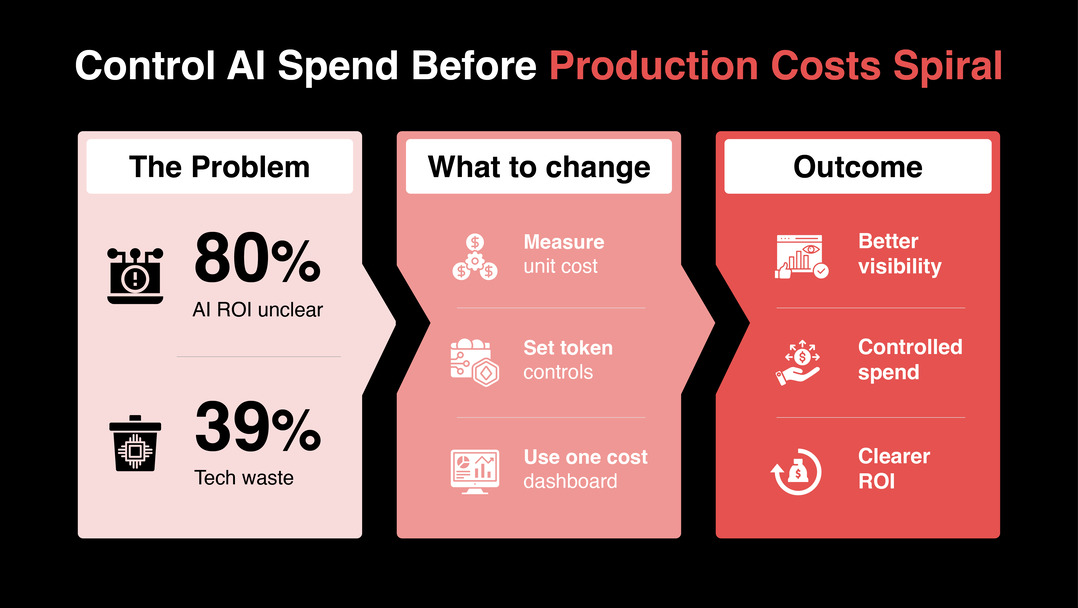


 Published Jun 25, 2026 in
Articles
Finance
Contributors
Justina Uy
Published Jun 25, 2026 in
Articles
Finance
Contributors
Justina Uy
AI cost governance has entered a different phase.
Traditional technology investment models were built around licences, implementation costs, infrastructure budgets and depreciation cycles.
AI adds consumption patterns that move with adoption, prompt length, model choice, inference volume, agent behaviour, data retrieval and cloud architecture.
A pilot can look affordable because the user base is narrow, the workflow is controlled and the support effort is hidden.
Once AI moves into daily finance, customer, operations and technology workflows, cost exposure spreads across tokens, compute, storage, APIs, integration, security, monitoring and energy.
ADAPT’s CFO research shows why this issue now belongs on the finance agenda.
CFOs and CIOs use similar evaluation frameworks for IT initiatives, but CFOs place stronger emphasis on risk reduction, while CIOs focus more on cost savings.
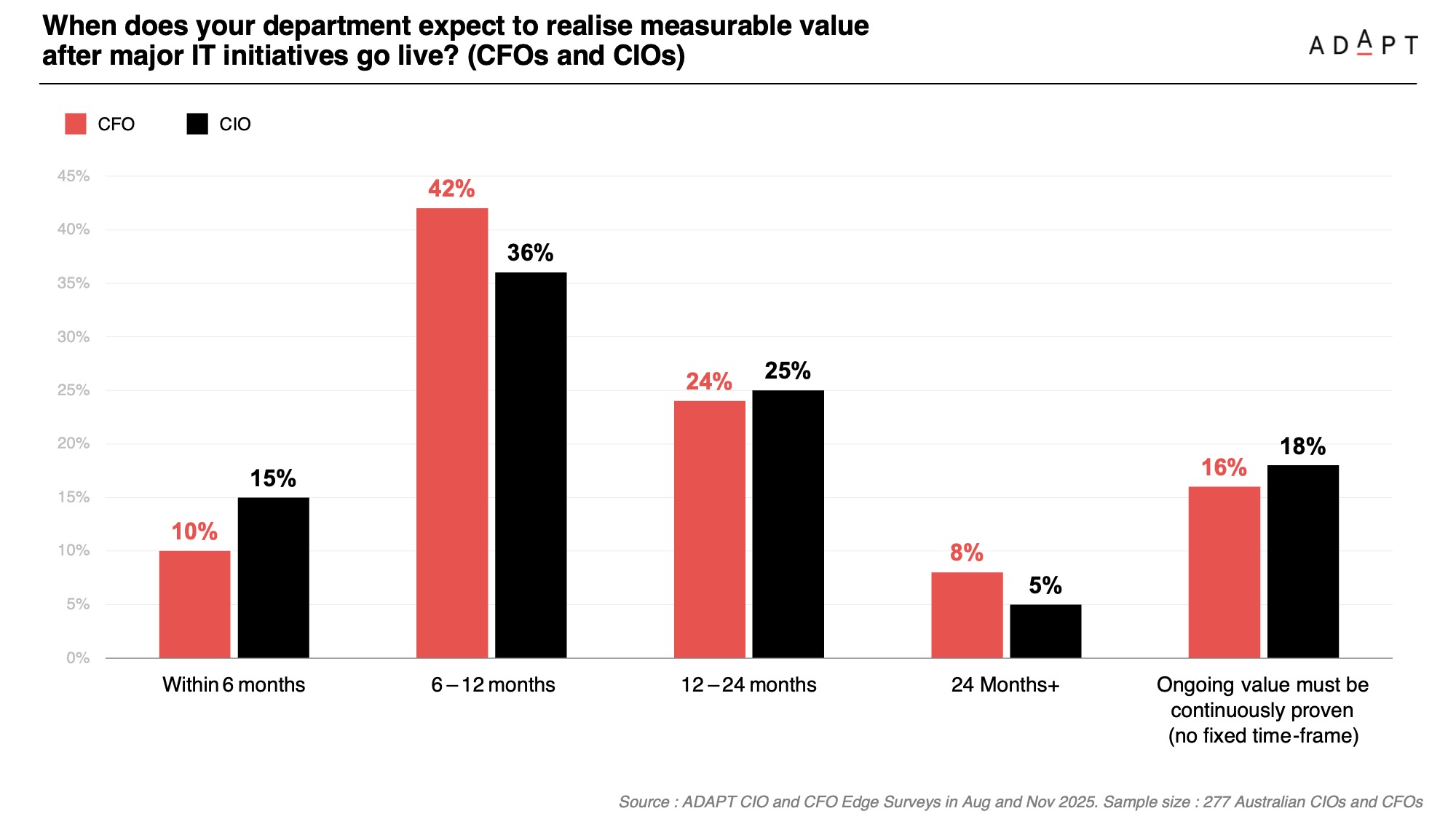
More than half of CFOs and CIOs expect measurable value within one year after major IT initiatives go live.
CFOs also report that the biggest funding barriers for CIOs are budget constraints at 40% and difficulty articulating ROI at 36%.
Finance leaders cannot govern AI spend through invoice review after usage has already expanded.
They need a cost model built for variable consumption, business ownership and value accountability.
Build AI cost visibility before usage scales
AI spend rarely appears as one clean budget item. It spreads across public cloud platforms, GenAI tools, internal applications, model calls, vector databases, storage, data pipelines, integration work and operational support.
ADAPT’s CFO Edge research shows Australian finance leaders already face technology waste.
On average, only 61% of organisations’ current technology capabilities are adopted and in use.
That leaves 39% of existing technology capability underused, before AI adds new consumption layers.
The visibility gap is even sharper when CFOs assess their own technology support.
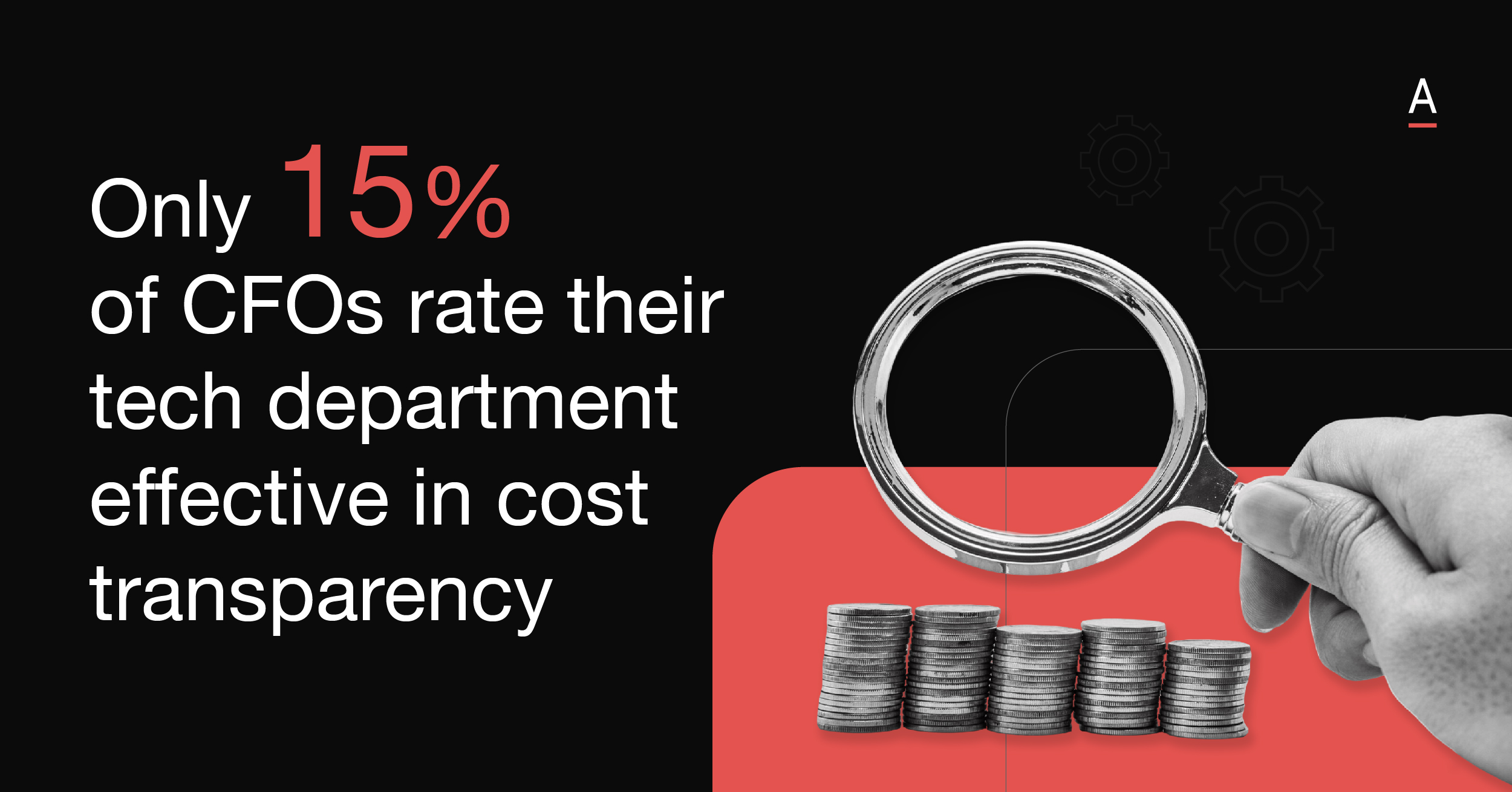
Only 15% of CFOs rate their tech department effective in cost transparency, which means most finance teams are being asked to govern AI investment without a reliable view of the cost base beneath it.
AI can deepen that waste if finance cannot attribute cost to the workflow creating it.
A chatbot may show adoption while token usage rises through repeated prompts.
A finance assistant may reduce manual effort while creating additional cloud, retrieval and governance costs.
An agent may complete a task while calling unnecessary tools in the background.
Datacom’s 2025 Cloud and Infrastructure Report shows the cloud environment already has cost visibility problems.
Less than half of Australian organisations have seen the cloud benefits they expected, while persistent challenges include higher than expected total cost of ownership, complex billing structures, lack of visibility and immaturity in cloud financial management.
CloudZero’s 2025 AI cost research shows how quickly AI cost visibility becomes a finance control issue.
Only 51% of organisations can confidently evaluate AI ROI, while 15% have no formal AI cost tracking system in place.
The CFO’s first test is attribution.
AI cost must be visible by use case, workflow, business unit, model, environment and owner.
Without that structure, finance will see aggregate spend but miss the behaviours driving it.
Recommended action: Establish AI cost allocation by use case, workflow, model, business owner, environment and consumption driver before scaling production usage.
Redesign ROI around output capacity
AI ROI cannot rely on project approval assumptions.
Production costs change with how often the system is used, how much context it consumes, how many outputs it generates, how many tools it calls and how much data it retrieves.
Luke Bebbington, Industry Advisor, APAC at Workday, argues that finance leaders cannot scale AI agents on messy data and old ROI assumptions.

He says clean data foundations are non negotiable for AI in finance because weak data readiness makes it difficult to generate ROI and deliver value.
He also warns that many organisations operate with several versions of the numbers across operational systems, general ledgers, consolidation processes, planning teams and forecasting teams.
This shifts ROI from project cost recovery to output economics.
He uses the example of flash reports, which may take a person an hour to compile each morning but can be generated instantly by an agent.
The value sits in timelier insight, better executive questions and faster business response.
Traditional discounted cash flow models struggle to capture that value, particularly when early agents carry setup costs before wider adoption makes returns clearer.
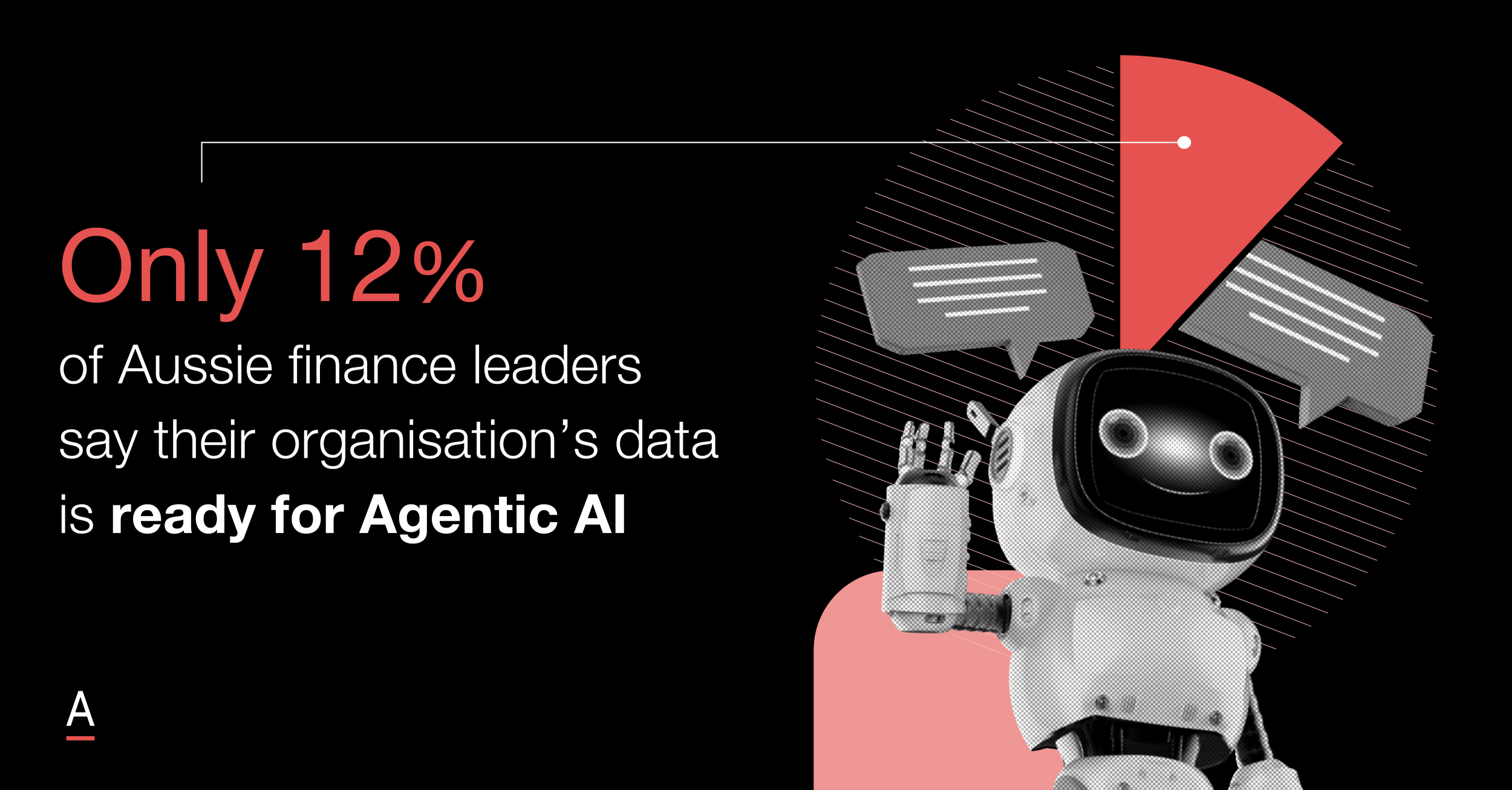
But only 12% of Australian finance leaders say their organisation’s data is ready for Agentic AI.
Without trusted data, AI cost governance becomes guesswork because finance cannot reliably connect consumption to outcomes, forecast quality, operational decisions or enterprise value.
ADAPT’s CFO Edge research reinforces the pressure.
Gabby Fredkin, Head of Analytics and Insights at ADAPT, reported that 80% of finance leaders say AI ROI remains unclear.

He also highlighted that poor data quality, fragmented systems and outdated ERP platforms constrain AI progress, with only 14% of organisations running fully modernised ERPs.
Finance needs sharper unit economics.
Cost per flash report generated. Cost per forecast improved. Cost per invoice processed. Cost per risk detected. Cost per reporting cycle shortened.
These measures connect AI consumption to business performance without reducing AI value to token cost alone.
Recommended action: Replace generic AI ROI cases with unit economics that link token use, inference cost, cloud consumption, data readiness and output quality to measurable business outcomes.
Govern tokens as a financial control
Tokens are a direct cost driver.
They determine how much organisations pay for prompts, outputs, context windows, retrieval, tool calls and repeated agent loops.
Finance teams do not need to manage prompt engineering, but they need governance over the economic logic of AI usage.
High capability models should be reserved for tasks that justify their cost.
Long context windows need a value reason.
Agent workflows need thresholds for retry loops, tool calls and escalation.
The FinOps Foundation states that FinOps for Generative AI extends traditional cloud financial management to address AI workload characteristics, including model size, GPU and CPU utilisation, inference optimisation, cost, performance and scalability.
ADAPT’s CFO research shows finance leaders already evaluate technology through risk reduction, cost, productivity, customer experience and revenue growth.
Token governance turns those criteria into AI operating rules: which model is appropriate, how much context is allowed, when caching should be used, when a workflow stops and when a human approves further consumption.
This is also where agent sprawl becomes a finance problem.
Luke notes that agents access data and take actions with that data, which makes governance, audit trails, executive support for decisions and auditor confidence essential.
Recommended action: Define token budgets, model selection rules, context limits, caching policies, audit requirements and stop thresholds for each production AI workflow.
Connect cloud, inference and data costs into one view
AI spend cannot be controlled through model pricing alone.
Inference sits inside a wider cost system covering compute, storage, networking, security, data movement, latency, integration, sovereignty and energy.
Datacom found budget constraints remain the top data centre and cloud computing strategy challenge in 2025, with 26% of Australian organisations highlighting budget as an issue.
The report also links AI workloads to rising demand for high performance, low latency infrastructure, data protection, regulatory requirements and in country processing.
ADAPT’s points to the same operating gap.
AI value depends on the systems surrounding it, including funding cycles, data flows, governance rhythms and cross functional decision making.
For CFOs, cloud, inference and data costs need to be treated as connected parts of the same cost system because each AI use case draws on all three before value can be measured.
A model decision can increase storage demand.
A data sovereignty requirement can change platform choice. A real time use case can increase inference cost and infrastructure requirements.
A fragmented ERP environment can add data preparation costs before AI produces value.
UTS Institute for Sustainable Futures found 72% of surveyed Australian and New Zealand IT managers had either adopted or were piloting AI technologies, while 67% agreed AI deployment was adding pressure on IT departments because of insufficient budget.
The same report found 68% had at least some concern about AI’s increased energy consumption when meeting ESG goals.
The cost view needs to extend beyond finance ledgers. AI demand affects cloud spend, storage architecture, compute capacity, data management, energy consumption and sustainability reporting.
CFOs need one view that shows how each use case consumes resources and whether that consumption produces measurable value.
Recommended action: Create one AI cost dashboard across finance, technology and business teams covering tokens, inference, cloud, storage, data movement, energy, security, integration and support.
Fund AI through portfolio discipline
AI pilots often receive approval because the initial spend looks contained.
Scaling reveals the real economics.
ADAPT found 62% of organisations are progressing ERP and core finance system modernisation, yet only 14% have fully integrated ERP with the broader technology stack.
Without stronger integration, CFOs will struggle to measure AI value, allocate cost and compare outcomes across business units.
ADAPT also found that 60% of Australian CFOs now co build technology strategy, placing finance leaders at the centre of enterprise transformation.
Funding constraints remain the top barrier across executive personas, which makes shared accountability between finance and technology more important as AI investment grows.
This is where the broader system around AI becomes decisive.
AI cost governance fails when funding cycles, governance gates and decision rhythms move slower than usage growth.
CFOs need review cadences that track cost, value and risk while AI workflows are still being shaped, not after spend has normalised.
Chris Merjane, Head of Finance, Corporate Functions at ResMed, shows how this can work in practice.
He describes democratised finance data, embedded analytics, FinOps practices that reduce technology sprawl and AI experiments that automate cost centre summaries and explore agentic forecasting workflows.

His approach links real time visibility, platform consolidation and workforce capability rather than treating AI as a standalone tool.
Portfolio discipline gives CFOs a better control model than pilot by pilot approval.
Each use case should have a business owner, cost owner, value measure, risk profile, data readiness requirement and scale threshold.
Funding should increase only when adoption, cost attribution, controls and business outcomes are visible.
Recommended action: Fund AI as a governed portfolio, with staged investment tied to data readiness, cost attribution, adoption, risk controls and measurable value.
 Justina Uy
Content Marketing Manager
Justina Uy
Content Marketing Manager
Justina Uy is a data-driven content marketer that thrives on democratising elite know-how to empower Australia’s underdogs.
Skilled at translating complex ideas into a compelling story across formats and channels, she shifts seamlessly between writing long-form articles, creating viral social media posts, and producing thumb-stopping videos.
Since 2015, Justina executes her vision through a sophisticated understanding of the rapidly evolving digital and business landscape to serve entertaining and educational insights to the executive community.
Less Join the ADAPT
 Insider Community
Get the latest A/NZ market research and insights on the core trends impacting leaders.