
















With 28% planning to repatriate workloads, how can infrastructure leaders build for AI without repeating cloud’s mistakes?
160+ leaders gathered at Cloud & Infrastructure Edge to explore sovereign AI, workload placement and the economics of scaling compute.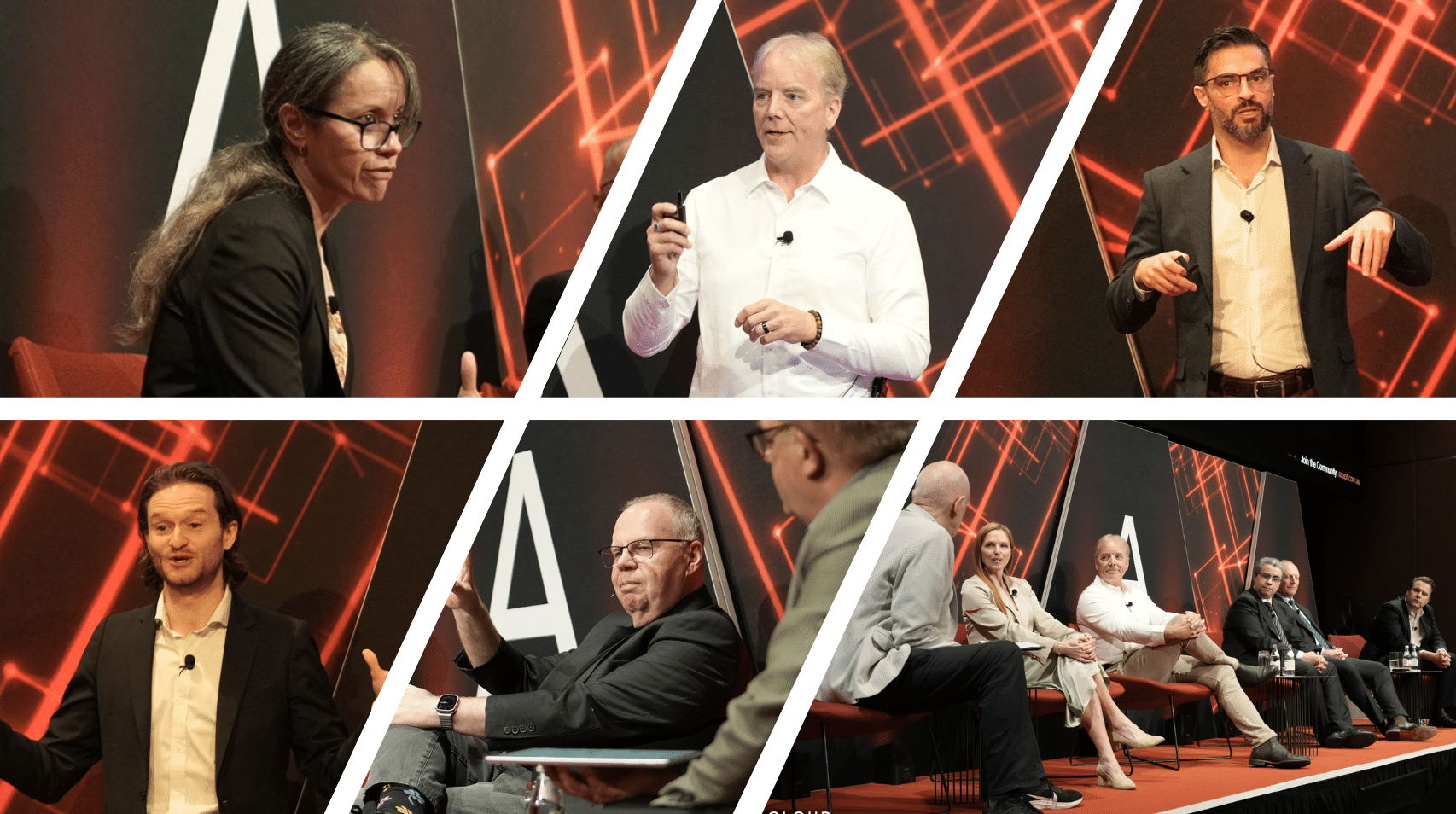


 Published Jul 22, 2026 in
Articles
Cloud & Infrastructure
Contributors
Justina Uy
Published Jul 22, 2026 in
Articles
Cloud & Infrastructure
Contributors
Justina Uy
Infrastructure leaders are being asked to give businesses faster access to AI, protect sensitive data and keep an increasingly variable compute bill under control.
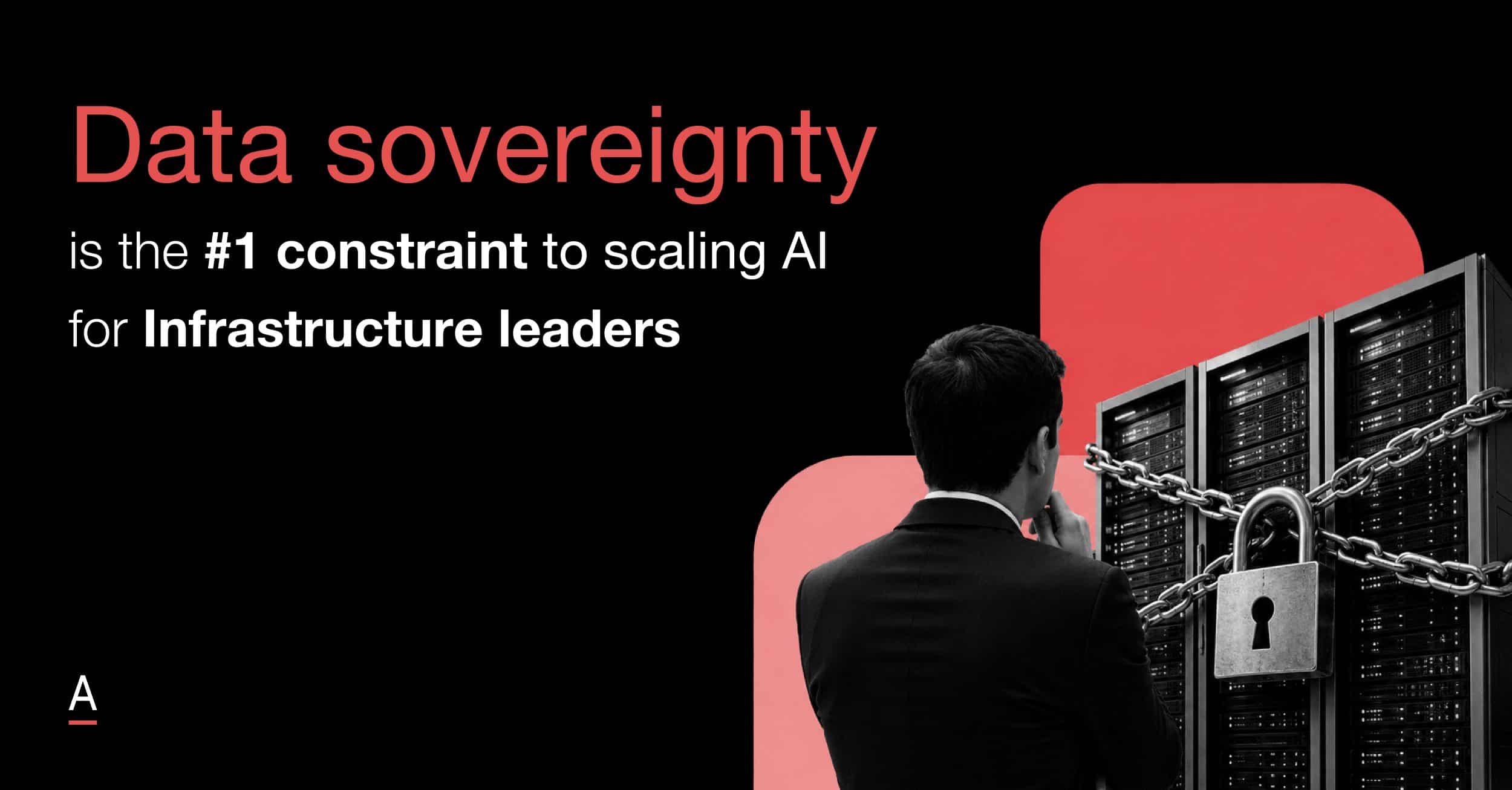
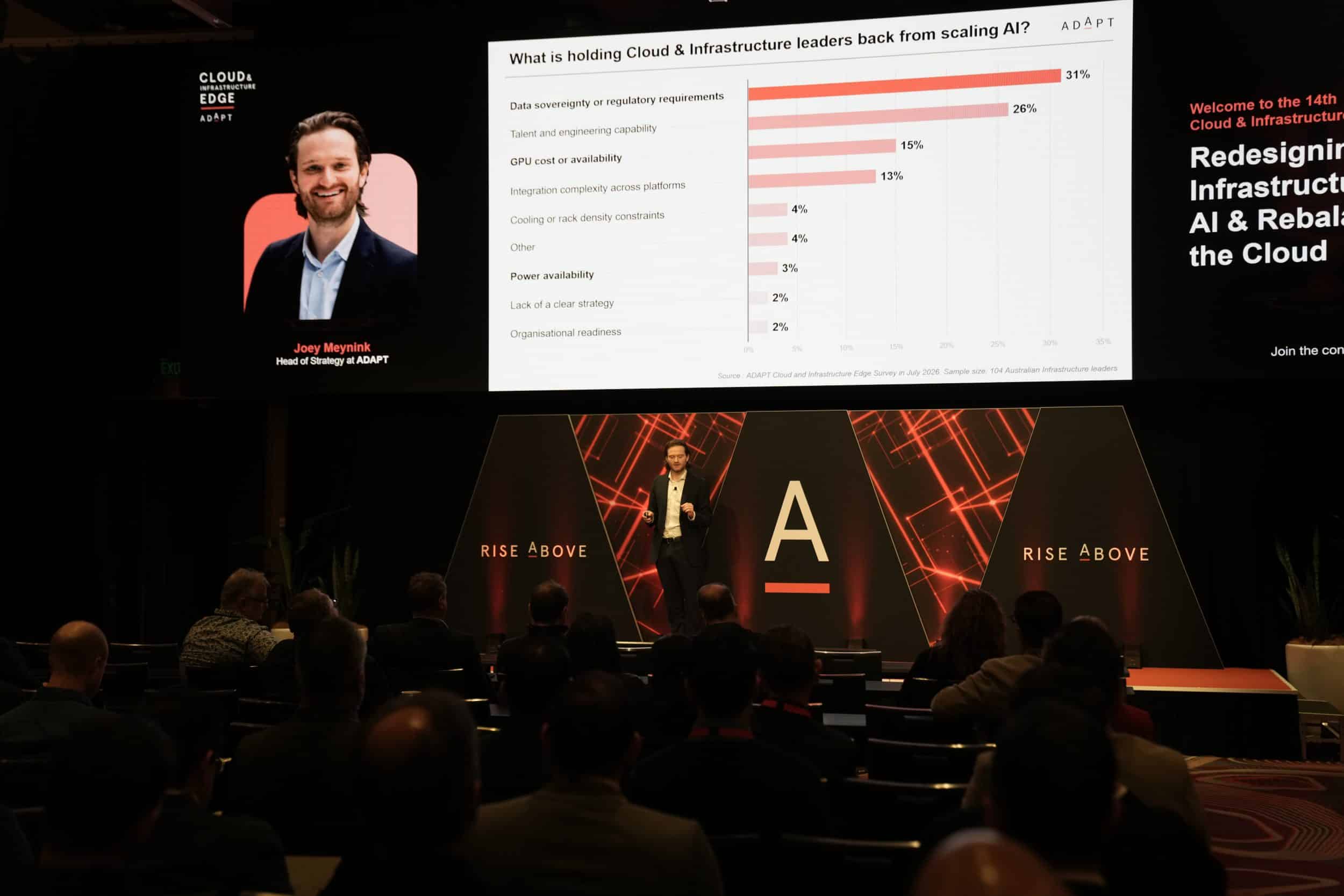
However, data sovereignty is now the leading constraint to scaling AI, while the proportion of leaders considering workload repatriation has reached an all-time high.
ADAPT research captures the tension.
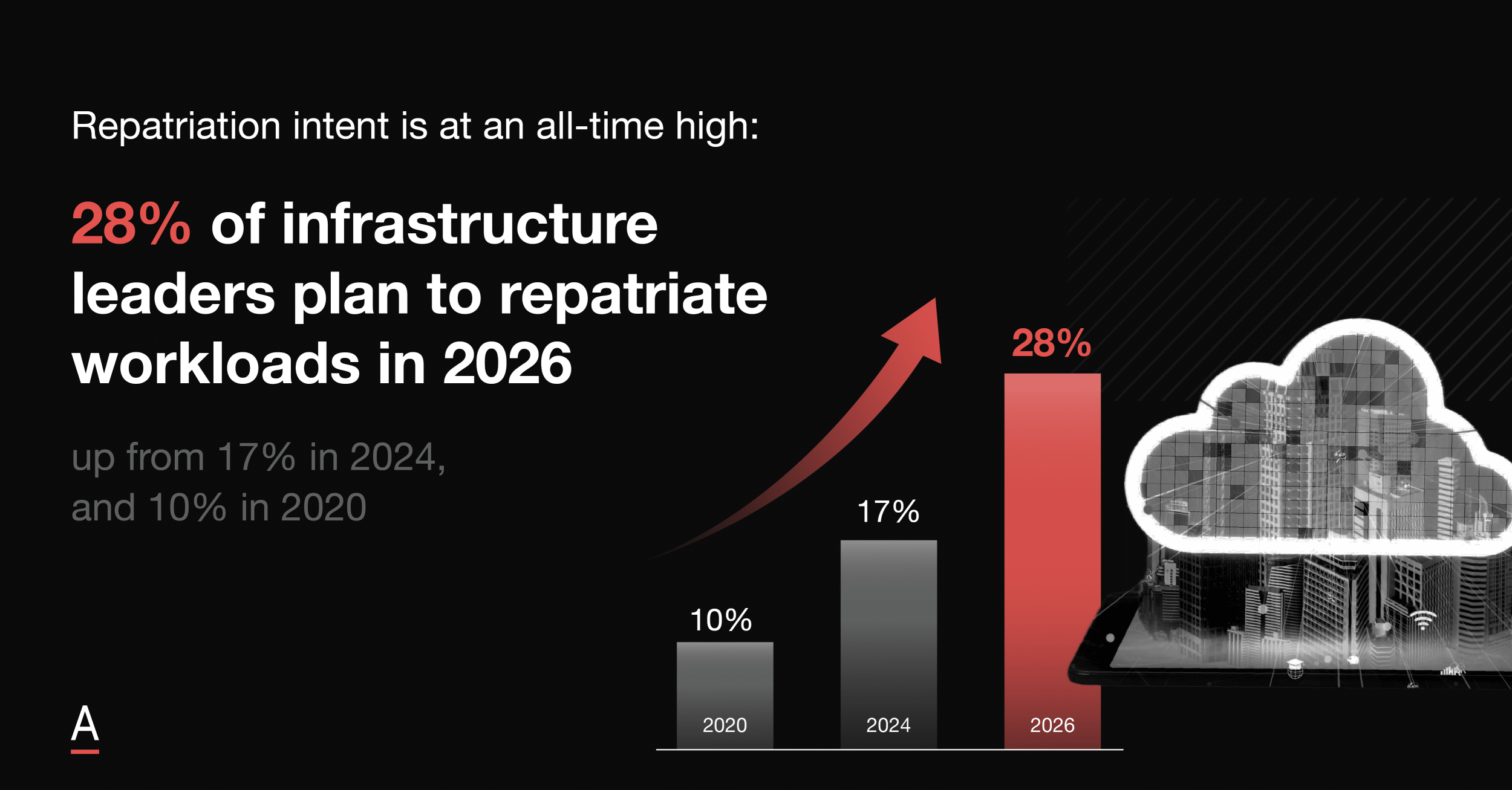
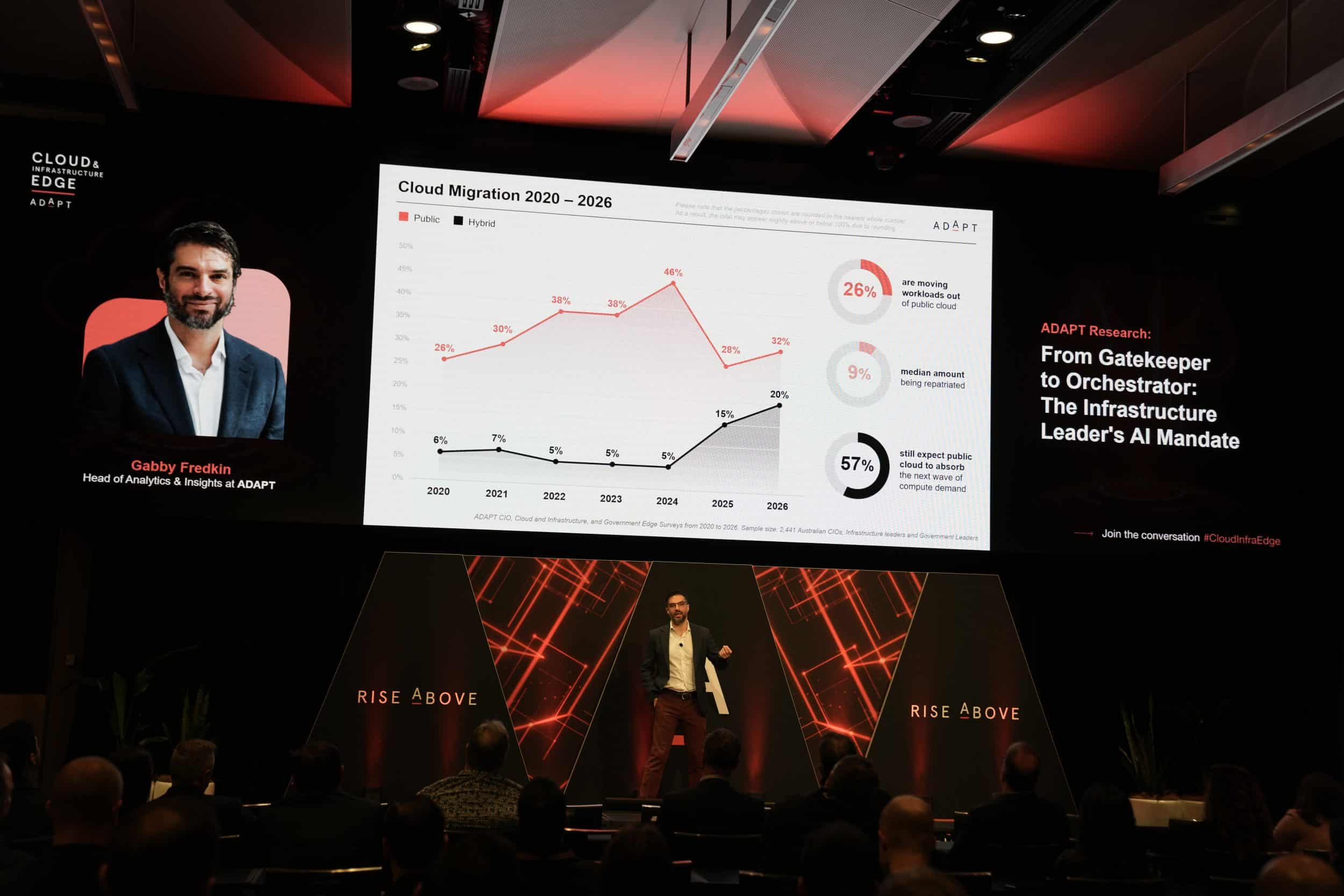
While 57% expect future AI demand to be supported through public cloud GPUs, 28% plan to repatriate workloads in 2026, up from 17% in 2024 and 10% in 2020.
Only 1% say their infrastructure is fully ready for AI, 29% have no defined strategy for future capacity, and a third expect compute spending to rise by more than 20% over the next two years.
Opening ADAPT’s 14th Cloud & Infrastructure Edge in Sydney, Head of Strategy Joey Meynink framed the challenge around three questions: can infrastructure keep pace, what is preventing AI from scaling, and who owns the compute bill?
Across discussions with more than 160 cloud, infrastructure and architecture leaders, one conclusion emerged: there is no single destination for every workload.
Leaders need an infrastructure portfolio that can adapt as economics, sovereignty requirements and AI architectures change.
Rebalance workloads before AI locks in the next cost base
Higher repatriation intent does not represent a wholesale retreat from cloud.
Repatriation intent has reached 28%, but the planned moves remain selective.
Leaders considering repatriation expect to relocate an average of 13% of their public cloud workloads, down from 21% in 2025.
Among workloads being considered for repatriation, databases and data warehousing rank highest at 18%, followed by big data and analytics at 17%, backup and disaster recovery at 16%, dev/test and end-user computing at 15%, and high-performance computing at 14%.
These choices point to selective rebalancing based on cost, predictability, sovereignty and performance rather than a reversal of cloud strategy.
This is reinforced by the 57% of leaders who still expect public cloud GPUs to support the next wave of AI demand.
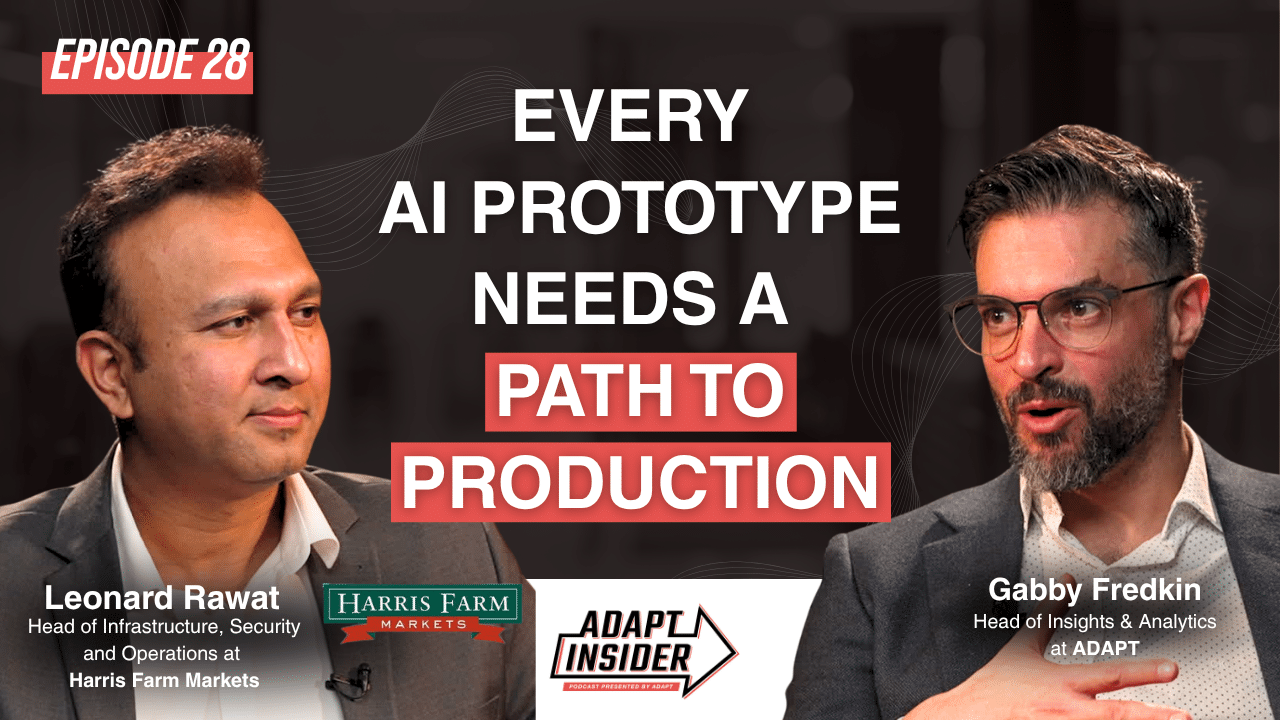
ADAPT Head of Analytics & Insights Gabby Fredkin explained that organisations are reassessing where established applications and data-intensive workloads should sit as their economics and control requirements change.
David Walker, former CTO at Westpac and DBS and an ADAPT Advisor, described how both banks assessed workloads against security, availability, performance and economics.
Approximately 70% were more economical on infrastructure the banks operated, while 30% benefited from cloud flexibility, particularly bursty workloads requiring specialised capacity for short periods.

The ratio is specific to those organisations, but the principle is broadly applicable: placement should be decided workload by workload rather than through a universal cloud-first or on-premises-first policy.
Lisa Yourmann, Acting First Assistant Secretary for Enterprise Systems at the Department of Defence, added that speed must be matched to the consequence of failure.
Cloud can accelerate research, prototyping and simulation, but systems affecting national security or operational decisions may need to move at the pace of assurance.
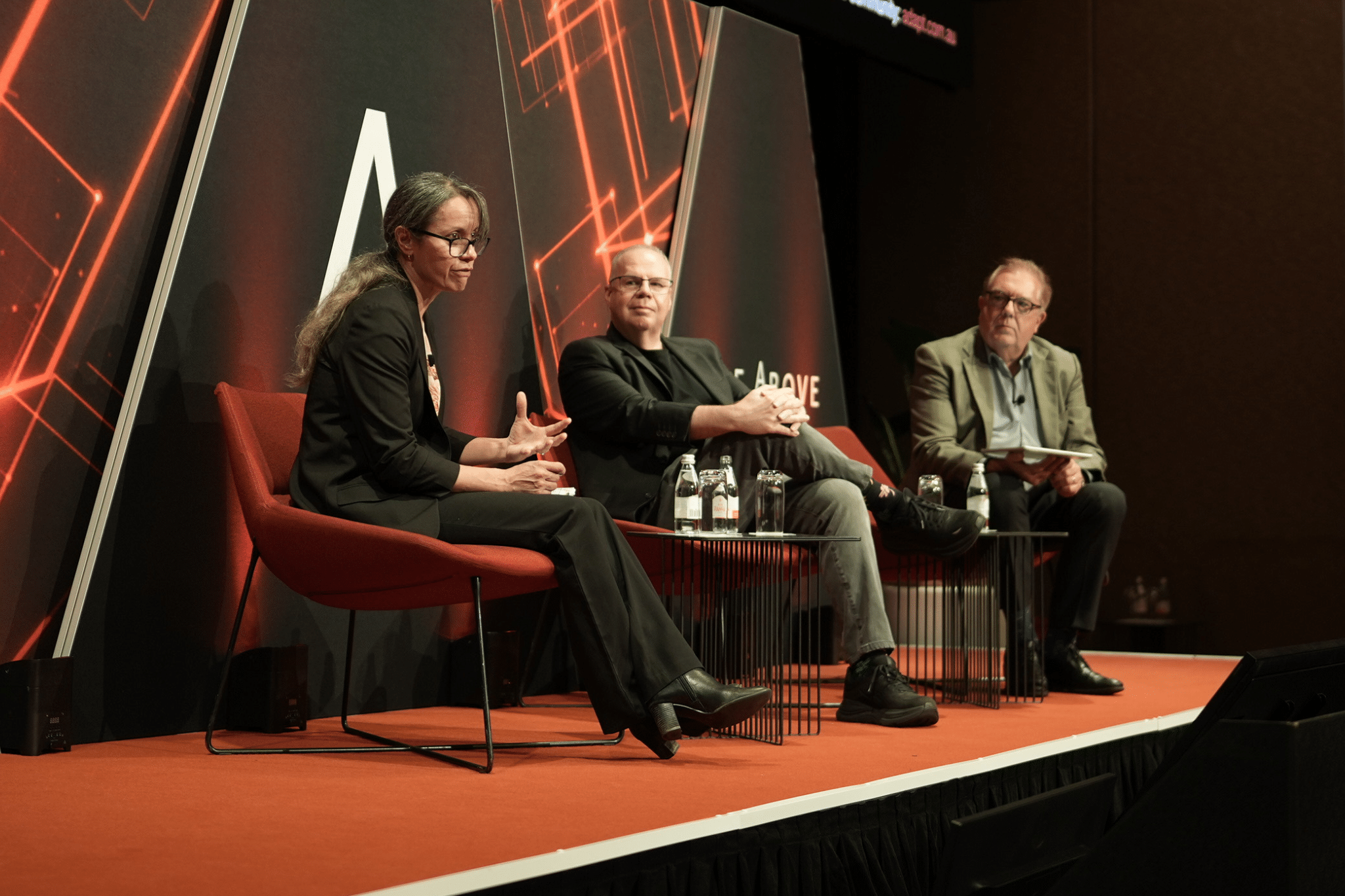
She also argued that architectures should be designed for reversibility, allowing workloads to move between public cloud, sovereign, private and edge environments as cost, risk and strategic requirements change.
Workload placement is therefore becoming an ongoing governance decision rather than a permanent destination.
Extend sovereignty across the AI lifecycle
Data residency captures only one part of sovereign control.
AI introduces additional assets that may become as sensitive as the information used to create them.
Lisa Yourmann explained that Defence must consider the sovereignty of model weights, training pipelines, audit trails and the recommendations or autonomous decisions AI systems produce.
A model trained on years of operational, logistics or intelligence data may contain strategic knowledge that cannot be protected solely by keeping the original dataset in Australia.
Sovereignty therefore depends on whether an organisation can govern, access, assure, operate, modify and replace an AI capability throughout its lifecycle.
It also includes control over how the model is retrained, what knowledge it absorbs and who determines its future behaviour.
Gabby similarly challenged blanket approaches to data sovereignty.
Organisations need to classify which information, models and workflows require local control rather than assume every dataset must receive the same treatment.
This requires greater visibility into AI already operating across the enterprise.
Half of the models in pilot or production are not covered by a formal governance framework, leaving leaders without a reliable view of what data they access, what actions they can take or how much they cost.
For commercial organisations, sovereignty also intersects with continuity.
A critical workflow built entirely on an external model remains exposed if commercial terms, government policy or access conditions change.
Belinda Dennett, CEO of Data Centres Australia, argued that locally hosted infrastructure gives Australia greater influence over how its laws, security requirements and values are reflected in the services being developed.

Greg Boorer, Founder and CEO of CDC Data Centres, went further, describing domestic compute as an economic and national security capability.
Access to an externally controlled model can be withdrawn far more quickly than a disrupted physical resource can be replaced.

Leaders need to decide which capabilities can be consumed as a service and which require enough domestic control to remain available, governable and replaceable under changing conditions.
Govern AI as a variable operating cost
AI is changing infrastructure expenditure from a largely provisioned cost into a continuously moving meter.
Joey Meynink challenged leaders to determine who should own that meter.
Does the cost sit with infrastructure, the CIO, the AI program or the business unit consuming the capability?
Without a clear answer, AI compute becomes a shared resource that many teams use but no executive fully manages.
The readiness gap is significant.
ADAPT research shows 77% of infrastructure leaders are under board-mandated optimisation targets, yet only 14% have mature FinOps practices with accurate allocation, forecasting and optimisation capability.
Gabby Fredkin explained why traditional reporting cycles are insufficient for AI.
One organisation exhausted its annual token budget within three months while using AI to transcribe meetings and distribute notes.
The immediate technical use case worked, but it automated an activity whose underlying value had not been challenged.
The organisation also discovered the overspend only when its scheduled reporting process surfaced it.
Token consumption requires more immediate visibility because the cost continues to accumulate with every interaction, retry and workflow.
Model costs are also only one component of the total.
David Walker cautioned that an agent may depend on CPUs, databases, storage, retrieval systems, orchestration platforms and other services.
Production costs can also include human verification, exception handling, compliance controls, escalation paths and failed decisions.
Infrastructure and finance teams therefore need to measure the total cost of a successful business outcome rather than the price of an individual token or model call.
This requires clearer decision rights.
The business owner should remain accountable for the outcome and its budget.
Infrastructure teams should provide placement, architecture and consumption guardrails.
Finance teams need near-real-time allocation and forecasting.
Risk and data leaders must be able to see which models are operating, what information they can access and what actions they can take.
That visibility remains incomplete.
Half of the AI models currently being piloted or deployed are not covered by a formal governance framework.
Cost, risk and observability are becoming part of the same infrastructure problem.
Without model inventories, routing controls, usage thresholds and accountable owners, leaders cannot determine whether AI is scaling value or simply scaling consumption.
Build for distributed inference rather than one AI future
Much of the current AI infrastructure market is being shaped by a small number of companies training frontier models.
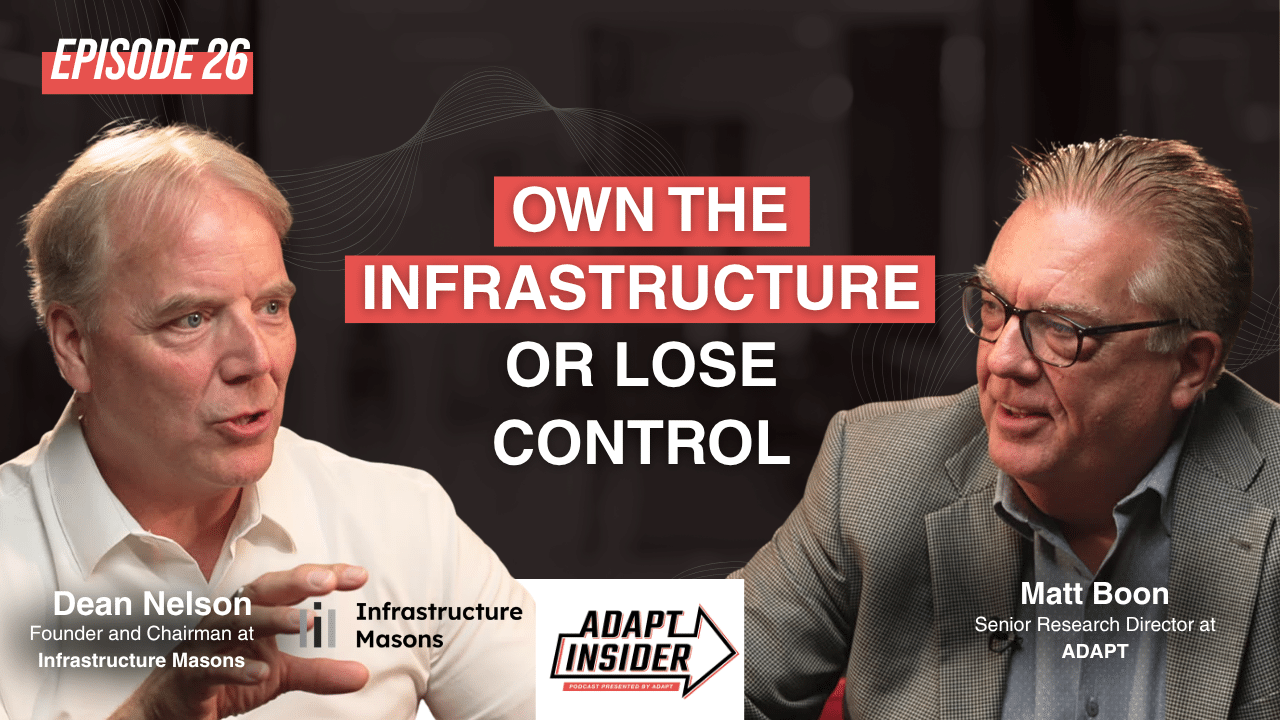
Dean Nelson, Founder and Chairman of Infrastructure Masons, estimated that around 90% of current AI infrastructure demand supports training, while only 10% supports inference.

He expects that balance to reverse as enterprises begin running specialised models, agents and AI-enabled services throughout their operations.
Inference is where organisations apply models to decisions, workflows and customer interactions.
It is also likely to be more distributed than the current training market.
Instead of relying exclusively on gigawatt-scale AI factories, organisations may deploy smaller clusters closer to their users, operational data and physical environments.
That transition could produce two distinct infrastructure markets: large AI factories for training and a more distributed network of smaller deployments located closer to users, data and operational environments.
Gabby Fredkin found that 64% of infrastructure leaders believe onshore inference will be critically important for large language models.
Organisations are also reconsidering locally hosted and smaller language models where frontier-scale capability is unnecessary.
In the Cloud & Infrastructure Edge panel, Dr Amr Hassan, Director of Emerging Technologies and Program Director of MAVERIC at Monash University, argued that Australia’s strongest opportunity may lie in models fine-tuned for specific datasets, industries and problems.

A specialised model can provide stronger control, greater energy efficiency and a clearer business outcome than a general-purpose model, provided the organisation has the capability to operate it.
Large models will continue to play an important role, but they should not become the default for every workload.
The challenge for infrastructure leaders is that the underlying technology is changing far faster than the assets supporting it.
Data centres, electrical systems and cooling infrastructure are long-lived investments.
Chip architectures, rack densities and model designs can shift within a few years.
Dean Nelson highlighted rapid changes in power density, liquid cooling and electrical architecture that could force facilities designed around today’s standards to reinvest much earlier than their original financial models assume.
David Walker raised the same problem at a national level.
Australia needs more AI compute, but current demand does not provide a reliable blueprint for the next 35 years.
Models may become smaller and more efficient.
More inference may move to the edge.
Organisations may favour use-case-specific models or direct access to hardware rather than hyperscaler services.
Building too narrowly around the current training wave could leave organisations with the wrong type of capacity.
Infrastructure plans should therefore use multiple demand scenarios and modular designs.
Planning should therefore test several scenarios for training, inference, edge deployment, power and hardware density.
The objective is to preserve enough modularity to adapt as demand becomes clearer, rather than commit every investment to the architecture currently attracting the most capital.
Connect national compute to productivity and energy outcomes
Domestic compute capacity will gain public and political support only when its value extends beyond construction activity and infrastructure ownership.
Andrew Sjoquist, Founder and CEO of WinDC, argued that data centres should be assessed through the productivity they enable across hospitals, banks, airlines, government services and other industries.
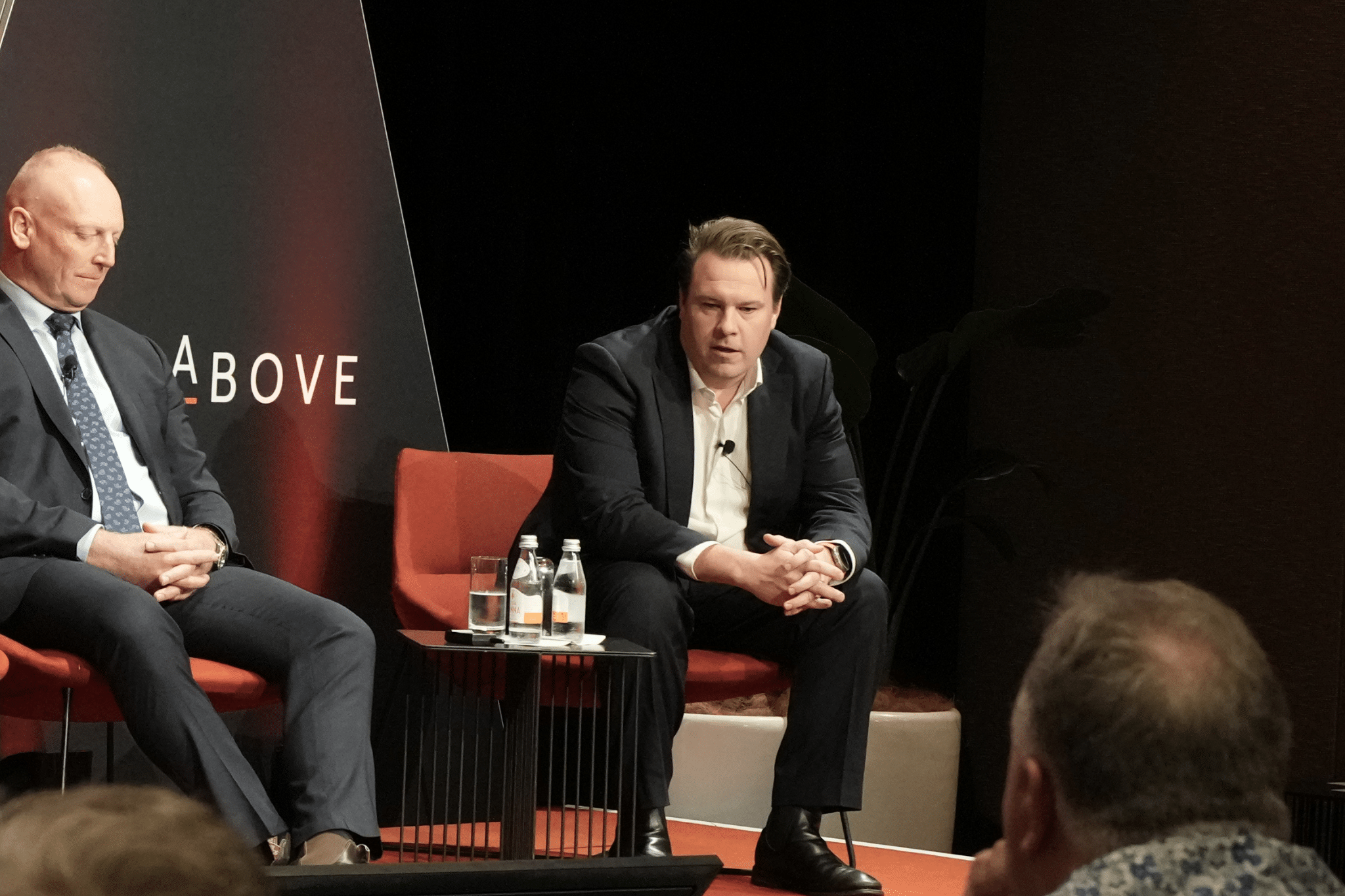
He also pointed to government as a potential anchor user.
Practical AI applications addressing public-sector productivity could demonstrate economic value while creating demand for domestic infrastructure.
Dr. Hassan similarly argued that data centres are a means to an end.
Australia can capture greater value by using compute to support research, medicine, industry-specific applications and local capability development.
Belinda Dennett identified an additional regional opportunity. Australia’s renewable-energy potential, political stability, rule of law and security relationships could support its role as a trusted AI and data infrastructure hub.
However, capital is mobile, and the opportunity depends on consistent policy, available energy and a credible plan for how domestic capability will develop alongside foreign investment.
Andrew Sjoquist warned that policy ambiguity acts as a tax on investment.
Long-lived energy and infrastructure projects require settings that remain stable enough for capital providers to assess risk and commit funding.
Greg Boorer argued that new data centre demand could help finance renewable generation, transmission and grid-scale storage when facilities are located near available energy and enter long-term power agreements.
Sjoquist added that demand response may also become part of the sector’s contribution, allowing some facilities to adjust consumption when supply is constrained.
This does not mean every data centre proposal should proceed.
Poorly located or inefficient projects can impose costs on communities, strain local systems and weaken trust in the wider industry.
Dr. Hassan called for minimum standards covering environmental performance, safety and community engagement, while preserving flexibility for different facility designs and operating environments.
Belinda Dennett supported outcome-based standards rather than prescribing a single cooling or energy solution.
She also stressed that established planning systems and local-government involvement should remain part of decisions about where infrastructure is built.
Meanwhile, Dean Nelson framed the wider challenge through five pressures:
- power
- people
- public pushback
- planetary constraints and
- policy

Addressing one while neglecting the others can delay projects or undermine the social licence required to operate them.
The sector will need to explain how facilities use energy and water, which services they enable, how host communities benefit and where development should be refused.
Social licence will require transparent evidence and local engagement rather than national ambition alone.
Recommended actions for cloud and infrastructure leaders
The next stage of AI infrastructure planning requires leaders to replace fixed platform strategies with repeatable placement, funding and governance decisions.
- Classify workloads and set placement triggers. Assess sovereignty, security, performance, scale and economics, then define when workloads should move between environments.
- Design for reversibility. Build portability into architecture and contracts before lock-in makes change costly.
- Extend FinOps across AI. Track tokens, models, agents, infrastructure and human oversight against business outcomes.
- Assign clear ownership and visibility. Give each AI workload an accountable owner, budget and risk profile, supported by a current model inventory.
- Modernise the foundations beneath AI. Improve data flows, automation and team accountability before adding AI to critical legacy systems.
- Plan for multiple infrastructure scenarios. Model different paths for inference growth, power demand, hardware density and edge deployment.
- Build sovereign capability, not only capacity. Pair domestic compute investment with the skills, energy resilience and community outcomes needed to sustain it.
AI is pushing infrastructure planning beyond fixed platform choices.
Workload placement will increasingly depend on how quickly organisations can reassess cost, control, performance and risk as models, architectures and market conditions change.
That puts greater weight on reversibility, clearer ownership of consumption and infrastructure designed to accommodate several possible futures rather than one settled forecast.
The next phase of cloud and infrastructure strategy will be shaped less by where workloads sit today than by how easily they can move, scale and remain governable as AI demand evolves.
 Justina Uy
Content Marketing Manager
Justina Uy
Content Marketing Manager
Justina Uy is a data-driven content marketer that thrives on democratising elite know-how to empower Australia’s underdogs.
Skilled at translating complex ideas into a compelling story across formats and channels, she shifts seamlessly between writing long-form articles, creating viral social media posts, and producing thumb-stopping videos.
Since 2015, Justina executes her vision through a sophisticated understanding of the rapidly evolving digital and business landscape to serve entertaining and educational insights to the executive community.
Less Join the ADAPT
 Insider Community
Get the latest A/NZ market research and insights on the core trends impacting leaders.