














Repatriation has reached 28% as workload placement gets more selective
Australian leaders are moving 13% of cloud workloads as cost, sovereignty and AI economics reshape placement.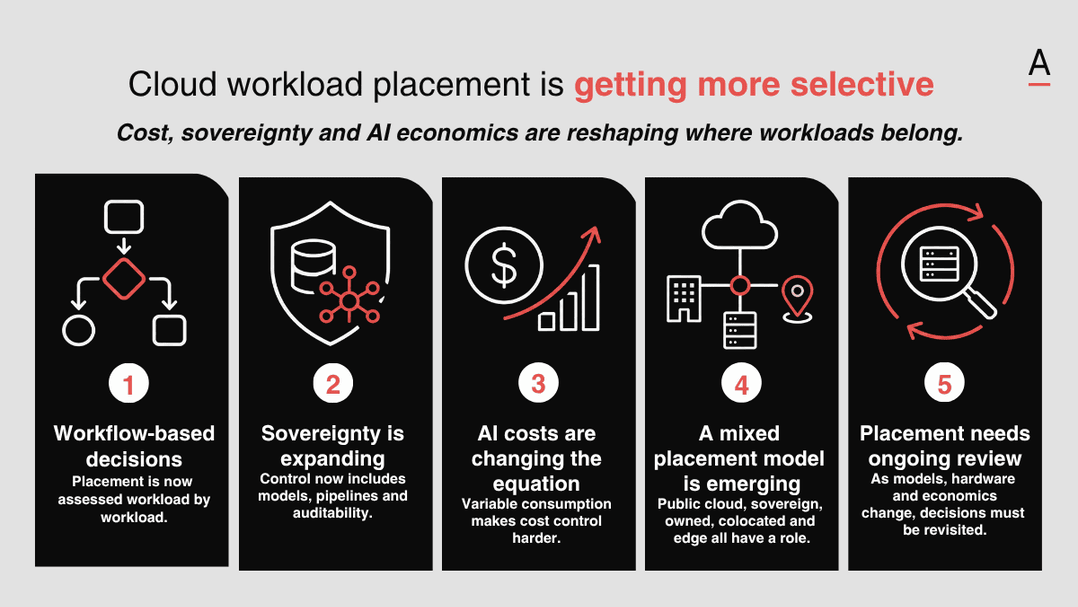


 Published Jul 31, 2026 in
Articles
Cloud & Infrastructure
Contributors
Justina Uy
Published Jul 31, 2026 in
Articles
Cloud & Infrastructure
Contributors
Justina Uy
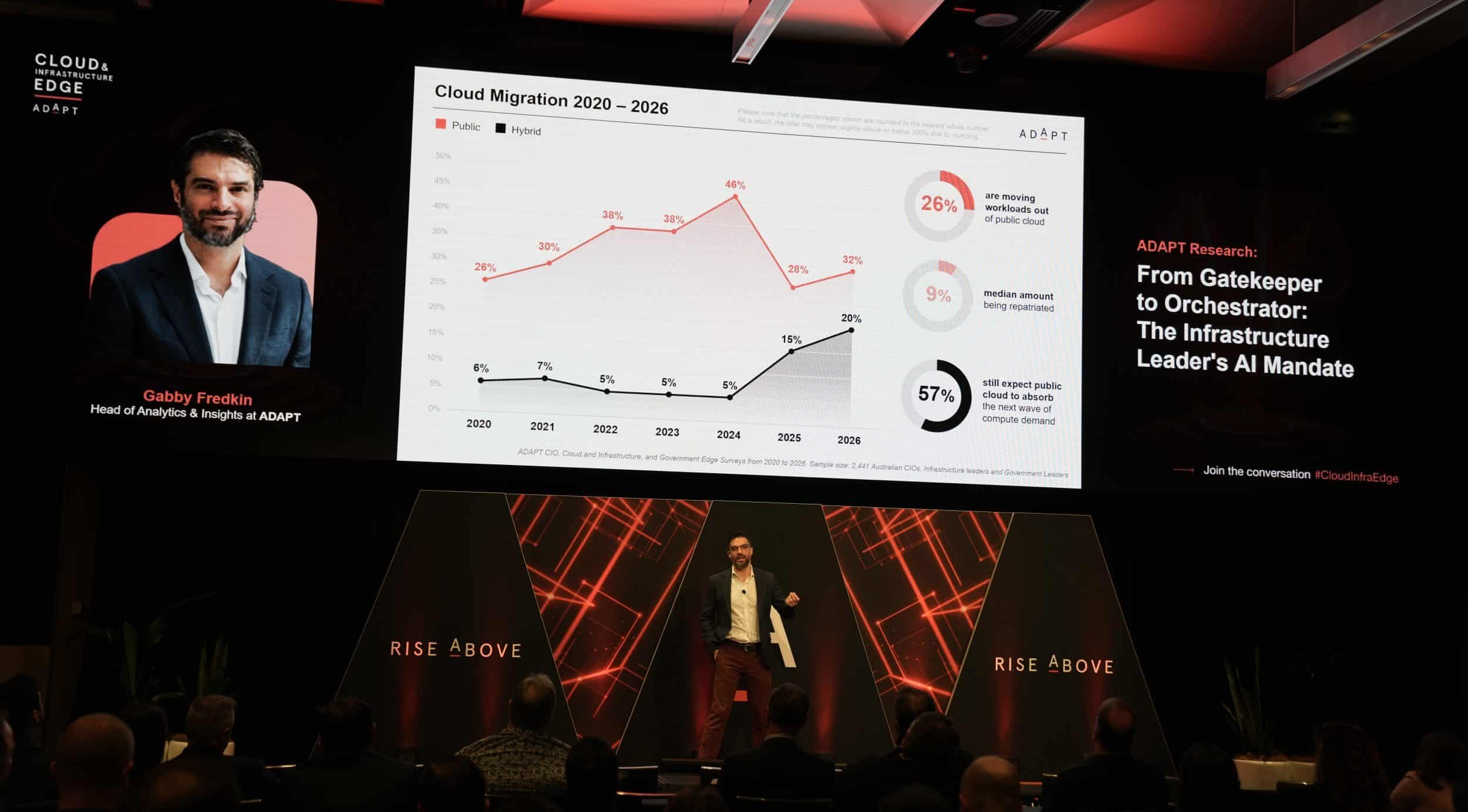
Cloud repatriation intent has reached 28%, but the scale and composition of the planned moves tell a more useful story.
At ADAPT’s Cloud & Infrastructure Edge 2026, research and executive discussions showed leaders considering relocating an average of 13% of their public cloud workloads, down from 21% in 2025.
Databases and data warehousing lead at 18%, followed by big data and analytics at 17%, backup and disaster recovery at 16%, and development and testing at 15%.
At the same time, 57% still expect public cloud GPUs to support the next wave of AI demand.
Cost, sovereignty, performance and risk are now being weighed at the workload level, with public cloud retained where elasticity and specialised capacity justify the trade-offs.
The workloads being reviewed are largely established, data-intensive or predictable.
Their operating requirements and long-term economics can be assessed with greater confidence than newer, more variable AI workloads.
Insights shared at Cloud & Infrastructure Edge point to three pressures driving that reassessment: workload economics, expanding sovereignty requirements and AI costs that many organisations cannot yet attribute or control.
In this article, we examine the forces behind selective repatriation and what they mean for infrastructure decisions:
- Workload economics replacing platform-wide placement policies
- Sovereignty extending from data to models and operational control
- Variable AI costs reshaping infrastructure choices
- Practical steps to improve placement, reversibility and cost ownership
Placement is now a workload decision, not a platform policy
Cloud-first mandates helped organisations move away from slow provisioning, ageing infrastructure and capital-intensive technology estates.
They also encouraged some organisations to treat public cloud as the preferred destination before fully examining whether each workload suited that environment.
Repatriation is prompting a more detailed assessment.
Workload economics depend on demand patterns, security requirements, availability, latency, data sensitivity, internal capability and the cost of operating the workload over time.
David Walker, former CTO at Westpac and DBS and an ADAPT Advisor, described how both banks assessed workloads through a hierarchy of security, availability, performance and economics.

Approximately 70% were more economical on infrastructure operated by the banks.
These were generally predictable workloads using relatively conventional architectures that could be run efficiently at scale.
The remaining 30% benefited from public cloud economics.
Bursty workloads were one example.
A bank running intensive credit models overnight could access specialised capacity for a limited period rather than owning infrastructure that remained idle for most of the day.
At DBS, the team also compared live pricing between cloud providers and directed compute to the more economical environment.
The 70–30 split is specific to large banks with substantial engineering capability, purchasing power and operating scale.
Its broader relevance lies in the method used to reach it.
Placement decisions were based on the characteristics and economics of each workload rather than a single infrastructure policy.
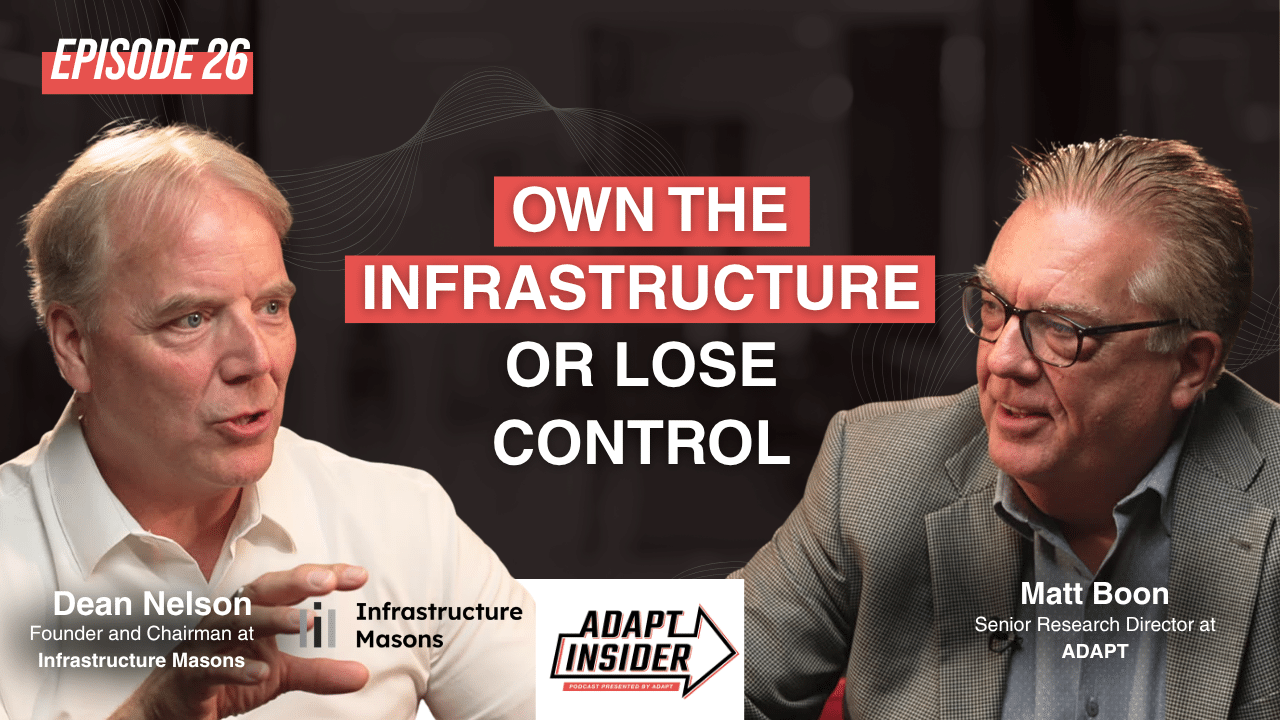
Dean Nelson, Founder and Chairman of Infrastructure Masons, explained why those assessments may need to happen more frequently as AI infrastructure evolves.

Much of the current AI infrastructure build is concentrated in gigawatt-scale facilities used to train large foundation models.
Enterprise inference is likely to create a more distributed pattern.
Dean described inference platforms deploying infrastructure in 10-megawatt blocks, using clustered systems under a common control plane.
These environments are far smaller than the largest AI factories and can sit closer to the users, data and operational systems consuming the models.
As inference becomes more distributed, proximity, predictable performance, data control and cost per token may carry more weight in placement decisions.
A workload that suits one environment today may be reassessed as models become smaller, hardware changes, inference becomes more efficient or alternative providers improve the economics.
Workload placement is becoming an ongoing management discipline, supported by clear criteria for when a workload should stay, move or be redesigned.
Sovereignty now includes the model, not only the data
Sovereignty used to focus mainly on where data was stored and who could access it.
AI has widened that concern to include the models trained on that data, the systems used to develop them and the control organisations retain once those models become part of critical operations.
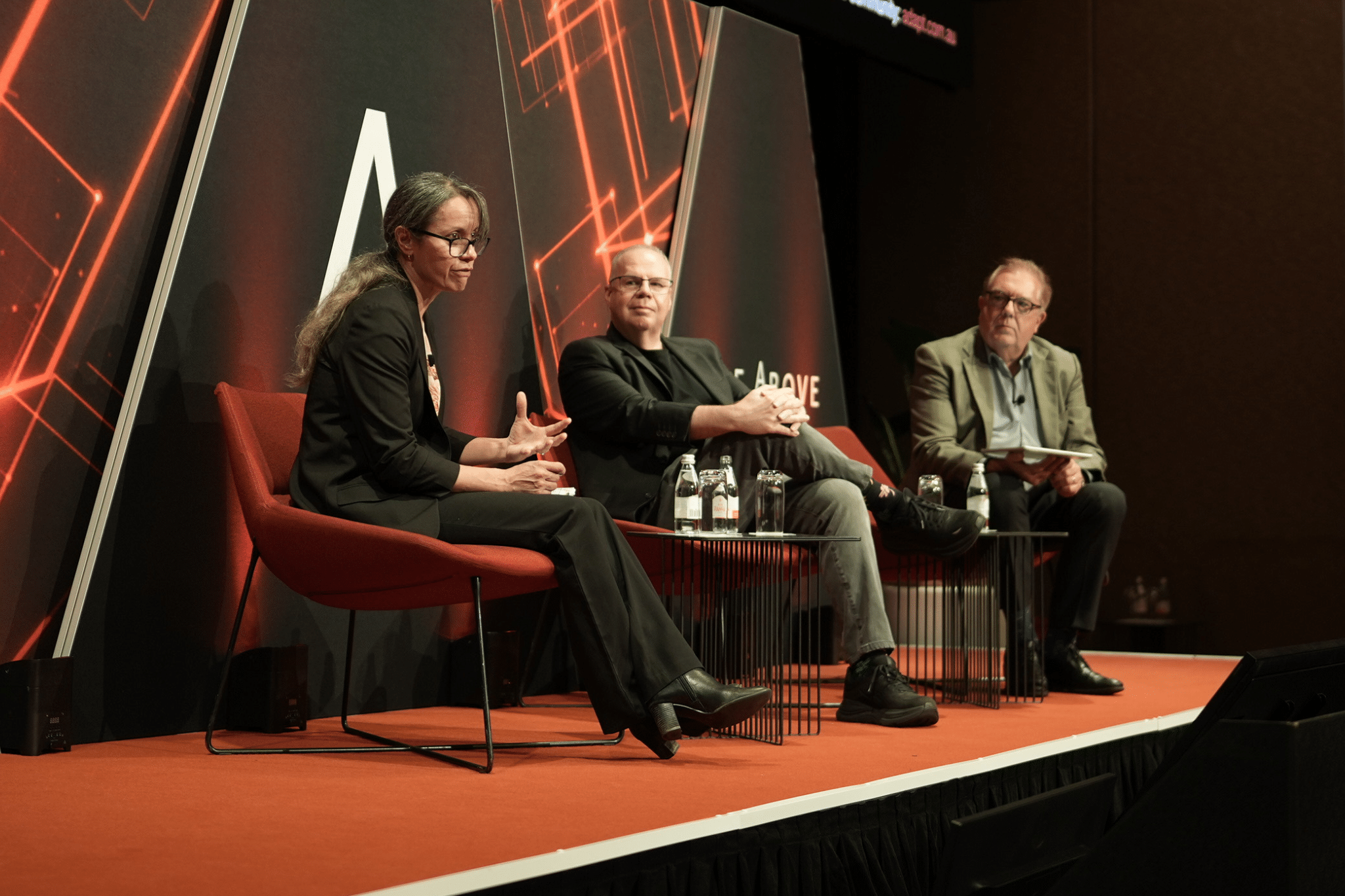
Lisa Yourmann, Acting First Assistant Secretary for Enterprise Systems at the Department of Defence, explained that organisations now need to consider the models trained on their data, along with the training pipelines, model weights, audit trails and decisions those systems produce.
A model trained on years of operational information may contain strategic knowledge that is as sensitive as, or more revealing than, the underlying dataset.
Sovereignty increasingly depends on whether an organisation can govern, access, operate, assure, sustain, modify and, where necessary, replace the AI capabilities on which it relies.
That control also extends to how a model evolves.
Models are retrained, fine-tuned and updated.
The organisation controlling what a model learns from can influence both its future behaviour and the direction of the capability.
Hosting infrastructure in Australia addresses only part of the dependency.
An organisation may still rely on an overseas provider for the model, hardware, software, encryption, maintenance or commercial permission to continue using the service.
Belinda Dennett, CEO of Data Centres Australia, extended the issue from organisational continuity to national influence.
Locally hosted infrastructure gives Australia more influence over how its laws, culture and values are reflected in the services and models used across the economy.
Global technology companies generally follow the requirements of the markets in which they operate.

However, a country with limited domestic capability has less influence over the infrastructure and models on which its organisations become dependent.
Greg Boorer, Founder and CEO of CDC Data Centres, made the continuity risk more immediate.
He compared dependence on overseas compute with dependence on energy passing through the Strait of Hormuz.

A disruption to physical fuel supply may still leave weeks of reserves in which governments and businesses can develop alternatives.
Access to a model can disappear much faster.
Greg recounted an AI model used in data centre operations becoming unavailable following an external decision.
The organisation had limited control over the interruption because the capability sat outside its own environment.
This is becoming an economic and operational continuity issue as models are embedded into logistics, healthcare, finance, public services and critical infrastructure.
The appropriate level of control will differ by workload.
Some models can be consumed as external services with acceptable risk.
Others may contain strategic knowledge, support essential workflows or require a level of assurance that makes greater domestic control necessary.
That assessment now needs to distinguish between data residency, infrastructure location, operational control and control across the model lifecycle.
Repatriation is also responding to variable AI costs
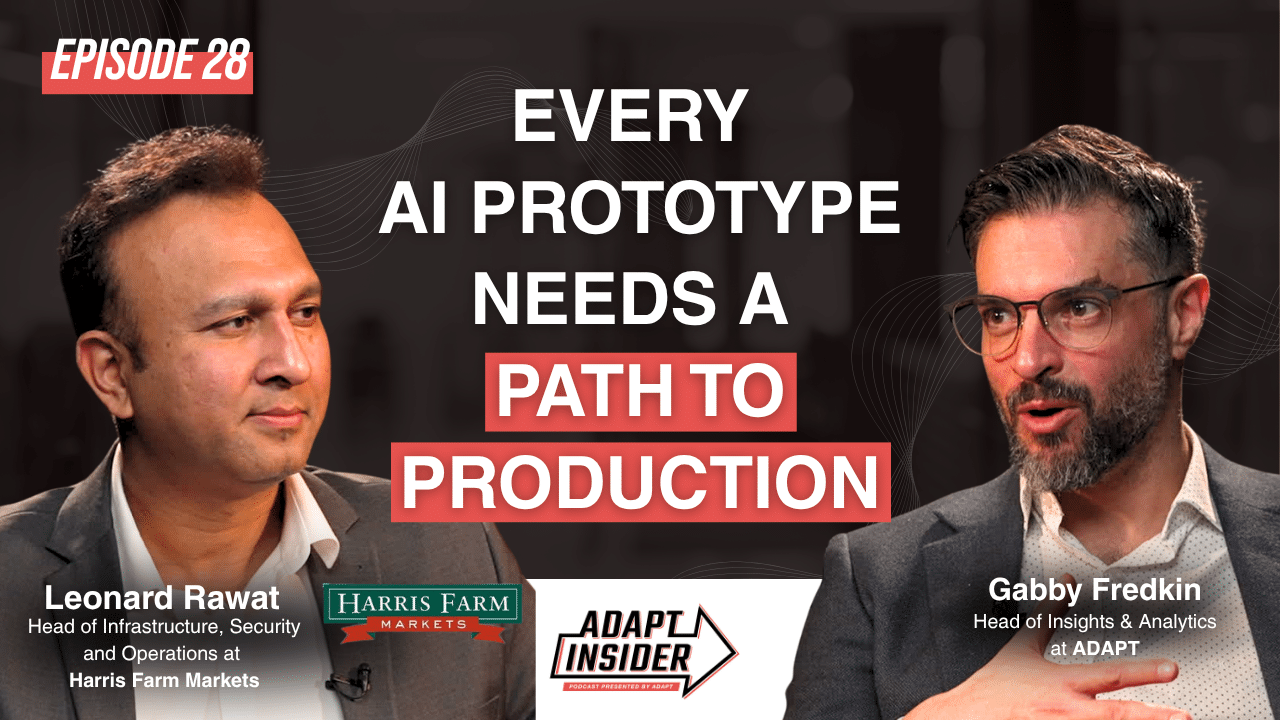
Gabby Fredkin, Head of Analytics & Insights at ADAPT, described token spend as “EBITDA with two Ts”.
Traditional infrastructure spending can still be difficult to manage, but most organisations understand the basic mechanics of licences, hardware, storage, network capacity and contracted cloud services.
AI introduces a meter that moves with usage.
Token consumption changes with the number of users, prompt length, model choice, workflow design, retries, agent behaviour, data retrieval and the number of steps required to complete a task.
The financial risk increases when business units can consume AI without clear accountability for the resulting cost.
ADAPT research shows that 77% of infrastructure leaders are operating under board-mandated optimisation targets.
Only 14% describe their FinOps capability as mature enough to provide strong visibility and active cost control.
Gabby shared the example of an organisation that consumed its entire annual token budget within three months.
Its use case involved recording meetings, transcribing them, producing notes and distributing them across the organisation.
Although the workflow operated as designed, the value of the activity had not been tested rigorously enough.
Significant spend was going towards notes that few people were likely to read, and the problem only surfaced three months later when the scheduled cost report was produced.
Repatriating stable, high-volume workloads may improve cost predictability.
It does not resolve unclear ownership or weak use-case discipline.
An inefficient AI workflow remains inefficient regardless of where the supporting infrastructure sits.
FinOps models also need to account for more than tokens.
David Walker noted that agents may consume graph databases, conventional CPUs, storage, APIs, monitoring, security controls and human review.
Model costs can represent only one part of the total expense involved in completing a task.
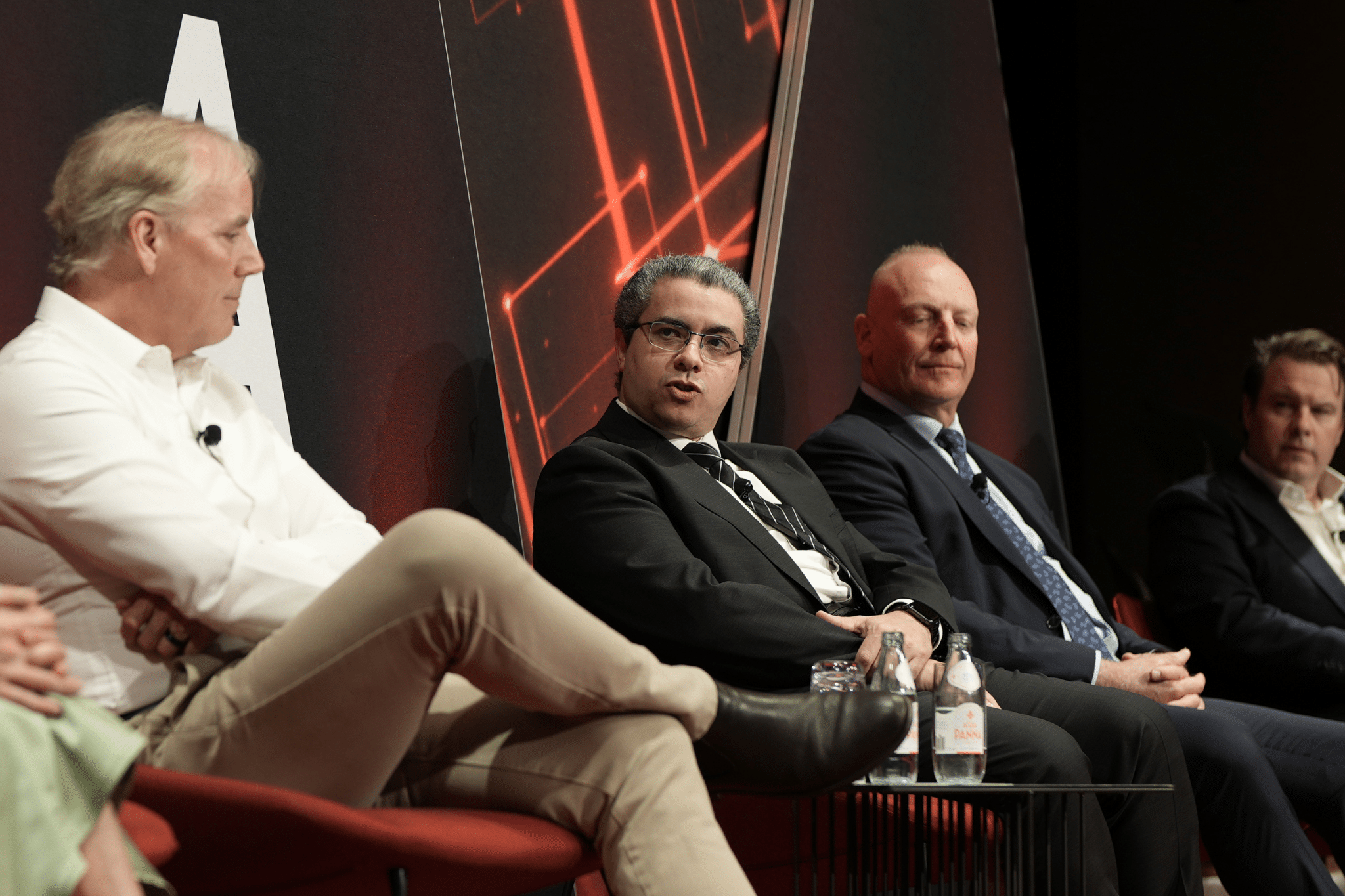
Dr Amr Hassan, Director of Emerging Technologies and Program Director of MAVERIC at Monash University, identified model selection as another cost lever.
Many enterprise problems may not require a general-purpose frontier model.
Fine-tuned or smaller industry-specific models can offer greater control and lower energy consumption when designed around a defined dataset, sector or operational task.
Infrastructure placement should therefore be assessed alongside model choice, workload design and the value of the outcome being produced.
The comparison may need to cover:
- Frontier, fine-tuned and small language models
- Public cloud, neocloud, sovereign cloud, colocated and owned infrastructure
- Centralised and edge inference
- Model-as-a-service and models controlled by the organisation
- Unit cost and the value of the resulting business outcome
Better economics are more likely when the model, workload and environment are assessed together, with clear ownership of both consumption and results.
Executive actions for cloud & infrastructure leaders
Workload placement, sovereignty and AI cost control now need to be managed as connected decisions.
Classify workloads before selecting environments
Maintain a current inventory covering demand patterns, data sensitivity, latency, availability, architecture, model dependencies and business criticality. Historical placement and existing contracts should not determine where a workload remains.
Define placement and movement triggers
Set the conditions that would prompt a workload to stay, move or be redesigned. These may include usage volume, cost per outcome, latency, regulatory change, concentration risk, model availability or sovereignty requirements.
Design for reversibility
Limit dependencies that could make a future move commercially prohibitive. Portability across data, models, interfaces and infrastructure preserves options as pricing, technology and business requirements change.
Extend sovereignty classification beyond data
Identify the models, training pipelines, weights, audit trails and specialised knowledge that require greater organisational or domestic control. Infrastructure location should be assessed separately from control across the full model lifecycle.
Make AI consumption attributable
Track token, inference, storage, data movement, agent tooling, monitoring and review costs close to real time. Attribute spend to the workflow, business unit and outcome creating the demand.
Compare model options before adding compute
Test whether the workload requires a frontier model. Fine-tuned, smaller or use-case-specific models may provide sufficient capability with lower infrastructure and energy requirements.
Measure cost per outcome
Assess the cost per claim, decision, interaction, workflow run or completed task. Include retries, human checking, escalation and the consequences of incorrect outputs.
Predictable, data-intensive and control-sensitive workloads are moving out of public cloud, while bursty demand, specialised compute and much of the next wave of AI remain there.
That is creating a mixed placement model across public cloud, sovereign infrastructure, owned environments, colocation and edge.
The harder task is keeping those decisions current as costs, model requirements and sovereignty pressures change.
 Justina Uy
Content Marketing Manager
Justina Uy
Content Marketing Manager
Justina Uy is a data-driven content marketer that thrives on democratising elite know-how to empower Australia’s underdogs.
Skilled at translating complex ideas into a compelling story across formats and channels, she shifts seamlessly between writing long-form articles, creating viral social media posts, and producing thumb-stopping videos.
Since 2015, Justina executes her vision through a sophisticated understanding of the rapidly evolving digital and business landscape to serve entertaining and educational insights to the executive community.
Less Join the ADAPT
 Insider Community
Get the latest A/NZ market research and insights on the core trends impacting leaders.