














Legacy applications still account for 27% of mission-critical workloads, limiting AI scale
In his Cloud & Infrastructure Edge keynote, Gabby Fredkin reveals the data reshaping AI, cloud and infrastructure strategy across A/NZ.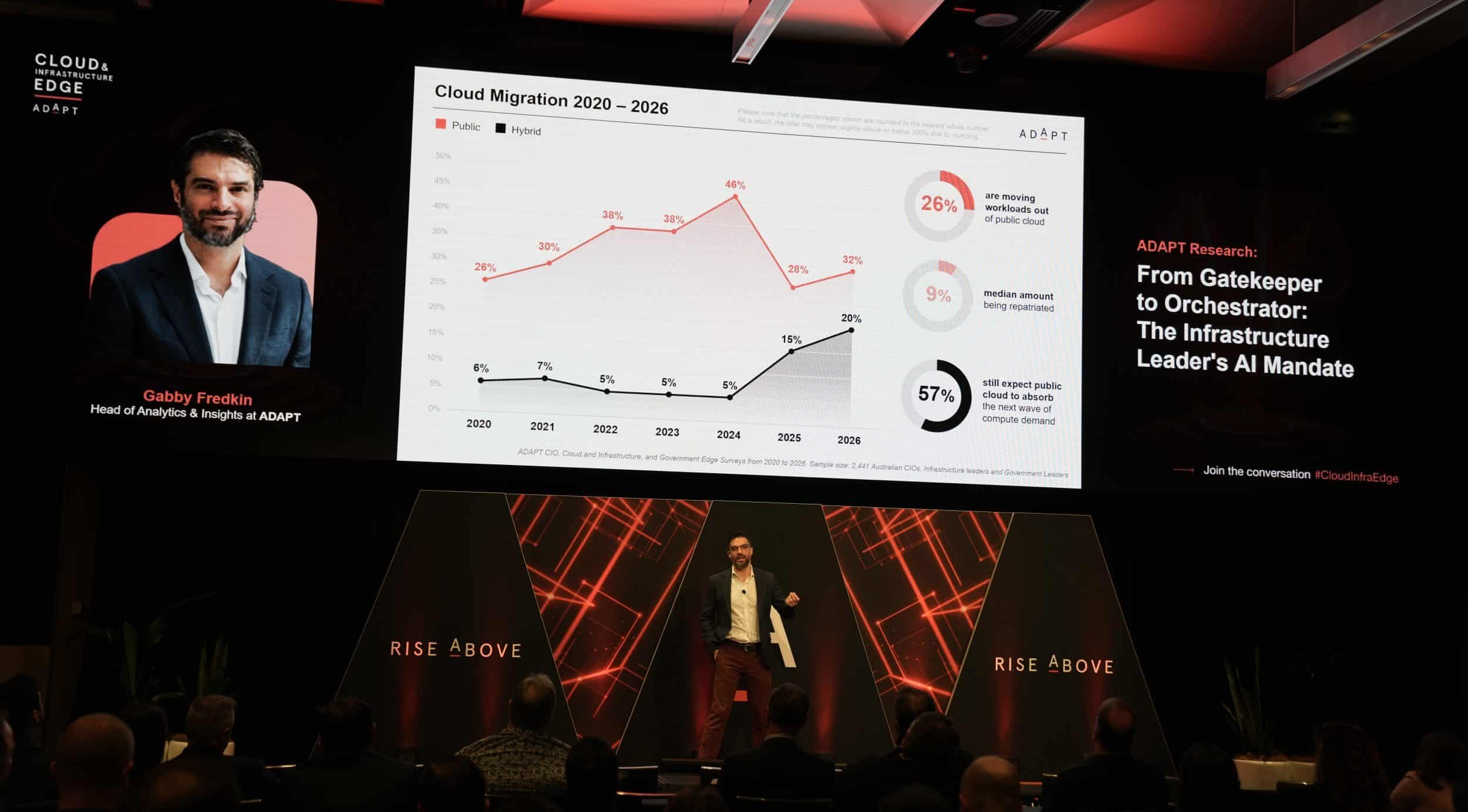


 Published Jul 27, 2026 in
Expert Presentations
Cloud & Infrastructure
Contributors
Gabby Fredkin
Published Jul 27, 2026 in
Expert Presentations
Cloud & Infrastructure
Contributors
Gabby Fredkin
As AI adoption accelerates, infrastructure leaders are being asked to balance cloud economics, sovereignty, governance and operational resilience at the same time.
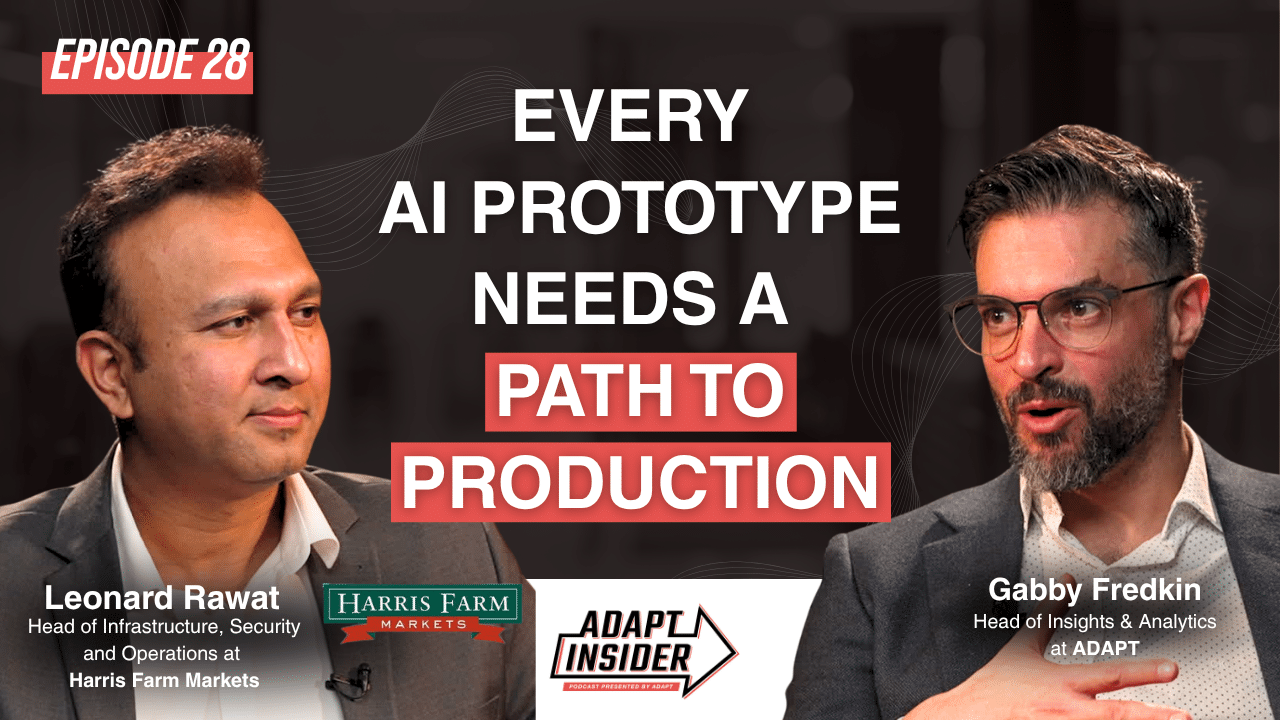
At Cloud & Infrastructure Edge, ADAPT’s Head of Analytics & Insights, Gabby Fredkin, shared the latest research into how Australia’s leading organisations are responding, revealing the trends shaping the next generation of enterprise infrastructure.
Key takeaways:
- Match AI workloads to the environment that best balances performance, sovereignty, security and cost.
- Extend FinOps beyond cloud spend to measure tokens, inference, agents and business outcomes.
- Build governance into infrastructure operations through model visibility, access controls and clear accountability.
- Strengthen data foundations before scaling AI into business-critical workflows.
- Design infrastructure strategies around long-term operational outcomes, not short-term AI experimentation.
AI is reshaping cloud strategy, not replacing it
AI is changing where workloads belong, but not in the way many expected.
ADAPT’s latest research shows 57% of infrastructure leaders expect AI growth to be absorbed by public cloud, while 26% are repatriating workloads.
Rather than signalling a reversal of cloud adoption, the findings point to a more deliberate approach to workload placement, with organisations balancing performance, sovereignty, security and economics.
Gabby kin argued that infrastructure strategy is moving beyond a cloud versus on-premises debate.
Instead, leaders are evaluating each AI workload on its own requirements, recognising that different models and applications will perform best in different environments.
AI economics require a new operating model
Infrastructure leaders are under growing pressure to control AI costs while continuing to scale adoption.
According to ADAPT’s research, 77% of organisations are operating under board-level AI cost optimisation mandates, yet only 14% have mature FinOps capabilities.
Traditional cloud cost management is proving insufficient as organisations contend with token consumption, inference costs and autonomous agents.
Gabby explained that organisations need better visibility into AI consumption and stronger links between infrastructure investment and business outcomes.
Measuring cloud spend alone is no longer enough.
Leaders must understand the full cost of operating AI in production, including governance, oversight and ongoing operational support.
Governance has become an infrastructure responsibility
As AI becomes embedded across enterprise operations, governance is increasingly becoming an infrastructure capability rather than a standalone policy exercise.
ADAPT’s research found that half of AI models in pilot or production remain outside formal governance frameworks, creating risks around visibility, accountability and data access.
Gabby said organisations need governance that enables innovation rather than restricts it.
That means knowing which models are running, what information they can access and who is responsible for their outputs, while giving teams the confidence to experiment safely within clear operational guardrails.
 Gabby Fredkin
Head of Analytics & Insights at ADAPT
Gabby Fredkin
Head of Analytics & Insights at ADAPT
As the Head of Analytics and Insights at ADAPT, Gabby Fredkin’s primary role is managing analysis to produce ADAPT’s actionable insights to identify trends supporting organisations in Australia.
With a passion for creating stories with data, Gabby is consistently rated as one of the top speakers at ADAPT’s events. In roundtable discussions, he specialises in using statistics to initiate thought-provoking discussions, enabling ADAPT’s customers to become more data-driven.
Using modern data science techniques, he provides ADAPT and its customers with confidence in the accuracy and validity of the information used for ADAPT’s research, advisory and events.
Working across artificial intelligence, machine learning, AI ethics, DevSecOps, end-user behaviour, and human-centred design, Gabby’s vast experience continues to grow, supported in part by a Master of Business Analytics from Deakin University.
Less Join the ADAPT
 Insider Community
Get the latest A/NZ market research and insights on the core trends impacting leaders.
Join the ADAPT Insider Community
Get the latest A/NZ market research and insights on the core trends impacting leaders.