














The fastest organisations are learning to remove before they add, says work futurist Dom Price
In this interview, Work Futurist Dom Price explains why organisations that rethink how people work, not just technology, are the ones turning transformation into results.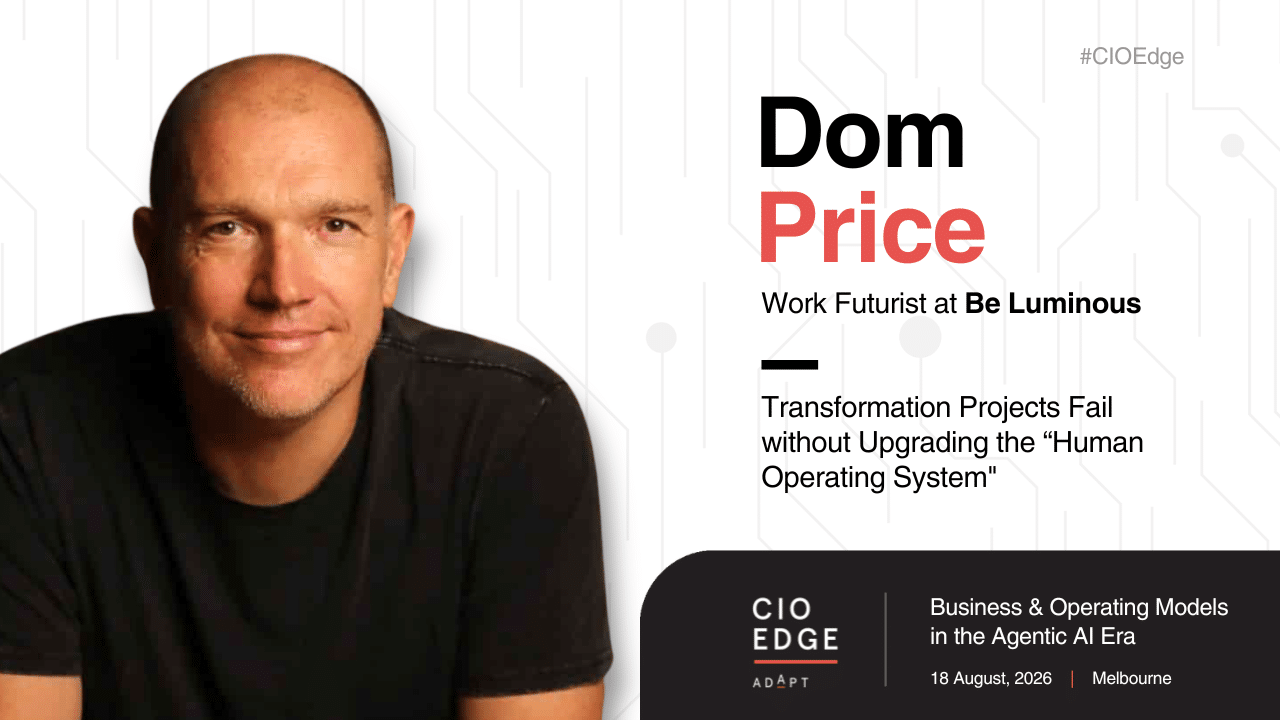


 Published Jul 20, 2026 in
Strategic Business Initiatives
Contributors
Dom Price
Gabby Fredkin
Published Jul 20, 2026 in
Strategic Business Initiatives
Contributors
Dom Price
Gabby Fredkin
As organisations accelerate AI adoption, many are discovering that technology is only one part of transformation.
Ahead of CIO Edge Melbourne this August, Work Futurist at Be Luminous Dom Price spoke with ADAPT Head of Analytics & Insights Gabby Fredkin about why organisations often automate outdated ways of working, how leadership is evolving as expertise becomes more distributed, and why simplifying operating models can create more room for transformation.
Key takeaways:
- Organisations achieve better outcomes when they redesign work before introducing AI into existing processes.
- Leadership is becoming more collaborative as expertise extends beyond traditional organisational hierarchies.
- Faster learning cycles help organisations respond more effectively to changing business conditions.
- Removing outdated processes and rituals can create as much value as introducing new technology.
Redesign work before introducing technology
Dom believes many organisations are approaching AI from the wrong starting point.
Rather than asking where AI can be applied, leading organisations begin by identifying the business problem they are trying to solve and questioning whether the existing process remains fit for purpose.
He sees many organisations accelerating legacy ways of working instead of redesigning them, allowing inefficient processes to happen faster rather than improving the outcome itself.
Some organisations are already shifting that mindset. Rather than running AI hackathons, they’re bringing employees and customers together to solve business problems first, with technology becoming one possible part of the solution.
Leadership is becoming more connected
Dom also sees leadership evolving as expertise becomes more widely distributed across organisations.
Experience remains valuable, but leaders increasingly need to bring together people with different perspectives rather than relying solely on traditional reporting structures or tenure.
That includes creating opportunities for cross-functional collaboration, encouraging knowledge to move across teams and generations, and seeking expertise wherever it exists inside the organisation.
The organisations adapting most effectively are creating environments where diverse experience contributes to better decisions.
Learning cycles are becoming shorter
According to Dom, many organisations continue to approach transformation as a project with a defined beginning and end.
He believes organisations are better served by building regular learning cycles into how they operate.
Several leadership teams he works with review major initiatives every week, giving themselves frequent opportunities to adjust priorities, respond to new information and refine their approach.
As access to information becomes easier, the speed at which organisations learn and respond is becoming an increasingly important capability.
Simplifying organisations creates room for change
One of Dom’s recurring observations is that organisations often focus on adding new initiatives while spending far less time removing practices that have outlived their usefulness.
He compares many enterprises to ships collecting barnacles over time. Individual processes, governance structures and rituals may have once been valuable, but together they gradually make organisations slower and more complex.
Rather than treating every existing practice as permanent, leaders can benefit from regularly reviewing which ways of working still contribute to the organisation’s goals and which have simply become habit.
Creating space for new ideas may depend just as much on what organisations choose to retire as what they introduce.
Hear from Dom Price and Dayle Stevens OAM at CIO Edge in Melbourne as they explore the behaviours and operating practices that help transformation gain traction.
More than 180 CIOs and IT leaders will examine how agentic AI is reshaping business models, operating models and the CIO’s role.
 Dom Price
Work Futurist and Visionary at Be Luminous
Dom Price
Work Futurist and Visionary at Be Luminous
Dom Price is a Work Futurist, team obsessive, and Partner at Be Luminous and someone who has lived the chaos of scaling a business from the inside out. Joining Atlassian as employee #600, Dom stayed for 12 years as their resident Work Futurist, helping grow the company to over 16,000 people globally. That’s not theory – that’s scar tissue.
Dom operates at the intersection of tech and humans, and his mission is simple: upgrade the human operating system of how we work. Because as he’ll tell you, “a fool with a tool is still a fool… you’ve just made them faster.” In a world drunk on AI and the next shiny solution, Dom is the pragmatic voice asking whether your people are actually set up to use it well – driving change that’s sustainable, not just spectacular.
As a keynote speaker, Dom doesn’t trade in polished frameworks or borrowed wisdom. He shares real, lived experience the messy, hard-won kind which is exactly why he’s in demand. Less thought leader, more battle-tested practitioner.
Co-creator of the Atlassian Team Playbook, TED speaker, and advisor to C-suite leaders globally. Dom believes that work and life should be about thriving, not just surviving. A keen traveller and veteran of 53+ countries, he calls Australia home. Manchester made him. The rest? Still very much in progress.
 Gabby Fredkin
Head of Analytics & Insights at ADAPT
Gabby Fredkin
Head of Analytics & Insights at ADAPT
As the Head of Analytics and Insights at ADAPT, Gabby Fredkin’s primary role is managing analysis to produce ADAPT’s actionable insights to identify trends supporting organisations in Australia.
With a passion for creating stories with data, Gabby is consistently rated as one of the top speakers at ADAPT’s events. In roundtable discussions, he specialises in using statistics to initiate thought-provoking discussions, enabling ADAPT’s customers to become more data-driven.
Using modern data science techniques, he provides ADAPT and its customers with confidence in the accuracy and validity of the information used for ADAPT’s research, advisory and events.
Working across artificial intelligence, machine learning, AI ethics, DevSecOps, end-user behaviour, and human-centred design, Gabby’s vast experience continues to grow, supported in part by a Master of Business Analytics from Deakin University.
Less Join the ADAPT
 Insider Community
Get the latest A/NZ market research and insights on the core trends impacting leaders.
Join the ADAPT Insider Community
Get the latest A/NZ market research and insights on the core trends impacting leaders.