














How organisational design shapes AI scale and value
At CIO Edge in Melbourne, former Westpac and DBS CTO David Walker shows why organisational agility matters more than technology alone.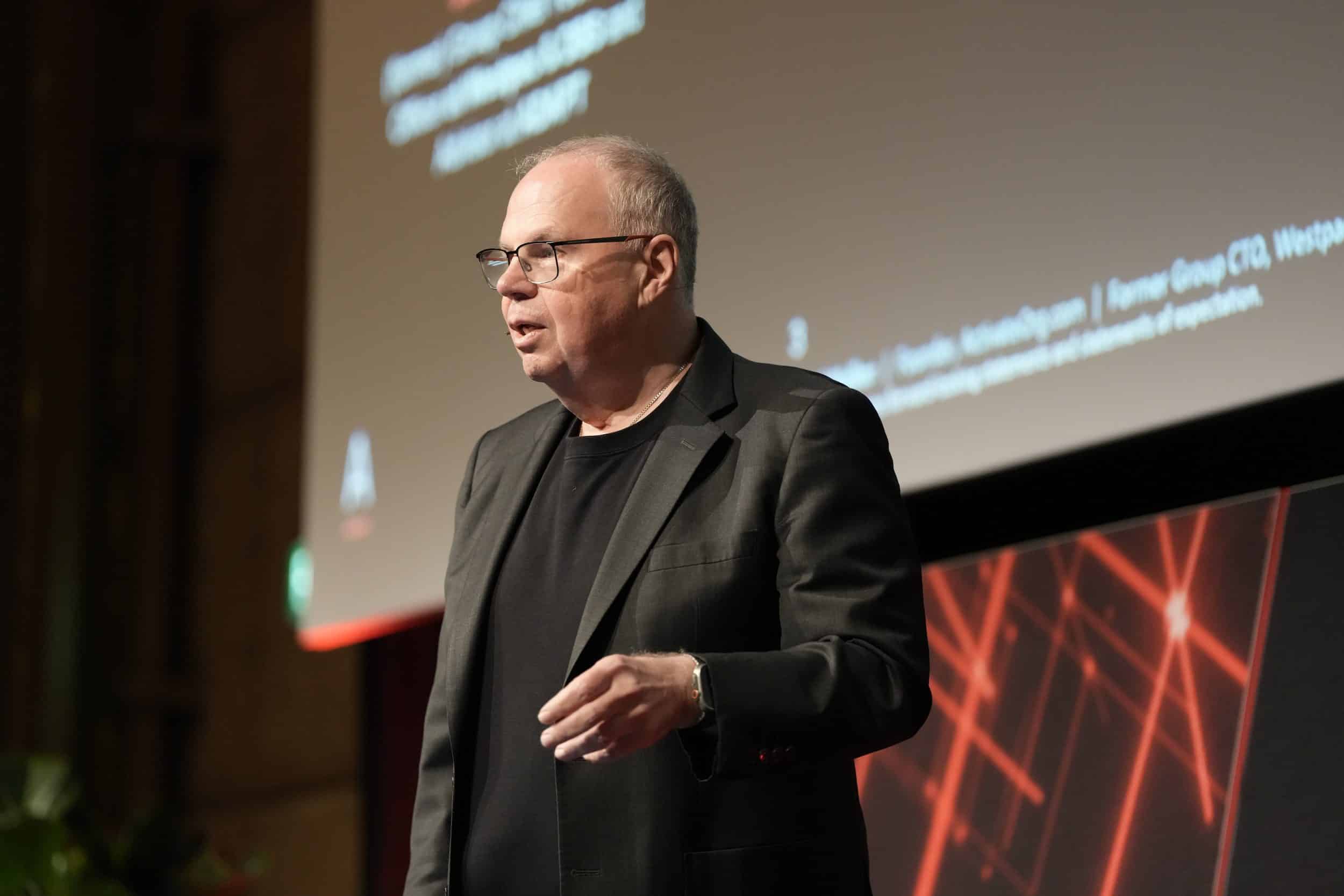


 Published Aug 25, 2026 in
Expert Presentations
Strategic Business Initiatives
Contributors
David Walker
Published Aug 25, 2026 in
Expert Presentations
Strategic Business Initiatives
Contributors
David Walker
Most barriers to scaling AI sit inside the organisation rather than the technology stack.
At CIO Edge, David Walker, former Group Chief Technology Officer at Westpac and DBS and ADAPT Advisor, argues that leadership, culture, operating models, finance, and workforce readiness determine whether organisations can turn experimentation into enterprise value.
Key takeaways
- Direct more attention to organisational barriers: Leadership, culture, finance processes, operating models, and workforce change account for far more scaling friction than the technology itself.
- Design for change rather than certainty: Flexible architecture, abstraction layers, and adaptable operating structures allow organisations to change models and infrastructure without wholesale rework.
- Treat nimbleness as an enterprise capability: Organisations that can change direction, absorb disruption, and reinvent quickly are better positioned to capture value from successive technology shifts.
Organisational barriers are holding back AI scale
Technology accounts for only a fraction of the barriers organisations face when moving from experimentation to enterprise deployment.
David analysed 14 major research studies across 105 countries, identifying 367 barriers to scaling AI.
Around 70% were organisational, 20% related to technology and data, and 10% directly to AI technology.
The imbalance matters because investment can concentrate on the smallest category of constraint.
Models and platforms may improve while leadership alignment, culture, workforce engagement, finance processes, and ways of working remain unchanged.
David also points to a deeper mismatch.
Probabilistic technology is being introduced into organisations designed around deterministic systems and processes, creating new demands on governance, decision-making, and tolerance for uncertainty.
Only around 1% of organisations, in the research David cites, have reached a level where they can scale meaningfully.
Closing that gap requires as much attention to how the organisation operates as to the capability being deployed.
Flexible architecture gives organisations room to change direction
Rapid changes in models, infrastructure, and economics make rigid technology decisions harder to sustain.
Trying to predict which model or platform will dominate can lock organisations into assumptions that age quickly.
David recommends using appropriate abstraction layers so components can change as the market and technology evolve.
That flexibility also applies to model selection. Workloads may increasingly use models tuned for specific tasks rather than relying exclusively on large general-purpose models.
The goal is to identify where future change is most likely and avoid hard-wiring those decisions into the architecture.
Models, infrastructure, and supporting components should be replaceable without forcing widespread redesign.
The same principle applies to operating structures. Organisations need enough flexibility to adjust roles, processes, and investment as new capabilities emerge.
Nimbleness turns disruption into an operating advantage
The ability to change quickly shapes how much value organisations can capture from major technology shifts.
David’s work identifies eight characteristics of organisational nimbleness and shows that more nimble organisations respond faster to disruption and achieve materially stronger outcomes.
In the model he presented, the difference equated to at least a threefold return.
DBS provides an example of that progression.
The bank moved from a digital laggard to a recognised digital leader and later generated significant measured value from AI.
That performance came through an organisation capable of sustained reinvention rather than a single technology implementation.
Leaders need to understand how quickly their organisation can change today, identify where friction slows adaptation, and strengthen the systems and behaviours that allow teams to respond.
The organisations best positioned for the next technology shift will be those already built to change when it arrives.
 David Walker
(former) Group Chief Technology officer at Westpac & DBS and Chair of the AI Council at UNSW
David Walker
(former) Group Chief Technology officer at Westpac & DBS and Chair of the AI Council at UNSW
David Walker was appointed Westpac Group’s Chief Technology Officer in August 2019. He led Westpac through its technology transformation – simplifying and merging the bank, building 4th gen cloud-native applications, establishing and operating evergreen platforms, leading Westpac’s AI technology, and building a culture of passionate and forward-thinking tech and emerging talent.
David began his technology career in 1987 as a software engineer, focusing on coding complex systems. After a decade of evolving his software engineering craft, David founded a data science consulting. Over the following decade, it became the number one expert data insights company in Australia and Southeast Asia.
For the last 15 years, David has held executive roles in large, complex organisations across the APAC region. Prior to joining Westpac, David was part of the leadership team of Singaporean bank, DBS. In his ten years there, David helped transform DBS from a traditional bricks and mortar bank with little brand presence or recognition outside Singapore, to being recognised as the ‘Best Bank in the World’ and the ‘Best Digital Bank in the World’ by leading global financial publication Euromoney.
Less Join the ADAPT
 Insider Community
Get the latest A/NZ market research and insights on the core trends impacting leaders.
Join the ADAPT Insider Community
Get the latest A/NZ market research and insights on the core trends impacting leaders.