














Agentic AI is forcing leaders to rebuild the business from the inside out
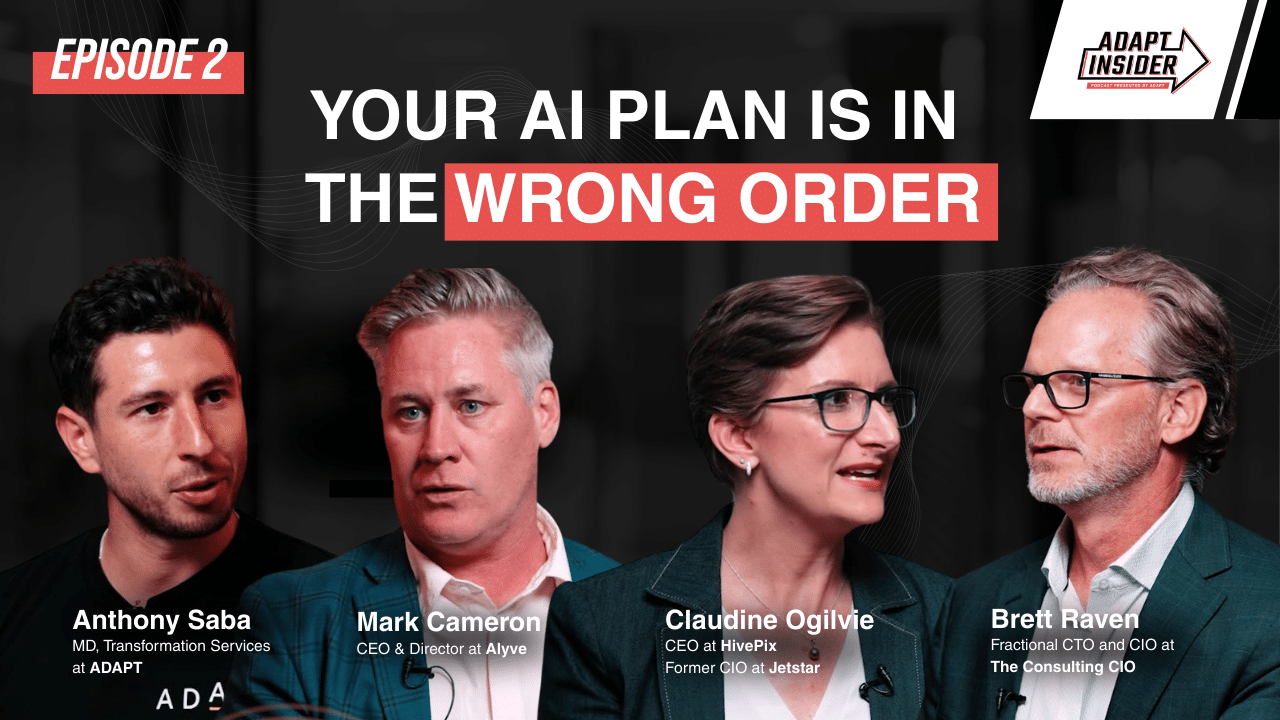
In this ADAPT Insider podcast episode, Claudine Ogilvie, Mark Cameron, and Brett Raven examine why AI adoption is pushing organisations to redefine risk appetite, ownership, and operating discipline before it can scale.


 Published Mar 10, 2026 in
Peer Insights
Digital Transformation
Contributors
Brett Raven
Claudine Ogilvie
Mark Cameron
Anthony Saba
Published Mar 10, 2026 in
Peer Insights
Digital Transformation
Contributors
Brett Raven
Claudine Ogilvie
Mark Cameron
Anthony Saba
Key takeaways:
- Boards are moving from broad AI guardrails to clearer risk appetite. Leaders are being forced to define where experimentation is encouraged, where tighter controls apply, and how much downside the organisation is willing to tolerate.
- The strongest AI programs start with a business problem. Fear of missing out is still driving poor sequencing, with many organisations choosing tools first and searching for value later.
- Agentic AI is turning governance into an operating model issue. As AI takes action across workflows, leaders need clearer ownership, stronger controls, and explicit accountability for outcomes.
Boards need clearer risk appetite as AI moves deeper into the business
AI is becoming a board level issue because it is starting to shape business value, operating models, and enterprise risk.
Broad guardrails were a useful starting point, but they are no longer enough.
Claudine argues that boards are now moving towards clearer policy and more explicit risk appetite.
That matters because leaders need to define where experimentation is encouraged, where tighter control is needed, and how much downside the organisation is prepared to tolerate.
As AI becomes more embedded in the business, governance has to become more specific and more actionable.
The fastest way to waste AI investment is to start with the tool
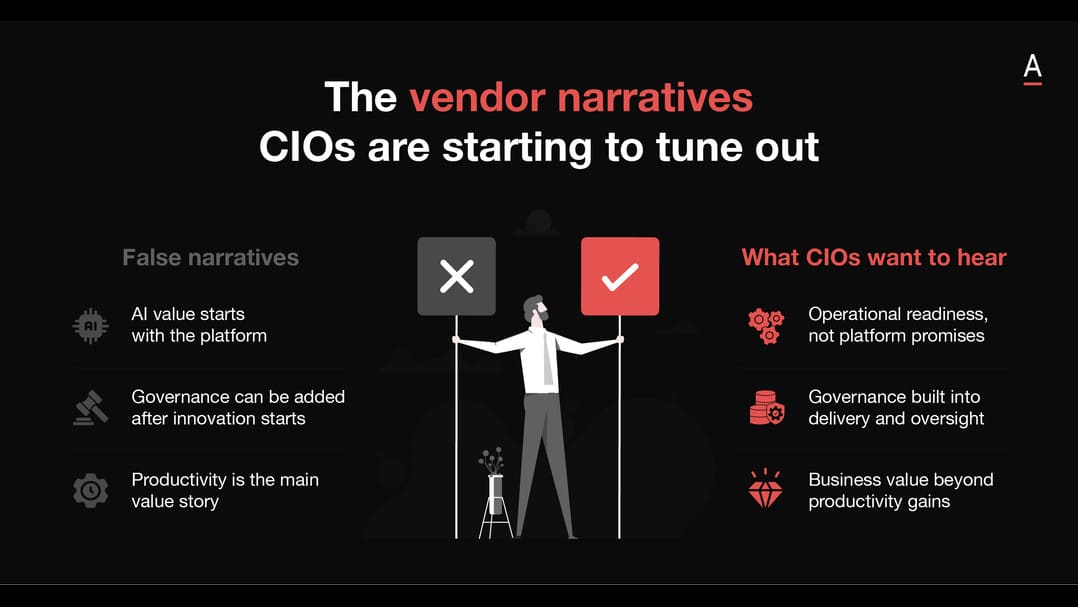
Many organisations are still approaching AI backwards, choosing the platform first and searching for the use case later.
Brett warns that this approach is usually driven by fear of missing out rather than clear strategy.
His argument is simple, start with the business problem, define the value to be created, then assess whether AI is the right fit.
That discipline is what separates scattered experimentation from meaningful adoption.
Agentic AI is turning governance into an operating model issue
Once AI starts acting across workflows, governance becomes much more than a policy discussion. It becomes a question of ownership, access, supervision, and performance.
Mark says leaders need to focus less on chasing every technical update and more on how AI is changing the structure of work itself.
In practice, that means defining the role an agent is performing, the boundaries around its actions, and who remains accountable for its outcomes.
As agentic AI spreads, organisations will need stronger controls and much clearer operating discipline.
The organisations that move fastest will be the ones with the strongest discipline
As AI moves from experimentation into execution, the organisations that pull ahead will be the ones that treat governance, ownership, and operating discipline as core parts of adoption, rather than problems to solve later.
 Brett Raven
Fractional CTO and CIO at The Consulting CIO
Brett Raven
Fractional CTO and CIO at The Consulting CIO
Brett helps enterprises navigate AI and digital transformation with clarity and purpose. With 30+ years in technology, from CIO and CTO roles to executive advisory at Salesforce and Accenture, Brett brings deep experience translating emerging technologies into tangible business value. Brett’s focus today is on building pragmatic, AI-ready roadmaps that span systems, teams, and operations.
Less Claudine Ogilvie
CEO at HivePix, ADAPT Advisor, and former CIO at Jetstar
Claudine Ogilvie
CEO at HivePix, ADAPT Advisor, and former CIO at Jetstar
Entrepreneur, CEO and board director with 20 years’ experience in strategy, technology leadership, and innovation. Claudine is the Managing Director of O&O Consulting, co-founder and CEO of HivePix, and a Non-Executive board Director for Cuscal and Scyne Advisory. Claudine was awarded Top CIO50 in Australia in 2016. She has expertise in data, artificial intelligence, quantum computing, cyber security governance and risk management.
Previously, Claudine was a Non-Executive board Director for Youi Insurance. Claudine led the Digital and Data businesses and innovation for Compass Group Asia Pacific, and was the Group Chief Information Officer (CIO) for the Jetstar Group of Airlines (Jetstar’s Branded Airlines include Singapore, Japan, Vietnam, ANZ businesses & JVs), and Ridley Corporation; She led Consumer and Industrial Markets (CIM) at KPMG; and broad industry experience in sales, marketing, and product management.
She is a 2015 graduate of the Australian Institute of Company Directors (GAICD). She has completed a Quantum Computing course at Massachusetts Institute of Technology (MIT), has a Bachelor of Business from the University of Technology Sydney, Australia (B.Bus) and a Diploma of Business Management from the Ecole Supérieur de Commerce Reims, France (Dip.Mgnt).
Claudine is also an advisor and coach to innovative and bold leaders from a variety of industries. She is a champion for diversity, inclusion, ESG and the role it plays in business and leadership effectiveness.
Less Mark Cameron
CEO at Alyve
Mark Cameron
CEO at Alyve
I am the CEO of Alyve, a specialist digital transformation consultancy.
I have written over 500 digital strategy-focused articles in columns for BRW, CMO.com.au and Marketing Magazine. I also write for Social Media Today, Social Media Monthly and Smart Data Collective.
Less Anthony Saba
Partner & Research and Advisory Executive Director
Anthony Saba
Partner & Research and Advisory Executive Director
Anthony leads the growth and development of ADAPT’s Research and Advisory Practice, engaging directly with ADAPT’s community of C-Level Executives and equipping them with the relevant research, tools and advice to effectively lead and transform their organisations.
ADAPT’s Research & Advisory is pillared around equipping C-Level Executives with the insights & tools to:
– Empower the Workforce
– Improve Operational Efficiency
– Execute Data Driven Strategies
– Modernise Legacy Environments
– Embed Trust & Security
– Enhance Customer Experience
– Transform as a Business Leader
– Align the CEO & Board
– Engage Stakeholders Effectively
– Drive Technology Thought Leadership
– Enable Innovation & Transformation
– Optimise Budgets & Ensure ROI
Additionally, Anthony manages ADAPT’s 13-person Delegate Advisory Team responsible for the execution and delivery of all delegate acquisition and advisory programs for ADAPT across Asia Pacific.
Anthony also works within ADAPT’s Strategic Partner team consulting to leading service providers on customer acquisition and GTM strategies.
Externally to ADAPT, Anthony is the Public Officer and Board Member for Conviction Group; a newly established not-for-profit organisation aimed at encouraging young Australian’s to re-evaluate their perspectives on pivotal issues concerning their mental health and provide them with the tools to enhance their decision-making.
Less
Join the ADAPT
Insider Community
Get the latest A/NZ market research and insights on the core trends impacting leaders.
Join the ADAPT
Insider Community
Get the latest A/NZ market research and insights on the core trends impacting leaders.