














University of Wollongong’s AI advisory chair on why AI strategy still starts with the problem
In this interview, Syed Ahmed, Chair of the Digital, Technology and AI Advisory Committee at UOW, explains why AI starts with clarity.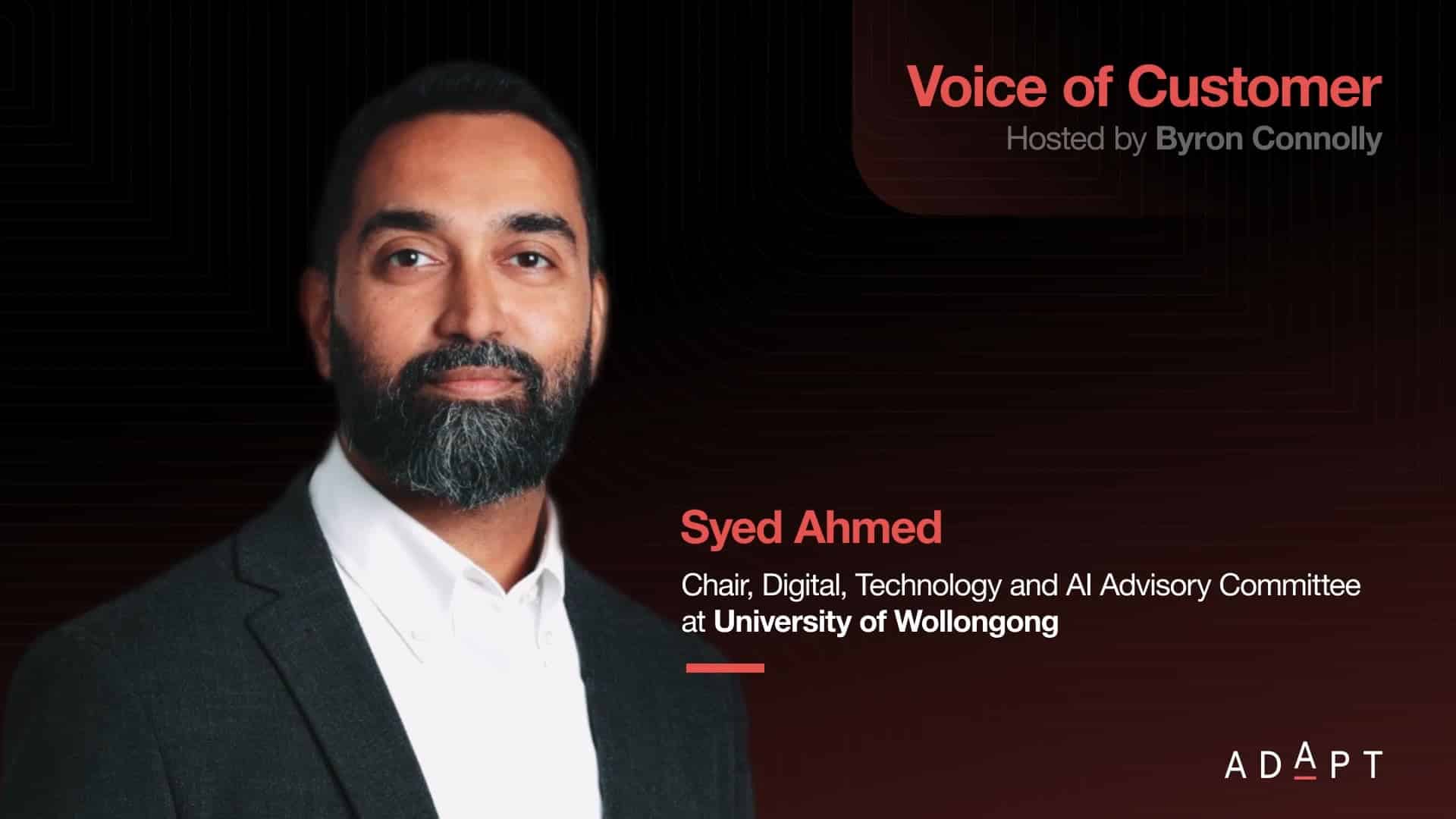


 Published Mar 17, 2026 in
Peer Insights
Digital Transformation
Contributors
Syed Amed
Published Mar 17, 2026 in
Peer Insights
Digital Transformation
Contributors
Syed Amed
In this interview with ADAPT’s Head of Programs & Value Engagement Byron Connolly, Syed Ahmed, Chair of the Digital, Technology and AI Advisory Committee at UOW, explains why AI success depends on problem clarity, data readiness and literacy.
In 2001, enterprise tech veteran, Syed Ahmed completed his honours thesis, Programming artificially intelligent autonomous agents with assumptions.
His paper explored enhanced belief systems, agent reasoning and multi-agent cooperation, optimised for what he says were “painfully expensive” compute resources at the time.
Twenty-five years later, Ahmed, the former chief executive of mental health software company Innowell, says one thing hasn’t changed: organisations are still wrestling with the ‘why’ behind deploying AI tools.
“We’re honestly still struggling with the ‘why’ of this thing. We have a solution as we did 25 years ago. It’s a slightly better solution, but we still don’t really understand the problem.
He likens it to the hype around 3D printers.
“Should everyone have [one]? Possibly. Do they solve great commercial problems? They do. But should everyone have one? I am not sure. It’s the same thinking.
“Just because the tech exists and it’s better, I think you really want to think about what the problem is; that philosophy hasn’t really changed. So, we are commercialising something that we don’t really have a problem for”.
Another constant, he says, is that AI remains a computer science problem that’s predicated on good or not so good statistics.
What has changed is the scale: from hand-coded parameters to set-based approaches, to today’s billions or trillions of parameters now being trained.
Accessibility has also significantly improved. For years, the only way to access AI was through programming, until OpenAI added a chat interface to its large language model (LLM) suddenly, making it widely accessible.
“Compute was [also] really expensive and I’d argue that it [still is]. Chips and data centres are not cheap, [but] now they’re funded with billions of dollars. So, that really hasn’t changed except the capital now exists for it.”
The agentic expectation gap
Ahmed agrees there’s now a gap between how agentic AI solutions (which make independent decisions and take action), are marketed and what Australian enterprises are experiencing on the ground, where poor data quality, governance issues and skills shortages hinder deployments.
Their ability to act is an important distinction between AI agents and other solutions, he says.
“An intelligent system has a sensor that takes input, a processing centre and an actuator; it can act, physically or digitally. If we agree on that definition of agents, then the things [that are holding organisations back] are organisational issues.”
“Yes, data is messy or incomplete; in itself, that’s not necessarily a problem. But being able to classify [data] properly and training your LLM on it, all those things kick into place. That’s the operational element of it.”
Agentic solutions are also underpinned by generative AI, which is considered to be 80% accurate. This means that organisations need to decide whose “neck to choke” [tongue in cheek] when things go wrong 20% of the time.
“That’s unresolved. What happens when something goes wrong? Is it catastrophic? If so, what will you do about it? Who takes on that risk? These questions are still open and we’re trying to solve them.”.
Cultural barriers, however, present the bigger challenge. The hype around agentic AI has created fear that jobs will be displaced.
“That’s not true and I certainly don’t subscribe to that view. Change management is hard…you get passive resistance, and all the usual issues with [during] regular projects are exacerbated in AI projects.”
Tertiary education’s ‘semi-crisis’
Ahmed, the newly appointed Chair of the Digital, Technology and AI Advisory Committee at the University of Wollongong, says tertiary education is in a ‘semi-crisis’.
“The nature of knowledge is morphing; the nature of work has changed substantially. [We] went from a big corporate industrial machine to the gig economy. How people engage with the workforce has changed and so has access to information. Together, these shifts have fundamentally changed the nature of life.
“Universities are at this intersection of education and research; it’s symbiotic and virtuous cycle. You’ve got to do great research, you progress knowledge, you teach it and elevate people in their ability to think critically. Then you can segment that into a particular domain.”
Ahmed role as committee chair is to “look at all of these things in combination” – not just AI, data or the massive amount of money it takes to build core infrastructure and teaching technologies at a university.
“[It’s about] how we bring all that together and put that in the context of learning pedagogy and considering how researchers feel about it.
“How do individuals use AI? The reality is most people don’t know how to use Microsoft Word properly, and it’s been around for 30 years.”
For AI, the challenge will be raising literacy across students, educators, researchers and professional staff.
“[We need to ask], ‘what’s the core level of literacy for individual roles? How do you improve that across groups? How do students, teachers and researchers use it, and what are the linkages?
“If you bring that together, you can say ‘ok, now we know what the problem is. Do we have a good solution? What overlaps with existing technologies? How do we bring it together and create solutions?
“That’s the grand ambition here.”
 Syed Amed
Chair, Digital, Technology and AI Advisory Committee, University of Wollongong
Syed Amed
Chair, Digital, Technology and AI Advisory Committee, University of Wollongong
Syed Ahmed is a technology transformation executive and board director with 25+ years leading large-scale, mission-critical digital systems across government, health, financial services, and education. His career has been shaped by working at the intersection of three things: the technology itself, the digital products and experiences that connect organizations to millions of users, and the people and culture required to build and sustain them.
Syed has led teams from 8 to 180+ across startups, enterprises, and government – building environments where people do their best work and organisations continue to grow long after he moved on.
Syed has spent his career leading transformations that combine technical complexity with human impact. He has raised capital, negotiated multi-jurisdictional government contracts, engaged Federal Cabinet on technology policy, scaled enterprise teams to 180+, and led life-critical systems where technology saves lives.
Less Join the ADAPT
 Insider Community
Get the latest A/NZ market research and insights on the core trends impacting leaders.
Join the ADAPT Insider Community
Get the latest A/NZ market research and insights on the core trends impacting leaders.