















Assessment is becoming the real AI challenge for universities, says the University of Sydney’s Interim CIO
In this ADAPT Insider episode, Kerry Holling explains how universities are responding to student led AI adoption by building practical guardrails, rethinking assessment, and protecting trust across learning and research.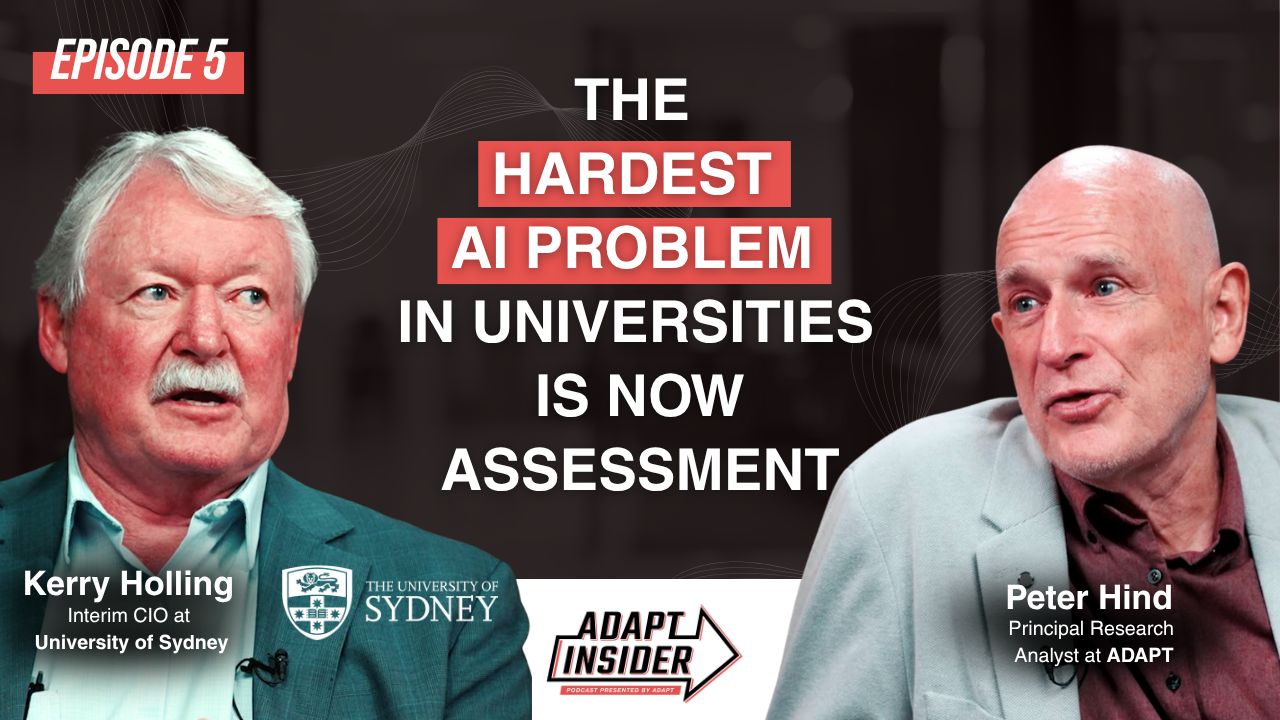


 Published Apr 7, 2026 in
Peer Insights
Digital Transformation
Contributors
Kerry Holling
Peter Hind
Published Apr 7, 2026 in
Peer Insights
Digital Transformation
Contributors
Kerry Holling
Peter Hind
AI pressure is hitting universities differently from most organisations.
It is being driven from the ground up by students, academics, and researchers already testing where AI helps and where it starts to distort learning.
Kerry Holling, Interim CIO at the University of Sydney, explains how that pressure is changing governance, teaching, and trust across the institution.
Listen to the full episode on Apple Podcasts and Spotify.
Key takeaways:
- Student behaviour is forcing universities to move faster on AI governance, with guardrails that protect privacy, sovereignty, and research integrity without slowing useful experimentation.
- Assessment design is becoming a bigger challenge than tool access, as universities work out how to test real understanding in an AI enabled learning environment.
- Trust in university AI depends on balance, with enough freedom to support research and learning, and enough control to protect rigour, accountability, and public confidence.
Universities need guardrails that people will actually use
AI governance in universities has to work in the real world. If the controls are too rigid, staff and students will route around them.
If they are too loose, privacy, data sovereignty, and research integrity are exposed.
That is why the University of Sydney has focused on practical guardrails developed jointly across IT and Legal, with self assessment tools that help staff judge use cases without turning governance into a bottleneck.
Kerry’s point is that balance matters more in a university environment because academic work depends on openness and experimentation, while the institution still has to protect sensitive data, intellectual property, and research quality.
The goal is to create enough structure to support safe use without shutting down the value AI can bring to research, teaching, and operations.
The bigger teaching challenge is no longer access to AI, it is assessment
The hard question for universities is no longer whether students will use AI.
The real issue is whether assessment still measures understanding, judgement, and learning in an environment where AI can generate convincing outputs quickly.
That is where Kerry sees the pressure building.
He argues that AI can improve learning when it helps students deepen their understanding, but weak assessment design will invite shortcuts instead.
The stronger institutional response is to rethink how knowledge is tested so students still have to demonstrate real comprehension.
He also points to examples where AI is improving access to teaching rather than undermining it.
One University of Sydney academic built Cogniti to replicate parts of one to one support at scale, and Kerry says it is now used by more than 5,000 academics to help develop curriculum material and provide more personalised tuition to students.
For him, that is what useful AI in education looks like, expanding learning support in places where human access is naturally limited.
Trust grows when AI is used to augment people, not displace judgement
Universities will get more value from AI when they treat it as a tool for augmentation, not as a substitute for human thinking, academic rigour, or institutional accountability.
Kerry is optimistic about AI’s potential, but he is careful about how far that optimism should go.
He supports AI for personal productivity and sees genuine value in tools that accelerate research, improve learning outcomes, and reduce friction in university work.
At the same time, he is wary of over-dependence, concerned about the concentration of power in large technology companies, and clear that institutions should be selective about how they deploy AI.
He describes it as something that should be used with respect, not submission, and that framing matters.
The trust challenge in higher education is not only about policy.
It is also about making sure AI strengthens human capability, protects academic judgement, and earns confidence as adoption becomes more embedded.
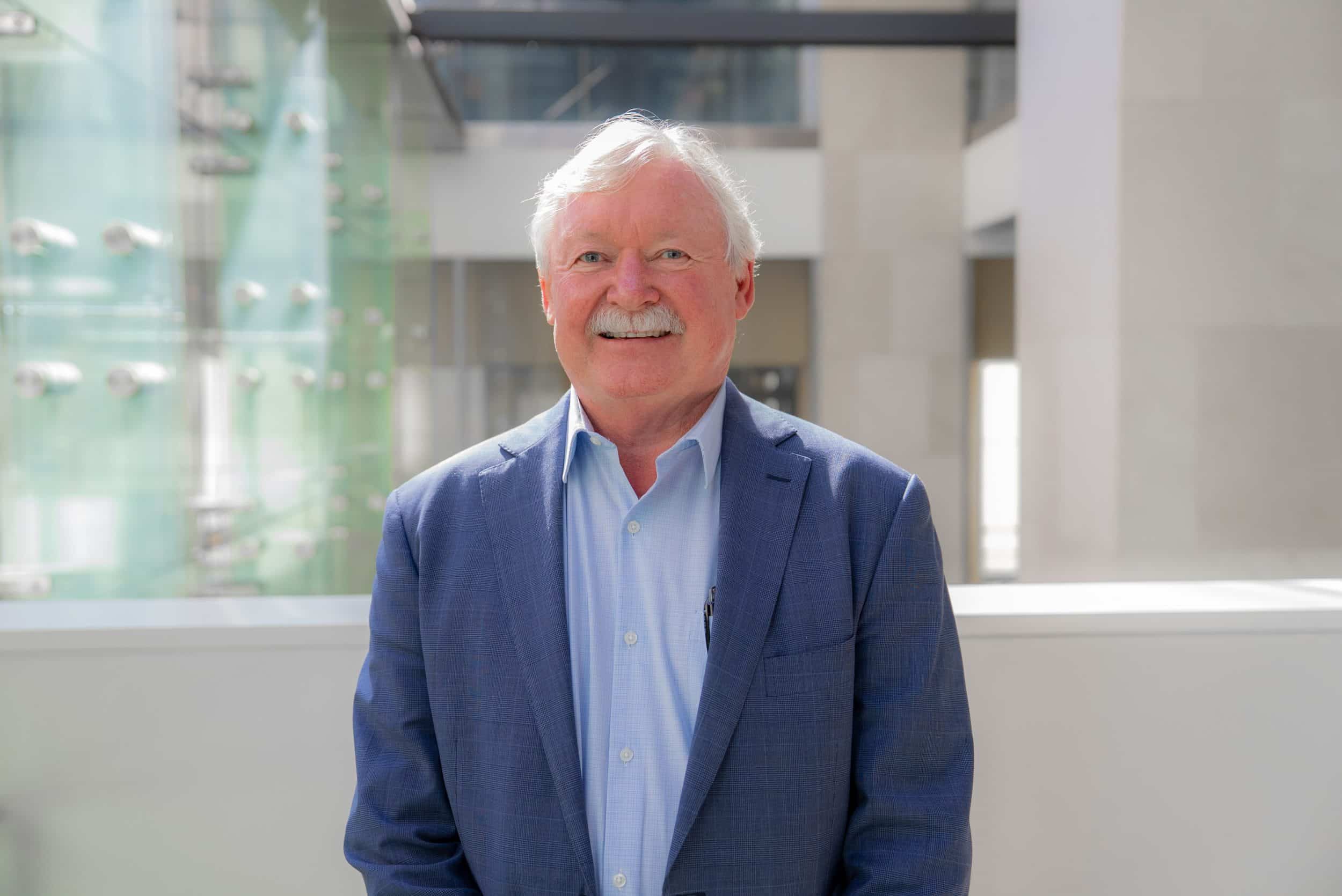 Kerry Holling
Interim CIO at University of Sydney
Kerry Holling
Interim CIO at University of Sydney
Kerry is an accomplished technology executive with over 30 years of leadership experience across multiple sectors. He took up the role of Interim CIO at The University of Sydney in July 2025 and prior to that, was the Interim Deputy CIO at UNSW for six months in 2023. This followed eleven years as the Chief Information and Digital Officer at Western Sydney University.
Prior to his tenure at WSU, Kerry held various senior positions in the Government and Technology sectors, including CIO at what was then called the NSW Department of Community Services and subsequently, the Department of Human Services. He also worked in CIO roles for HP, Compaq, and Digital Equipment Corporation between 1996 and 2006.
As Secretary on the CAUDIT Executive (Council of Australasian University Directors of IT), Kerry brings his expertise to help guide the organisation’s strategic direction. Additionally, until his departure from WSU, he also convened the NSW Chapter of CAUDIT, where he promoted collaboration and knowledge-sharing among IT leaders in the higher education sector.
Originally from New Zealand, Kerry holds a degree in Computer Science from the University of Canterbury. He has lived and worked in Sydney for over 40 years with a proven track record of driving collaboration and change.
 Peter Hind
Principal Research Analyst at ADAPT
Peter Hind
Principal Research Analyst at ADAPT
Peter Hind has spent the last 25 years as an analyst and commentator on the ICT industry.
His primary areas of interest are the potential of technology to transform the way organisations operate, the change management obstacles executives encounter in realising this potential, as well as the tactics and techniques leaders have deployed to overcome these difficulties.
Peter now takes on multiple roles within ADAPT including the moderation of private events and roundtables, interviewing business executives about the strategies they are pursuing and assisting with the structuring of delegate surveys.
He also interrogates and analyses ADAPT’s treasure trove of end-user and C-suite data.
Less
Join the ADAPT
Insider Community
Get the latest A/NZ market research and insights on the core trends impacting leaders.
Join the ADAPT
Insider Community
Get the latest A/NZ market research and insights on the core trends impacting leaders.