









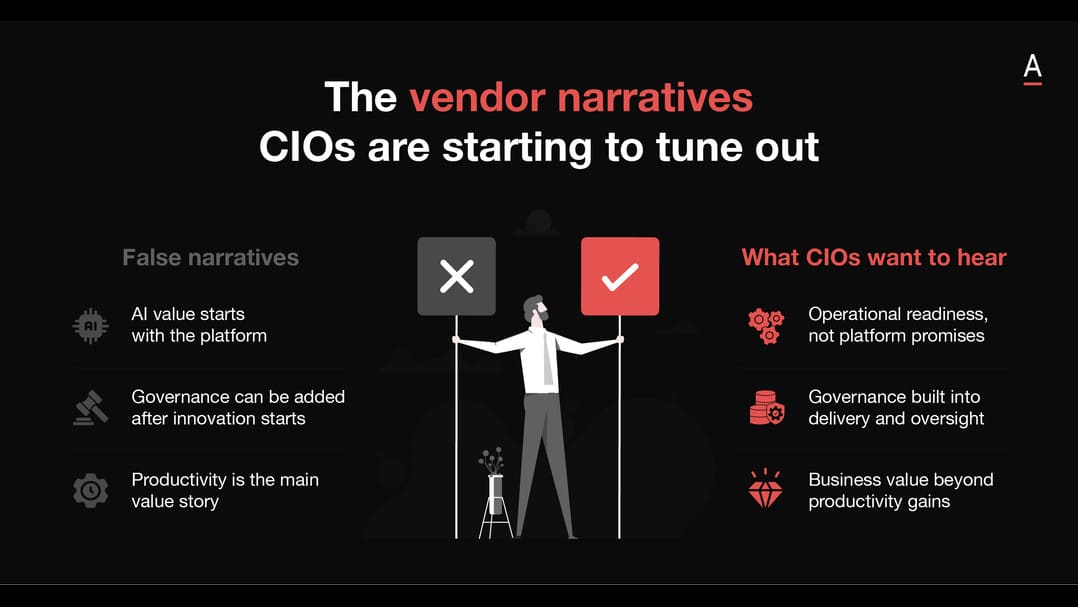





Why most AI pilots fail after the demo, according to an ASX 30 transformation leader
In this ADAPT Insider episode, Vijayan Seenisamy explores why controlled pilots often mask the delivery, ownership, and cost pressures that surface in production.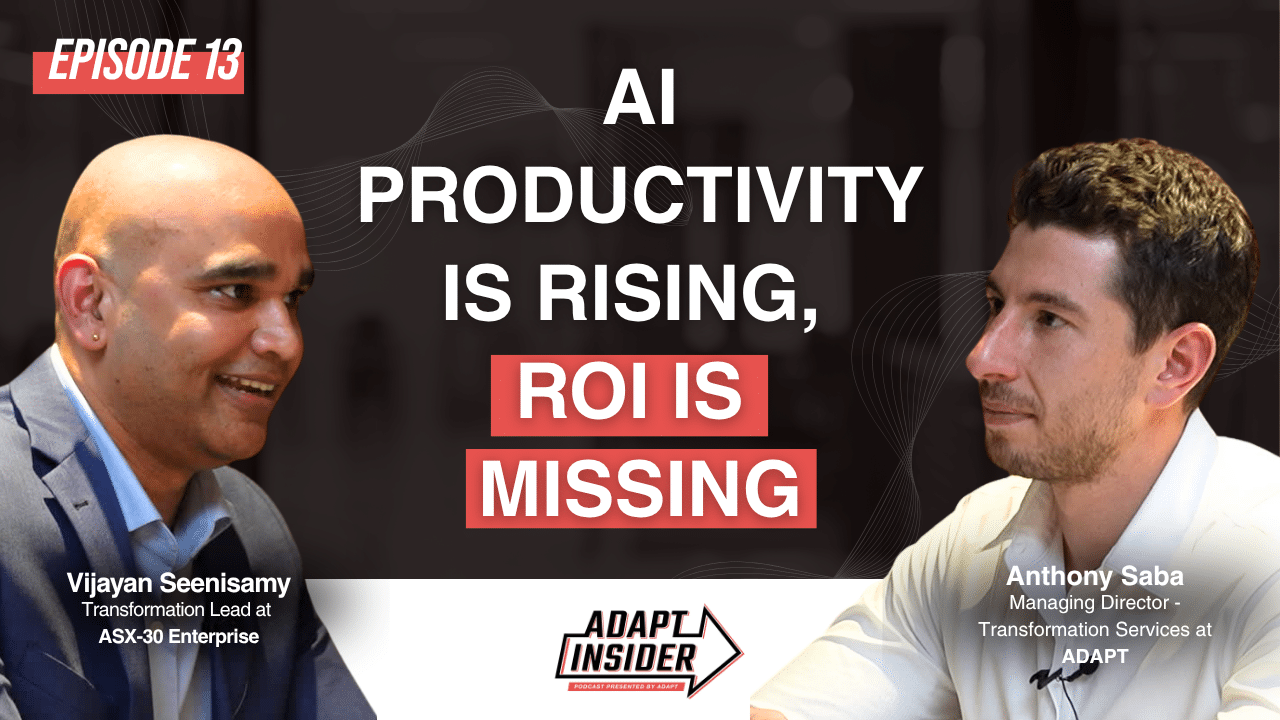


 Published Jul 7, 2026 in
Peer Insights
Data & AI Strategy
Contributors
Vijayan Seenisamy
Anthony Saba
Published Jul 7, 2026 in
Peer Insights
Data & AI Strategy
Contributors
Vijayan Seenisamy
Anthony Saba
The pilot can make enterprise AI look further along than it really is.
Once systems hit live workflows, organisations start dealing with messier user behaviour, weaker ownership, and economics that no longer match the original case.
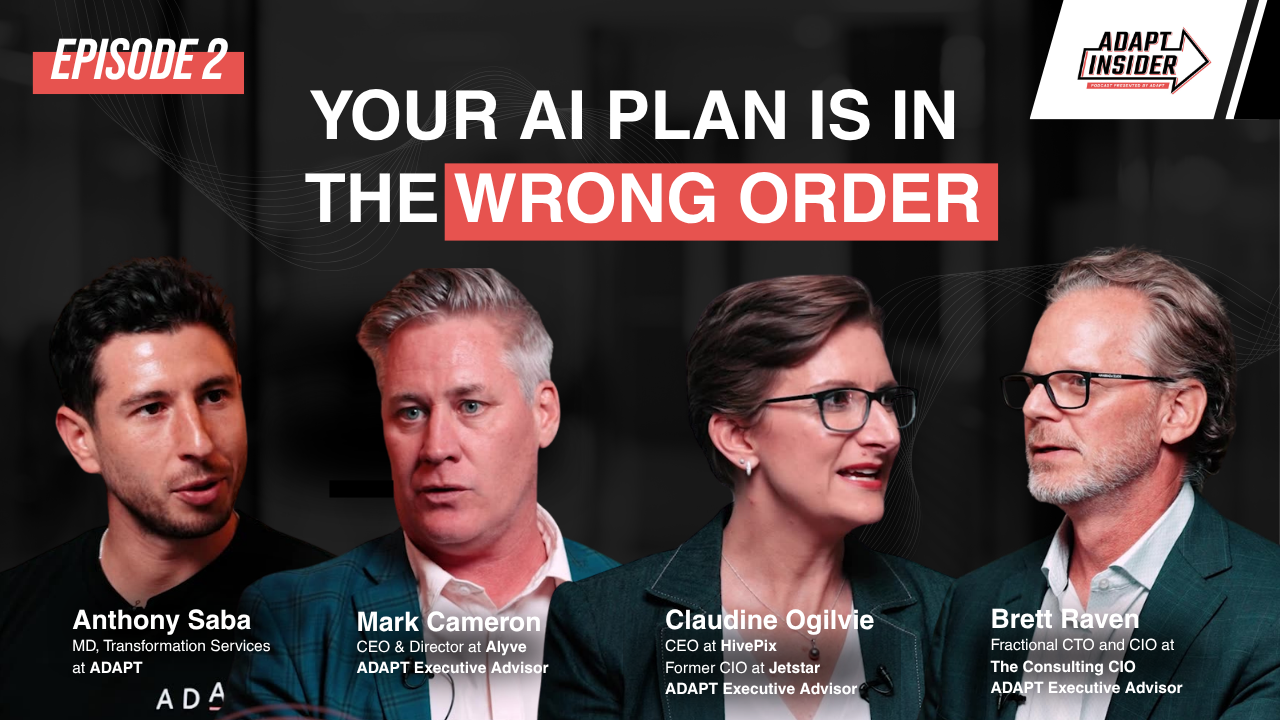
In a conversation with Anthony Saba, Partner & Managing Director, Transformation Services at ADAPT, Vijayan Seenisamy, Transformation Lead at an ASX 30 enterprise, argues that these failures are rarely about the model itself.
They come from trying to scale AI inside operating structures that were built for a different kind of technology.
Listen to the full episode on Apple Podcasts, Spotify, and YouTube.
Key takeaways:
- AI pilots break down when production exposes weak ownership, messy workflows, and economics that were never tested properly.
- Enterprise AI creates value when leaders treat it as a business transformation, not a narrow technology program.
- Cost per successful outcome is a more useful measure than adoption or token volume when judging whether AI is working at scale.
- Shared ownership across technology, finance, and the business is what gives AI a better chance of surviving beyond the pilot.
Most AI programs are framed too narrowly
Vijayan argues that many organisations get the framing wrong from the start.
Once AI is labelled a technology transformation, responsibility narrows too quickly to the CIO or CTO. That misses the bigger issue.
In his view, AI is a business transformation that affects workflows, leadership, workforce design, and operating model choices far more than most executive teams are prepared to admit.
Technology may be essential, but it is only one part of the change.
That is also why so many organisations are seeing a gap between executive expectation and financial outcome.
Teams may have bought copilots, pushed adoption, and reported productivity gains, but the CFO still sees little movement in the P&L.
The local wins are real, but they do not become enterprise value unless the business changes how work is structured around them.
Production is where the business case starts to unravel
Vijayan describes a familiar pattern.
The pilot is built in controlled conditions, with curated data, known prompts, and the builders close enough to keep things working.
Production removes those protections.
Real users behave differently, data gets messier, and systems start to wobble under conditions the demo never had to survive.
He also points to unit economics as a major blind spot.
If an agent costs more to complete a task than the human process it was supposed to replace, the business case weakens fast.
That gets worse in multi agent systems, where orchestration overhead can erode the performance that individual agents appeared to have in isolation.
What looked efficient in a pilot can become expensive and unstable once usage grows.
AI needs a different economic and ownership model
A core argument in the conversation is that AI should be measured as a business asset, not as another software rollout.
Vijayan says the most important metric is cost per successful outcome, meaning the cost of producing an outcome a user or stakeholder would actually accept.
Token costs, task costs, and adoption rates are useful, but they do not tell leaders whether value is really being created.
He also argues that ownership has to widen.
Most AI initiatives still sit under a one signature model, usually with the CIO holding the budget and delivery burden.
His alternative is a three signature model: the CIO for delivery feasibility, the CFO for unit economics, and a business leader for workflow change.
That spreads accountability across the people who control whether AI can work in practice, not just in demo conditions.
 Vijayan Seenisamy
Transformation Lead at ASX-30 Enterprise
Vijayan Seenisamy
Transformation Lead at ASX-30 Enterprise
Vijayan Seenisamy is a transformation leader focused on building the discipline of Enterprise Agentic AI Systems Delivery, the methodology, governance, and role clarity required to move AI agents from pilot to reliable production at enterprise scale. His work is grounded in two proprietary frameworks: AI ROF, which redesigns role accountability so humans and AI agents operate with clear ownership, decision rights, and escalation paths, and ICE, or Intelligence Centred Enterprise, an operating model that treats intelligence as a practice rather than a product, built around the loop of Sense, Reason, Act, Learn.
He is the author of The Pilot Trap which examines why most enterprise AI pilots fail to reach production and identifies the category errors and operating disciplines behind that gap. He also wrote The AI Delivery Manager Blueprint, the first book to define the role between AI engineering and business outcomes. Alongside two white papers on enterprise AI role evolution and intelligence centred operating models, he has introduced concepts such as Agent Coaching, System Stewardship, the Demo God Curse, and Negative Unit Economics.
Vijayan publishes ongoing thinking through The AI Delivery Discipline, a biweekly newsletter read by more than 2,000 senior practitioners, and works as Group Transformation Lead at Woolworths Group, one of Australia’s largest organisations.
Less Anthony Saba
Partner & Managing Director, Transformation Services at ADAPT
Anthony Saba
Partner & Managing Director, Transformation Services at ADAPT
Anthony leads the growth, strategy, and delivery of ADAPT’s Transformation Services and Go-to-Market Services Business Units.
He is driven by a core belief that we are experiencing a modern industrial revolution, one that will fundamentally reshape how business is done and pose serious challenges to the future of many Australian organisations and industries.
In this environment, success will not necessarily favour incumbents, or those with the deepest pockets or broadest resources, but rather organisations who are most able to ADAPT quickly and effectively to the evolving needs of their customers, employees and ecosystems.
With this belief, ADAPT is evolving into a critical platform that Australia’s enterprise leaders, local solution providers, and trusted advisors can rely on to succeed over the next decade.
By removing barriers, democratising access to proven expertise, promoting local ANZ innovation, and enabling rapid, meaningful connections between leaders and experts, ADAPT is committed to helping Australia not just survive, but thrive in the complex and uncertain times ahead.
Less
Join the ADAPT
Insider Community
Get the latest A/NZ market research and insights on the core trends impacting leaders.
Join the ADAPT
Insider Community
Get the latest A/NZ market research and insights on the core trends impacting leaders.