
















What Do We Automate Next?
Westpac, CommBank and Sovereign Australia digital & AI leaders share what it takes to move agentic AI from experimentation to scalable business value.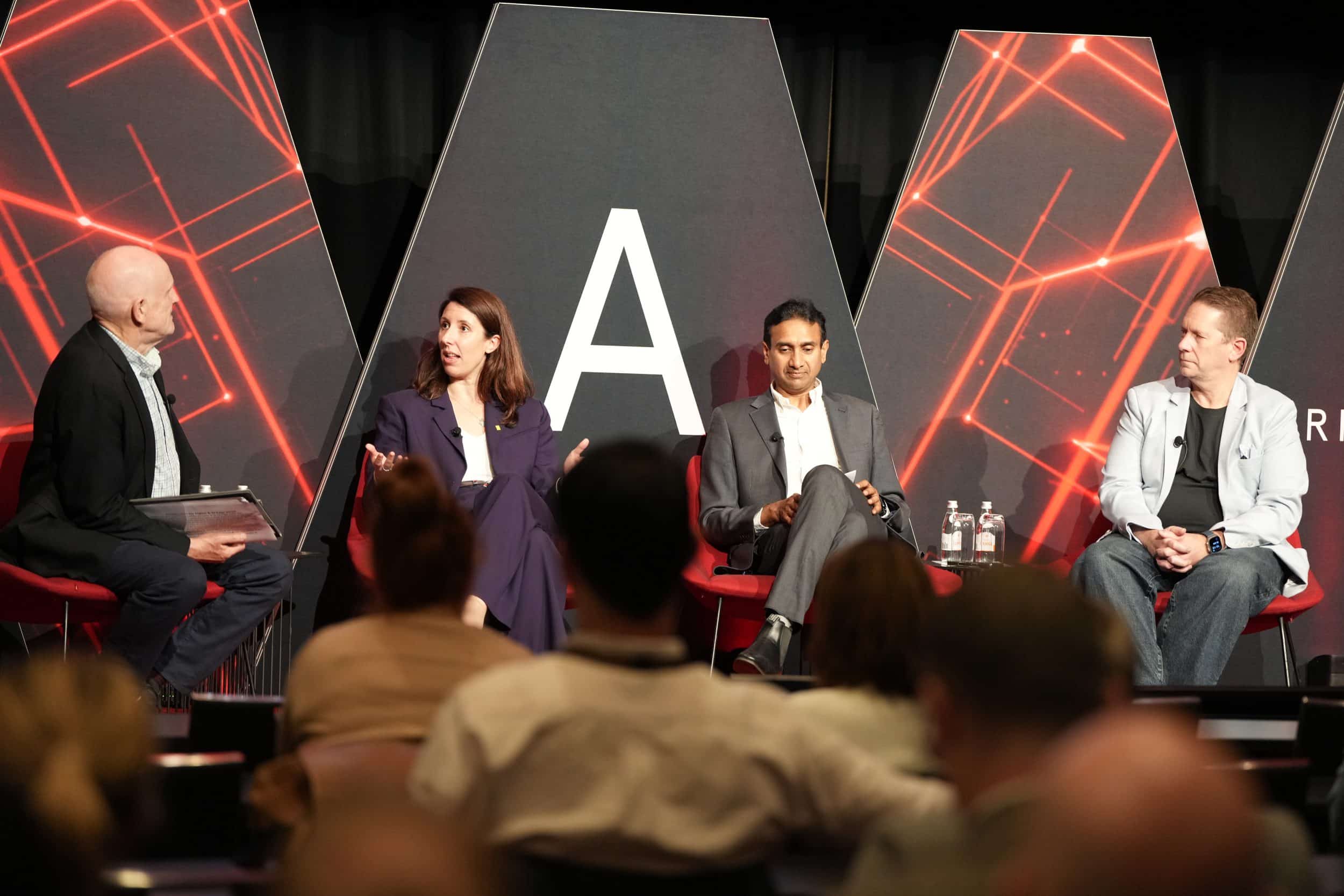


 Published Jul 22, 2026 in
Expert Presentations
Digital Transformation
Contributors
Jen French
Bhaskar Katta
Simon Kriss
Peter Hind
Published Jul 22, 2026 in
Expert Presentations
Digital Transformation
Contributors
Jen French
Bhaskar Katta
Simon Kriss
Peter Hind
Everyone’s talking about agentic AI, but why are so few actually scaling it?
In this Digital & AI Edge executive panel, Jen French, General Manager AI Acceleration at CommBank, Bhaskar Katta, General Manager at Westpac, Simon Kriss, ADAPT Advisor and CEO at Sovereign Australia AI and Peter Hind, Principal Research Analyst at ADAPT unpack the gap between experimentation and real-world deployment.
This reveals that the tipping point isn’t about better tech, but about discipline, design and organisational readiness.
Key takeaways:
- Scale is built, not bought: Successful agentic AI comes from incremental capability building, not leapfrogging to advanced use cases.
- Control determines value: Financial discipline, governance and visibility are critical to avoid cost blowouts and operational risk.
- There’s no universal playbook: The right approach depends on organisational culture, leadership alignment and how well people are brought into the journey.
The journey to scale is evolutionary, not a leap
Moving from POC to production requires a layered, iterative approach, not a single “big bang” deployment.
Many organisations stall because they try to jump straight to advanced agentic use cases.
In reality, scaling AI depends on building foundational capabilities, process intelligence, data understanding and incremental automation, before introducing more autonomous systems.
Bhaskar explains that Westpac’s journey started with RPA, evolved through document processing and knowledge tools, and only then moved into agentic AI, allowing change management, stakeholder buy-in and trust to build along the way before scaling.
The real risk isn’t adoption, it’s uncontrolled scale
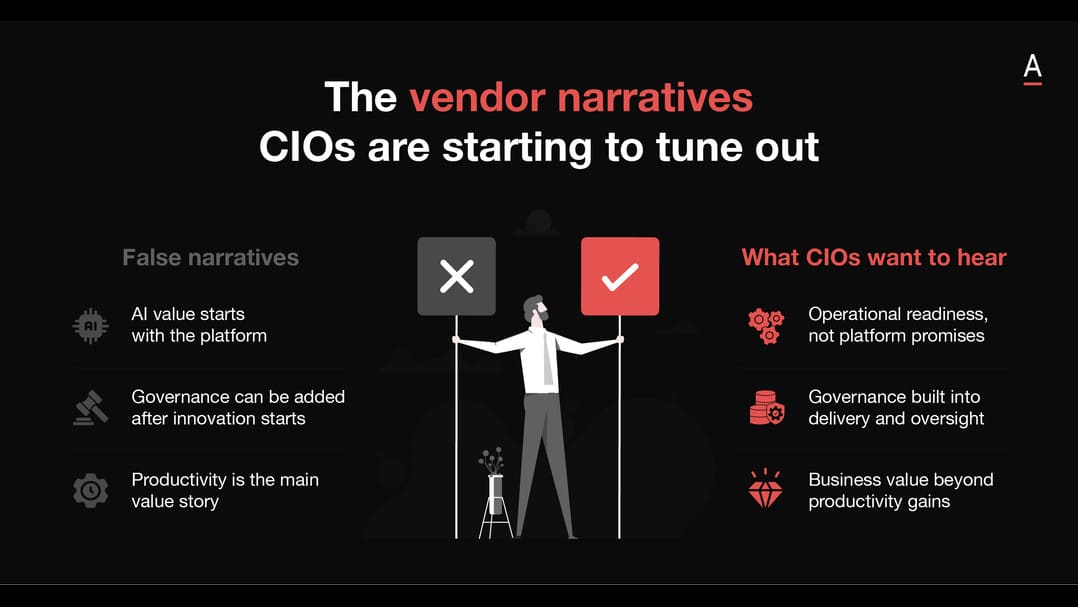
Without governance and financial discipline, agentic AI can quickly become a cost and risk multiplier rather than a productivity driver.
Agentic systems operate at machine speed, amplifying both value and risk.
From token consumption blowouts to model dependencies and system fragility, organisations must actively manage visibility, cost and control.
Panellists highlighted “token shock” as a key emerging risk, where autonomous loops consume massive compute spend in minutes.
At the same time, fragmented experimentation can lead to uncontrolled sprawl, forcing organisations to balance innovation with central oversight and decision discipline.
Success depends on people, design and organisational self-awareness
The organisations that scale agentic AI successfully are those that redesign work, involve people early and align with their own cultural DNA.
There is no single “right” approach, (data-first, process-first, experimentation-first or governance-first), all work depending on the organisation.
What matters is clarity of outcomes, internal alignment and the ability to bring people on the journey.
Jen emphasises starting with outcomes and redesigning processes using design thinking, while ensuring customer service teams are involved early to build trust.
Meanwhile, leaders stress aligning strategy to organisational culture, whether risk-averse or entrepreneurial, rather than copying others’ approaches.
This piece was a paid content partnership between Commonwealth Bank of Australia and ADAPT.
 Jen French
GM - AI Acceleration at CommBank
Jen French
GM - AI Acceleration at CommBank
Jen French is a senior leader at CommBank, where she leads initiatives to embed AI capability across one of the region’s most digitally advanced banks.
Working at the forefront of fintech innovation, Jen focuses on how AI can deliver better customer outcomes, enabling simpler, more intuitive, and more personalised banking experiences at scale. She is passionate about applying AI in ways that strengthen trust, enhance decision-making, and deliver meaningful real-world impact.
Her leadership spans the organisation, helping shift AI from experimentation to scalable, enterprise-wide value, with a strong focus on responsible, secure, and customer-centred implementation in a highly regulated environment.
With deep expertise in transformation and digital adoption, Jen has a distinctive ability to simplify complexity and connect strategy, technology, and execution through a human-centred lens.
Less Bhaskar Katta
General Manager at Westpac
Bhaskar Katta
General Manager at Westpac
Bhaskar Katta is a recognised expert with ~3 decades of experience in Operations &Technology, Consumer Business, Strategy, Customer-centric design, and Digital with a successful track record in delivering meaningful transformations in financial services.
He is currently General Manager of Global Operations at Westpac, leading a team of over 6,500 employees. Formerly as General Manager at ANZ, Bhaskar brought his extensive background in digital transformation in the Deposits, Payments, and Wealth business for over 6 million customers and managing the wealth business partnerships. Prior to that Bhaskar was Regional Chief Operating Officer in Singapore covering over 20 markets across Asia & Pacific and leading a Digital-only bank initiative. He has also has~2 decades experience with Citi across Europe, Middle East and Africa living and working in India, UAE, Russia, Czech Republic &UK in COO, CEO (Consumer Bank) & MD roles.
Bhaskar holds an MBA from Sri Sathya Sai Institute of Higher Learning in India and an Executive Education from MIT covering Digital Business Transformation and is experienced in building and leading high performing diverse teams and has a track record for leading significant organisational transformations that achieve outstanding results.
Less Simon Kriss
Chief AI Officer at simonkriss.ai
Simon Kriss
Chief AI Officer at simonkriss.ai
Simon is one of the world’s most influential AI thought leaders. HE is both an advisor and a hands-on Chief AI Officer. Simon’s work spans business and government across Australia and the globe, focused on ethical AI adoption.
Simon presents on AI to audiences around the world, including recently speaking at the UN in Geneva. As the author of The AI Empowered Customer Experience and host of the AI in 5podcast, he makes AI accessible and exciting.
- Chief AI Officer at simonkriss.ai and author of The AI Empowered Customer Experience.
- Named one of 2024’s Top 50 Global CX Influencers.
- Advises boards on AI strategy, adoption, and ethical implementation.
- Specialises in AI for customer experience and service transformation.
- Background in global CX operations across 15+ countries and multiple industries.
- Speaker, podcast host, and commentator on CX, AI, and digital futures.
 Peter Hind
Principal Research Analyst at ADAPT
Peter Hind
Principal Research Analyst at ADAPT
Peter Hind has spent the last 25 years as an analyst and commentator on the ICT industry.
His primary areas of interest are the potential of technology to transform the way organisations operate, the change management obstacles executives encounter in realising this potential, as well as the tactics and techniques leaders have deployed to overcome these difficulties.
Peter now takes on multiple roles within ADAPT including the moderation of private events and roundtables, interviewing business executives about the strategies they are pursuing and assisting with the structuring of delegate surveys.
He also interrogates and analyses ADAPT’s treasure trove of end-user and C-suite data.
Less Join the ADAPT
 Insider Community
Get the latest A/NZ market research and insights on the core trends impacting leaders.
Join the ADAPT Insider Community
Get the latest A/NZ market research and insights on the core trends impacting leaders.