














Productivity gains create little value without a plan for saved time, says Work Futurist Dom Price
In this ADAPT Insider episode, Dom Price talks about how better outcomes, talent investment and learning velocity create value from AI.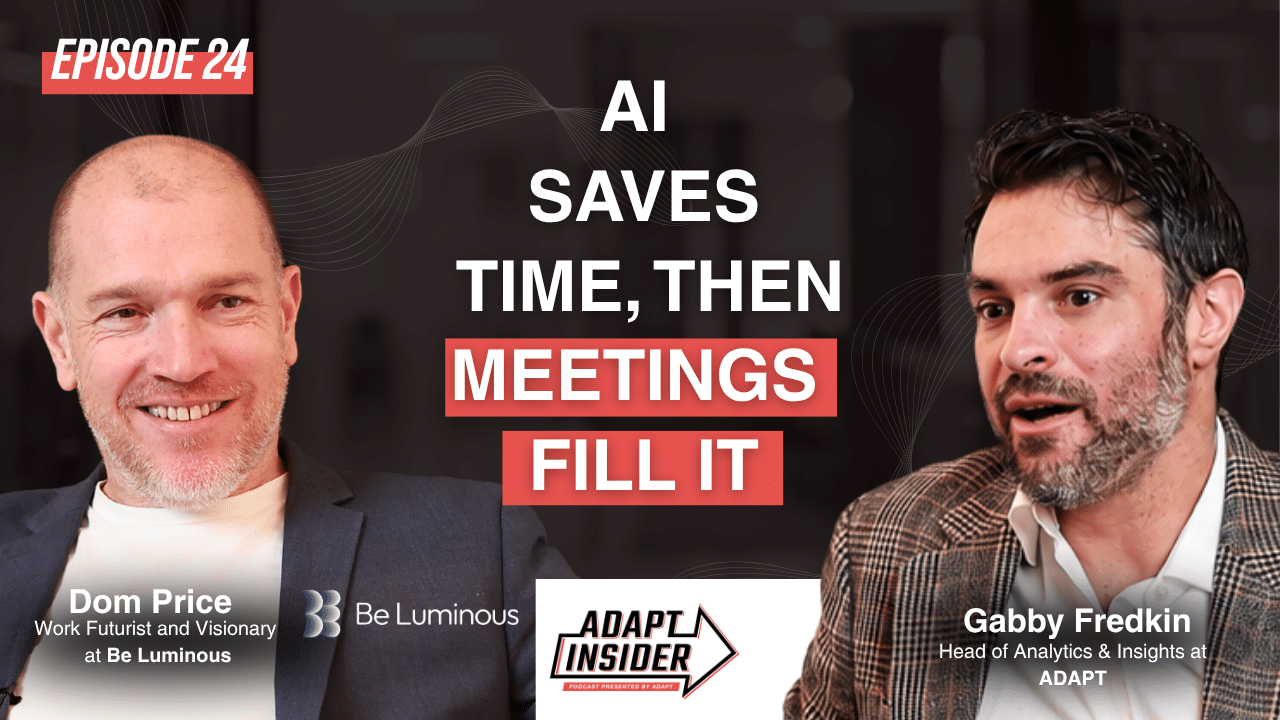


 Published Sep 21, 2026 in
Podcast
Digital Transformation
Contributors
Dom Price
Gabby Fredkin
Published Sep 21, 2026 in
Podcast
Digital Transformation
Contributors
Dom Price
Gabby Fredkin
Saving time creates little value when organisations have no deliberate use for the capacity released.
In this ADAPT Insider episode, Dom Price, Work Futurist and Visionary at Be Luminous, examines why conventional productivity metrics reveal too little about the conditions that sustain performance.
He considers how organisations can redirect saved time, protect long-term workforce capability and build the confidence to experiment amid constant change.
Listen to the full episode on Apple Podcasts, Spotify or YouTube.
Key takeaways:
- Productivity gains create value when organisations direct released capacity towards meaningful, higher-value work.
- Workforce decisions should account for the experience, context and institutional knowledge that employees develop over time.
- Small, safe experiments help teams act on new information, adjust direction and share useful lessons across the organisation.
Saved time requires a deliberate destination
Productivity, sales and GDP remain common measures of performance.
These lagging indicators reveal little about whether people have the environment, tools, trust and space to produce meaningful work.
Dom points to organisations that achieved significant productivity gains, then filled the released capacity with more meetings.
Without a clear next-best use for that time, greater efficiency changed the volume of activity without improving its value.
Leaders can assess the conditions behind performance alongside the final output.
Discretionary effort, curiosity and human connection reveal whether people feel engaged enough to contribute beyond the minimum expected of them.
Automation decisions shape future capability
AI can improve work by augmenting employees and redirecting their attention towards higher-value contributions.
Removing roles without considering the talent pipeline risks leaving organisations without the experience required for future leadership and specialist positions.
Graduate roles illustrate the long-term value at stake.
Early-career employees may initially cost more than they contribute, yet those roles build context, experience and institutional knowledge over time.
Dom points to IKEA’s decision to redeploy employees affected by automation into new roles.
Their existing expertise remained inside the organisation and supported a different source of value.
Workforce planning should account for the capabilities an organisation will require in the future, including the pathways through which employees develop them.
Learning velocity helps organisations adapt
Many organisations were designed around stability, efficiency and five-year planning.
Constant disruption has reduced the value of waiting for certainty before acting.
Dom describes learning velocity as the ability to absorb new information, adjust direction and test ideas without punishing people for changing course.
Leaders can select one manageable opportunity each quarter, test it at low cost and share the result.
A small experiment gives teams evidence they can act on while limiting the consequences of failure.
Leading by example gives employees permission to try, learn and adapt.
Repeated experimentation builds practical knowledge faster than waiting for a perfect business case.
At CIO Edge in Melbourne in August 2026, Dom Price joined Dayle Stevens OAM, AI Executive at Telstra, to explore how behaviour, trust, and capability shape AI adoption.
 Dom Price
Work Futurist and Visionary at Be Luminous
Dom Price
Work Futurist and Visionary at Be Luminous
Dom Price is a Work Futurist, team obsessive, and Partner at Be Luminous and someone who has lived the chaos of scaling a business from the inside out. Joining Atlassian as employee #600, Dom stayed for 12 years as their resident Work Futurist, helping grow the company to over 16,000 people globally. That’s not theory – that’s scar tissue.
Dom operates at the intersection of tech and humans, and his mission is simple: upgrade the human operating system of how we work. Because as he’ll tell you, “a fool with a tool is still a fool… you’ve just made them faster.” In a world drunk on AI and the next shiny solution, Dom is the pragmatic voice asking whether your people are actually set up to use it well – driving change that’s sustainable, not just spectacular.
As a keynote speaker, Dom doesn’t trade in polished frameworks or borrowed wisdom. He shares real, lived experience the messy, hard-won kind which is exactly why he’s in demand. Less thought leader, more battle-tested practitioner.
Co-creator of the Atlassian Team Playbook, TED speaker, and advisor to C-suite leaders globally. Dom believes that work and life should be about thriving, not just surviving. A keen traveller and veteran of 53+ countries, he calls Australia home. Manchester made him. The rest? Still very much in progress.
 Gabby Fredkin
Head of Analytics & Insights at ADAPT
Gabby Fredkin
Head of Analytics & Insights at ADAPT
As the Head of Analytics and Insights at ADAPT, Gabby Fredkin’s primary role is managing analysis to produce ADAPT’s actionable insights to identify trends supporting organisations in Australia.
With a passion for creating stories with data, Gabby is consistently rated as one of the top speakers at ADAPT’s events. In roundtable discussions, he specialises in using statistics to initiate thought-provoking discussions, enabling ADAPT’s customers to become more data-driven.
Using modern data science techniques, he provides ADAPT and its customers with confidence in the accuracy and validity of the information used for ADAPT’s research, advisory and events.
Working across artificial intelligence, machine learning, AI ethics, DevSecOps, end-user behaviour, and human-centred design, Gabby’s vast experience continues to grow, supported in part by a Master of Business Analytics from Deakin University.
Less Join the ADAPT
 Insider Community
Get the latest A/NZ market research and insights on the core trends impacting leaders.
Join the ADAPT Insider Community
Get the latest A/NZ market research and insights on the core trends impacting leaders.