















What enterprise AI looks like when leadership and governance are built in, with DBS Bank’s MD
In this ADAPT Insider episode, Sanjoy Sen outlines how DBS embedded AI into the bank through culture, capability, and governance.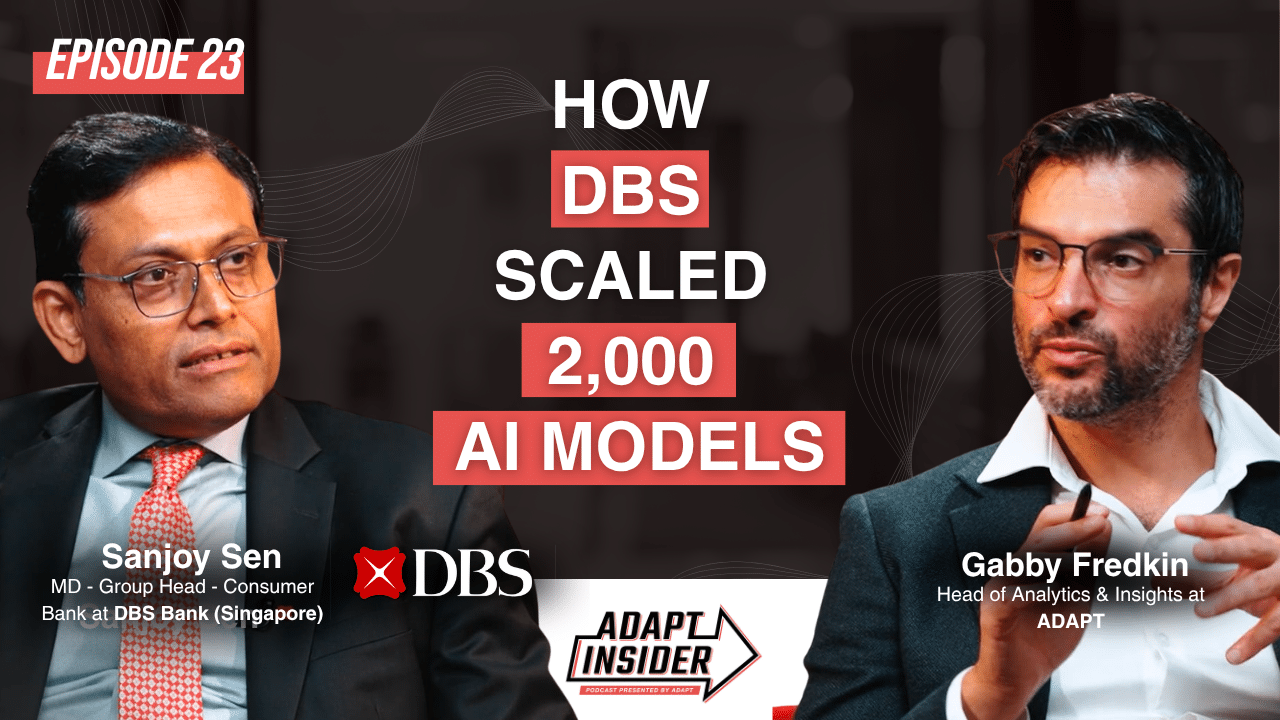


 Published Sep 13, 2026 in
Podcast
Digital Transformation
Contributors
Sanjoy Sen
Gabby Fredkin
Published Sep 13, 2026 in
Podcast
Digital Transformation
Contributors
Sanjoy Sen
Gabby Fredkin
DBS built AI into the bank through leadership ownership, digital and data foundations, and governance built into the workflow.
In this ADAPT Insider conversation, Sanjoy Sen, MD – Group Head of Consumer Bank at DBS Bank (Singapore), shares how that shift helped move AI from isolated use cases into broader operating change across the bank.
Listen to the full episode on Apple Podcasts, Spotify, and YouTube.
Key takeaways:
- Leadership ownership and organisation-wide experimentation help AI move beyond isolated use cases.
- Digital, data, and workflow foundations make AI more usable across the enterprise.
- Human accountability and embedded governance help AI earn trust as it spreads.
Leadership ownership helps AI spread across the organisation
Sanjoy’s view is that enterprise AI starts with leadership mandate and organisation-wide adoption.
A central team can support the work, but adoption grows when leaders across the business understand AI as part of their role and teams are encouraged to experiment with it directly.
At DBS, that meant creating a culture where employees could test ideas using data, see what worked, and scale successful ideas quickly.
That approach gave AI a place inside the operating rhythm of the bank rather than leaving it in a separate innovation stream.
Strong foundations make enterprise AI usable
Sanjoy is equally clear on the role of foundations.
AI needs digital readiness, usable workflows, and a real-time data environment to support it.
DBS had already invested in cloud-based architecture, straight-through processing, and a stronger data platform before pushing AI more broadly across the organisation.
Those foundations made it easier to apply AI across underwriting, customer journeys, and service operations in a way that could support real decisions and real execution.
Without that groundwork, AI stays fragmented and localised. With it, AI can move across the business with much more consistency.
Governance and accountability shape trust at scale
DBS also keeps human judgement and governance inside the design.
Sanjoy describes three principles that guide this: human in the loop for key processes, human-centred design in the workflow, and human accountability for the final decision.
That sits alongside the bank’s PURE framework, where AI use has to be purposeful, unsurprising, respectful, and explainable.
Together, those principles help keep trust close to the work itself.
AI can support the analysis, improve speed, and surface better insights, while people remain accountable for judgement, customer impact, and regulatory confidence.
 Sanjoy Sen
MD - Group Head - Consumer Bank at DBS Bank (Singapore)
Sanjoy Sen
MD - Group Head - Consumer Bank at DBS Bank (Singapore)
Sanjoy is the Group Head of Consumer Bank at DBS Bank and a member of the DBS Group Management Committee. DBS, headquartered in Singapore, is a leading financial services group in Asia, recognized globally as the “World’s Best Bank” by Euromoney and Global Finance, and as the “World’s Best Digital Bank” by Euromoney.
In his role, Sanjoy oversees the bank’s consumer business across the region, driving strategy, market development, and business performance while leading the expansion of DBS’s regional footprint. He is responsible for advancing the Consumer Bank’s digital transformation, developing new ecosystem partnerships, and leveraging DBS’s banking and technology capabilities to scale the business.
Sanjoy brings more than 30 years of international consumer banking experience and joined DBS in 2018. Prior to DBS, he led ANZ Bank’s Consumer and Private Bank across the Asia Pacific region for five years. Before that, he spent 22 years at Citibank, where his last role was Consumer Bank Head for the Middle East and North Africa.
He currently serves on several boards within DBS, including DBS Bank Taiwan, DBS Vickers Holding, and DBS Vickers Thailand. Sanjoy also sits on the board of the DBS Foundation, where he helps oversee sustainability initiatives and champion social enterprises.
Beyond DBS, he is actively involved in a number of external boards and committees. He serves as Board Director and Treasurer at the Singapore Institute of Management and is a Governor on the Board of the Singapore International Foundation, supporting its mission to build enduring people to people connections around the world. He is also a member of the Strategic Advisory Council of the Singapore FinTech Association, contributing to the strategic growth and global expansion of Singapore’s fintech ecosystem.
Previously, Sanjoy served as a Board Director for ANZ’s subsidiaries in Cambodia and Vietnam, and as a Director of Metrobank Cards Corporation in the Philippines. He has also held honorary positions with the National Volunteer & Philanthropy Centre and the Singapore Institute of Directors, and served on the board of the Tanglin Club for several years.
In recognition of his contributions to the industry, Sanjoy was conferred the IBF Fellow Award for Consumer Banking in 2019. He is a regular keynote speaker at international conferences and leading business schools, and teaches in the Asia Financial Leadership Program, of which he is also an alumnus.
Less Gabby Fredkin
Head of Analytics & Insights at ADAPT
Gabby Fredkin
Head of Analytics & Insights at ADAPT
As the Head of Analytics and Insights at ADAPT, Gabby Fredkin’s primary role is managing analysis to produce ADAPT’s actionable insights to identify trends supporting organisations in Australia.
With a passion for creating stories with data, Gabby is consistently rated as one of the top speakers at ADAPT’s events. In roundtable discussions, he specialises in using statistics to initiate thought-provoking discussions, enabling ADAPT’s customers to become more data-driven.
Using modern data science techniques, he provides ADAPT and its customers with confidence in the accuracy and validity of the information used for ADAPT’s research, advisory and events.
Working across artificial intelligence, machine learning, AI ethics, DevSecOps, end-user behaviour, and human-centred design, Gabby’s vast experience continues to grow, supported in part by a Master of Business Analytics from Deakin University.
Less Join the ADAPT
 Insider Community
Get the latest A/NZ market research and insights on the core trends impacting leaders.
Join the ADAPT Insider Community
Get the latest A/NZ market research and insights on the core trends impacting leaders.