


















The biggest productivity gains sit beyond agency boundaries, say APS digital leaders
In this Government Edge panel, digital & technology execs from ADHA, Defence, and Dept. of Prime Minister and Cabinet discuss why collaboration, service outcomes, and trust are shaping the next phase of government productivity.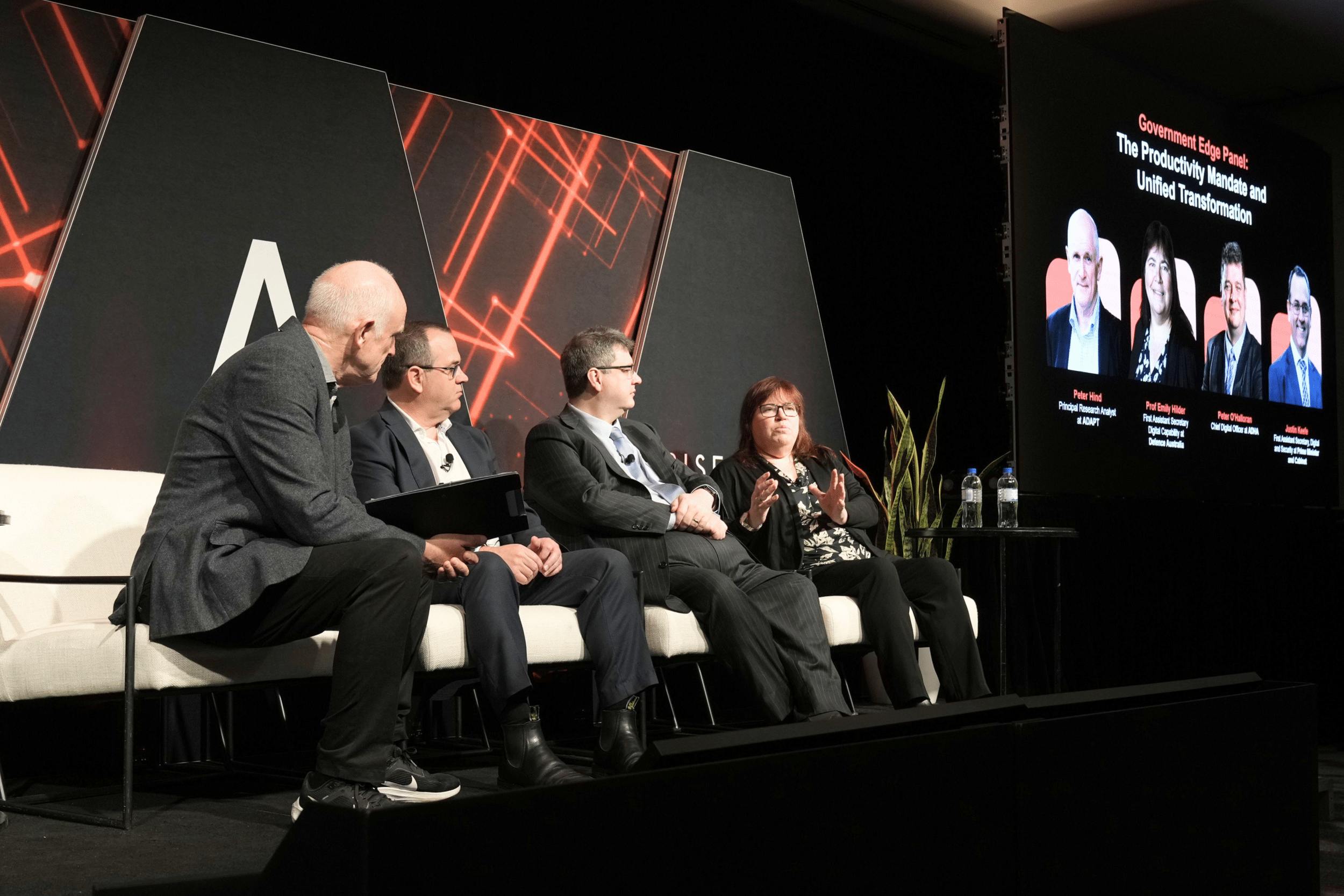


 Published Jun 23, 2026 in
Expert Presentations
Digital Transformation
Contributors
Peter O’halloran
Emily Hilder
Justin Keefe
Peter Hind
Published Jun 23, 2026 in
Expert Presentations
Digital Transformation
Contributors
Peter O’halloran
Emily Hilder
Justin Keefe
Peter Hind
The opportunity presented by AI is becoming too significant for agencies to remain on the sidelines. At the same time, leaders face growing pressure to improve productivity, modernise services, and maintain public trust.
In a Government Edge panel discussion, Peter O’Halloran, Chief Digital Officer at the Australian Digital Health Agency, Emily Hilder, First Assistant Secretary Digital Capability at the Department of Defence, Justin Keefe, First Assistant Secretary Digital and Security at the Department of the Prime Minister and Cabinet, and ADAPT Principal Research Analyst Peter Hind explored how agencies can pursue productivity gains without losing sight of governance, collaboration, and service outcomes.
Key takeaways
- Measure productivity through citizen and service outcomes rather than agency activity.
- Treat sensitivity and complexity as constraints to manage, not barriers to collaboration.
- Start with the problem to be solved before selecting technology or AI tools.
- Build trust through practical use cases that deliver visible and sustainable value.
- Create guardrails that encourage innovation while maintaining accountability and oversight.
Productivity should be measured where services are delivered
For Peter O’Halloran, productivity starts with the people receiving the service rather than the agency delivering it.
At the Australian Digital Health Agency, the focus is on helping clinicians access information faster, reduce duplication, and make decisions with greater confidence.
Peter pointed to examples such as sharing pathology and diagnostic imaging results across care settings, enabling clinicians to access existing test results rather than repeating them unnecessarily.
The result is faster treatment decisions, reduced costs, and better experiences for both clinicians and patients.
He argued that the biggest productivity gains often sit beyond agency boundaries.
Improving outcomes for frontline workers and citizens creates far greater value than focusing solely on internal efficiency measures.
The risk equation is changing
Emily Hilder challenged traditional assumptions about risk and AI adoption.
As AI capabilities mature, the opportunity presented by the technology is becoming increasingly difficult to ignore.
In some areas of government, the balance has shifted to the point where the risks associated with inaction deserve as much attention as the risks associated with adoption.
Emily highlighted the importance of identifying the problem before selecting a tool.
With hundreds of new AI capabilities entering the market, agencies can easily become distracted by technology choices.
The organisations achieving the greatest gains are those that clearly define the outcome they want to achieve before evaluating potential solutions.
She also highlighted the importance of enterprise guardrails that encourage innovation while preventing uncontrolled proliferation of tools, models, and duplicated effort across large organisations.
Collaboration begins with shared challenges
While agencies often focus on what makes them unique, the panel argued that common challenges create greater opportunities for collaboration.
Justin Keefe encouraged agencies to look beyond their own sectors for ideas, approaches, and lessons that can be adapted to government environments.
He argued that sensitivity, complexity, and risk are realities faced across the public sector and should be treated as constraints to manage rather than reasons to avoid sharing knowledge or working together.
Peter reinforced this point through his experience collaborating with health agencies across Australia and internationally.
While operating environments may differ, many of the underlying challenges around data, governance, service delivery, and technology adoption remain remarkably similar.
Agencies that actively learn from one another can accelerate progress while reducing duplication of effort.
Trust is earned through visible outcomes
The panel concluded that successful transformation depends on demonstrating value early and often.
Peter argued that agencies should prioritise initiatives capable of delivering clear and measurable benefits in the near term.
Early wins build confidence among employees, citizens, executives, and government leaders while creating support for more ambitious transformation programs.
Justin highlighted the role leaders play in maintaining curiosity and building workforce confidence during periods of rapid change.
As AI capabilities continue to evolve, organisations that invest in learning, experimentation, and capability development will be better positioned to realise long term productivity gains.
Across the discussion, a common theme emerged.
Technology may enable transformation, but trust is built when agencies consistently demonstrate that new approaches improve services, strengthen decision making, and deliver meaningful outcomes.
 Peter O’halloran
Chief Digital Officer at ADHA
Peter O’halloran
Chief Digital Officer at ADHA
Peter O’Halloran was appointed Chief Digital Officer of the Australian Digital Health Agency in February 2023. As Chief Digital Officer, Peter is responsible for stewarding the national digital health ecosystem, products and standards.
Peter represents Australia as the Australian Delegate to the Global Digital Health Partnership (GDHP) and as the Australian Delegate to the SNOMED International General Assembly. Peter is also the Co-Chair of the GDHP Evidence and Evaluation Work Stream.
Peter has been a Chief Information/Digital Officer in the healthcare portfolio in the public service since 2009 and has held senior roles with the National Health & Medical Research Council, the National Blood Authority and ACT Health. Peter was named as Technology Leader of the Year 2024 by itnews.
Prior to joining the Australian Digital Health Agency, Peter was the Chief Information Officer for ACT Health, overseeing the development and implementation of the Territory’s Digital Health Strategy 2019-2029. In November 2022, under Peter’s leadership, ACT Health implemented the Territory’s Digital Health Record based on Epic’s EMR platform.
Peter is a Fellow of the Australasian Institute of Digital Health, a Fellow of the Institute of Managers and Leaders, a Senior Member & Certified Professional of the Australian Computer Society and a member of the Australian Institute of Company Directors.
Less Emily Hilder
First Assistant Secretary Digital Capability at Defence Australia
Emily Hilder
First Assistant Secretary Digital Capability at Defence Australia
Professor Emily Hilder is First Assistant Secretary Digital Capability at the Department of Defence, where she oversees Defence Digital Group capability management and enterprise ICT program delivery. She joined Defence in 2020 after senior research leadership roles at the University of South Australia and the University of Tasmania, including Director of the Future Industries Institute. Emily holds a PhD in analytical chemistry and has held major science leadership roles across maritime, platforms, and advanced strategic capabilities. She is a Fellow of ATSE and RACI, and has received multiple awards for her contribution to analytical science and national security.
Less Justin Keefe
First Assistant Secretary, Digital and Security at Prime Minister and Cabinet
Justin Keefe
First Assistant Secretary, Digital and Security at Prime Minister and Cabinet
Justin Keefe is a senior Australian public sector technology leader with more than two decades of experience delivering large scale digital transformation, enterprise technology strategy, and government ICT modernization initiatives.
He currently serves as First Assistant Secretary, Information Services at the Department of the Prime Minister and Cabinet, having joined the department in late 2024.
Prior to this, he held several executive leadership roles within the Department of Defence, including Chief Technology Officer, Acting Chief Information Officer, and First Assistant Secretary Digital Capability, where he led technology strategy, architecture, digital capability development, and major ICT programs supporting Defence’s modernisation agenda.
Earlier in his career, Justin held senior technology and program leadership positions at the Attorney General’s Department, the Department of Infrastructure, and IBM. He holds a Bachelor of Information Systems from the University of the Sunshine Coast and is recognized for his expertise in government technology transformation, digital capability, and enterprise service delivery.
Less Peter Hind
Principal Research Analyst at ADAPT
Peter Hind
Principal Research Analyst at ADAPT
Peter Hind has spent the last 25 years as an analyst and commentator on the ICT industry.
His primary areas of interest are the potential of technology to transform the way organisations operate, the change management obstacles executives encounter in realising this potential, as well as the tactics and techniques leaders have deployed to overcome these difficulties.
Peter now takes on multiple roles within ADAPT including the moderation of private events and roundtables, interviewing business executives about the strategies they are pursuing and assisting with the structuring of delegate surveys.
He also interrogates and analyses ADAPT’s treasure trove of end-user and C-suite data.
Less Join the ADAPT
 Insider Community
Get the latest A/NZ market research and insights on the core trends impacting leaders.
Join the ADAPT Insider Community
Get the latest A/NZ market research and insights on the core trends impacting leaders.