















Organisational design is becoming the biggest predictor of AI success
At Digital & AI Edge, ADAPT's Gabby Fredkin explains why organisational design, workforce readiness and execution discipline drive AI outcomes.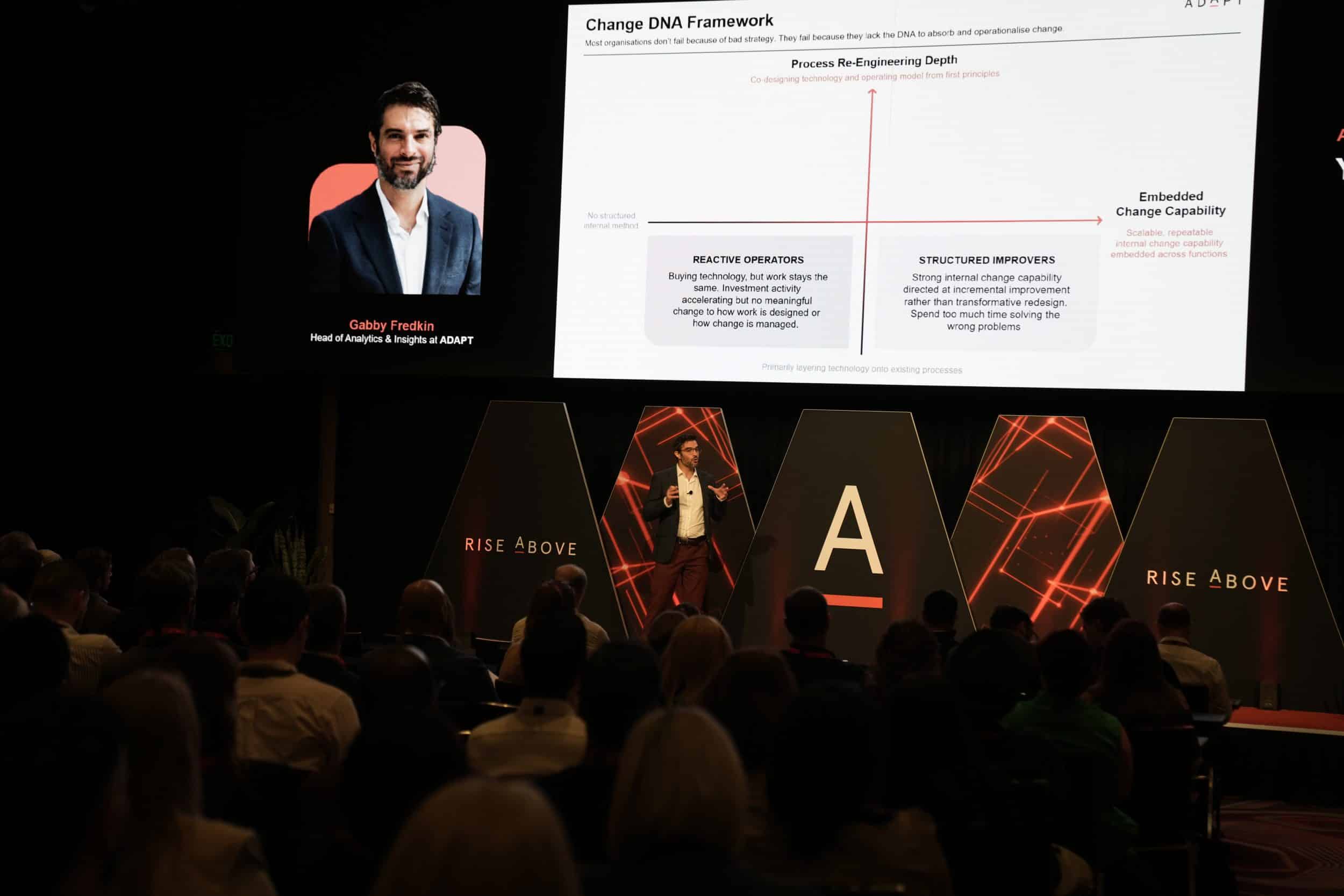


 Published Jun 23, 2026 in
Expert Presentations
Digital Transformation
Contributors
Gabby Fredkin
Published Jun 23, 2026 in
Expert Presentations
Digital Transformation
Contributors
Gabby Fredkin
If everyone has access to the same AI tools, why are outcomes so different?
In his keynote presentation at the 11th Digital & AI Edge, Head of Analytics & Insights Gabby Fredkin revealed insights from 1,500+ regional surveys of Heads of IT, Digital, Security and Finance to examine why some organisations are turning AI investment into measurable business outcomes while others remain stuck in experimentation.
His conclusion was that technology is rarely the differentiator.
The organisations creating the most value from AI are better equipped to absorb change, redesign work and build capability across the business.
Key takeaways:
- AI investment is widespread, but meaningful changes to work remain uncommon.
- Organisations create value when they combine capability building with process redesign.
- Execution discipline, governance and workforce readiness determine whether AI reaches scale.
Most organisations are investing, but not transforming
AI investment is widespread but meaningful change to how work is done is still rare.
There’s a growing disconnect between commitment and outcomes.
While AI has become a top executive priority, the majority of organisations are still stuck in experimentation, unable to translate pilots into real operational impact.
77% of organisations are investing in AI agents, yet only 7% report meaningful changes to work.
Around 80% say AI is either too early to measure or hasn’t met expectations, highlighting a systemic execution gap.
Change capability, not technology, determines outcomes
The biggest differentiator in AI success is how well organisations absorb change, not how much tech they deploy.
AI adoption is fundamentally a workforce and operating model challenge. Without the right internal capability and process redesign, technology becomes layered on top of existing workflows, failing to deliver value.
Organisations fall into four archetypes:
- Reactive: Buying AI but not changing work
- Structured improvers: Building capability but solving the wrong problems
- Reengineering leaders: Redesigning processes in silos
- Adaptive: Combining both capability and redesign to scale impact
Only the “adaptive” organisations consistently realise value because they embed change structurally across the business.
The path to value is disciplined
Progress comes from tightly scoped, value-led execution, not broad, ambitious transformation efforts.
Many organisations fail because they either chase large-scale transformation without foundations or invest in capability without clear outcomes.
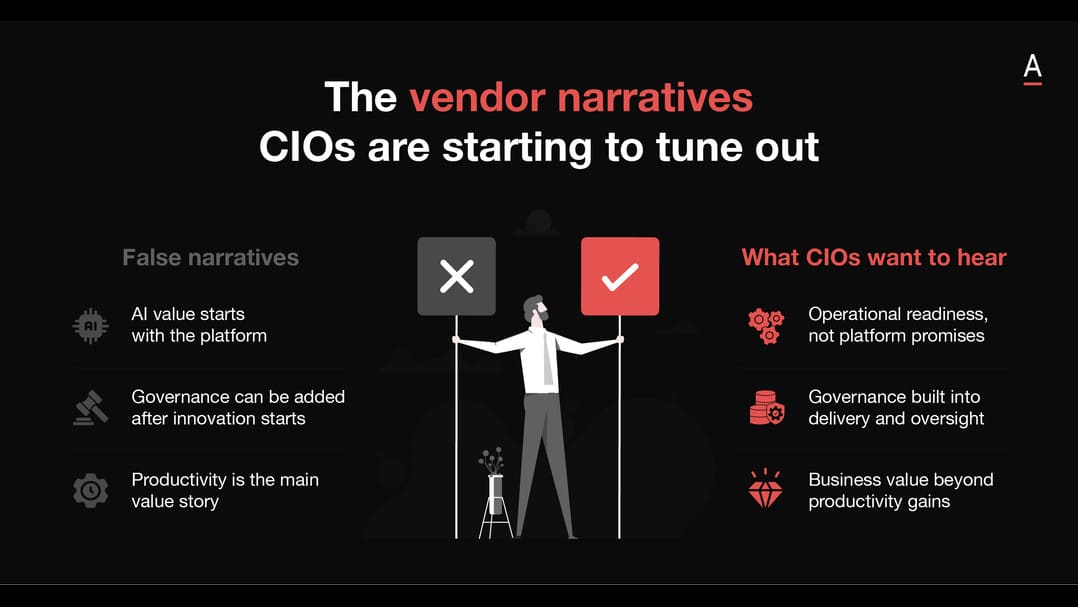
Success requires precise prioritisation, governance and alignment to real business problems.
Reactive organisations often blame budget constraints, but the real issue is credibility.
CFOs estimate ~40% of technology spend is wasted.
Meanwhile, structured improvers invest heavily (e.g., CRM transformations) but miss outcomes by solving the wrong problems.
Adaptive organisations, by contrast, prioritise measurable value, embed governance, and focus AI beyond productivity into customer-facing impact.
 Gabby Fredkin
Head of Analytics & Insights at ADAPT
Gabby Fredkin
Head of Analytics & Insights at ADAPT
As the Head of Analytics and Insights at ADAPT, Gabby Fredkin’s primary role is managing analysis to produce ADAPT’s actionable insights to identify trends supporting organisations in Australia.
With a passion for creating stories with data, Gabby is consistently rated as one of the top speakers at ADAPT’s events. In roundtable discussions, he specialises in using statistics to initiate thought-provoking discussions, enabling ADAPT’s customers to become more data-driven.
Using modern data science techniques, he provides ADAPT and its customers with confidence in the accuracy and validity of the information used for ADAPT’s research, advisory and events.
Working across artificial intelligence, machine learning, AI ethics, DevSecOps, end-user behaviour, and human-centred design, Gabby’s vast experience continues to grow, supported in part by a Master of Business Analytics from Deakin University.
Less Join the ADAPT
 Insider Community
Get the latest A/NZ market research and insights on the core trends impacting leaders.
Join the ADAPT Insider Community
Get the latest A/NZ market research and insights on the core trends impacting leaders.