














Australian AI tutor CurricuLLM takes its personalised learning model into England
In this interview with ADAPT’s Head of Programs & Value Engagement Byron Connolly, CurricuLLM founder Dan Hart explains how the platform’s England launch sharpens feedback, expands content access, and advances personalised learning.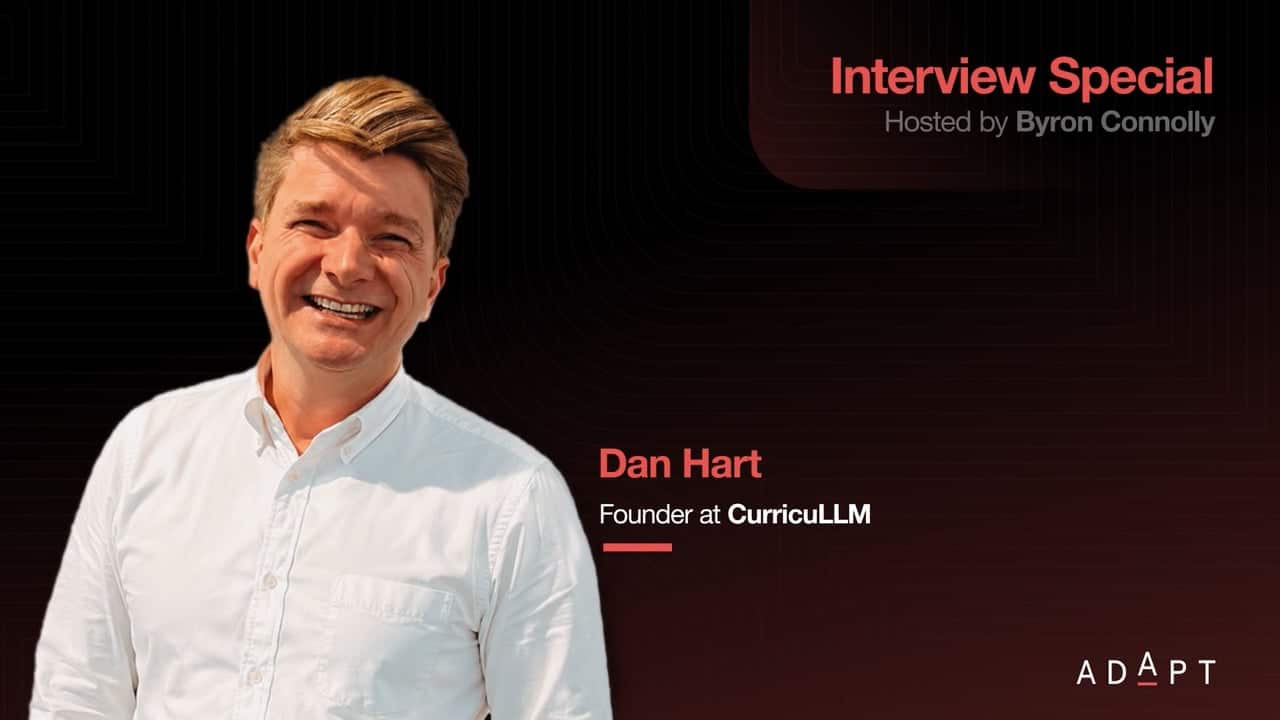


 Published Jul 15, 2026 in
Data & AI Strategy
Contributors
Dan Hart
Byron Connolly
Published Jul 15, 2026 in
Data & AI Strategy
Contributors
Dan Hart
Byron Connolly
CurricuLLM, an AI tutor designed for Australian schools, is launching across England’s national school curriculum says the product’s founder, Dan Hart.
The domain-specific tool, which Hart launched last year and is now being used by around 135 schools across Australia and New Zealand, assesses students’ performance and progress in real time and maps them against roughly 20,000 curriculum outcomes and content points.
Hart tells ADAPT that the timing of the England launch for CurricuLLM was partly a strategic business decision. Australian schools break for summer holidays over December and January, a period when Hart and his team can build but not test.
Entering the market in England, with its opposite seasonal calendar, gives the team a year-round feedback loop.
England also offers a technical advantage that has sped up the tool’s development considerably.
The UK Department of Education works with resource hub and online classroom provider, Oak National Academy, which maintains a machine-readable ontology that has been integrated into the tool.
The academy’s library of lesson plans and videos, covering every hour of school content, has also been folded in, giving English teachers a notably different experience from their Australian counterparts.
Hart hopes to strike a similar partnership with a content provider in Australia in the future.
Personalised learning and changing teacher roles
Beyond geographic expansion, Hart is focused on how tools like CurricuLLM are beginning to reshape pedagogy itself.
He argues that the typical school structure of one teacher, 30 students and a single pace has always been a function of resource constraints rather than pedagogical ideals.
He says AI doesn’t add more teachers to the classroom, but it does make personalised learning more achievable.
“To being with, that looks like using differentiation tools, including the kinds built into the curriculum, to make lessons more specific for groups of students.
“But over time, you’re going to be able to do that for every individual student, and that means not just personalising the content that the teacher wants to teach in class, but it also means catching up. Maybe they forgot something from a year ago.
“We can reincorporate that without the teacher having to work that out for the students or fetch last year’s content”, he says.
At the same time, students who have moved ahead in the curriculum can move ahead without waiting for the rest of the class.
Hart predicts the traditional grade-based structure of schooling will gradually erode over the next two to three decades, replaced by students mastering material at their own pace.
He draws on his own experience with high school chemistry to explain what’s at stake. Having missed the introduction to the periodic table, he found himself lost for the remainder of the subject, a gap he only closed as an adult.
“If you skip over the periodic table in chemistry, [you’re] pretty much disabled for the rest of the curriculum because everything is based on that. If I had access to some adults who could have helped me through that…then I probably wouldn’t have been in that position.”
Personalisation also shows up in unexpected ways.
Hart describes a student who used CurricuLLM to build Dungeons and Dragons characters purely for fun until the system recognised the interest and, without prompting, wove it into a geography lesson on migration.
It encouraged the student to build migrant personas using a format that they already liked.
Making sure learning is happening
Central to both CurricuLLM and Hart’s earlier creation, EduChat, is Socratic questioning, a deliberately frustrating style of interaction designed to keep students in what is known as ‘the proximal zone of struggle.’
This is the sweet spot between what the student can do independently and what they can achieve with guidance.
In the earliest, MVP version of CurricuLLM, the team were testing a feedback cycle that analysed students’ conversations and stored them in a knowledge graph.
The team gathered good data from the first version, but engagement was low.
“Version 2 and version 3 have had tremendous uptake, and we’ve now got teachers using it every day in those [Australian] schools and, increasingly in some of our trial schools, whole student populations”, he says.
Because the tool collects data on how students respond to each question, the team can tune difficulty ‘subject by subject’, watching for patterns such as students abandoning a conversation after a particularly hard jump.
“We’re always optimising for longer conversations because while Socratic dialogue is taking place, we can be pretty sure there’s learning happening.”
Integration challenges and the need for constant vigilance
Building an AI tutor for a federated education system has proven technically demanding. CurricuLLM documents differ in terminology and structure not just between countries but between states, and even between subjects within the same syllabus.
CurricuLLM’s solution has been to build an internal standard ontology that maps each jurisdiction’s terminology to a common structure before supplying the AI with a glossary bridging the two. Hart says the company is close to fully automating this onboarding process, which would allow CurricuLLM to expand into new markets far more quickly.
Meanwhile, safety and misuse prevention are ongoing priorities, and deploying AI to children under 10 years of age demands continuous testing.
A key feature of CurricuLLM for students is language translation.
This helps learners from language backgrounds other than English translate lessons into their home language if they haven’t understood what the teacher has said.
“What we don’t want the AI to do in that instance is to go into a Socratic dialog about, ‘What do you think the translation should be?’ We just want it to happen, so we provided instructions to the AI to skip Socratic questioning when doing a translation request.
One Australian student tried to hack this feature. He found a way to bypass some of the tool’s content filtering and get through one layer of its defences, a bug that has since been fixed.
“One smart student worked out that we were doing this just through interacting with [the tool] and then started trying to get it to respond by asking it questions in Base64 and then translating back to English.”
Base64 is binary-to-text encoding system used to translate the English language into a hexadecimal numbering system for computers.
“It’s super interesting that that happened; it’s obviously patched up but we keep on top of it by observing”, he says.
The tool runs a broad layer of safety monitoring beneath the surface, watching for behaviours like concealment, students forming parasocial attachments to the AI, or general confusion about whether they’re speaking to a person.
Rather than flooding teachers with individual alerts, CurricuLLM bundles recurring patterns into a single safety incident report, an approach Hart says was inspired by cyber security software.
The system also watches for academic offloading, where students repeatedly answer, “I don’t know”, hoping to extract a full answer, and flags disengaged students to teachers.
Hart is careful not to overstate the tool’s impact. He says uptake is lower in maths and science than in English and the humanities, a gap the team is now working to close.
“I would be delusional if I came here and said that this AI tool was amazing and that it was improving every student’s outcome. CurricuLLM is great where the student wants to learn, but it means they have to have a foundation of things already in place for that to happen.
“If they want to learn and they’re prepared for it and set up, then it can be a great aid, but it’s not going to help [with] other issues in the classroom that are related to [the student] wanting to learn.”
Next steps for the LLM
Looking ahead, Hart says CurricuLLM has already fielded interest from other countries, though the company is deliberately pacing its expansion.
England, for now, is primarily about balancing the sales and feedback cycle against Australia’s opposite school calendar.
But as CurricuLLM onboarding becomes increasingly automated, Hart expects that pace to accelerate, making it easier to expand into additional countries.
 Dan Hart
General Manager AI at Sydney University
Dan Hart
General Manager AI at Sydney University
Dan Hart works on the practical application of AI, with a focus on systems that are deployed at scale and used in daily operations. His work spans conversational AI, search, and personalised learning, with an emphasis on measurable outcomes and safe use. He bridges technical implementation with organisational needs, helping teams adopt AI effectively and safely.
Less Byron Connolly
Head of Programs & Value Engagement at ADAPT
Byron Connolly
Head of Programs & Value Engagement at ADAPT
Byron is a highly experienced technology and business journalist, editor, corporate writer, and event producer.
Prior to joining ADAPT, he was the editor-in-chief at CIO Australia and associate editor at CSO Australia. He also created and led the well-known CIO50 awards program in Australia and The CIO Show podcast.
Byron creates valuable insights for our community of senior technology and business professionals that help them reach their organisational and professional goals. He has a passion for uncovering stories about the careers and personal philosophies of Australia’s top technology and digital executives.
When he is not working, Byron enjoys hot yoga, swimming, running and spending time with his family. He completed the North Face 100km ultra marathon in the NSW Blue Mountains in 2012 and 2013.
Less Join the ADAPT
 Insider Community
Get the latest A/NZ market research and insights on the core trends impacting leaders.
Join the ADAPT Insider Community
Get the latest A/NZ market research and insights on the core trends impacting leaders.