













The real AI shift is the repricing of cognition, says Wisely AI co-founder
In this ADAPT Insider episode, Mark Pesce argues that AI is forcing businesses to rethink cost structures built around human cognition.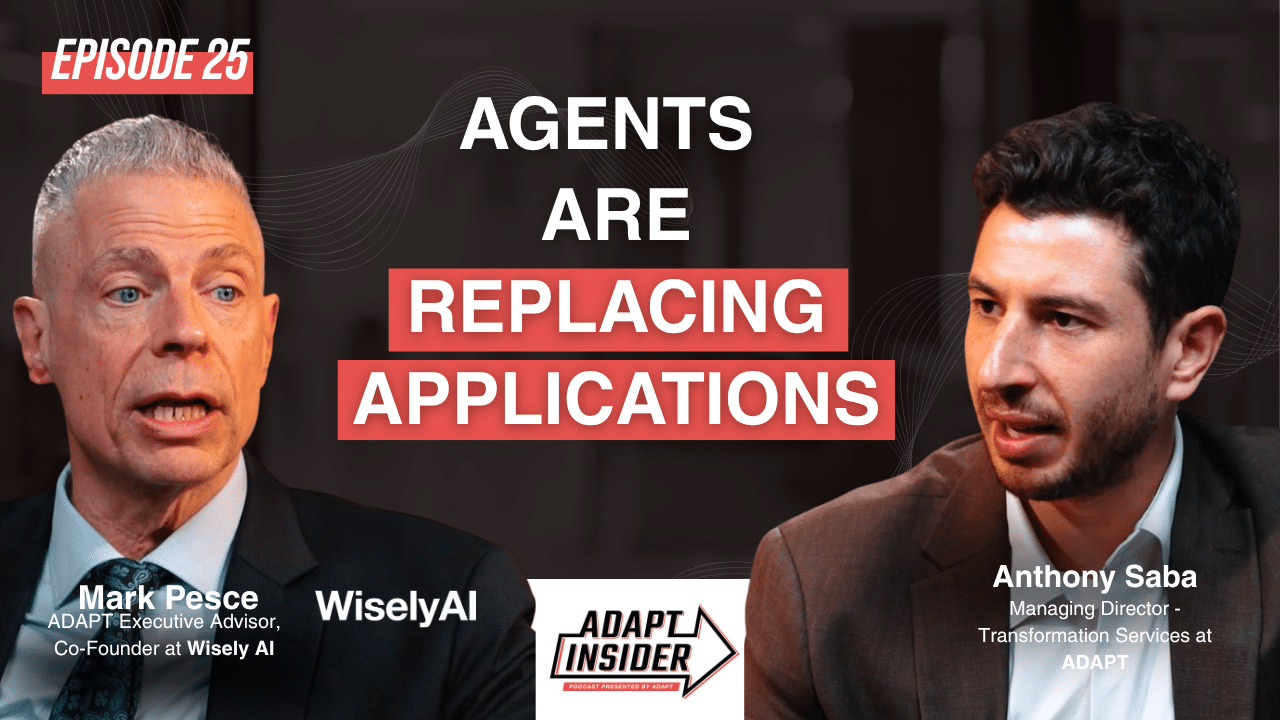


 Published Sep 28, 2026 in
Podcast
Data & AI Strategy
Contributors
Mark Pesce
Anthony Saba
Published Sep 28, 2026 in
Podcast
Data & AI Strategy
Contributors
Mark Pesce
Anthony Saba
For the first time, organisations can measure and buy certain kinds of cognitive work at scale.
Once thinking becomes measurable through tokens, the economics underneath a business start to shift.
Work that once sat inside roles, teams, and service models can now be broken apart, reassessed, and redistributed across people and agents.
In this ADAPT Insider conversation, Mark Pesce, ADAPT Executive Advisor and Co-Founder at Wisely AI, argues that this is why the current moment is bigger than another wave of software.
Businesses are not simply adopting a new tool. They are being pushed to rethink the cost of work, the design of processes, and the basis of competitive advantage.
Listen to the full episode on Apple Podcasts, Spotify, and YouTube.
Key takeaways:
AI is becoming infrastructure, which means the real shift is organisational design, not tool selection.
Cognition can now be priced more directly, forcing businesses to rethink where cost sits and where value is created.
The biggest gains will go to organisations that redesign workflows around agents and feedback loops instead of optimising old processes.
AI is becoming part of the infrastructure
Mark’s view is that AI will disappear into the background in the same way electricity did.
It will stop being treated as a standalone capability and become embedded across products, workflows, and decisions.
That is why he uses electrification as the comparison.
Businesses that once bolted electricity onto old factory designs were eventually overtaken by those that rebuilt around distributed power.
He sees the same pattern emerging with AI.
The larger gains will go to organisations that redesign around agents rather than leaving AI in a central team or treating it as a side feature.
The real pressure is economic
Mark is less interested in AI as a novelty than in what it does to the economics of cognition.
Once organisations can buy certain kinds of thinking directly, they have to revisit where expensive human effort is still essential, where agents can take on part of that load, and how that changes their margins and operating model.
That is where he sees the real disruption.
Many businesses are still running on assumptions formed before this shift began.
The bigger risk is discovering too late that the business is still priced and organised for a world that no longer exists.
Redesign will matter more than optimisation
Mark is clear that the biggest gains will not come from adding AI to existing workflows and hoping for incremental improvement.
The larger opportunity comes from redesigning those workflows around agents and feedback loops.
He points to software engineering as an example, where agents are already being used to detect issues, fix code, test changes, and redeploy continuously.
In that kind of setup, the work does not disappear, but it changes.
Humans move up a level, from executing repetitive tasks into designing, guiding, and improving the loop itself.
 Mark Pesce
Co-Founder, Wisely AI, ADAPT Executive Advisor
Mark Pesce
Co-Founder, Wisely AI, ADAPT Executive Advisor
Mark is a futurist, inventor, and thought leader in emerging technology. Best known as the co-inventor of VRML (early web 3D tech), he has decades of experience helping organisations anticipate and navigate disruptive change – bringing a unique lens to AI, the future of work, digital finance, education, and media.
Less Anthony Saba
Partner & Managing Director, Transformation Services at ADAPT
Anthony Saba
Partner & Managing Director, Transformation Services at ADAPT
Anthony leads the growth, strategy, and delivery of ADAPT’s Transformation Services and Go-to-Market Services Business Units.
He is driven by a core belief that we are experiencing a modern industrial revolution, one that will fundamentally reshape how business is done and pose serious challenges to the future of many Australian organisations and industries.
In this environment, success will not necessarily favour incumbents, or those with the deepest pockets or broadest resources, but rather organisations who are most able to ADAPT quickly and effectively to the evolving needs of their customers, employees and ecosystems.
With this belief, ADAPT is evolving into a critical platform that Australia’s enterprise leaders, local solution providers, and trusted advisors can rely on to succeed over the next decade.
By removing barriers, democratising access to proven expertise, promoting local ANZ innovation, and enabling rapid, meaningful connections between leaders and experts, ADAPT is committed to helping Australia not just survive, but thrive in the complex and uncertain times ahead.
Less Join the ADAPT
 Insider Community
Get the latest A/NZ market research and insights on the core trends impacting leaders.
Join the ADAPT Insider Community
Get the latest A/NZ market research and insights on the core trends impacting leaders.