








Rebuilding HR: AI’s impact on Australia’s fast-changing workforce
ADAPT surveyed 100 Australian HR leaders: over half lack accountability for AI agents. People & AI Edge speakers share how to close the gap.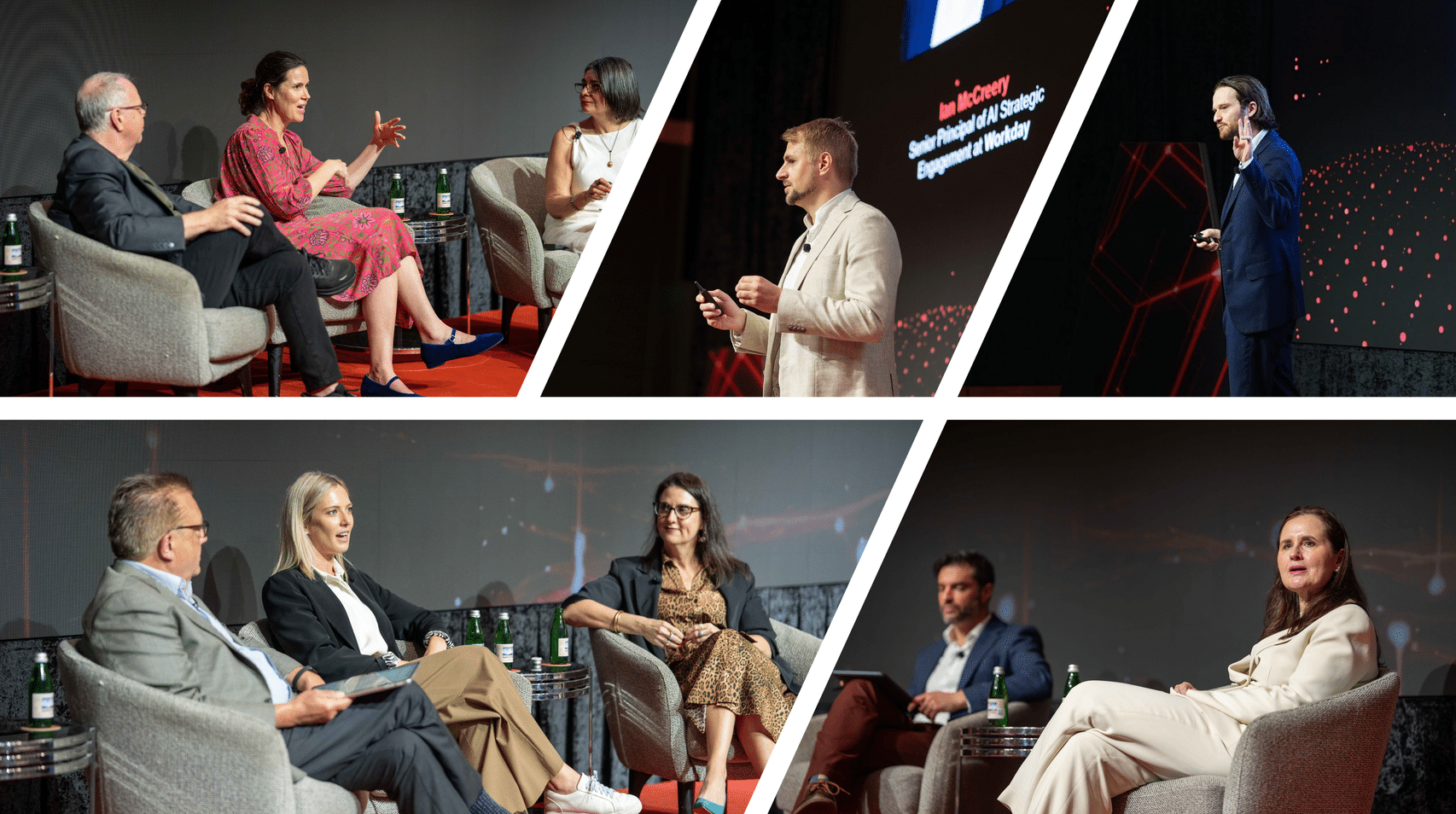


 Published Oct 29, 2026 in
Articles
People
Contributors
Byron Connolly
More than half of the 100 Australian human resources leaders surveyed by ADAPT in October say they have no defined frameworks or accountabilities for AI agents making decisions that directly affect their employees.
Only 3% say they have clear, defined decision rights.
As agentic and generative AI tools enter the workplace, people and culture executives are still grappling with how best to use and govern these technologies that can augment hiring processes and help manage human and agentic workforces.
For one-third of respondents, AI workforce strategies are ‘vague’ or non-existent while only 7% say their strategies are AI-informed. Like other C-suite leaders, HR executives are stuck in the pilot phase, with AI being used in just one or two processes.
Many of these executives gathered in Sydney on 13 October 2026 for People & AI Edge to discuss how they are responding to changing work environments, driven largely by technologies like AI. They’re focused on prioritising AI use cases, building agents, working with new vendors and developing platforms.
But, as ADAPT’s Head of Strategy, Joey Meynink, told the Edge audience, AI programs rarely stall because of the technology. They stall when leadership, talent and culture fail to keep pace with the tools.
“Where people are not focused is on leadership, talent and capability. This is becoming a bigger and bigger gap as people try to drive towards AI value”, Meynink says.
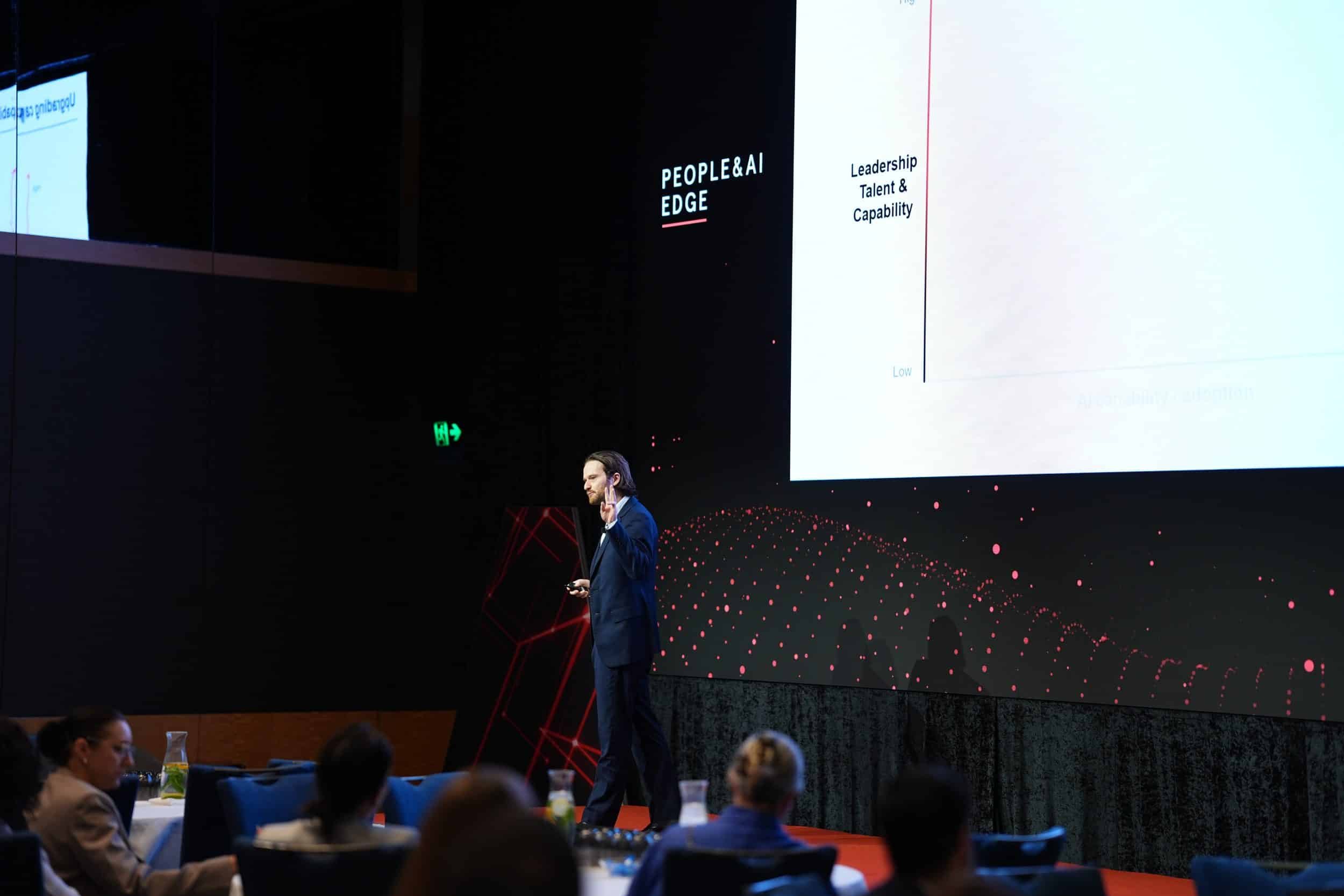
ADAPT’s Head of Strategy, Joey Meynink
ADAPT and Andy Foster of Clarity Partners call this the AI leadership velocity gap: organisations focus on tools, adoption and agents while leadership, talent and capability lag.
“Whatever models, tools or platforms you have access to, your competitors will have access to the same ones in a couple of years. What’s harder to replicate is the quality of your leadership, your people and your culture”, Meynink says.
ADAPT’s research identifies individuals, teams and cultures as three areas where leading Australian organisations are closing the gap. For example, the Commonwealth Bank trains 30,000 staff across three streams. It also maps every role, including the CEO’s, to tasks and skills, and reports $200 million in gross AI benefits in FY26.
“What I really like is that one stream focuses on leading with AI; a dedicated stream for executives and senior leaders to help them understand how to build long-term plans with AI”, Meynink says.
Meynink adds that leadership teams must also own AI together. He argues that organisations can’t just delegate AI strategy to IT; they need to create value across the whole business, not just in silos.
At CIO Edge in August, Telstra’s AI leader, Dayle Stevens, spoke about how the big telco is doing exactly this: mapping AI to existing company objectives and making sure it’s on every executive’s agenda.
The organisation has tied 5% of its executives’ bonuses to AI outcomes. This helps execs move past concerns about risk and speed up AI initiatives, including the telco’s AI agent, Ask Telstra, which shipped in six weeks and now supports more than 8,000 frontline staff.
When it comes to culture, AI is a people problem, not a technology problem, Meynink says. He highlights how Canva’s Chief People Officer, Jennie Rogerson, paused the company for a week of AI training, twice, so its people would not become the bottleneck.
More than 5,000 Canva staff were AI-trained and generated around 500 ideas through a hackathon.
Canva now runs an AI hub, holds fortnightly AI forums and has dedicated internal AI champions. But the real measure of success, Meynink says, is that AI use rose from about 70% to 90% in one week and 90% of staff use these tools every week.
“The main takeaway here is that people felt safe generating these ideas and presenting them back to their peers and the organisation. Jennie creates a safe environment for that.
“Canva didn’t just want to do the training and the hackathons and then have everyone move on and go back to BAU. They want to build systematic, deeper change capabilities within the organisation”, Meynink told the Edge audience.
Rethinking the nature of work: Workday’s Ian McCreery
For Workday’s Senior Principal of AI Strategic Engagement and keynote speaker, Ian McCreery, organisations have always been designed around the intelligence people provide. He says that is no longer the case, and HR leaders now need to rethink the nature of work itself.
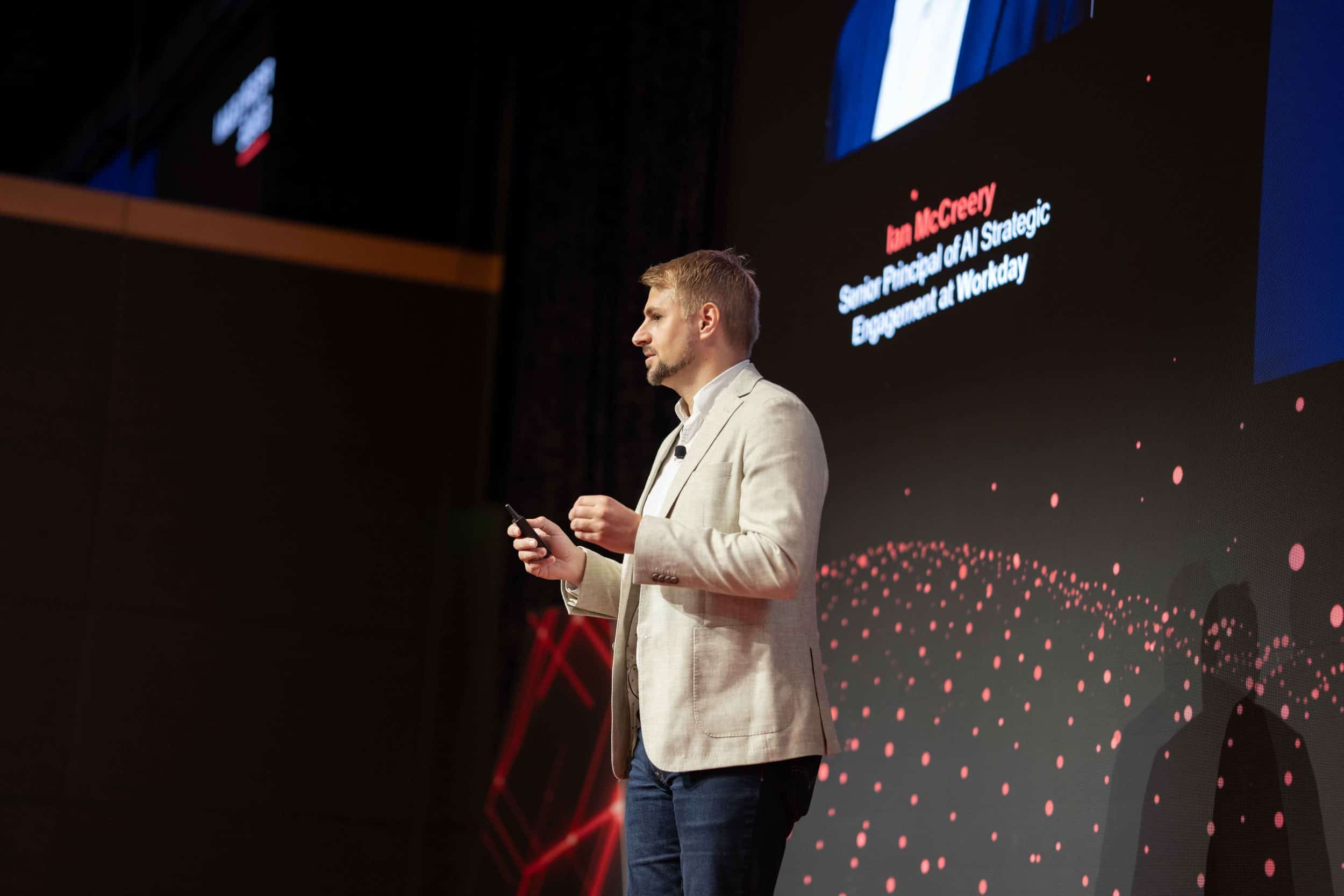
Ian McCreery, Workday’s Senior Principal of AI Strategic Engagement
McCreery, a former Head of Talent Acquisition at Optus, told the Edge audience that most organisations deploy AI to replicate what people already do.
“What many organisations do is implement AI or agentic AI in a way that mimics human performance and behaviour. But I think that’s a very limited view of agentic AI, which operates fundamentally differently from its human counterparts”, he says.
McCreery points to Wharton Professor Ethan Mollick’s argument that AI fundamentally alters the notion that our organisations were built around human intelligence.
When research that once took weeks takes minutes, the bottleneck becomes deciding what research to do. When content can be generated instantly, the constraint is knowing what actually matters to people, he says.
McCreery sees opportunity, rather than constraint, in that shift.
“I think what he [Mollick] is talking about here is where new types of human value come into play. This is going to be the last generation where humans work alone to get work done.”
The AI productivity tax: ‘happy dogs versus hard dollars’
In March, Harris Poll research commissioned by Workday found that workers across Australia and New Zealand are broadly positive about AI at work. They say it gives them some time back in their day, but does not deliver large, measurable impacts.
The first reason is what McCreery calls ‘the AI productivity tax’: the effort of sense-checking outputs, rewriting drafts and validating sources, a trade-off between time gained and time spent.
“Often, it requires humans to lean in manually to bridge the gap between disconnected systems and data that were never designed for the agentic era”, he says.
He says that most organisations bolt AI onto existing systems or narrow pilots and that fragmentation compounds the problem. Every disconnected AI tool gives more room for risk and errors and adds to the cognitive load on employees who have to manage and bridge systems.
The second reason, he says, is ‘happy dogs versus hard dollars’. Even the best AI tools return about 25 to 30 minutes per day, which often goes towards “walking the dog or clearing email.”
“Getting AI to hit the bottom line is fundamentally different from giving people time back to walk the dog. To deliver a hard dollar, you have to think about work itself”, he says.
McCreery’s advice is to break roles into tasks, identify the skills each task requires, and then decide deliberately whether each task should be led by a human, an AI agent or both. Workday does this with its own recruiters and has gained 34% in capacity.
“The value add isn’t the 34% gain in recruiter capacity. The value for us is asking what we can do with that reclaimed time and redirecting people to higher value tasks.”
For Workday, that means sharper job briefs, better interview debriefs and more time for strategic workforce planning and internal mobility.
HR’s post-COVID shift: PwC’s Karen Lonergan
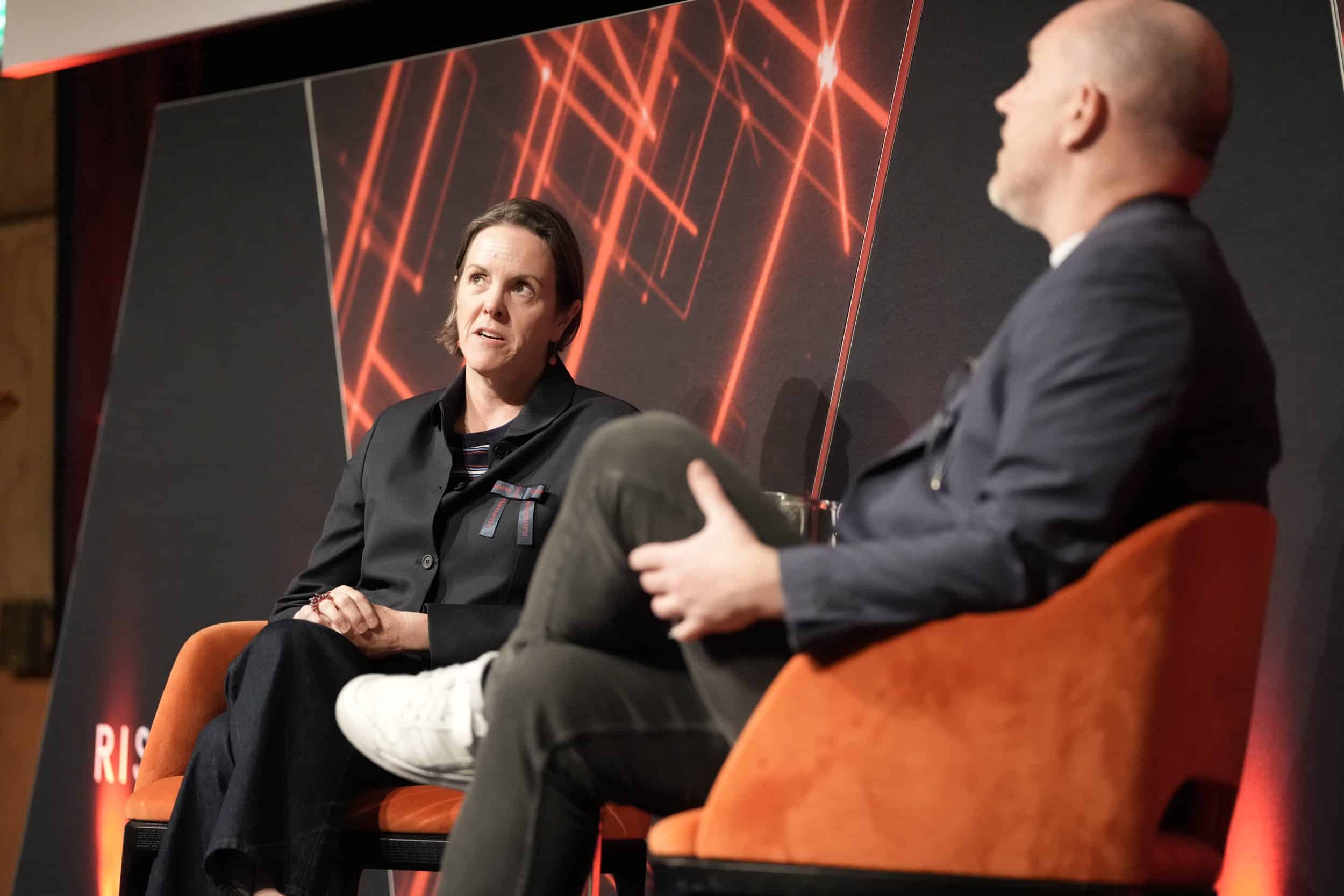
PwC Australia’s Chief People Officer (CPO), Karen Lonergan, is candid about what the job now demands. She says there’s never been a better, or more challenging, time to be a CPO.
“We’ve all collectively spent a lot of time over the years lamenting [not having] a seat at the table. My God, we’ve got a seat at the table right now”, she told the Edge audience during a fireside chat with ADAPT’s Gabby Fredkin.
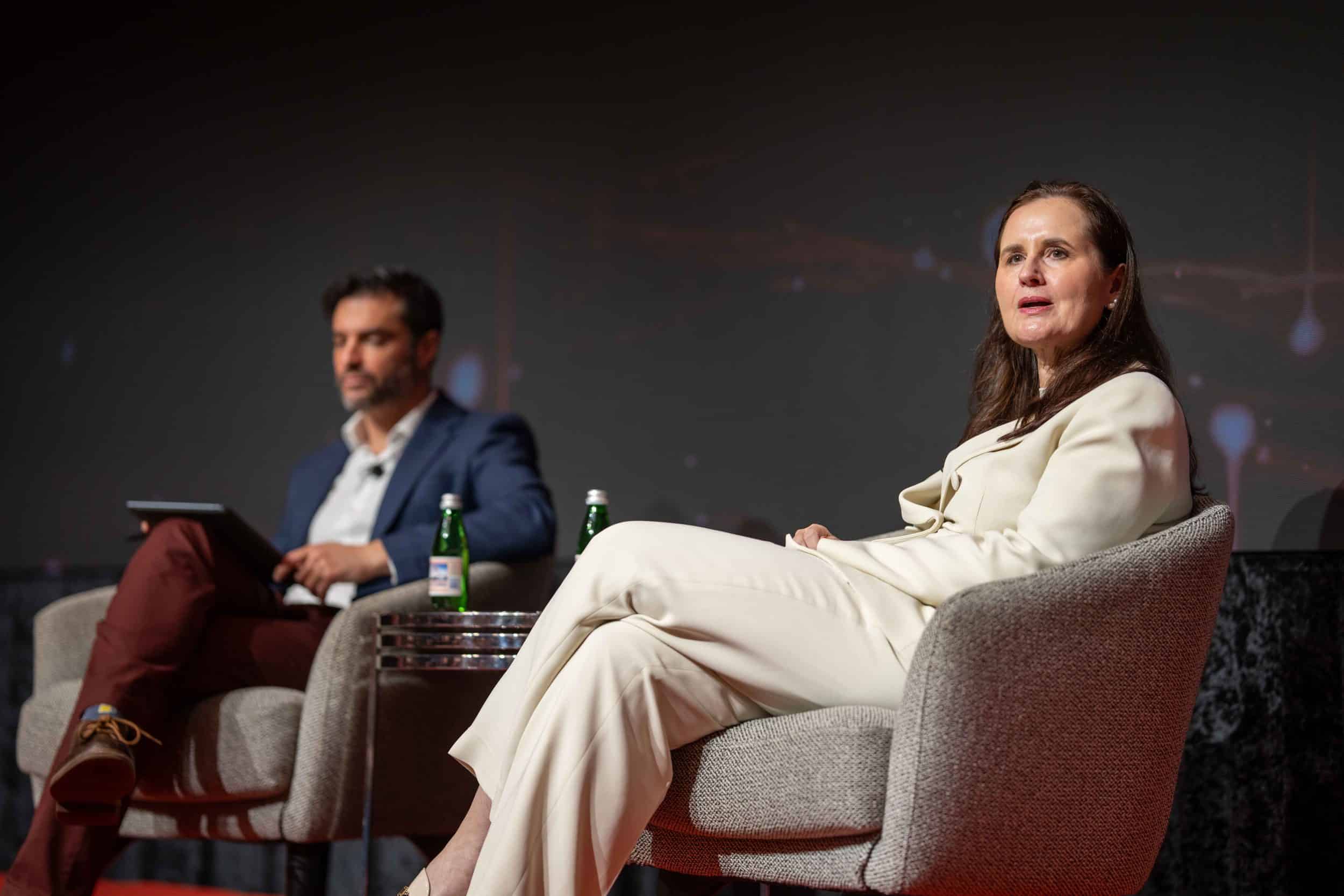
ADAPT’s Head of Analytics and Insights, Gabby Fredkin, with PwC’s Chief People Officer, Karen Lonergan
Lonergan, who has previously led people functions at Stockland, Qantas and Woolworths, says the shift began during the pandemic.
“It’s not that we weren’t relevant before. It’s that COVID was sort of the first time where, with just about all of the issues, we’re the first people everyone around the executive table looks at. We were just sort of coming out of that and then AI hit [with its] psychosocial risk and all of these other related concepts.”
She says that AI calls for a different kind of partnership between HR and the wider organisation from the one forged during the crisis.
“The scale of change is so significant, and it’s not going to be an ‘in and out’ kind of dynamic like COVID. The partnership has to be much more strategic rather than tactical.”
A thousand flowers bloom no more
PwC’s generative AI journey began about three years ago, with a focus on building people’s confidence to use the tools safely. Pilots helped staff find their own use cases, but over the past 12 months, the ‘let 1,000 flowers bloom’ approach has stopped being fit for purpose, Lonergan says.
One reason is cost: the organisation suddenly realised that AI isn’t free. The other is scale, as AI demands more strategic enterprise thinking and the ‘right sort of change wrapper around it’, she says.
Redesigning workflows, introducing agents at the right point and putting risk and governance controls around them is critical work. But the human experience is often missed.
“We’re not solving for AI; we’re solving for a bunch of other things that are important to us like managing psychosocial risk or sustainable high performance”, she says.
Psychosocial risk has been climbing the risk register for several years, driven by legislation, community expectations and changing attitudes to work, says Lonergan.
But she argues that treating it purely as a compliance issue misses the point.
“If you’re managing for the risk, I think you’re missing the bigger opportunity to actually build work in a way that lets people be more creative and collaborate better, which is more sustainable over the long term”, she says.
AI makes this more urgent, partly because trust is eroding across the global workforce.
“The level of trust in leaders is dropping like a stone. We know that if our people don’t trust us, they’re much less likely to engage with the benefits of new technology. It’s not just because you can get into trouble with the regulator if you don’t do it. It’s about how we make work sustainable”, she says.
Sitting in the ambiguity
Rebuilding trust requires a new style of empathetic leader, Lonergan says.
“Our context is so complicated that that old, ‘I’ve got all the answers’ type of leadership doesn’t work anymore”, she says.
A leader rolling out an agentic workflow may sense that it will need fewer people overall without knowing what that means for any individual.
Lonergan sees two traps. One is avoiding the conversation, leaving people feeling they’re not being told the truth. The other is giving a very certain answer when you’re not at all certain, which is something that diminishes trust.
“We’re trying to help our leaders get better at sitting in the ambiguity with people, providing clarity over time and answering what they can, rather than claiming certainty about an outcome and then being proven wrong”, she says.
Lonergan is also wary of giving agents names and personalities to ease adoption. She argues that doing so can create accountability problems when agents are blamed for issues.
Fewer tools, more people: Marissa Alley and Juliette Tobias-Webb
CPA Australia’s Chief People Officer, Marissa Alley, writes board papers faster than she ever has and they’re tighter and sharper as a result. But the speed comes with an unexpected side effect: a period of guilt in which she wonders whether she is losing her intellect.
It was a small, honest snapshot of leading an AI-augmented workforce. The technology moves fast, people adapt slowly and leaders are left managing the gap.
During a panel discussion moderated by ADAPT’s Senior Research Director, Matt Boon, Alley and Dr Juliette Tobias-Webb, a behavioural scientist and Professor at the AI & Cyber Futures Centre, argued that building an AI-augmented workforce has less to do with the tools than with how companies design the environment around their people.
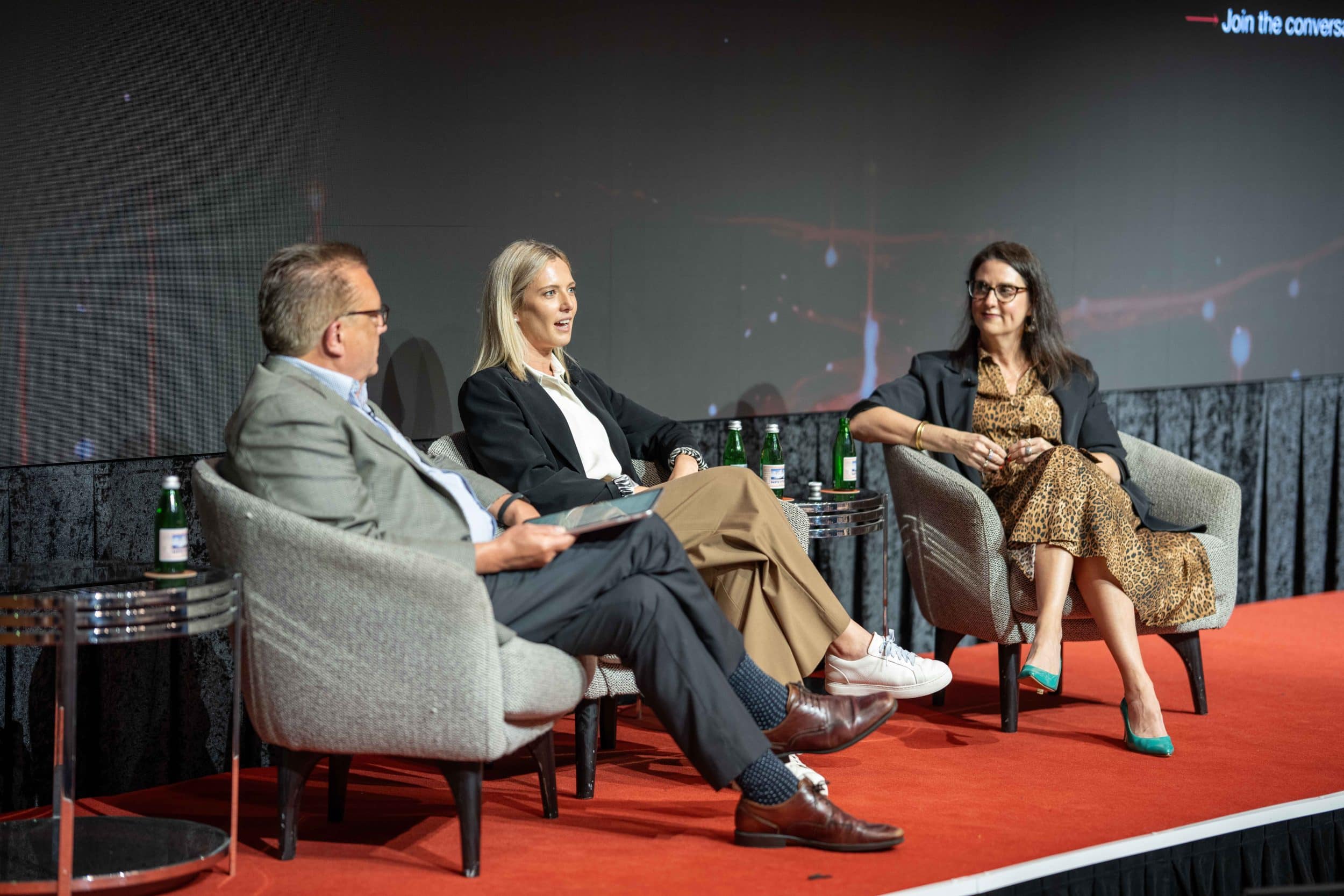
ADAPT’s Senior Research Director, Matt Boon, with behavioural scientist, Dr Juliette Tobias-Webb (centre) and CPA Australia’s Chief People Officer, Marissa Alley
CPA Australia started its AI program more than a year ago, partly in response to claims that the accounting profession would cease to exist. It anchored the work on member needs, but Alley admits the approach was too heavy.
With a risk-averse board, governance piled up until the strategy ran to 100 pages. Many of the original use cases are no longer relevant.
“If I were to start all over again, I’d do it entirely differently”, she told the Edge audience.
Alley says she would settle on a secure tool sooner and, in the case of CPA’s Copilot rollout, move straight to fluency: explaining what AI is and isn’t and involving staff early to bust myths.
The AI & Cyber Futures Centre’s Tobias-Webb says big-bang programs overwhelm people, pushing them into a ‘threat state’ in which they make worse decisions. Her advice is to let a team pick one use case, set clear parameters and build capability from there.
For staff worried about losing their intelligence, she starts with note-taking.
“Then they’re all suddenly like, ‘Oh, I can talk to my AI and take some notes.’”
When uncertainty is high, Tobias-Webb says people need clarity about what will stay the same, as well as consistent messages from every leader. She points to Australia’s Banking Royal Commission, where stated values say one thing while KPIs reward purely financial outcomes.
At CPA Australia, that clarity came from the CIO and CPO fronting the program together. Staff saw it was not just a tech initiative. Alley’s message that humans would stay in the loop carried weight because it came from people and culture.
Her advice for making AI a team sport is direct: get it on the table at the executive level.
The CEO is now the sponsor. Usage analytics help CPA find ‘champions in every function’ who act as AI ambassadors, while investment decisions go to a group spanning privacy, data and legal.
“It’s an enterprise-wide challenge. Who’s going to solve it? The people; AI isn’t going to do it”, she says.
Cues, chafe and confetti
Tobias-Webb offered three more levers. The first is cues and the shadow that leaders cast.
“People watch what you say, what you do, and where you spend your time. So, if you’re not leaning into AI, your team likely isn’t either”, she says.
The second is chafe, or friction. Execs should remove friction so people can start small, but they should also look hard at how roles are changing.
Behavioural research shows people tend to add rather than subtract. She cites a Lego experiment where participants paid to add pieces rather than remove one for free. Giving staff a say in what they drop makes adoption easier.
The third is confetti: letting people choose how they build AI into their work and rewarding them for it. That requires a clear view of what the human contributes and what the machine does.
Measure value, not just cost
CPA’s adoption numbers are strong. Microsoft data shows that staff at the organisation use Copilot about 35% more per person than staff at similar-sized Australian peers. They submit 83,000 prompts in a month and have built around 700 agents.
Yet Alley still can’t show her CFO a tangible financial return. She refuses to fall back on headcount cuts, preferring to redesign roles and build capabilities.
Tobias-Webb agrees, adding that treating people purely as a return on investment erodes that return over time.
“ROI [return on investment] is dead; it should be ROV or return on value”, she says.
Fix the cockpit
Tobias-Webb’s closing advice came from aviation, where the principle is that no error is pilot error. When something goes wrong, the industry fixes the cockpit rather than blaming the pilot. Onboard computers process objective data quickly and correct for human biases, while pilots bring care, context and judgment.
Incidents such as QF32, a passenger flight from Singapore to Sydney in 2010 that suffered a catastrophic engine failure, show the human is still essential. That approach helped make the sky one of the safest places in the world.
Tobias-Webb says that organisations rarely correct for these biases.
“We don’t come back to fixing what I would call that cockpit: our organisational ways of working”, she says.
Leaders who redesign that environment, rather than waiting for individuals to catch up, get the most from their people and their machines, she adds.
The workforce question AI can’t answer without HR: David Walker and Gemma Corke
Most organisations are pouring their AI budgets into the wrong problem, according to David Walker, former Group CTO at Westpac and DBS. He says research spanning about 105 countries and 40,000 data points identifies some 1,300 barriers to AI adoption.
“About 70% of these, when you cluster them together, are what you’d call organisational change issues”, he told the audience during a panel discussion with ADAPT’s Head of Product, Lisa Drum.
“About 20% have to do with internal technology and the data inside the companies, and less than 10% have to do with the AI technology itself”, he says.
Yet spending runs the other way, with most companies allocating at least 70% of their investment and time to AI tech. Walker says that’s the wrong way around.
Gemma Corke, Director of People for McKinsey in Australia and New Zealand, says HR now sits at ‘the intersection between strategy, tech and people’.
McKinsey makes HR its ‘lighthouse function’ for reimagining work, putting agents into its evaluation process and the way it allocates people to teams. But Corke warns against incrementalism.
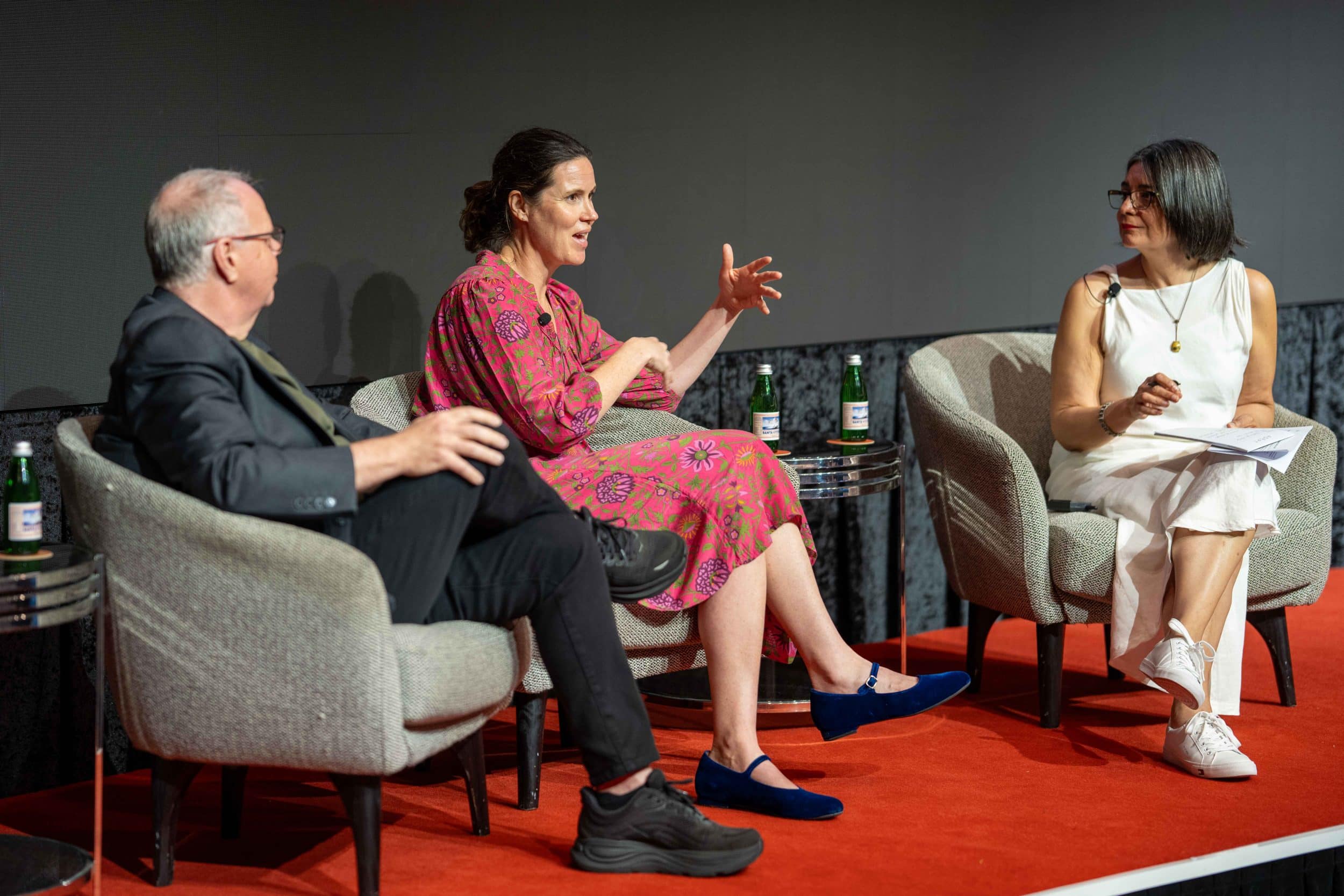
ADAPT Advisor, David Walker, with Gemma Corke, Director of People at McKinsey (centre), and ADAPT’s Head of Product, Lisa Drum
“Where they [agents] have sort of added in an agent in a step to be like, ‘Well, we’ve run the process like this forever, we’ve added an agent here, we’re agentic now.’ That’s where we fail. It’s actually [about] how we think end-to-end.”
Walker says the starting point is permission, not tools.
“A lot of people go into AI and AI training and give people tools. You’ve got to back up before that and give people perspective and the safety to allow themselves to change.”
The trouble with a human in the loop
Walker calls the familiar safety promise of keeping a human in the loop a ‘false statement’.
“The AI is getting so good now that it’s only one in 1,000 are the exceptions. What happens when a human is only trying to pick up one in 1,000? They’re not paying attention anymore.”
Organisations either need to redesign that role with the right incentives and structures or use technology to do the detecting, he says.
Corke flags a related skills gap, saying there are more people who are managing agents without having managed people before.
“They’re not necessarily used to interpreting the results and applying that judgment day to day”, she says.
What separates the programs that land
Corke says successful rollouts share four traits: leaders who visibly champion the tools, a clear explanation of why they’re being used, capability built inside the work, and reinforcement.
“Not everyone is motivated by delivering a few little savings”, she says.
On capability, she favours practice over courses. There’s only so much that can be learnt in the abstract; the training happens in the work. McKinsey now discusses AI use in performance reviews and showcases examples in town halls.
Walker says the scale of the shift explains why fewer than 1% of companies are doing AI well.
AI is a general-purpose technology, like electricity or the internet, he says, and these technologies take decades to become embedded in companies. He says few in the C-suite grasp that, other than the ‘HR or people person’.
His parting advice is personal.
“This is not something you can witness from the side. However you become that expert yourself, you need to be. You can’t lead through this without that”, he says.
What you may have missed at Edge
Only 8% of the Australian HR leaders who completed ADAPT’s survey for People & AI Edge say they have change embedded in how they operate and only 5% have scalable change capabilities.
This means that 95% rely on external consultants or ad hoc methods when deploying innovative tools across their organisations.
Perhaps the biggest question for HR leaders who attended People & AI Edge, and those who didn’t, is: when digital colleagues arrive at scale, who will manage them and be accountable?
As ADAPT’s CEO, Jim Berry, pointed out during his Edge keynote, two-thirds of survey respondents say responsibility is shared across lines of business, with the Chief Digital Officer playing a significant role. Only 9% of HR leaders expect to be fronting the agentic workforce.
“Nobody is expecting your function to run this emerging agentic workforce, not even you, and that’s going to be okay as long as this shared responsibility doesn’t become nobody’s responsibility”, Berry told the audience.
Ultimately, every agent an organisation deploys must have a named human owner who is accountable for how it behaves over time. That person can make the necessary changes if an agent starts going rogue.
A recent 60 Minutes report lays bare the unintended impacts of AI automation and agents on Australia’s workforce, particularly on older people who are desperately looking for work.
The report captures one side of the story, the risk of handing judgment to systems people don’t understand. What emerged at People & AI Edge was the other side: the fundamental disruption of the people operations function, which is more confronting for HR execs.
With almost two-thirds of organisations still lacking a documented AI workforce strategy, the speakers agreed that the technology is not the hard part. Putting people leaders at the centre of the work, while measuring value rather than chasing headcount cuts, is a better test of success.
AI reshapes work regardless, but whether it does so well depends on how deliberately organisations redesign roles, governance and culture around their people.
 Byron Connolly
Head of Programs & Value Engagement at ADAPT
Byron is a highly experienced technology and business journalist, editor, corporate writer, and event producer.
Prior to joining ADAPT, he was the editor-in-chief at CIO Australia and associate editor at CSO Australia. He also created and led the well-known CIO50 awards program in Australia and The CIO Show podcast.
Byron creates valuable insights for our community of senior technology and business professionals that help them reach their organisational and professional goals. He has a passion for uncovering stories about the careers and personal philosophies of Australia’s top technology and digital executives.
When he is not working, Byron enjoys hot yoga, swimming, running and spending time with his family. He completed the North Face 100km ultra marathon in the NSW Blue Mountains in 2012 and 2013.
Less Join the ADAPT
Insider Community
Get the latest A/NZ market research and insights on the core trends impacting leaders.