














More occupations face AI augmentation than automation, says JSA Acting Commissioner
At Government Edge, Jobs and Skills Australia Acting Commissioner Trevor Gauld outlines how job redesign, skills and inclusion can shape AI’s workforce impact.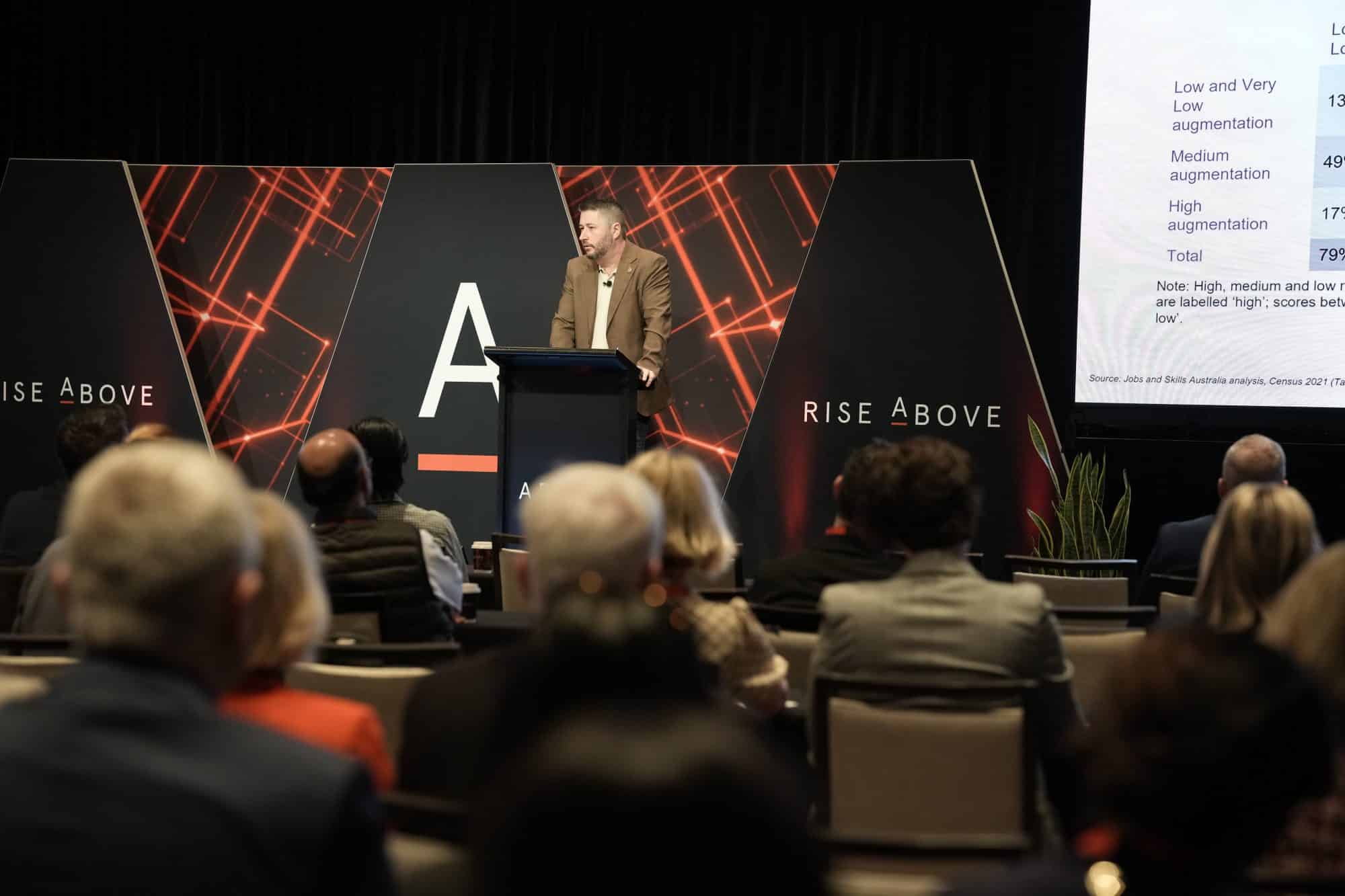


 Published Nov 16, 2026 in
Expert Presentations
People
Contributors
Trevor Gauld
Across the public service, workforce appetite for AI is running ahead of organisational readiness.
At Government Edge, Trevor Gauld, Acting Commissioner at Jobs and Skills Australia (JSA), drew on JSA research to show how augmentation, job redesign, skills development and inclusive workforce planning will shape Australia’s transition to generative AI.
Key takeaways:
-
- Map how AI could affect your workforce and the communities your agency serves.
- Pair technology investment with job redesign, manager capability and ongoing skills development.
- Protect entry-level pathways so productivity gains do not weaken future workforce capability.
AI exposure points to more augmentation than automation
JSA’s analysis suggests 79% of occupations have low or very low exposure to AI, and augmentation outweighs automation by 31% to 4%.
Only 2% of occupations have high exposure to both.
Trevor stresses that exposure measures potential impact, not job losses.
To date, JSA’s analysis has not identified any displacement from AI adoption.
The split varies by skill level. Higher-skilled occupations tend to skew towards augmentation, while some occupations with certificate-level entry pathways have greater automation exposure.
That makes workforce planning as important as technology deployment.
Organisations need to understand which tasks are changing, where human judgement still matters and how roles should evolve around new capabilities.
Productivity gains come from redesigning work
Time saved on existing tasks is the early productivity gain. The bigger opportunity lies in deciding how to use that capacity, whether that means improving work quality, meeting unmet demand, redesigning roles or creating new value.
Trevor names managerial capability, job design, role clarity and workforce skills as critical to turning technology investment into sustained productivity.
He also warns against work intensification. Removing routine tasks can strip out the natural pauses in a working day and leave employees with a heavier concentration of complex work.
JSA’s employer case studies show how far workforce preparation still trails technology.
In those case studies, 84% mentioned technology investment, compared with 25% for AI training and 18% for AI-focused leadership education.
If productivity gains are to last, technology and workforce investment need to move together.
Skills pathways need to survive the transition
Workforce adaptation depends on how people build judgement, practical experience and transferable skills over time.
Trevor cautions against cutting entry-level roles without weighing their part in developing future capability.
These positions let people make mistakes safely, build experience and develop the judgement that more complex work demands.
Demand for human capabilities is growing.
JSA’s analysis shows critical-thinking requirements have more than tripled in recent job advertisements, with strong growth in roles such as construction apprenticeships.
Access to AI’s benefits is uneven. Around one in five Australians are digitally excluded, and the gaps are larger for people with disability, First Nations people and regional communities.
When planning adoption, agencies need to consider the communities they serve as well as their own workforces.
Trevor’s research points to a transition shaped by deliberate choices about jobs, skills and learning. Success will come down to whether more Australians can build valuable skills, move into better opportunities and benefit from the changes AI brings to work.
 Trevor Gauld
Acting Commissioner at Jobs and Skills Australia
Trevor Gauld is Deputy Commissioner at Jobs and Skills Australia (JSA), where he plays a key role in shaping national skills strategies to meet Australia’s current and future workforce needs. With deep expertise in workforce development, vocational education, and strategic policy, Trevor brings a strong commitment to building a future-ready, inclusive, and skilled economy.
Prior to joining JSA, Trevor served as the National Assistant Secretary of the Electrical Trades Union, where he championed the rights of workers and advocated for quality training and apprenticeship pathways. His career began in the electrical industry, working across power distribution, transmission, maintenance, and construction—giving him firsthand insight into the importance of practical skills and lifelong learning.
Trevor has held numerous board directorships and committee roles, providing strategic advice on skills development, worker entitlements, immigration, trade policy, and climate and clean energy initiatives. His collaborative approach has seen him work closely with government, industry, unions, and education providers to drive innovation and improve outcomes for learners and employers alike.
He is a passionate advocate for equity in education, employment and training, and his leadership continues to support JSA’s mission to enhance skills mobility, workforce capability, and economic participation across Australia.
Less Join the ADAPT
Insider Community
Get the latest A/NZ market research and insights on the core trends impacting leaders.
Join the ADAPT Insider Community
Get the latest A/NZ market research and insights on the core trends impacting leaders.