








Nimble organisations are built for reinvention, says former Westpac and DBS Group CTO David Walker
In this ADAPT Insider episode, David Walker examines how organisational readiness, executive ownership and adaptable systems support AI value.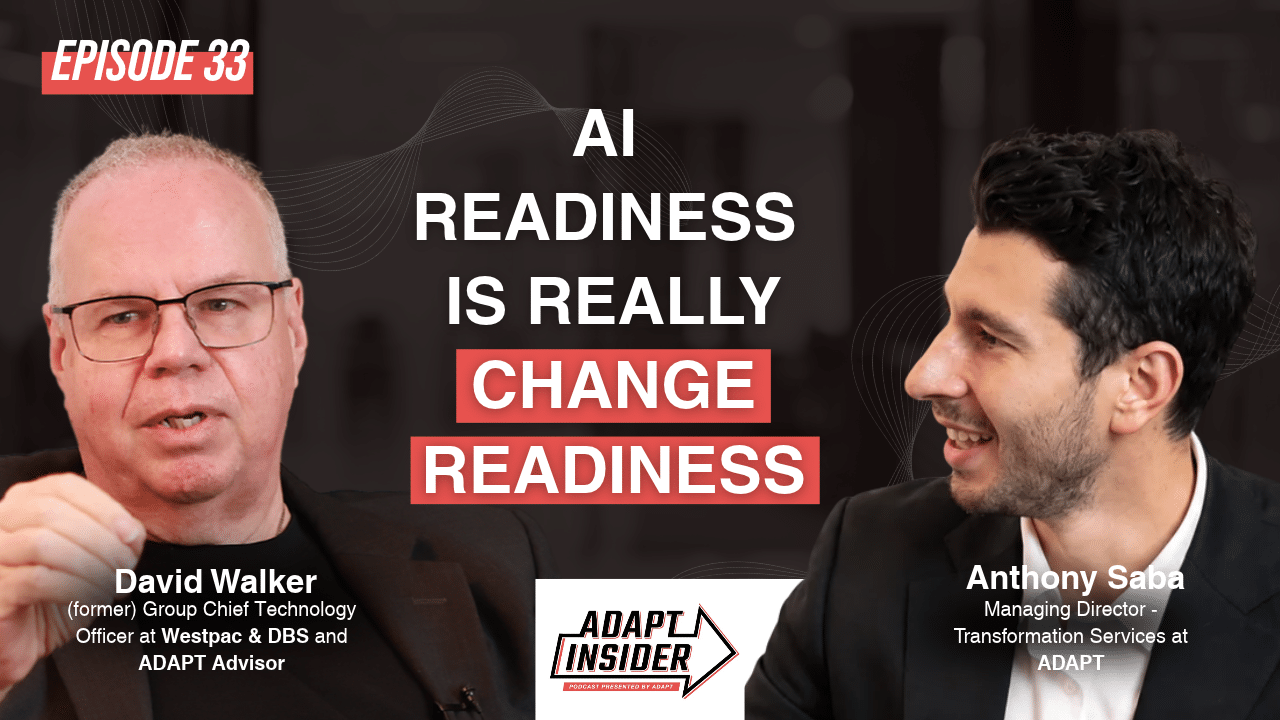


 Published Nov 16, 2026 in
Podcast
Digital Transformation
Contributors
David Walker
Anthony Saba
The ability to absorb AI rests largely on how an organisation leads change.
In this ADAPT Insider episode, David Walker, former Group Chief Technology Officer at Westpac and DBS and ADAPT Advisor, draws on his experience transforming DBS to explain how an ambitious purpose gives people permission to innovate throughout the organisation.
He also explores how enduring characteristics can guide technology strategy without locking the business into platforms that may quickly date.
Listen to the full episode on Apple Podcasts, Spotify or YouTube.
Key takeaways:
- Organisational nimbleness comes from a shared purpose, executive ownership and the ability to innovate throughout the business.
- Around 70% of the AI blockers identified in David’s research relate to organisational issues. Only about 9% relate directly to the technology.
- Technology strategies should define enduring characteristics that allow platforms and AI models to change as the market evolves.
A shared purpose gives transformation direction
Organisational nimbleness is the ability to change and reinvent when external conditions shift.
Technology can support that movement, but leadership determines whether people have the direction and authority to act.
During the transformation of DBS, fear of disruption initially supplied urgency.
The organisation later adopted a more ambitious goal: becoming the world’s best bank.
That purpose gave employees permission to think differently.
Innovation extended beyond a specialist team as people throughout the business learned the skills to develop new ideas and act closer to customers.
David says the CEO and executive team must visibly own the ambition. Consistent communication from senior leaders connects everyday decisions to the organisation’s purpose.
Organisational barriers restrict AI absorption
David’s research identified more than 1,300 barriers to AI across 105 countries.
Around 70% related to organisational factors such as leadership alignment, processes, training and finance systems.
About 9% related directly to AI technology.
Many organisations direct their investment towards that smaller technical category.
New tools may increase access to AI, yet they cannot resolve unclear ownership, inflexible processes or workforce capability gaps.
AI adoption measures whether people have access to the technology.
AI absorption reflects whether the organisation can redesign work around it and convert that access into sustained value.
Smaller and mid-sized organisations may hold an advantage because fewer layers can allow them to change direction faster.
Their opportunity lies in building the leadership alignment, learning culture and operating flexibility required to challenge established organisations.
Enduring characteristics protect strategic flexibility
Fast-moving technologies can make platform-led strategies vulnerable to technical debt and lock-in.
A technology selected today may constrain the organisation as the market evolves.
David recommends defining the destination through enduring characteristics.
Systems might be automated, built for change, organic, digital to the core and evergreen.
These characteristics give boards, employees and vendors a shared view of the intended environment without prescribing a fixed technology stack.
Deliberate abstraction layers also allow organisations to replace AI models as new options emerge.
Strategic flexibility comes from designing systems that accommodate change before individual technologies harden into long-term constraints.
 David Walker
(former) Group Chief Technology officer at Westpac & DBS and Chair of the AI Council at UNSW
David Walker was appointed Westpac Group’s Chief Technology Officer in August 2019. He led Westpac through its technology transformation – simplifying and merging the bank, building 4th gen cloud-native applications, establishing and operating evergreen platforms, leading Westpac’s AI technology, and building a culture of passionate and forward-thinking tech and emerging talent.
David began his technology career in 1987 as a software engineer, focusing on coding complex systems. After a decade of evolving his software engineering craft, David founded a data science consulting. Over the following decade, it became the number one expert data insights company in Australia and Southeast Asia.
For the last 15 years, David has held executive roles in large, complex organisations across the APAC region. Prior to joining Westpac, David was part of the leadership team of Singaporean bank, DBS. In his ten years there, David helped transform DBS from a traditional bricks and mortar bank with little brand presence or recognition outside Singapore, to being recognised as the ‘Best Bank in the World’ and the ‘Best Digital Bank in the World’ by leading global financial publication Euromoney.
Less Anthony Saba
Partner & Managing Director, Transformation Services at ADAPT
Anthony leads the growth, strategy, and delivery of ADAPT’s Transformation Services and Go-to-Market Services Business Units.
He is driven by a core belief that we are experiencing a modern industrial revolution, one that will fundamentally reshape how business is done and pose serious challenges to the future of many Australian organisations and industries.
In this environment, success will not necessarily favour incumbents, or those with the deepest pockets or broadest resources, but rather organisations who are most able to ADAPT quickly and effectively to the evolving needs of their customers, employees and ecosystems.
With this belief, ADAPT is evolving into a critical platform that Australia’s enterprise leaders, local solution providers, and trusted advisors can rely on to succeed over the next decade.
By removing barriers, democratising access to proven expertise, promoting local ANZ innovation, and enabling rapid, meaningful connections between leaders and experts, ADAPT is committed to helping Australia not just survive, but thrive in the complex and uncertain times ahead.
Less Join the ADAPT
Insider Community
Get the latest A/NZ market research and insights on the core trends impacting leaders.
Join the ADAPT Insider Community
Get the latest A/NZ market research and insights on the core trends impacting leaders.