








Building government for 2030 requires adaptable systems, skills and operating models
At Government Edge, leaders from ATO and IBM discuss how agencies can redesign work, strengthen trust and prepare services for AI and quantum.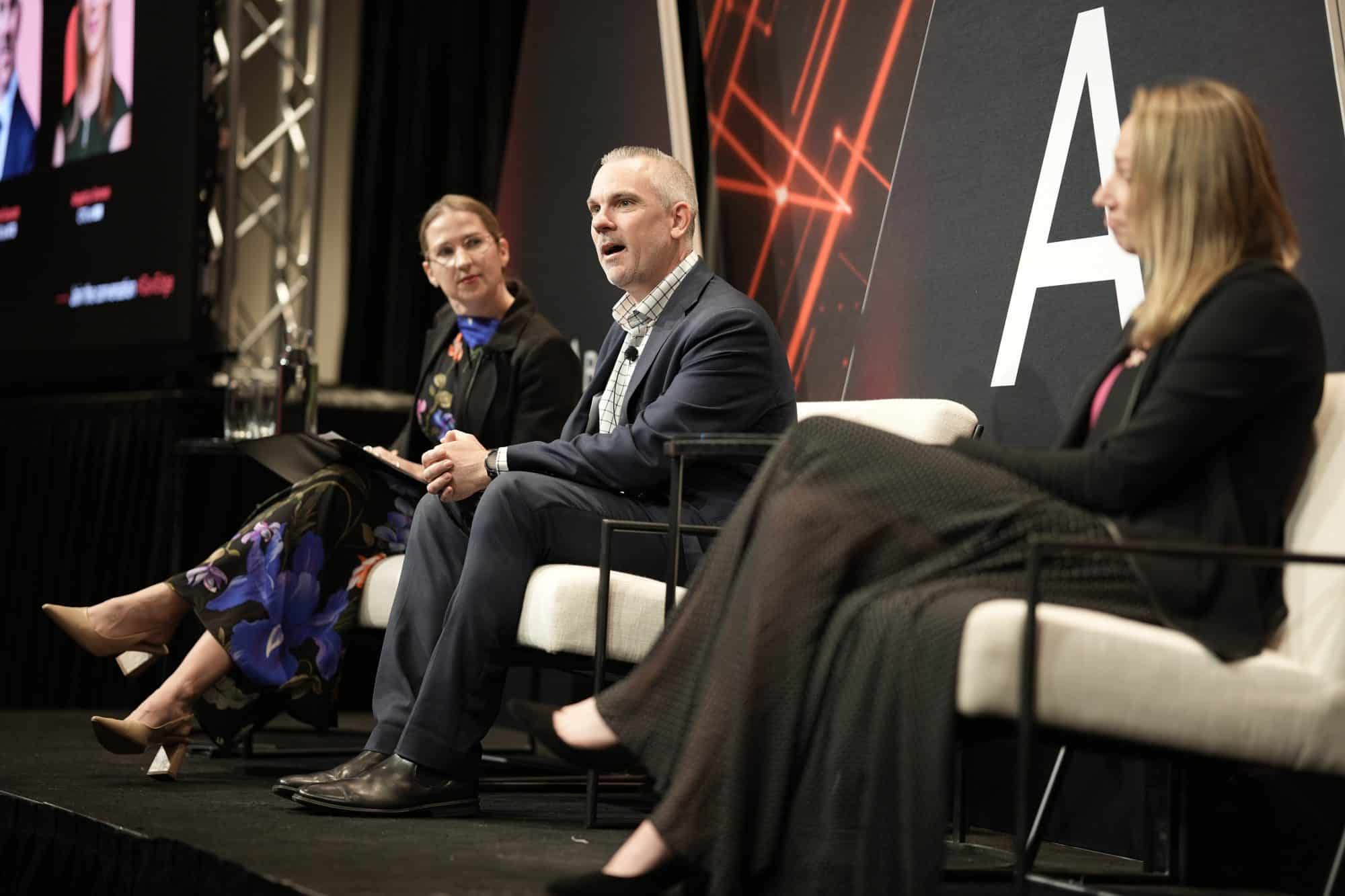


 Published Nov 16, 2026 in
Expert Presentations
Digital Transformation
Contributors
Mark Sawade
Angelica Veness
Kate Tollenaar
Government readiness for AI and quantum depends on the choices agencies make now about their people, systems and operating models.
At ADAPT’s 3rd Government Edge in Canberra, Kate Tollenaar, Director for Government at IBM, Mark Sawade, Chief Information Officer at the Australian Taxation Office (ATO), and Angelica Veness, CTO at IBM Australia, discussed how agencies can scale trusted AI and build adaptable, secure government services for the next wave of technological change.
Key takeaways:
-
- Challenge established constraints while keeping risk boundaries and service outcomes clear.
- Prepare for post-quantum security by mapping cryptography and building readiness into procurement.
- Define the outcome AI should deliver, then redesign work and measure the results.
Adaptable operating models start by challenging old assumptions
Mark says the pace of technological change is testing assumptions that have shaped government technology decisions for years.
He argues that agencies need to practise thinking beyond those constraints while staying clear about their risk profiles and the outcomes they are trying to deliver.
Angelica links that adaptability to unlearning established ways of working.
She says bringing together the people who understand an agency’s work with technology specialists gives teams a clearer view of what can change and where new capabilities can improve existing processes.
Building adaptability into systems and teams gives agencies more room to respond as technology changes.
Post-quantum preparation belongs in today’s technology decisions
The panellists describe post-quantum cryptography as a practical priority now.
Mark says the ATO is taking stock of the cryptography used across its systems and making sure new technology purchases can support post-quantum security.
He compares the scale of the work to Y2K, with the added uncertainty of not knowing when the threat will arrive.
Preparation also extends to system design and workforce capability.
Flexible, interoperable systems give agencies more options as requirements change, and existing teams need the skills and confidence to work with emerging technologies.
IBM’s Angelica Veness points to lessons from AI adoption, particularly the value of building curiosity and adaptability across the workforce as quantum technology develops.
Redesign the work, then measure the AI value
Agencies need a clear definition of the outcome before they can measure the value of AI.
Mark frames the choice around three options: handle more work with existing resources, deliver the same work with fewer resources, or improve the quality of the outcome.
Defining that objective gives agencies something concrete to measure and a clearer basis for assessing return.
Mark and Angelica both say scaling AI also requires changes to existing processes and service delivery.
Angelica describes IBM bringing HR and technology teams together to redesign processes around new capabilities.
Mark highlights broad access to Microsoft Copilot as a way to build staff experience with the technology, while measurable enterprise value is more likely to come from redesigning core processes and embedding AI and automation into service delivery.
The choices agencies make now about risk, system flexibility and how they redesign work will shape how effectively they absorb AI and quantum technology.
 Mark Sawade
Chief Information Officer at the ATO
I have over 24 years’ experience across the Australian Federal Government sector, having fulfilled a number of senior leadership roles in the Australian Bureau of Statistics, ComSuper, Department of Immigration and Border Protection, the Department of Education and Training, Department of Education, Skills and Employment, and the Department of Agriculture, Fisheries and Forestry.
 Angelica Veness
CTO at IBM
With more than 20 years’ experience helping organisations use data, AI and emerging technologies to drive business transformation. A strong advocate for human-centred design, Angelica believes technology delivers its greatest value when it is built around the needs of people, not just processes. She works with business and technology leaders across government and industry to turn innovation into practical outcomes that are trusted, adopted and scalable.
 Kate Tollenaar
Director for Government at IBM
Kate Tollenaar has broad corporate experience and has led teams across ICT, emerging technology, strategic planning, training design and delivery, and project management. An experienced leader in digital transformation and technology strategy, Kate is committed to contributing to organisations that champion technology to build responsible and sustainable systems for the future. Her specialist areas are data science and AI strategy, and digital strategy and implementation.
With academic and practitioner experience spanning humanities, strategy and computer science, Kate works effectively across disciplines and with stakeholders to deliver outcomes. She enjoys finding solutions to complex problems and contributes to a range of sectors through entrepreneurship, mentoring and not-for-profit programs.
Less Join the ADAPT
Insider Community
Get the latest A/NZ market research and insights on the core trends impacting leaders.
Join the ADAPT Insider Community
Get the latest A/NZ market research and insights on the core trends impacting leaders.