










Quantum security investment should follow business risk, says former Jetstar CIO
In this ADAPT Insider interview, Claudine Ogilvie shares how organisations can prioritise quantum security across assets, budgets and risk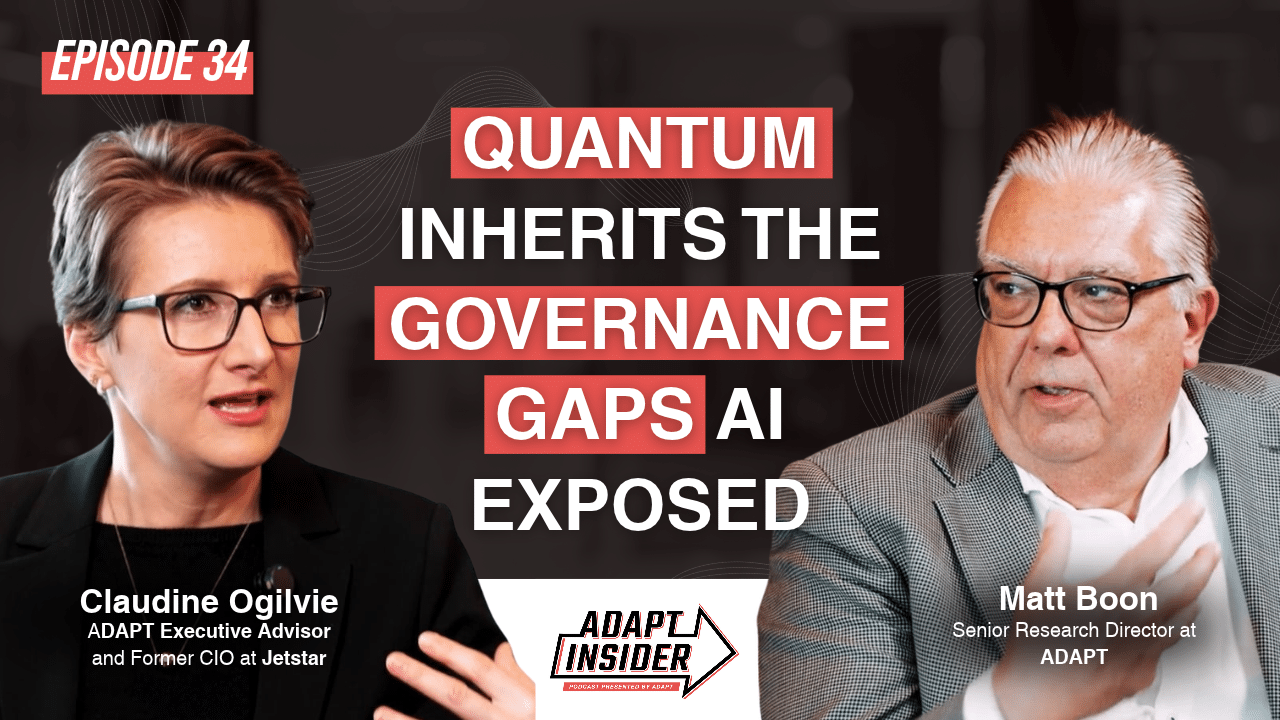


 Published Nov 23, 2026 in
Podcast
Data & AI Strategy
Contributors
Claudine Ogilvie
Matt Boon
Quantum security does not require every system to receive the same level of investment.
Organisations can apply post-quantum cryptography broadly while reserving more expensive protections for their most critical assets.
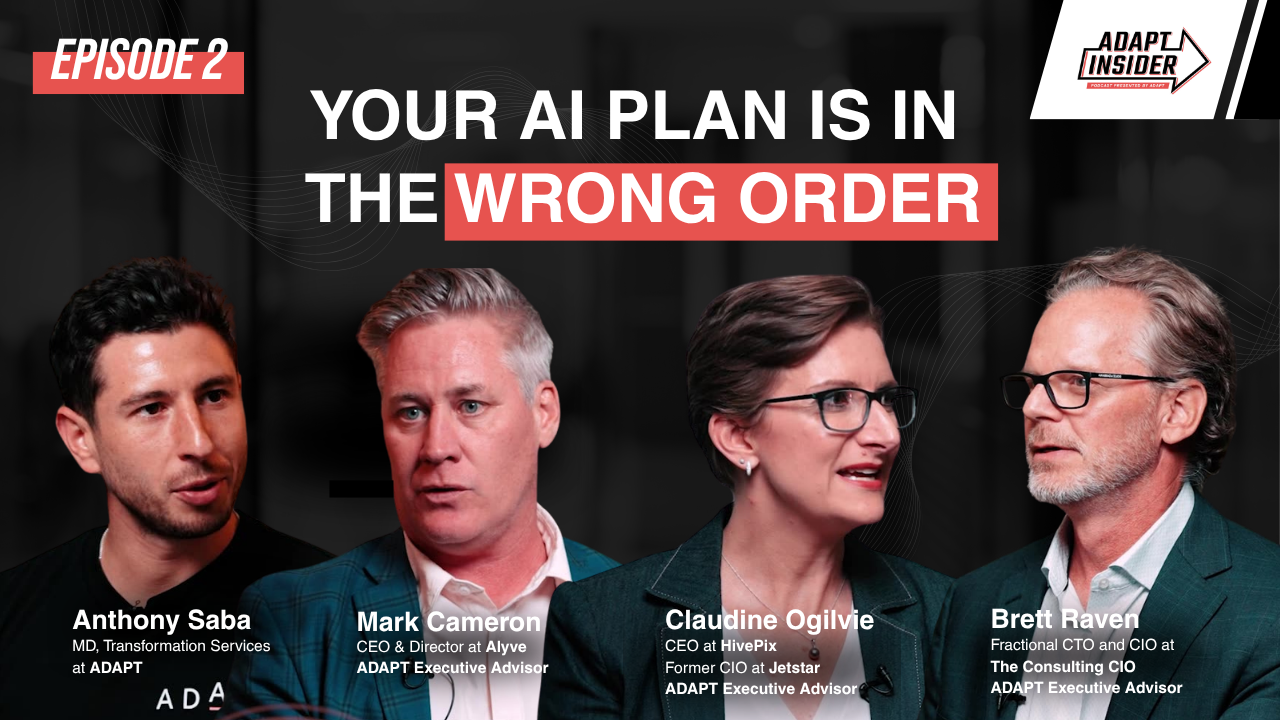
In this ADAPT Insider interview, Claudine Ogilvie, ADAPT Executive Advisor and former CIO at Jetstar, joins ADAPT Senior Research Director Matt Boon to discuss how organisations can sequence their response.
She connects quantum preparation to investment priorities, governance and the wider convergence of AI and emerging technology.
Listen to the full conversation on Apple Podcasts, Spotify, and YouTube.
Key takeaways:
- Post-quantum cryptography offers a practical first move because it is software-based, available now and suited to a multi-year implementation program.
- Quantum key distribution should be reserved for a small number of high-value or high-risk assets.
- Clear inventories, accountable owners and board-level risk appetite turn quantum preparation into an actionable business program.
Post-quantum cryptography provides a practical first move
Organisations are moving from awareness towards the long transition to post-quantum cryptography.
Its software-based approach makes it more accessible than infrastructure-intensive alternatives.
The scale and complexity of implementation still make it a multi-year program.
Beginning early gives organisations time to align budgets, technology inventories and delivery plans with their own risk exposure.
Claudine describes post-quantum cryptography as the more achievable action available to organisations now, even where quantum risk has yet to secure urgent board attention.
The strongest protection belongs around critical assets
Different systems carry different levels of business value and exposure, making prioritisation central to quantum security.
Quantum key distribution requires fibre, hardware and trusted nodes.
Its cost and architectural impact make universal deployment impractical for most organisations.
Claudine points to banking backbones and network infrastructure as examples of assets that may justify this stronger layer of protection.
Post-quantum cryptography can cover the wider environment, while quantum key distribution protects a smaller group of systems where compromise would carry the greatest consequence.
Governance connects quantum risk to business strategy
Quantum preparation relies on a clear view of the organisation’s assets, processes, suppliers and accountabilities.
Strong inventories and continuous monitoring help leaders identify where sensitive data sits, who owns each risk and which controls match the organisation’s risk appetite.
These foundations also support decisions across converging technologies.
AI autonomy, quantum computing and connected systems can introduce overlapping risks that cannot be managed through separate technology programs.
Translating technical choices into business priorities gives boards a clearer basis for investment and places accountability around the processes and suppliers involved.
 Claudine Ogilvie
Former CIO at Jetstar & APAC Tech Executive at Compass Group
Claudine is an accomplished entrepreneur, CEO, and board director with 20 years of leadership across strategy, innovation, and emerging technologies. She brings deep expertise in data, AI, quantum computing, and cyber governance, with a track record spanning aviation, finance, insurance, and consulting. Known for blending commercial acumen with visionary thinking, Claudine helps organisations navigate complex technology landscapes with confidence.
- Managing Director at O&O Consulting and CEO of HivePix.
- Board Director at Cuscal, Scyne Advisory, and formerly Youi Insurance.
- Former CIO at Jetstar Group and Lead technology, data businesses and innovation
at Compass Group APAC. - Past leader of Consumer and Industrial Markets at KPMG.
- Recognised in Australia’s Top CIO50 (2016).
- Holds qualifications from MIT (Quantum Computing), GAICD, UTS, and ESC Reims.
- Active adviser and coach to leaders in innovation, diversity, and ESG.
 Matt Boon
Senior Research Director at ADAPT
Matt Boon is the Senior Director for Strategic Research at ADAPT, responsible for directing and developing research content and positions.
For over 30 years, Matt has worked in research and advisory, including senior leadership roles at Gartner as Principal Analyst, Research Director, and Managing Vice President, where his 18 year history included working with Dell, Microsoft, and many others.
Throughout his career, Matt has been a sought after and highly respected authority on the local and global IT landscape. He interacts with executives daily, bringing together groups of C-suite leaders to discuss and prepare for the challenges and opportunities they face.
At ADAPT, Matt hosts numerous industry-leading business and technology events which Matt chairs, including the yearly Security Edge conference, delivering unique market trends and white-papers, advising executives across the technology provider landscape to make informed IT decisions.
When he is not working, Matt enjoys walking the many trails of the NSW Southern Highlands, travelling and listening to music. He is also partial to a good steak and nice glass of red wine.
Less Join the ADAPT
Insider Community
Get the latest A/NZ market research and insights on the core trends impacting leaders.
Join the ADAPT Insider Community
Get the latest A/NZ market research and insights on the core trends impacting leaders.