

















Tech Boosters Co-Founder on turning visibility into opportunity for women in tech
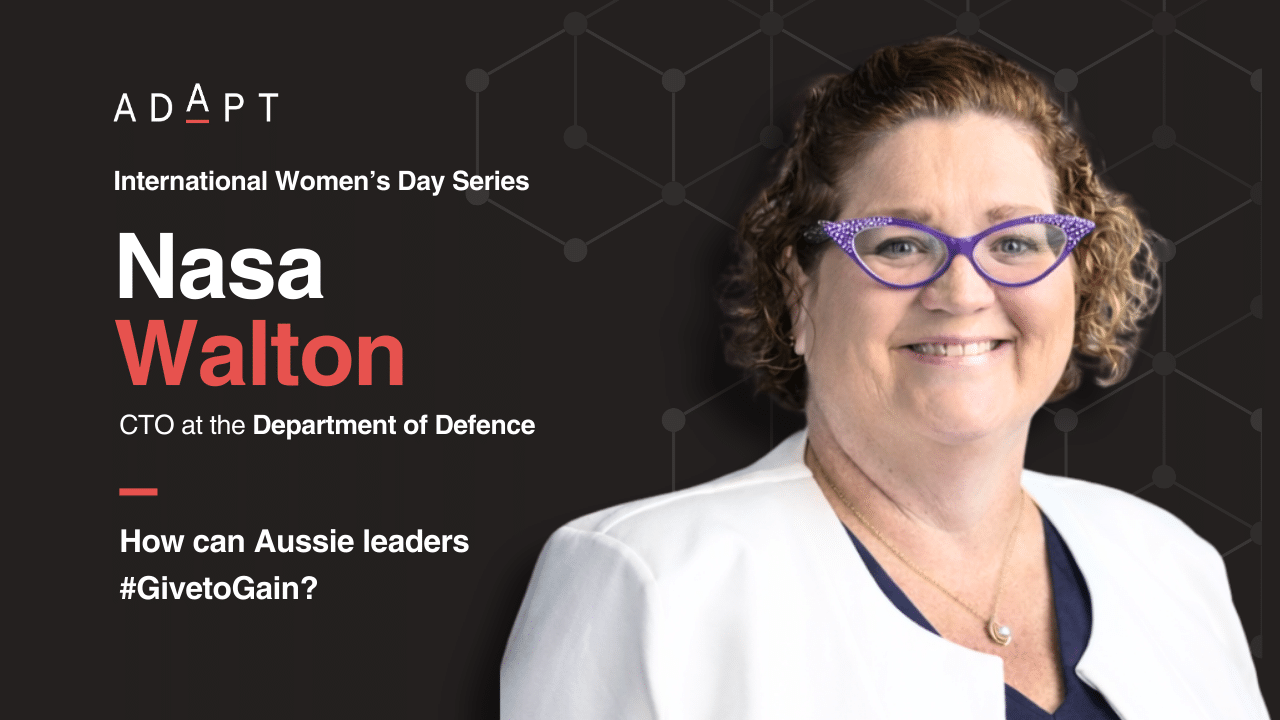
Samantha McIntyre, Tech Boosters Co-founder and ADAPT Advisor, shares how visibility, sponsorship and flexibility keep women advancing in tech.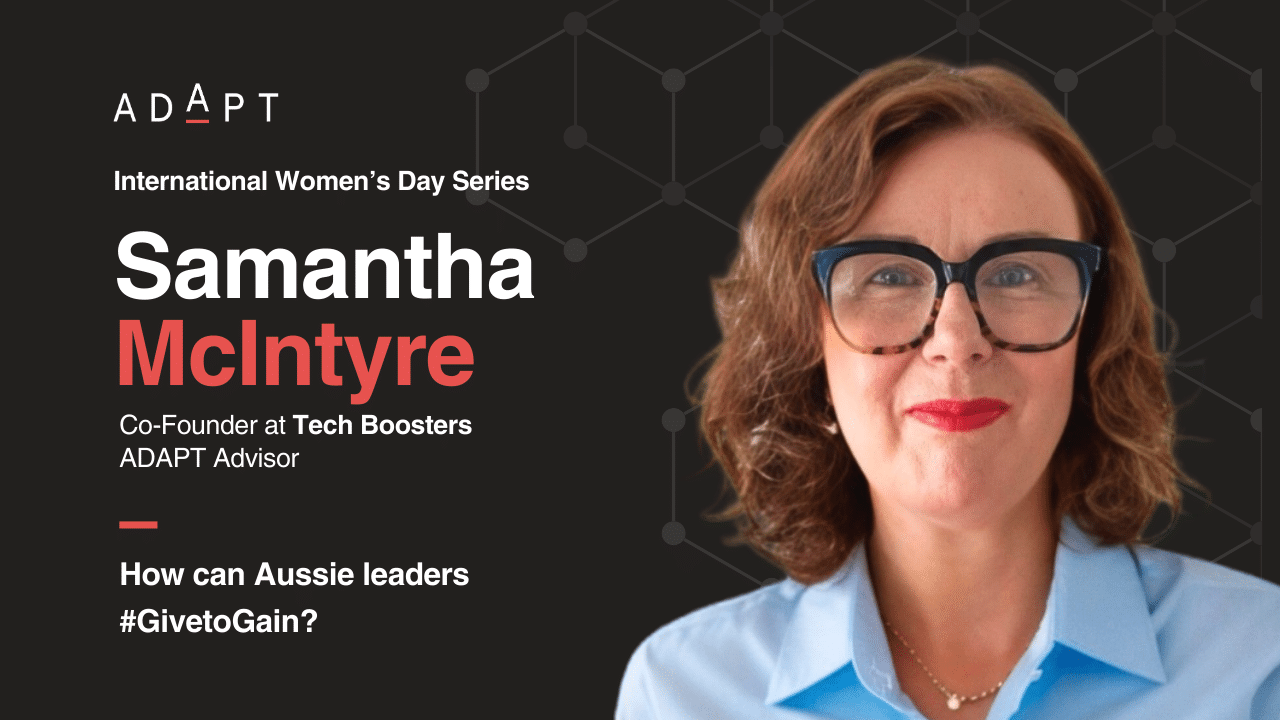


 Published Mar 2, 2026 in
Peer Insights
People
Contributors
Samantha McIntyre
Justina Uy
Published Mar 2, 2026 in
Peer Insights
People
Contributors
Samantha McIntyre
Justina Uy
Samantha McIntyre, Tech Boosters Co-founder and ADAPT Advisor, shares how visibility, sponsorship and flexibility keep women advancing in tech.
Samantha has spent more than 30 years in technology, including over 15 years in C-suite leadership roles as a CIO.
She has built teams, delivered major transformations, and navigated industries where women still carry an uneven burden, expected to solve problems fast, stay resilient, and keep moving, even when credit and opportunity do not follow at the same pace.
Many women do the work, but too many stay invisible while doing it.
Progression depends on being known by the people who make decisions, supported by leaders who advocate, and protected from assumptions that quietly remove options before a conversation even happens.
As part of ADAPT’s International Women’s Day 2026 celebration, Content Marketing Manager Justina Uy spoke with Samantha about the career moment where advocacy changed her trajectory, the leadership behaviours that shift representation, and the practical steps women can take to turn consistent delivery into influence and opportunity.
Visibility is a career lever, delivery alone is not enough
Samantha sees a familiar pattern in technology careers.
Women are often the ones carrying delivery load, solving urgent issues, and absorbing the complexity that keeps teams moving.
That contribution is real, but it does not automatically translate into progression.
“I do see a number of women in their careers being very busy solving everyone’s problems, but not necessarily being visible or speaking up enough about the work that they do.”
She links visibility to something even more practical, proximity to decision makers.
High potential can stall if the right people do not know you, or if you only show up once decisions are already made.
“It’s around creating relationships with the decision makers in an organisation and them knowing who you are. And I think it’s about your boss’s boss knowing who you are.”
Samantha is candid that she has learned this the hard way.
“I think I in some of the roles that I’ve been in, I haven’t done that well enough, and that has kind of jeopardised me, you know, in ways.”
Her advice to ambitious women is to keep delivering, but treat networking and visibility as part of the job, especially if you want to become a decision maker.
Advocacy is built, not granted
When Samantha looks back on moments where her career shifted, she points to one relationship that made the difference, a senior woman at Woolworths who supported her without being her direct manager.
Samantha was running a large team and a major program of work, but she did not report into the CIO.
She had come back from overseas, had a one year old at home, and had stepped into a large role inside an organisation with deep internal networks.
Rather than waiting for a sponsor to appear, she built the relationship deliberately.
“I just found the opportunity to have coffees with her and just developed a relationship with her. I used to use her as a sounding board for giving me advice on how to navigate such a big organisation.”
Over time, Samantha believes that relationship turned into advocacy that mattered inside the leadership system.
“I think behind the scenes, she worked to elevate me in that IT team.”
The outcome was tangible: she moved into a direct reporting line to the CIO and went on to run IT for Woolworths – Fuel Division.
For Samantha, that transition captured a broader truth about progression.
“It really took for someone to kind of see that.”
Advocacy does not always arrive through formal programs.
It often comes through relationships built with intent, consistency, and trust.
Measure what matters if you want to change outcomes
When Samantha talks to leaders about improving representation, she does not start with slogans.
She starts with measurement and accountability.
“Know your numbers. Right? So know how many women that you’ve got in your teams. Know what the levels are. Know what your attrition looks like, know what your retention looks like, know your numbers.”
From there, she encourages leaders to audit what actually happens, where roles are sourced, who is doing the hiring, and which candidates are being supported through the process.
She uses a phrase she often relies on in technology leadership.
“Follow the work.”
For Samantha, the data matters because it stops leaders hiding behind vague narratives.
If attrition spikes at a particular level, or women are missing from leadership layers, the numbers tell you where your system is failing.
Then the work becomes specific, change the process, adjust leadership structure, and build the conditions that keep women in the pipeline.
Middle managers move the dial
Samantha has seen a practical lever work repeatedly, women in middle management lift representation faster than broad targets or one off hiring pushes.
“I’ve been able to increase the women in my teams from, you know, 20% up to like 40% in an 18 month period of time. And that’s through having what I find is having women in middle management.”
She explains why it works.
Women leaders tend to hire more women, bring different networks, and remove biases that often sit inside job design, shortlists, and interview dynamics.
“They will hire more women. They will have networks of women. They don’t have some of the biases around the roles.”
She also calls out a common excuse she hears in technology leadership circles.
“I often talk to a lot of male colleagues in IT and they’re like, oh, I can’t find women.”
Her response is blunt because she sees the pattern as a choice.
“Women are not just going to land on your desk.”
If leaders want different outcomes, they need to change where they look, how they hire, and who they empower to lead teams in the middle layer that shapes culture and careers day to day.
Assumptions are the fastest way to block opportunity
Samantha is clear on one of the most damaging behaviours she still hears in senior rooms, assumptions about what women want, especially after motherhood, without ever asking.
“I’ve just heard around the boardroom table, oh, she’s had a baby, she wouldn’t want to go on that trip, without ever asking.”
She describes how this shows up as underestimation, and how quickly it can remove options.
“I think a number of women are underestimated. I think we assume what women need.”
Earlier in her career, she took an extreme approach to protect herself from those assumptions.
“I unfortunately didn’t really tell people in the office that I had young children because I didn’t want people to make assumptions.”
Her point is that women should not have to hide parts of their lives to be taken seriously.
Leaders should ask, listen, and design support around what the person actually needs, rather than letting stereotypes make decisions in silence.
Flexibility works when outcomes are the standard
Samantha sees flexibility as a practical retention lever, especially when leaders stop treating it as a compromise and start treating it as an outcomes decision.
“I’ve had senior women running departments who work four days. And that woman in that role will do such a fantastic job in those four days.”
She also challenges the idea that young children and senior roles do not mix.
Her own career story contradicts it.
“I walked into the most senior roles in my career when I had young children.”
The lesson she wants leaders to absorb is simple, stop assuming women are the same, stop assuming ambition drops, and start asking better questions.
“Not making assumptions about women because not all women are the same.”
Courage builds the confidence
Samantha has been underestimated many times, including being told she did not have the skill set to become a project manager.
She used that as fuel.
“I was told a long time ago that I wouldn’t be a project manager, that I didn’t have the skill set to be a project manager. So I, you know, well and truly smashed that out of the park.”
She has learned to say yes early, even when it is hard.
“I’ve always said yes to opportunities.”
When she talks to women starting out, she reframes the confidence conversation.
Confidence is not the starting point.
“It’s not confidence. Have the courage to try some things and do some things, which will then build the confidence to kind of make the next steps.”
She also acknowledges that everyone carries something that can make them want to think smaller than they should.
“I’m actually blind in one eye. I had a lisp as a child. Everyone has their things that are going to kind of stop you or make you want to think small, but like, just take those steps and those steps will lead to more steps.”
Raising allies starts at home
Samantha is also raising two sons, and she treats allyship as something built through expectations and lived examples.
She describes raising them to take responsibility, solve problems, and respect women’s voices because it is normal, not exceptional.
“They have a high respect for women.”
She also describes their reaction when she explains pay gaps and workplace inequity.
“They often look at me when I tell them things around my career and around payments and around women not being paid the same. They don’t understand it.”
For Samantha, that reaction matters. It shows what is possible when the default environment teaches respect, shared responsibility, and belief in women’s leadership.
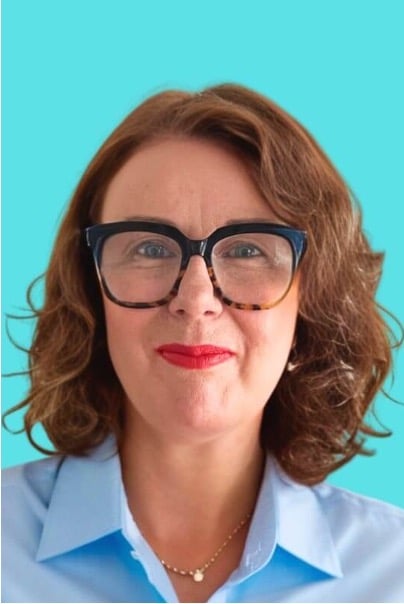 Samantha McIntyre
Founder Techboosters. Former CIO Target, Sussan Group & Loreal
Samantha McIntyre
Founder Techboosters. Former CIO Target, Sussan Group & Loreal
Samantha is a former CIO with 30+ years in tech, leading digital and IT transformations in organisations such as Tesco, Coles, and L’Oréal.
She co-founded “Tech Boosters” to help businesses scale efficiently and founded “Lady Leadership” to empower women in tech through coaching and mentoring.
– Held CIO roles at Target, L’Oréal, Simplot, and the Sussan Group.
– Led global digital and e-commerce transformation across major brands.
– Co-founder of Tech Boosters, focused on IT cost optimisation and virtual CIO services.
– Founder of Lady Leadership, empowering women in technology through coaching and education.
– Deep experience in retail, manufacturing, supply chain, and digital platforms.
– Known for building strong cultures and high-performing technology teams.
 Justina Uy
Content Marketing Manager
Justina Uy
Content Marketing Manager
Justina Uy is a data-driven content marketer that thrives on democratising elite know-how to empower Australia’s underdogs.
Skilled at translating complex ideas into a compelling story across formats and channels, she shifts seamlessly between writing long-form articles, creating viral social media posts, and producing thumb-stopping videos.
Since 2015, Justina executes her vision through a sophisticated understanding of the rapidly evolving digital and business landscape to serve entertaining and educational insights to the executive community.
Less Join the ADAPT
 Insider Community
Get the latest A/NZ market research and insights on the core trends impacting leaders.
Join the ADAPT Insider Community
Get the latest A/NZ market research and insights on the core trends impacting leaders.