














CFOs chasing cost transparency need a common language business can understand
Andre Freilinger, senior finance executive and former CFO, Technology at Westpac, shares his five-driver cost framework, why funding isn't the real constraint, and what's stayed hard after 30 years.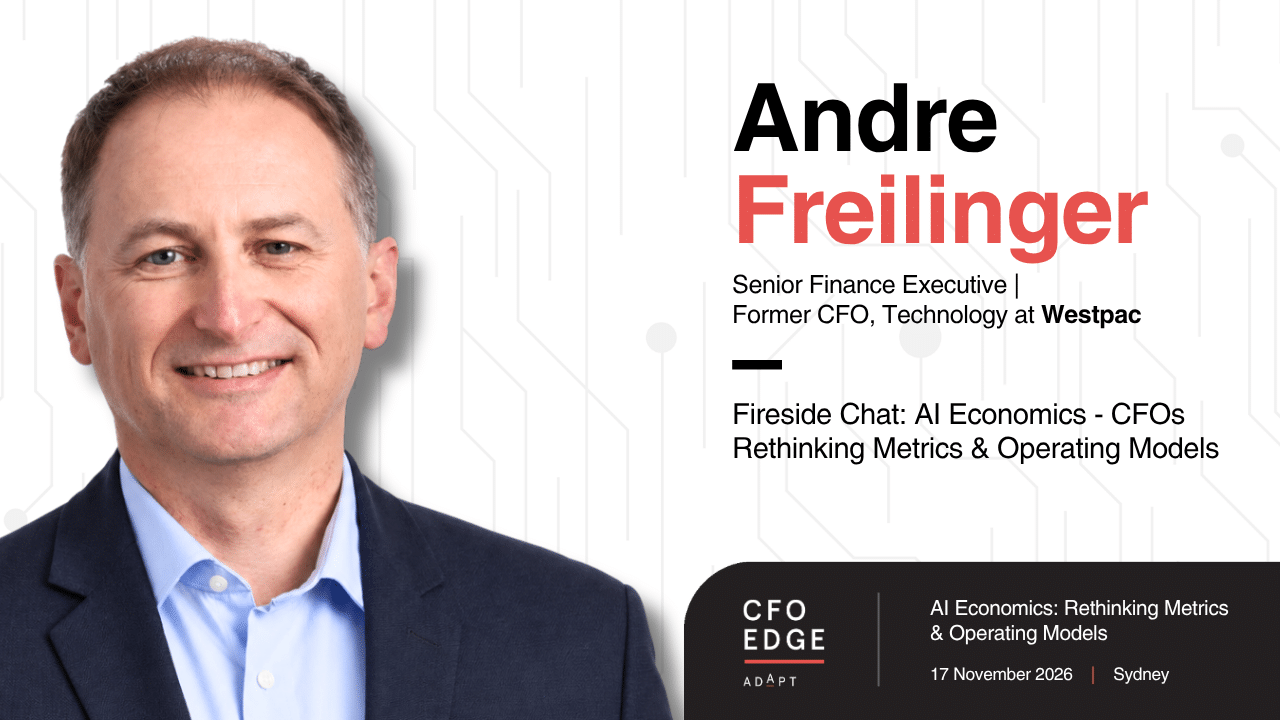


 Published Oct 6, 2026 in
Peer Insights
Finance
Contributors
Andre Freilinger
Justina Uy
Published Oct 6, 2026 in
Peer Insights
Finance
Contributors
Andre Freilinger
Justina Uy
Cost transparency and strategic influence don’t move together automatically.
A CFO can gain more say in shaping technology strategy and still struggle to see clearly where the money is going.
Andre Freilinger, senior finance executive and former CFO, Technology at Westpac, spoke with ADAPT’s Content Lead, Justina Uy, to discuss the framework he built to bring transparency to a $1.5 billion technology base, the real constraints behind transformation budgets, and what’s stayed hard about leading a finance function across three decades.
At CFO Edge in Sydney on 17 November, Andre joins David Walker, former Group CTO at Westpac and DBS, in front of 150+ finance leaders for a fireside chat unpacking how to build on existing foundations to measure AI’s value and what a genuinely trusted CFO-CIO partnership looks like.
Key takeaways:
- A shared framework, not more data, is what bridges business and technology complexity, and it’s what strategic influence alone doesn’t deliver.
- Funding is rarely the real constraint. Organisational capacity to absorb change matters more, and protected spend goes to regulatory and risk commitments first.
- Keeping up with a growing CFO remit comes down to breadth of experience, and to anchoring on what isn’t changing rather than chasing what is.
Building the five drivers of technology cost
Cost transparency was already a priority when Andre stepped into the CFO Technology role, but earlier attempts had lacked the sponsorship and tooling to stick.
He started with IT service costing, attributing every cost component to a service so the business could see its share of technology spend and what was driving it.
That worked at a business level, but with more than a thousand service lines at Westpac, it couldn’t roll up into a board-level view.
That gap led to the five drivers framework: technology cost as price times quantity, broken down into inflation, productivity, and two types of growth, organic and inorganic, with AI investment sitting inside the inorganic growth driver.
Benchmarking unit cost against best in class shows the maximum supply-side opportunity, while any remaining gap points to an oversized technology footprint on the demand side.
The framework let Andre and his team have a consistent, repeatable conversation about where investment was going and what it would cost to offset.
Why influence over strategy doesn’t guarantee cost visibility
ADAPT’s research found only 15% of CFOs rate their technology department as effective on cost transparency, even as most are now co-building tech strategy.
For Andre, the disconnect comes down to complexity.
Technology isn’t core to most businesses, so it stays hard to understand no matter how close a CFO sits to the strategy table.
What closed the gap at Westpac wasn’t more access, it was translating a long list of technical jargon into five drivers everyone, business and technology alike, could use as a shared anchor point for every investment conversation.
What actually limits transformation budgets
Funding constraints were a constant across Andre’s Westpac years, and ADAPT’s research still finds funding topping the list of barriers for finance leaders even as their remit grows. Andre’s experience points to a different limiting factor.
Westpac has had years where the full budget went unspent despite business leaders describing funding as tight, because the real constraint was organisational capacity, people, subject matter experts, and the ability to digest change.
Within any funding envelope, protected spend goes first to non-negotiables, regulatory commitments and risks outside appetite.
What’s left becomes discretionary, and deciding where to point it means weighing not just potential return but whether the receiving business area can actually absorb that much change without stalling.
Building breadth over a 30 year career
Asked what’s stayed hard about leading a finance function across a Nordic conglomerate, a wine importer, and one of Australia’s largest banks, Andre points to the widening scope of the CFO role itself.
Technology’s growing reach into every part of the business, paired with faster cycle times, keeps raising what’s expected of finance leaders.
His answer has been breadth, deliberately exposing himself to different industries, geographies, and disciplines rather than specialising narrowly.
He sees the same logic applying to AI, learning what’s working elsewhere rather than waiting to master it in isolation.
Start with what isn’t changing
Andre’s closing advice for CFOs navigating AI’s scale and pace is to resist starting with what’s shifting.
He points to identifying what stays true about a business and its function regardless of the wave of change moving through it.
That anchor point makes it easier to see clearly what does need attention, and to prioritise accordingly, rather than trying to process every shift in the landscape at once.
 Andre Freilinger
Senior Finance Executive | Former CFO, Technology at Westpac
Andre Freilinger
Senior Finance Executive | Former CFO, Technology at Westpac
André Freilinger is a finance executive with more than 30 years of international leadership across financial services, technology, manufacturing and consumer products. Most recently he was CFO, Technology and Data, Digital & AI at Westpac Group, leading the finance function behind one of Australia’s largest technology organisations. Across almost 18 years at Westpac he held senior roles including CFO Technology, Head of Finance for Customer Solutions & Technology, and Group Head of Enterprise Project Finance, working alongside the Group CIO to shape technology strategy and steer multi-billion-dollar transformation portfolios. Earlier, he led IT cost transparency for Stora Enso across Helsinki and Düsseldorf, and ran its Australian timber distribution business as Managing Director. He is a CPA Australia member and holds a Master’s in Business Administration and Computer Sciences from the University of Vienna.
 Justina Uy
Content Marketing Manager
Justina Uy
Content Marketing Manager
Justina Uy is a data-driven content marketer that thrives on democratising elite know-how to empower Australia’s underdogs.
Skilled at translating complex ideas into a compelling story across formats and channels, she shifts seamlessly between writing long-form articles, creating viral social media posts, and producing thumb-stopping videos.
Since 2015, Justina executes her vision through a sophisticated understanding of the rapidly evolving digital and business landscape to serve entertaining and educational insights to the executive community.
Less Join the ADAPT
 Insider Community
Get the latest A/NZ market research and insights on the core trends impacting leaders.
Join the ADAPT Insider Community
Get the latest A/NZ market research and insights on the core trends impacting leaders.