















Confronting conversations with vendors can be valuable, says former Toyota CIO Ellis Brover
Ellis Brover, former Toyota CIO, explores trust, procurement, and long-term vendor partnerships in this conversation with ADAPT’s Byron Connolly.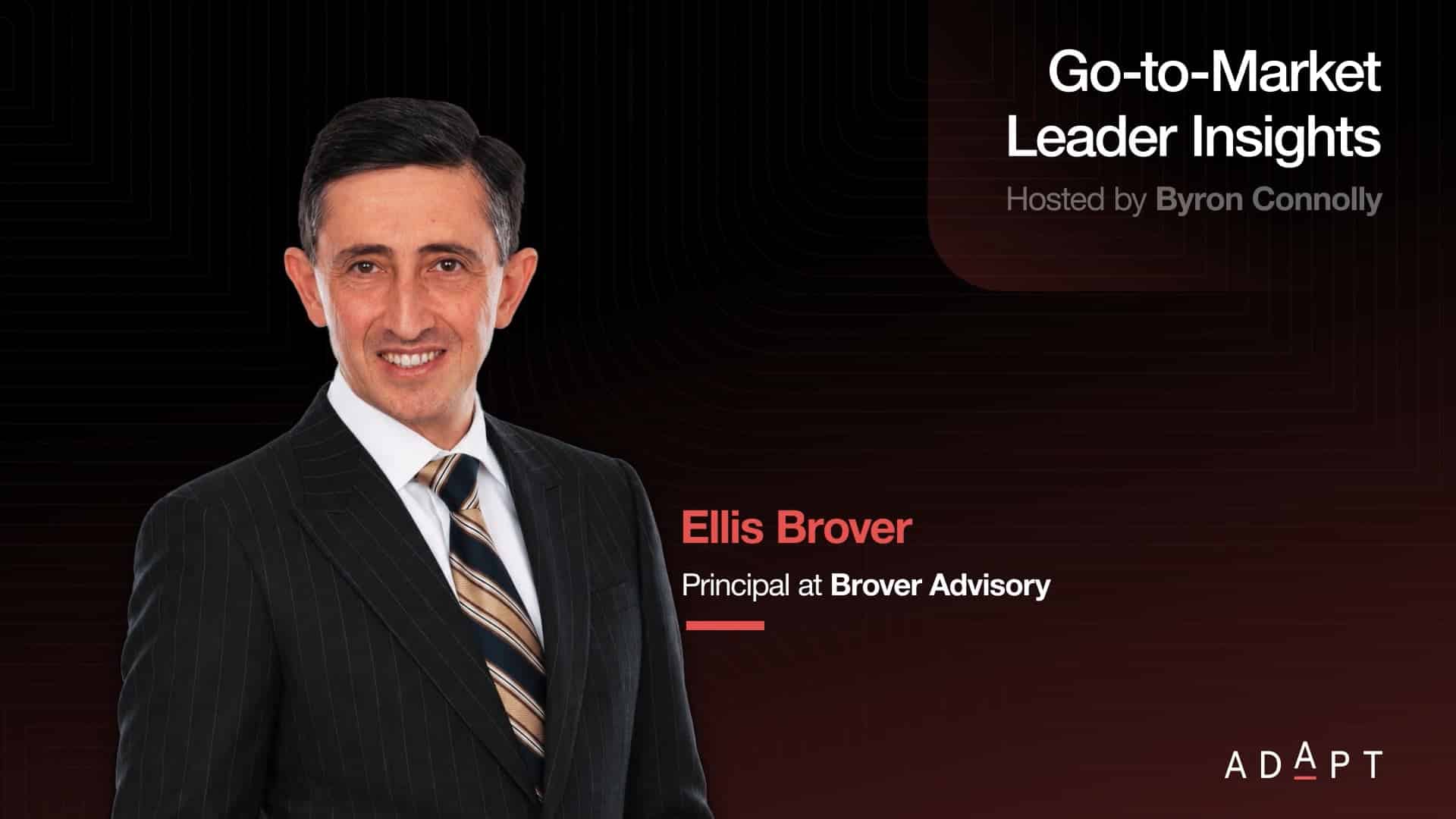


 Published Oct 9, 2026 in
Peer Insights
Go-To-Market
Contributors
Ellis Brover
Byron Connolly
Published Oct 9, 2026 in
Peer Insights
Go-To-Market
Contributors
Ellis Brover
Byron Connolly
Some of the most confronting conversations former Toyota Australia CIO, Ellis Brover had with IT vendors were also the most important and valuable.
Brover, who now advises organisations as an independent consultant, says these were discussions in which a vendor’s executive sponsor told him what his own people were getting wrong and what they could do better.
These conversations, while not pleasant, are worthwhile because internal failures can be difficult to see from the inside, he says.
“Obviously, you’re getting a particular story filtered up to you through your team. Sometimes the conversation is [that] it’s always the vendor’s fault. Sometimes, it’s good to hear the other side.
“Hearing both sides and trying to step back a little bit and take the perspective that ‘I’m not just here to protect my team.’ That’s certainly a big part of the job, but actually, I’m here to protect the organisation. Sometimes the right thing…is to make some changes inside my own team culture”, he says.
Brover tells ADAPT that Toyota’s corporate culture favoured long-term supplier relationships, an approach he tried to carry into IT.
Through sourcing reviews at Toyota, Brover consolidated a fragmented vendor base into a strategic partner panel.
But he still views ‘partnering’ as a commonly used and hackneyed term in the tech sector, and one of the least earned.
“Everybody says that they want a partner in a relationship. Not everyone actually achieves it, and it’s hard to do. It means that you’ve got to be prepared for [a bit of] give and take. That sounds obvious, but it means that when the hard times come, both sides have to be prepared to accept some pain and some loss. And that’s hard to do because we’re not used to it.”
That runs against instinct on both sides of the table, he says.
“As a vendor, typically you’re going to be focused on your short-term profitability. If that account dips a bit, you feel the pain. Equally on the client side…you’re used to saying, ‘Hey, you failed your SLAs [service level agreements] last month. That’s not good enough”, he says.
Nevertheless, his supplier consolidation helped cut contract and service costs by around 50%, and getting there relied heavily on strong procurement practices.
“If you try to make procurement your friend and ally rather than your sworn enemy, life is going to be a lot easier for you”, he says.
Brover says that this means bringing procurement execs into the tent early and showing them that the approach is sound, rather than a shortcut.
“Benchmarking is a very valid and important way of doing that. Showing that you’re benchmarking your service costs against industry norms is a very good way of convincing your procurement people [that they] are getting good value for money.
“Often, it’s very hard to demonstrate that. People in corporate procurement often don’t have a lot of experience with IT contracts. How do we measure whether this is good, bad or indifferent?” he says.
The second tool is a long-term plan owned jointly with procurement.
This should include a minimum five-year relationship, a retender point and a view of which services could be consolidated.
“[This is] something that lets them see that we actually have a plan here; we’re not just flying by the seat of our pants.”
The same thinking about credibility runs through how Brover sees the CIO role.
He describes three advantages a CIO can use: perspective, relevance and attitude.
Perspective comes from seeing across the whole business, while others in the C-suite focus on their own silos.
That view lets a CIO spot gaps and overlaps in business strategy and give the board visibility it may not otherwise have.
Relevance means speaking the language of the business. He says a classic failing is a CIO asking why the board isn’t interested in the tech strategy.
“That’s the wrong question. [The right question is], ‘Why aren’t you interested in the business strategy and how can you help it?’” he says.
Attitude, he says, is about resisting the slide into being seen as a commodity service provider, particularly as AI convinces business peers that technology can’t be that hard.
“You need to fight that as a CIO…with an attitude of humility. This starts by looking at your attitude and [that of] your IT team when they’re dealing with the business. Are they coming into meetings and saying, ‘No, you can’t do that; it’s against policy.’”
Doing this means business execs will find a way around the CIO, which increases risk for the organisation.
“So, the advice to CIOs would be to look in the mirror first. Start with that humble attitude of, ‘I need to start by improving my own people first.’”
Go to the source
Brover led Toyota Australia’s omnichannel transformation across a network of more than 200 independent dealerships.
Convincing dealer owners to invest, he says, was an order of magnitude harder than persuading corporate executives.
“It’s nothing against them, but [they are] a different breed. They’re people who are spending their own money, out of their own pockets, rather than shareholder or public company money. And they’re very very careful with the way they spend it.”
Brover’s approach drew on the Toyota principle of ‘genchi genbutsu’, or ‘go to the source’.
That meant visiting dealerships, understanding their day-to-day challenges and listening, then starting with small, quick wins to build credibility.
He was challenged hundreds of times on developer day rates, often with the suggestion that a “cousin down the road could do it cheaper.”
The core problem was fragmentation. Each dealer chose its own systems, all of which had to integrate with head office at significant cost.
The bigger issue was the customer experience. A customer wo had received a quote at one dealer shouldn’t face the same questions and different forms at another.
Harmonising those systems allowed Toyota to offer a single digital experience, he says.
Brover built a digital delivery capability of more than 120 people and kept it within IT, rather than placing it under marketing as many organisations do.
He has seen the risks when non-IT groups own substantial technology, from IP and contractual exposure to cyber and integration problems.
“Imagine what sort of trouble the organisation would be in if you let me have a go at setting the pricing and promotions for our cars. It’s not my skill set…and equally, nothing against marketing folk, they’re great at what they do, but their skill set and background aren’t about managing IT contracts, vendors, cyber security and IT architectures”, he says.
The transformation delivered substantial cost savings and reduced risk.
Delivery ran through cross-functional teams, with marketing-side product designers working alongside IT architects and testers, in autonomous teams with shared accountability.
Managing two speeds inside one IT group was among his hardest challenges. Left unchecked, the digital team becomes the A team and everyone else feels like the B team.
Brover deliberately rotated people between groups so they returned with a greater appreciation of each other’s work.
“We absolutely need cyber security, reliable infrastructure and core systems that work. We also need our great digital customer experience and it’s only going to work if all of those things can work together”, he says.
 Ellis Brover
Principal at Brover Advisory.
Ellis is an independent IT advisor, supporting organisations to deliver superior business value through a modern technology function.
Less Byron Connolly
Head of Programs & Value Engagement at ADAPT
Byron Connolly
Head of Programs & Value Engagement at ADAPT
Byron is a highly experienced technology and business journalist, editor, corporate writer, and event producer.
Prior to joining ADAPT, he was the editor-in-chief at CIO Australia and associate editor at CSO Australia. He also created and led the well-known CIO50 awards program in Australia and The CIO Show podcast.
Byron creates valuable insights for our community of senior technology and business professionals that help them reach their organisational and professional goals. He has a passion for uncovering stories about the careers and personal philosophies of Australia’s top technology and digital executives.
When he is not working, Byron enjoys hot yoga, swimming, running and spending time with his family. He completed the North Face 100km ultra marathon in the NSW Blue Mountains in 2012 and 2013.
Less Join the ADAPT
 Insider Community
Get the latest A/NZ market research and insights on the core trends impacting leaders.
Join the ADAPT Insider Community
Get the latest A/NZ market research and insights on the core trends impacting leaders.