













How the Fair Work Ombudsman is doing agentic software development without handing over the keys
In this interview, Fair Work Commission Chief Information Officer Dimitar Dimitrovski explains how agentic AI speeds delivery while keeping people in control.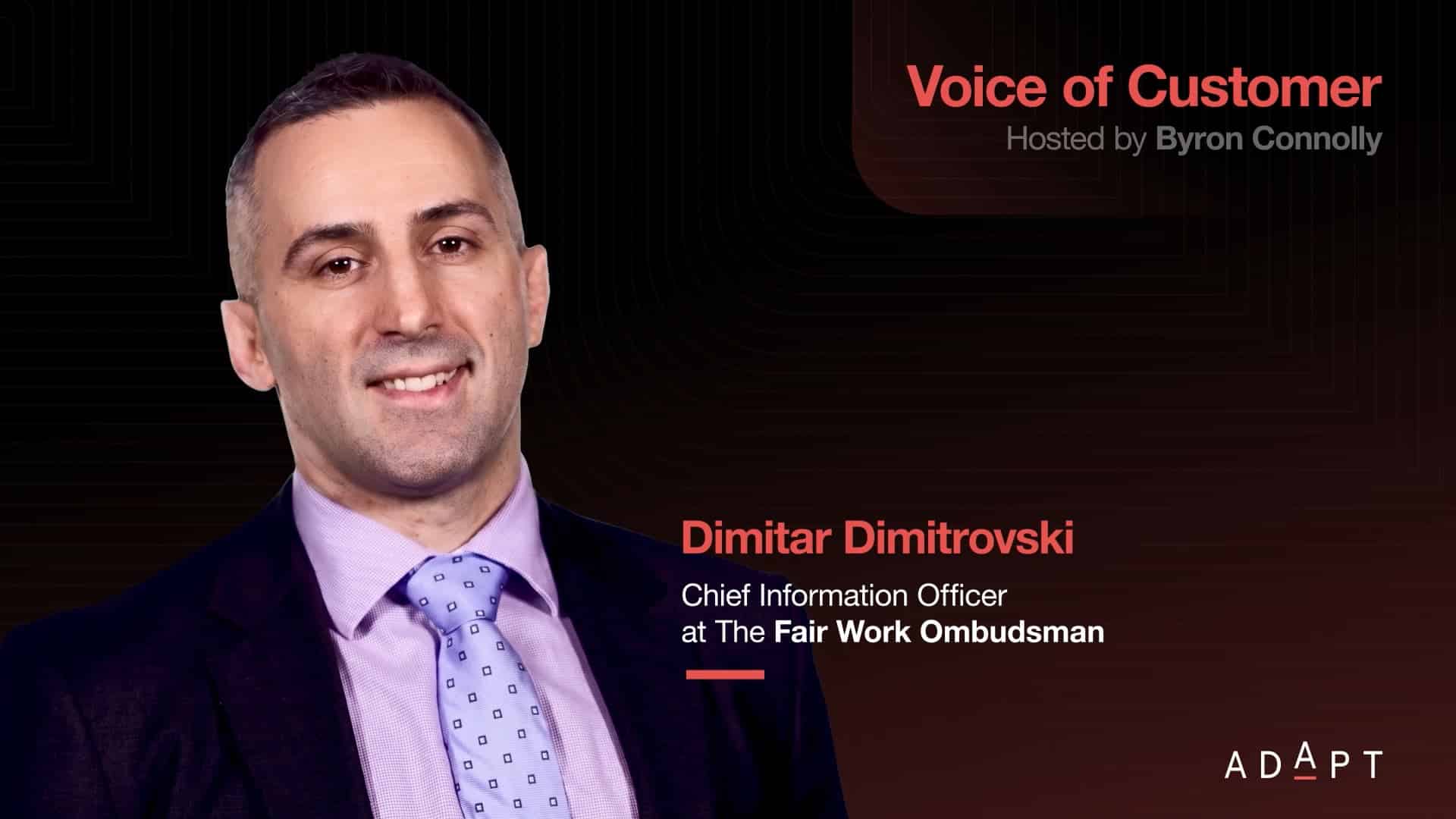


 Published Aug 26, 2026 in
Peer Insights
Data & AI Strategy
Contributors
Dimitar Dimitrovski
Byron Connolly
Published Aug 26, 2026 in
Peer Insights
Data & AI Strategy
Contributors
Dimitar Dimitrovski
Byron Connolly
When the Fair Work Ombudsman’s CIO, Dimitar Dimitrovski talks about AI, he keeps returning to a single, deliberately unglamorous idea: it’s a productivity tool, not a decision-maker.
The statutory agency, which informs Australians about national workplace relations system, investigates complaints and enforces compliance, has developed an agentic software development capability that assists coders without replacing human oversight, keeping people firmly in command at every consequential step.
Dimitrovski tells ADAPT that AI-assisted software engineering is accelerating the delivery of internal systems, including its case management platform and CRM-type systems that the ombudsman’s civil and criminal investigators rely on to record information and store evidence.
These systems have become even more critical to the agency’s work since the Australian government introduced changes to the Fair Work Act in January last year that make it a criminal offence for employers to intentionally underpay wages, super or entitlements.
AI assists across the entire development lifecycle, from the creation of business artifacts and requirements through to technical design, coding, testing, documentation and review.
Specialist agents have been deployed for focused tasks such as API and front-end development, testing and independent reviews.
Dimitrovski is clear about the boundary that governs all of it.
“In short, our process is agentic, but it’s not autonomous. AI helps work [but] people remain firmly in command. That’s been kind of the mantra and that’s also the government’s stance on this as well”, he says.
Agents operate inside what Dimitrovski describes as a heavily governed framework, with people orchestrating processes end-to-end.
That includes reviewing code, approving pull requests and controlling deployments.
A key reason agents are not turned loose, he says, is that the technology isn’t ready and much of that comes down to trust.
AI tools use probabilistic models and making them behave more predictably requires extensive grounding.
“That grounding consists of giving it more and more rules and information and more of the business context…so it doesn’t have to keep thinking. When it comes to software development…we’ve made our models really deterministic by providing reference architecture examples.
“We give it [the AI] examples of what code should look like [that show] what we expect to see for an API and or a .NET [component]. So, we ground it in the business context, the architectural artifacts and the reference architecture that we want to get from the start.
“So, we say, ‘here are the data models, the things [the agent] needs to build the code that [it’s being] asked to build. Then the code needs to be reviewed by a person as well”, he says.
A year’s work in four months
The Fair Work Ombudsman can now get working concepts, prototypes and features in front of execs much earlier in the delivery process and the payoff has been substantial.
The organisation has delivered a complete case management platform for one of its jurisdictions in four months, including the time spent building the entire agentic framework from scratch.
Dimitrovski says this would have previously taken at least a year.
But speed to market is only part of the story.
A tight feedback loop allows teams refine solutions before significant effort is sunk into them, changing how people engage with the development process.
Rather than wading through lengthy requirements documents, people can interact with tangible, working prototypes early in the process.
Analyst developers now sit down with business users and prototype requirements live in a session, allowing people to see what a system could look like.
Previously, a developer might have needed a week to translate requirements into something reviewable.
That translation can now happen in a day, Dimitrovski says.
The result has been stronger staff engagement and higher satisfaction.
Solutions are also more closely aligned to the original business intent because the feedback loop turns much faster, he says.
This shift has raised the importance of the disciplines that precede coding.
High-quality specifications, architecture and governance are even more important because they guide the AI-assisted process.
“It’s made us put the focus back on the architectural runway, that pre-work that you need to do, your specifications, your architecture and your governance. It’s the stuff that you build with”, he says.
Accountability stays with the human
If there is a single principle underpinning the agency’s approach, it is that accountability always sits with a person, never the AI.
“AI agents, they’re not decision makers. AI input is never taken as is, it’s always verified by people. It’s the people that approve the requirements, it’s the people that approve the code changes, the test results and production deployments.
“In general, I think human approval should increase and should be proportioned. It should increase as the consequence and risk of the outcome increases.”
Consequential decisions, especially those that will eventually affect citizens, must retain meaningful human involvement, because people should be able to understand in plain language why a decision was made.
“Ultimately, what I am getting at is, ‘the AI said so,’ is never an acceptable explanation [when a mistake is made]”, he says.
An agent, he says, is a probability matrix that has tokenised vast quantities of human knowledge and offers and statistically likely answer as an assistant, not a decision maker.
Developers, reviewers, product owners and executive sponsors all carry defined accountability within the agency’s processes, and auditability is achieved through version control, review workflows, testing records and deployment history.
AI must ultimately strengthen accountability rather than obscure it, he says.
“If we can’t identify the accountable person, we’ve designed the solution incorrectly.”
Before agents move anywhere near operational, citizen-facing environments, Dimitrovski wants trusted enterprise AI platforms, purity controls, audit logging, identity management, mature monitoring and clear operating models that spell out the role of the agent, the role of the human and where accountability lies.
Recent headlines about agents ‘jumping environments’ and causing problems are precisely the kind of risk Dimitrovski is not prepared to accept in an organisation that handles sensitive personal information.
The ethics and economics of tokens
AI governance extends to cost, and the Fair Work Ombudsman can’t responsibly hand developers an open ‘token wallet’ and risk discovering unexpected spending. The organisation caps Claude Code usage at a modest $40 per month, per developer.
It’s a deliberate constraint that protects the public pursue, keeps spending within budget and guards against a developer inadvertently triggering a workflow that racks up enormous costs.
Dimitrovski says government spending needs to be trusted.
“If the public can’t trust the government to spend tax money appropriately, confidence in government erodes”, he says.
He frames token consumption as the AI equivalent of cloud FinOps and argues that managing AI costs should be a core organisational capability.
That starts with education, teaching developers how prompts, session history and exponential token growth work.
Dimitrovski says the metric that matters is not raw consumption, but the value created per token consumed.
He stresses that there are genuine ethical implications to burning tokens needlessly: not every task requires the most capable or expensive model.
The agency plans to move to more powerful models once the education piece is right and developers have shown they won’t exhaust the limit.
Underlying it all is a settled view of what AI is for.
It is a productivity tool that can make automation and data science better and one that, in Dimitrovski’s experience, has only reinforced the value of skilled people.
 Dimitar Dimitrovski
Chief Information Officer at The Fair Work Commission
Dimitar Dimitrovski
Chief Information Officer at The Fair Work Commission
Dimitar Dimitrovski serves as the Chief Information Officer (CIO) at the Fair Work Ombudsman, where responsibilities include leading the organisation’s technology strategy, overseeing cybersecurity, data, digital transformation, and enterprise technology services. In this role, Dimitar is responsible for ensuring that technology investments are aligned with business priorities, support operational excellence, and deliver measurable outcomes for both the organisation and the community it serves.
With a strong focus on governance, risk management, and service delivery, Dimitar leads initiatives that strengthen organisational resilience, enhance digital capabilities, and enable the secure and effective use of technology across the enterprise, and also oversees the development of AI capabilities across the organisation, establishing frameworks that balance innovation with transparency, accountability, security, and public trust.
Less Byron Connolly
Head of Programs & Value Engagement at ADAPT
Byron Connolly
Head of Programs & Value Engagement at ADAPT
Byron is a highly experienced technology and business journalist, editor, corporate writer, and event producer.
Prior to joining ADAPT, he was the editor-in-chief at CIO Australia and associate editor at CSO Australia. He also created and led the well-known CIO50 awards program in Australia and The CIO Show podcast.
Byron creates valuable insights for our community of senior technology and business professionals that help them reach their organisational and professional goals. He has a passion for uncovering stories about the careers and personal philosophies of Australia’s top technology and digital executives.
When he is not working, Byron enjoys hot yoga, swimming, running and spending time with his family. He completed the North Face 100km ultra marathon in the NSW Blue Mountains in 2012 and 2013.
Less Join the ADAPT
 Insider Community
Get the latest A/NZ market research and insights on the core trends impacting leaders.
Join the ADAPT Insider Community
Get the latest A/NZ market research and insights on the core trends impacting leaders.