








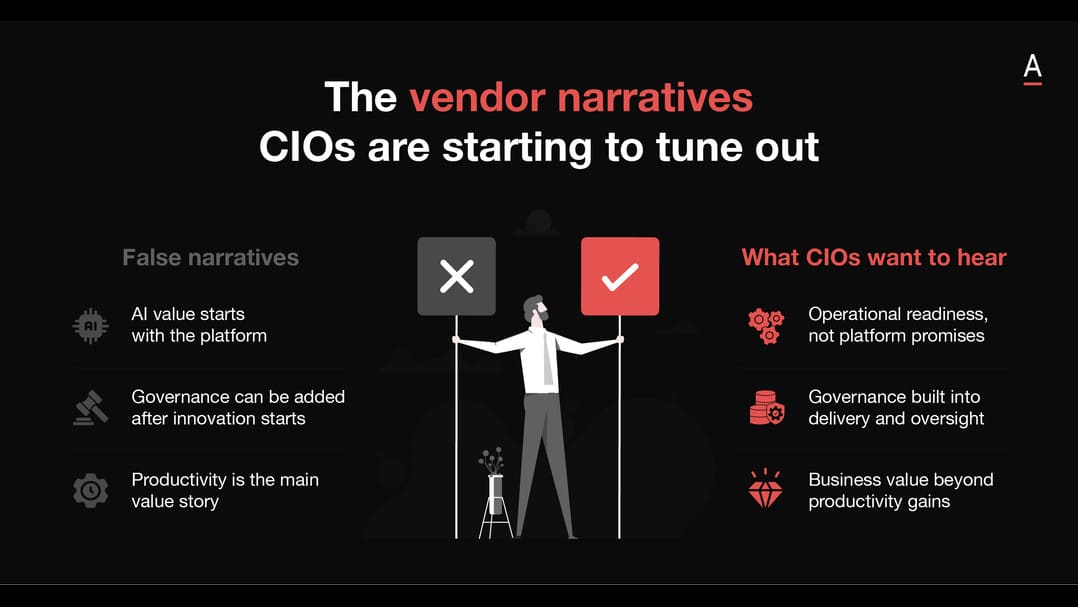





APS leaders need re-engineered processes before more AI tools, according to Commonwealth Bank’s Data and AI Leaders
Desmond Seeley talks about splitting grunt work from creative work, keeping accountability with people, and why a highly regulated bank might have more to teach government than it thinks.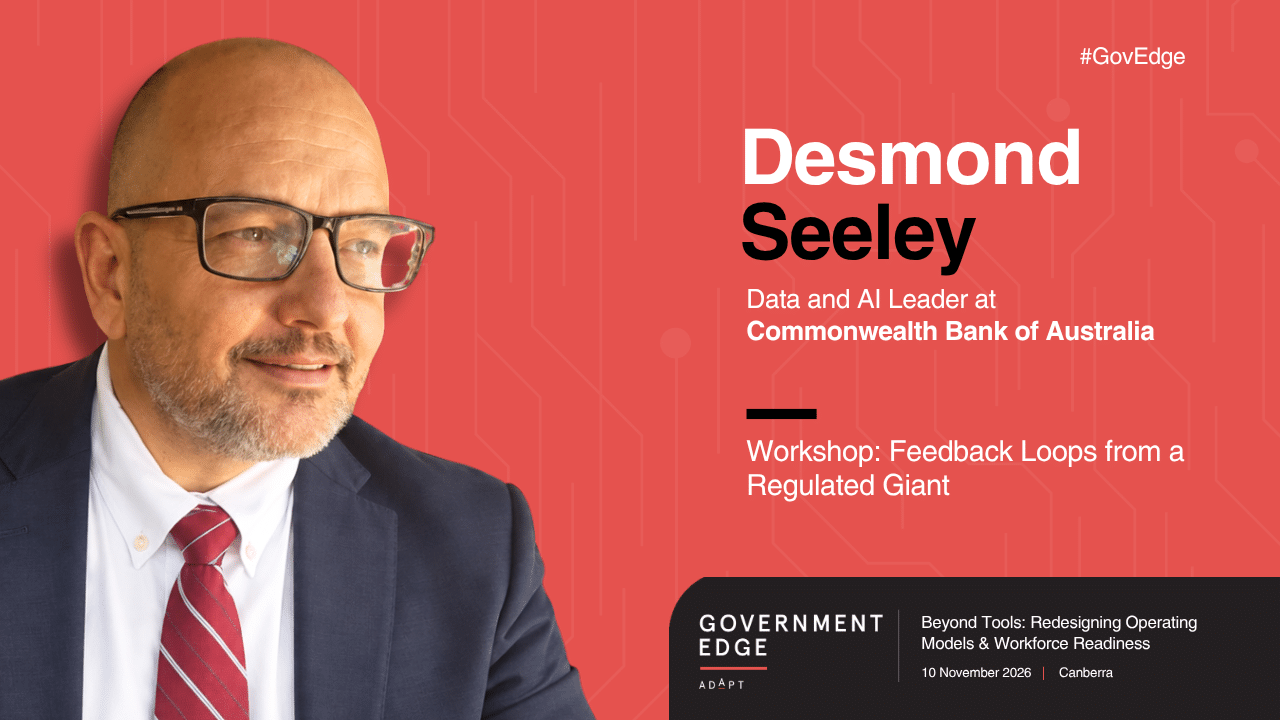


 Published Sep 28, 2026 in
Peer Insights
Data & AI Strategy
Contributors
Desmond Seeley
Justina Uy
Published Sep 28, 2026 in
Peer Insights
Data & AI Strategy
Contributors
Desmond Seeley
Justina Uy
Government leaders keep naming workforce readiness as the real barrier to AI delivery.
One place to start is redesigning the work itself before anyone touches the tooling.
Desmond Seeley, Data and AI Leader at Commonwealth Bank of Australia, sat down with ADAPT’s Content Lead, Justina Uy, to talk about reshaping work types, keeping humans accountable as AI takes on more of the grunt work, and adopting AI tooling safely inside one of the country’s most regulated environments.
At Government Edge in Canberra on 16 November, Desmond will give delegates a method for reshaping work types and adopting AI tooling safely, proven inside one of Australia’s largest and most heavily regulated organisations.
Key takeaways:
- AI adoption should start with sorting work into what AI should do and what people should keep, rather than with buying tools.
- Accountability stays with humans regardless of how much governance and monitoring work AI takes on.
- A golden path starts as a process re-engineering exercise, with tooling decisions coming after.
- Closed feedback loops, applied properly, turn AI anxiety into managed, measurable value.
- A regulated, well-funded private sector background can shortcut government’s trial and error.
Splitting grunt work from creative work
For Desmond, AI adoption means relooking at the work itself, distinguishing between grunt work and creative work.
Grunt work is what AI should be doing. Creative work is what people should keep doing.
At Government Edge, he’ll walk delegates through a real engineering process he’s re-engineered using this split, and what it changed about how people work and where the value actually showed up.
Accountability stays human, even as AI takes the grunt work
If the workforce isn’t ready to challenge or question a tool, does the guardrail actually hold, or does the risk just move from the tool to the person?
According to Desmond, accountability never shifts off humans.
AI’s role is reducing the cognitive load of governance and monitoring work, the detailed checking that eats people’s time, while humans keep the creativity and the responsibility.
Golden paths are a re-engineering exercise, not a shopping list
ADAPT’s own research has found only 6% of government leaders are seeing measurable productivity gains from the AI tools they’ve bought.
Desmond puts that gap down to mindset and sequencing.
A golden path is an integrated developer platform built by re-engineering a process end to end, then embedding tools inside it, rather than bolting tools onto an unchanged process.
Have no fear, use closed loops to manage what AI can’t
Asked for his one piece of advice for the 160-plus APS tech leaders heading into 2027’s operating model redesign, Desmond kept it simple, have no fear.
He points to a proper cybernetics view, building in closed feedback loops that catch what’s drifting out of control, as the mechanism that turns AI unease into real, managed success.
What a regulated, well-funded bank can teach government
Coming from the private sector to speak at a government conference, Desmond sees his background in a highly regulated, well-funded organisation as an advantage.
Large banks have already spent the money and absorbed the trial and error involved in tightening controls without breaking them.
He believes government agencies can skip a chunk of that same learning curve, and lift their risk appetite slightly, by drawing on lessons already tested at scale inside banking.
Hear more from Desmond at Government Edge where his session will give delegates a method for reshaping work types and adopting AI tooling safely inside a regulated environment.
 Desmond Seeley
Data and AI Leader at Commonwealth Bank of Australia
Desmond Seeley
Data and AI Leader at Commonwealth Bank of Australia
Desmond Seeley leads AI and Engineering at the Commonwealth Bank, directing the AI and engineering transformation of its Finance Services division and leading more than 100 engineers across Australia and India. Over six years at CBA he has moved through strategy and delivery transformation, treasury and regulatory reporting technology, and now AI and engineering, building the internal developer platform behind the bank’s “guardrails not gates” approach – embedding compliance into the toolchain so teams ship faster inside a heavily regulated environment. His workshop applies cybernetic methods, reinforcing feedback loops for continuous improvement, to how large and accountable organisations reshape work and adopt AI tooling safely.
 Justina Uy
Content Marketing Manager
Justina Uy
Content Marketing Manager
Justina Uy is a data-driven content marketer that thrives on democratising elite know-how to empower Australia’s underdogs.
Skilled at translating complex ideas into a compelling story across formats and channels, she shifts seamlessly between writing long-form articles, creating viral social media posts, and producing thumb-stopping videos.
Since 2015, Justina executes her vision through a sophisticated understanding of the rapidly evolving digital and business landscape to serve entertaining and educational insights to the executive community.
Less Join the ADAPT
 Insider Community
Get the latest A/NZ market research and insights on the core trends impacting leaders.
Join the ADAPT Insider Community
Get the latest A/NZ market research and insights on the core trends impacting leaders.