











Why a credible AI business case starts with a clear performance baseline
Senior finance executive Andre Freilinger and ADAPT Advisor David Walker discuss AI economics, baselines and investment decisions at CFO Edge.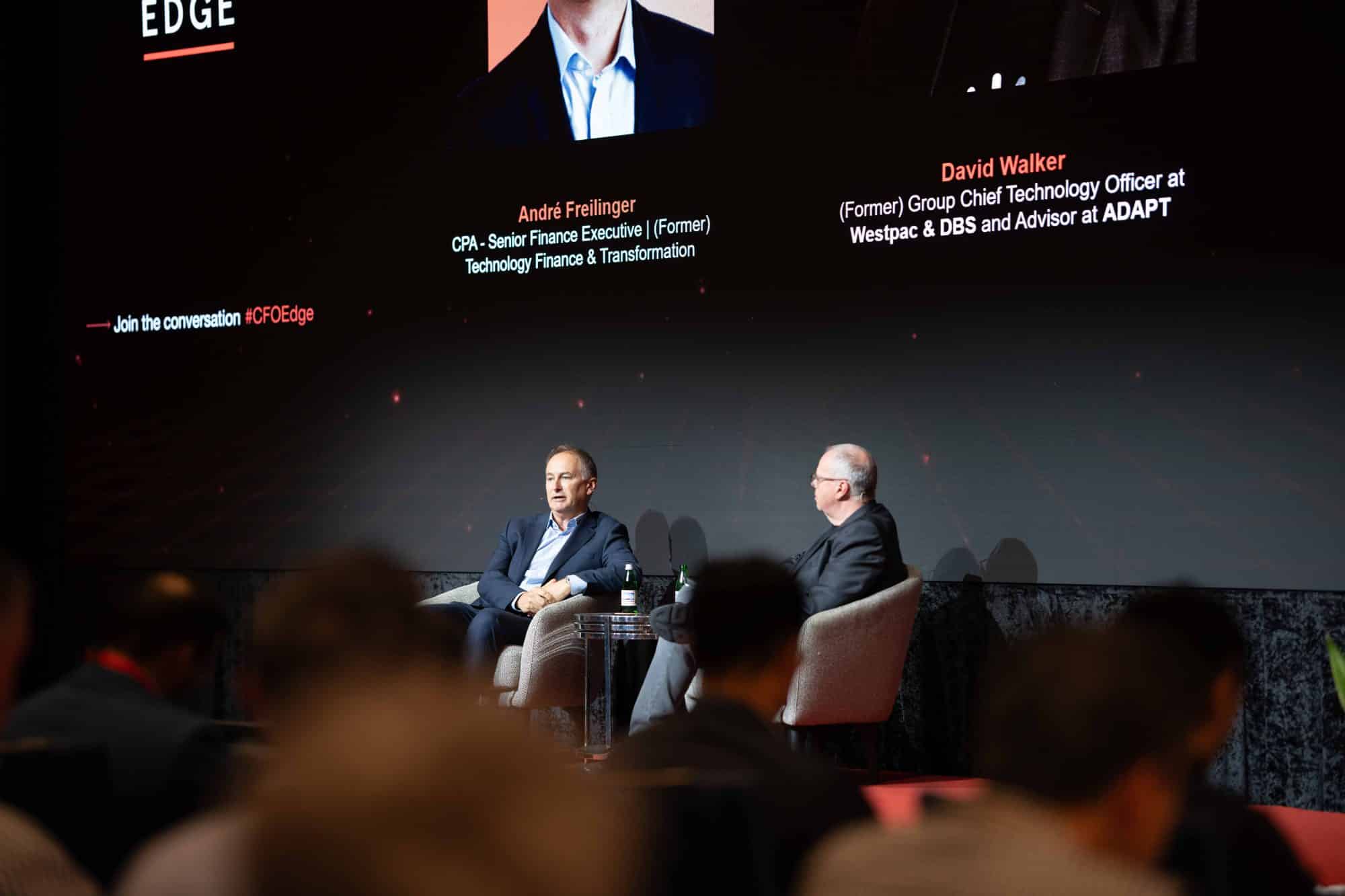


 Published Nov 23, 2026 in
Expert Presentations
Finance
Contributors
Andre Freilinger
David Walker
Finance needs a clear baseline before it can tell whether a use case has improved cost, speed, service or revenue.
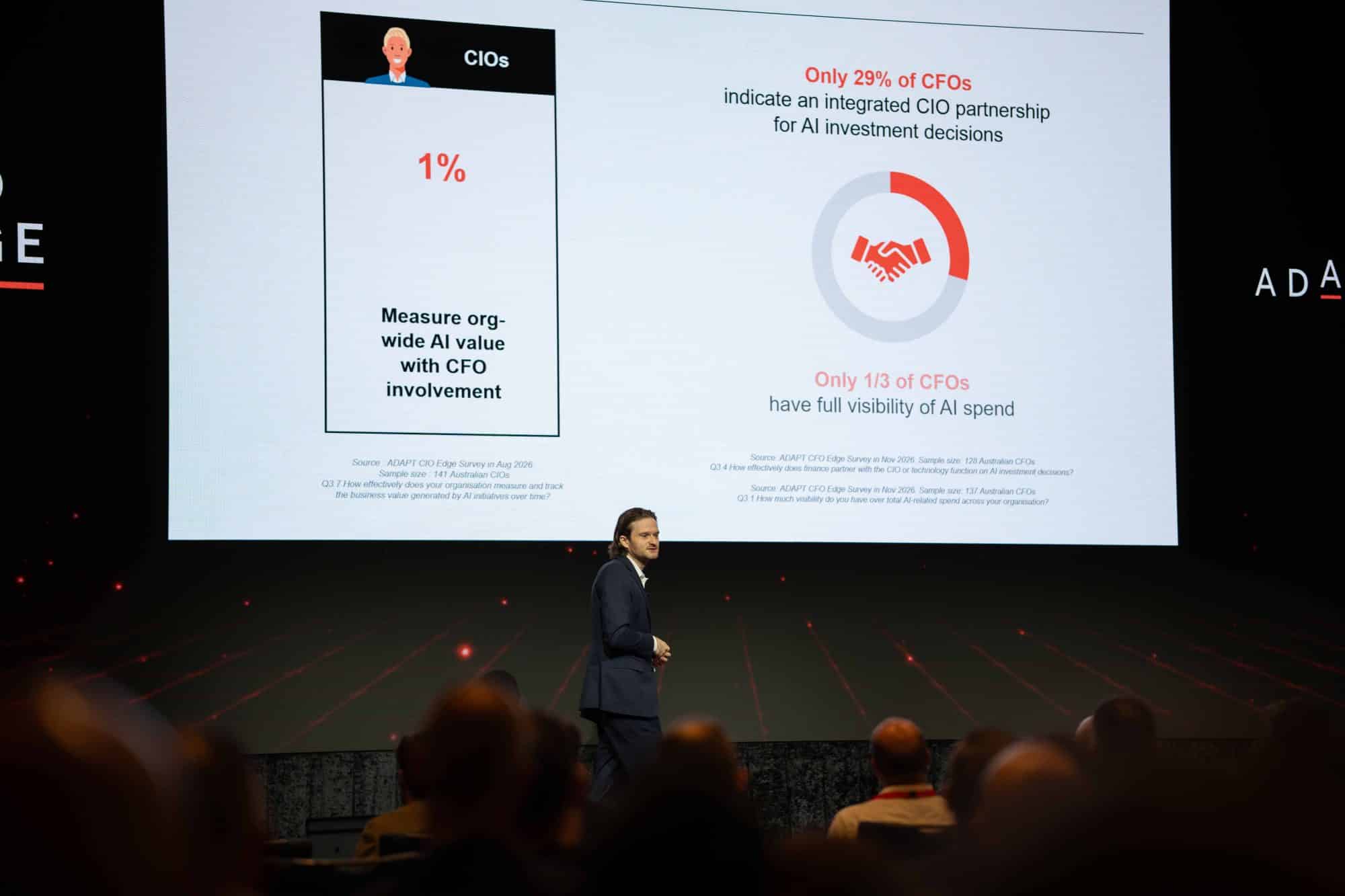
At CFO Edge, Andre Freilinger, CPA and Senior Finance Executive, joined David Walker, former Group CTO at Westpac and DBS and ADAPT Advisor, to discuss how existing IT cost and performance practices can be applied to AI investment decisions.
Key takeaways:
- Set a clear performance baseline before changing a process.
- Test investment against business outcomes, total costs and explicit assumptions.
- Use finance to connect AI spending with strategy, risk appetite and transparent decision-making.
Baseline the process before changing it
Finance needs a detailed view of how work performs today before measuring what changes after AI is introduced.
That includes processing time, cost per transaction, wait times, errors and rework.
The same applies to revenue. Measures such as conversion rates and average order values give teams a reference point for assessing whether a change has improved commercial performance.
Andre expects AI to push organisations towards more granular measurement, particularly at the transaction level.
A reliable before-and-after comparison gives finance a clearer view of both cost and business outcomes.
Start with the largest value pools and test the case
Investment decisions should begin with the areas of the business where improvement would create the most value.
Andre recommends identifying the largest value pools, assessing which are ready for transformation and then testing individual proposals against five questions:
- What business problem are we solving?
- Which processes will change, and how will we measure the before and after?
- What financial and non-financial outcomes define success?
- What are the upfront, ongoing and scaling costs?
- Is there a credible delivery plan with clear accountability?
Where returns remain uncertain, finance can express them as a range built on explicit assumptions and monitor those assumptions as the project progresses.
Shorter time to value also reduces the risk that business conditions change before the expected benefits arrive.
Finance should connect investment with strategy and risk appetite
CFOs have a role in aligning AI investment with business priorities and giving leaders transparent information about cost and performance.
The level of spending and oversight should reflect the organisation’s priorities and risk appetite.
Andre recommends building on existing capabilities rather than creating a separate economics framework from scratch.
Start by reviewing how the organisation already tracks technology spend, measures business performance and makes investment decisions.
Those practices can then be strengthened to handle the greater cost variability and measurement detail that AI introduces.
 Andre Freilinger
Senior Finance Executive | Former CFO, Technology at Westpac
André Freilinger is a finance executive with more than 30 years of international leadership across financial services, technology, manufacturing and consumer products. Most recently he was CFO, Technology and Data, Digital & AI at Westpac Group, leading the finance function behind one of Australia’s largest technology organisations. Across almost 18 years at Westpac he held senior roles including CFO Technology, Head of Finance for Customer Solutions & Technology, and Group Head of Enterprise Project Finance, working alongside the Group CIO to shape technology strategy and steer multi-billion-dollar transformation portfolios. Earlier, he led IT cost transparency for Stora Enso across Helsinki and Düsseldorf, and ran its Australian timber distribution business as Managing Director. He is a CPA Australia member and holds a Master’s in Business Administration and Computer Sciences from the University of Vienna.
 David Walker
(former) Group Chief Technology officer at Westpac & DBS and ADAPT Advisor
David Walker was appointed Westpac Group’s Chief Technology Officer in August 2019. He led Westpac through its technology transformation – simplifying and merging the bank, building 4th gen cloud-native applications, establishing and operating evergreen platforms, leading Westpac’s AI technology, and building a culture of passionate and forward-thinking tech and emerging talent.
David began his technology career in 1987 as a software engineer, focusing on coding complex systems. After a decade of evolving his software engineering craft, David founded a data science consulting. Over the following decade, it became the number one expert data insights company in Australia and Southeast Asia.
For the last 15 years, David has held executive roles in large, complex organisations across the APAC region. Prior to joining Westpac, David was part of the leadership team of Singaporean bank, DBS. In his ten years there, David helped transform DBS from a traditional bricks and mortar bank with little brand presence or recognition outside Singapore, to being recognised as the ‘Best Bank in the World’ and the ‘Best Digital Bank in the World’ by leading global financial publication Euromoney.
Less Join the ADAPT
Insider Community
Get the latest A/NZ market research and insights on the core trends impacting leaders.
Join the ADAPT Insider Community
Get the latest A/NZ market research and insights on the core trends impacting leaders.