















With 77% of organisations investing in AI agents, how can CIOs build governance that scales?
In this CIO Edge presentation, Gabby Fredkin, Head of Analytics & Insights at ADAPT, outlined how CIOs can scale AI agents safely, turning governance into measurable value at enterprise scale.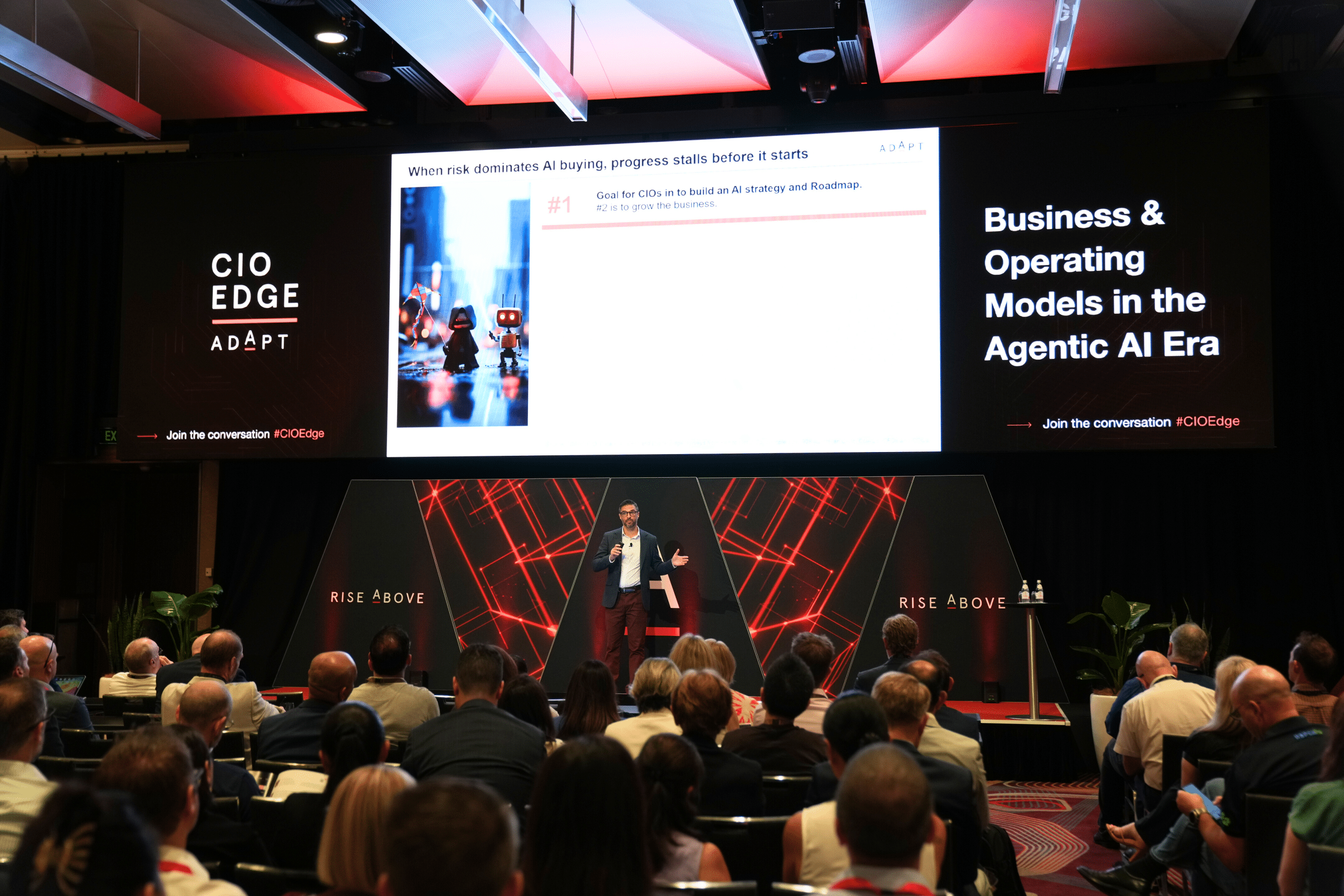


 Published Mar 2, 2026 in
Expert Presentations
Digital Transformation
Contributors
Gabby Fredkin
Published Mar 2, 2026 in
Expert Presentations
Digital Transformation
Contributors
Gabby Fredkin
He highlights that after two years of research involving roundtables, interviews, surveys and case studies, the real AI lifecycle is less about “pilot, deploy, scale” and more like buy it, use it, break it, fix it.
This reflects a continuous cycle of adoption and adaptation rather than a static maturity model.
Across industries, organisations are prioritising AI investment to meet strategic goals.
Developing an AI strategy is the top objective, closely tied to business growth and improving efficiency.
This is especially notable in government, where a 5% budget reduction is driving AI‑centred productivity agendas.
This year, 77% of organisations plan to invest in AI agents and 61% in AI development platforms.
Yet procurement is increasingly shaped by risk: the number one factor for CFOs allocating AI budgets is not ROI but risk and compliance.
This is a concern reinforced by 75% of CISOs who say their organisations are not ready to safely scale AI.
At the same time, use cases are broadening, from highly autonomous engineering and cyber agents to tightly governed knowledge‑based tools, yet governance gaps persist.
Half of AI pilots lack formal governance frameworks and 62% of data leaders report minimal or basic data controls, leaving lineage, traceability and model evaluation unclear.
Despite these challenges, mature organisations show what effective AI operating models look like.
Lendi, a 3,000‑person financial services organisation, has achieved 95% daily AI adoption, saved 55,000 hours through its internal sales agent, increased customer satisfaction by 20%, and deployed an after‑hours agent that now handles 100% of out‑of‑hours calls.
Their success is driven by strong governance, mandated training, clear ownership and embedding AI into business‑first use cases.
Yet industry‑wide, AI value measurement remains underdeveloped: 37% report no measurable ROI, while 47% say early indicators are too unclear to assess.
The challenge is not whether AI breaks, because it inevitably will, but whether organisations are designed to fix it, improve it and safely scale it.
The goal is operating models, governance frameworks and ROI measures that evolve as quickly as AI itself, enabling organisations to navigate the full cycle: buy it, use it, break it, fix it; and avoid the “crash it” scenario.
Key takeaways:
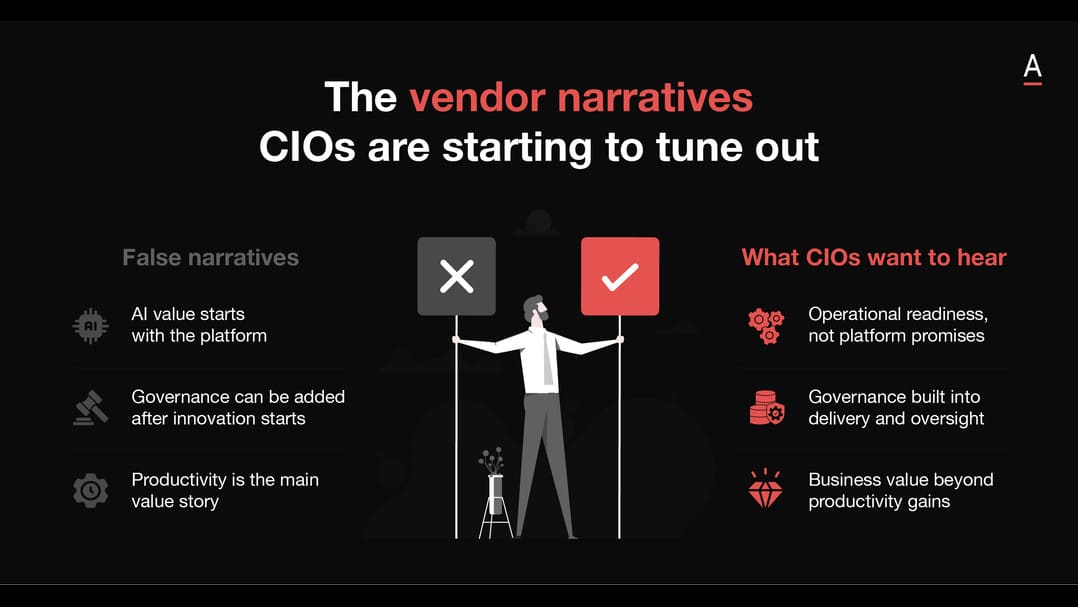
- AI adoption is accelerating, but risk is now the dominant driver: While 77% of organisations plan to invest in AI agents and 61% in AI development platforms, CFOs rank risk and compliance, not ROI, as the number one factor in budget decisions. This aligns with 75% of CISOs saying their organisations are not ready to scale AI safely.
- Governance gaps, not technology, are the biggest barrier to scaling: Half of AI pilots lack formal governance frameworks, and 62% of data leaders report minimal data controls, leaving lineage, traceability and model evaluation unclear. Most AI failures stem from governance weaknesses rather than model performance.
- Mature organisations embed AI into operating models, not just tools: Lendi demonstrates this approach: 95% daily AI adoption, 55,000 hours saved and a 20% uplift in customer satisfaction. Their success comes from strong governance, dedicated AI champions, mandated training and clear business‑first ROI measures.
 Gabby Fredkin
Head of Analytics & Insights at ADAPT
Gabby Fredkin
Head of Analytics & Insights at ADAPT
As the Head of Analytics and Insights at ADAPT, Gabby Fredkin’s primary role is managing analysis to produce ADAPT’s actionable insights to identify trends supporting organisations in Australia.
With a passion for creating stories with data, Gabby is consistently rated as one of the top speakers at ADAPT’s events. In roundtable discussions, he specialises in using statistics to initiate thought-provoking discussions, enabling ADAPT’s customers to become more data-driven.
Using modern data science techniques, he provides ADAPT and its customers with confidence in the accuracy and validity of the information used for ADAPT’s research, advisory and events.
Working across artificial intelligence, machine learning, AI ethics, DevSecOps, end-user behaviour, and human-centred design, Gabby’s vast experience continues to grow, supported in part by a Master of Business Analytics from Deakin University.
Less Join the ADAPT
 Insider Community
Get the latest A/NZ market research and insights on the core trends impacting leaders.
Join the ADAPT Insider Community
Get the latest A/NZ market research and insights on the core trends impacting leaders.