








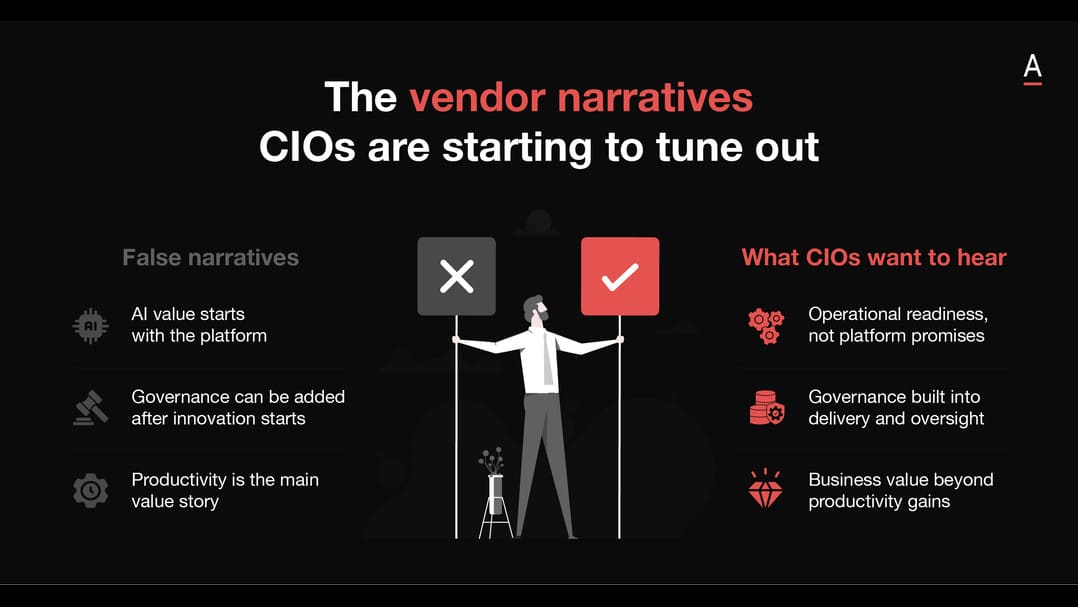





The real AI gap was between time saved and value captured, said Atlassian’s product and AI leaders
At CIO Edge, Atlassian’s product and AI leaders bust AI myths around ROI, workflows, and what actually scales.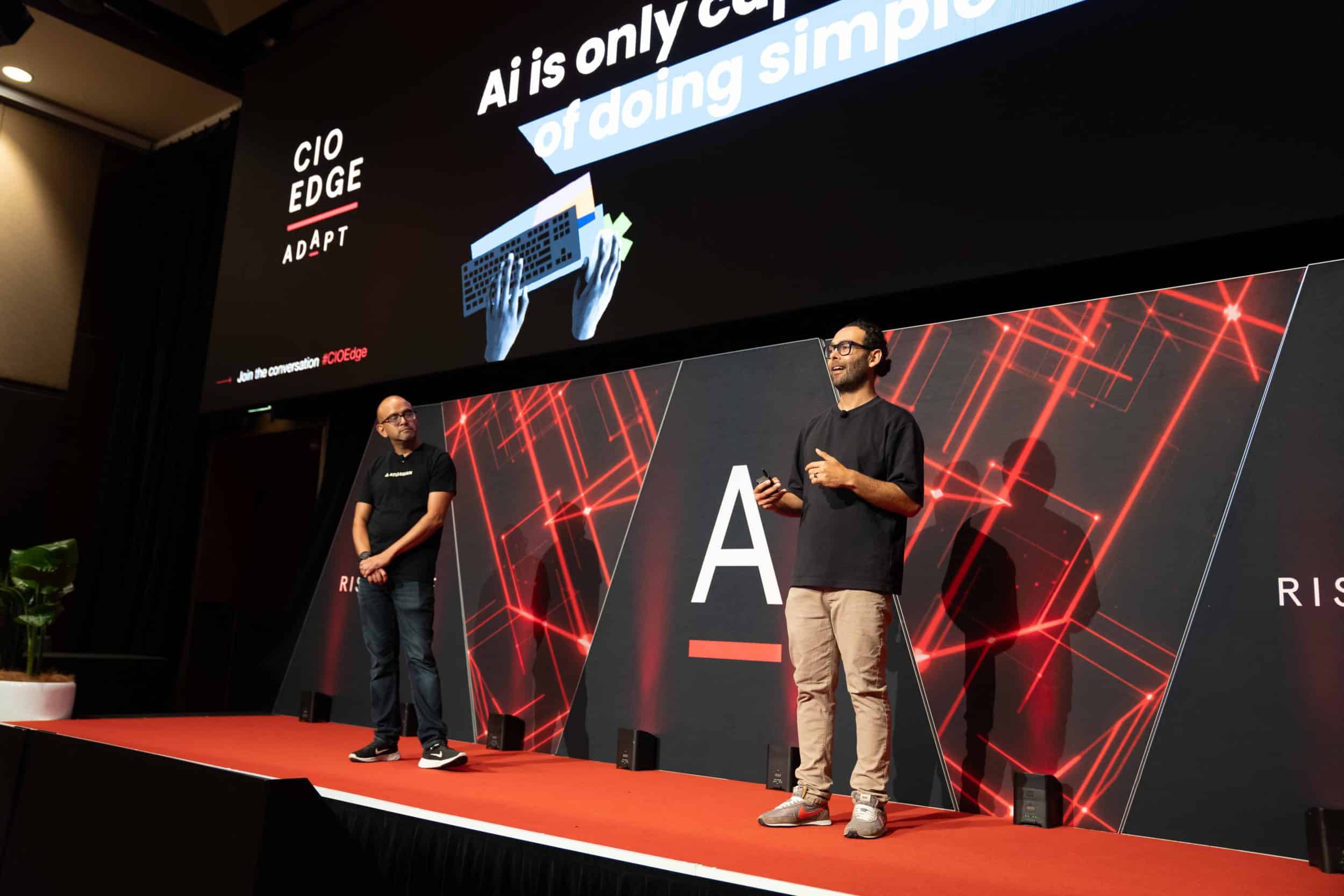


 Published Mar 2, 2026 in
Expert Presentations
Digital Transformation
Contributors
Abhik Sengupta
Sherif Mansour
Published Mar 2, 2026 in
Expert Presentations
Digital Transformation
Contributors
Abhik Sengupta
Sherif Mansour
AI value was proving easier to see at the individual level than at the enterprise level.
At CIO Edge, Abhik Sengupta, Principal Business Value Advisor at Atlassian, and Sherif Mansour, Distinguished Product Manager and Head of AI at Atlassian, argued that this gap sat at the centre of many current AI misconceptions.
Employees were saving time, lifting output, and using AI more confidently, yet most organisations were still struggling to turn those gains into measurable business outcomes.
Their argument was that the blocker was not a lack of model capability.
It was the failure to redesign workflows, embed context, and connect AI to the way work actually moved through the business.
Key takeaways:
- AI was delivering visible productivity gains, but most organisations were still failing to convert those gains into enterprise level value.
- The strongest AI outcomes were coming from agentic workflows connected to real business processes, not from isolated prompts or copilot use alone.
- What scaled best was not model novelty by itself, but stronger context, better workflow design, and an operating model that supported experimentation and learning.
Individual AI gains were not automatically becoming enterprise ROI
Abhik and Sherif challenged the idea that AI was failing to produce returns.
They pointed to clear signs of individual productivity improvement, including a 33% increase in personal output, 45 minutes saved per employee each day, and strong executive expectations around efficiency gains.
Yet fewer than 10% of organisations said they were achieving transformational value.
ADAPT data pointed to the same problem, with AI value measurement still immature across the market.
Their point was that time saved did not automatically become value captured.
The real gap sat between personal productivity and enterprise redesign.
If workflows, incentives, and operating models stayed the same, organisations could generate pockets of efficiency without changing outcomes in a way that showed up commercially or operationally.
In that sense, AI ROI was less a model question than an execution question.
AI was scaling through workflows, not isolated prompts
They also pushed back on the idea that AI was only useful for simple tasks.
In their framing, the technology had already moved well beyond basic prompting. What began with simpler interactions in 2023 had progressed into multi step orchestration in 2024 and then into longer running, self correcting agents by 2026.
They pointed to Atlassian customers executing more than 3 million agentic workflows in a single month, across use cases such as procurement reviews, product feedback pipelines, ticket deflection, staff ramp up, and engineering delivery.
Internal teams had seen engineering productivity double in some settings. Their broader message was that scale was no longer coming from isolated copilots.
It was coming from workflows where AI could operate across steps, systems, and decisions with enough context to be useful.
What scaled was context, judgment, and operating model change
Sherif stressed that advanced AI outcomes depended less on using the newest model and more on building the right organisational context around it.
That meant stronger data quality, enterprise search, permission structures, and connected graphs that allowed AI systems to act meaningfully within business processes.
Without that context, even capable systems would struggle to create differentiated value.
Both speakers also rejected the idea that AI would simply hollow out knowledge work.
They argued instead that work would be reshaped, with specialists remaining essential because they brought judgment, taste, and contextual nuance that generic systems could not replicate.
They made the same point about junior roles, noting that younger AI native employees were often the fastest adopters, the quickest to build agentic workflows, and the least constrained by old habits.
In their view, the organisations creating the most value were those where leaders modeled experimentation, encouraged rapid learning loops, and started evolving toward AI first operating models rather than staying trapped in isolated pilots.
 Abhik Sengupta
Principal Business Value Advisor at Atlassian
Abhik Sengupta
Principal Business Value Advisor at Atlassian
Abhik is a senior leader with over 20 years of experience in consulting and corporate roles, particularly within the financial services and technology sectors. He leads Atlassian’s Value Advisory practice for the APAC region, collaborating with enterprise customers across the region to maximise the value of Atlassian’s solutions. Prior to Atlassian, Abhik held leadership roles at companies including Macquarie, NAB, AMP and Salesforce. He holds a Master of Business Administration and currently shares his expertise as an Adjunct Professor at the SP Jain School of Global Management.
 Sherif Mansour
Distinguished Product Manager & Head of AI at Atlassian
Sherif Mansour
Distinguished Product Manager & Head of AI at Atlassian
Sherif Mansour is a Distinguished Product Manager for Atlassian and Head of AI. With over 20 years of software development under his belt, Sherif has played a key role in both developing new Atlassian products, including Rovo, Atlas, Stride, Team Calendars, and Confluence Questions, and in driving existing products forward, such as Confluence, a popular content collaboration tool for teams. Sherif now spends his days solving problems across all of Atlassian’s cloud products. Based in Sydney, Australia, Sherif enjoys running, pretending to be a professional soccer coach with kids under 10, and is a wannabe cartoonist.
 Join the ADAPT
 Insider Community
Get the latest A/NZ market research and insights on the core trends impacting leaders.
Join the ADAPT Insider Community
Get the latest A/NZ market research and insights on the core trends impacting leaders.