
















Atlassian product & AI leaders bust AI myths and explain what scales
At CIO Edge, Atlassian leaders debunk AI ROI myths, share 33% productivity gains, and explain why context and workflows unlock value.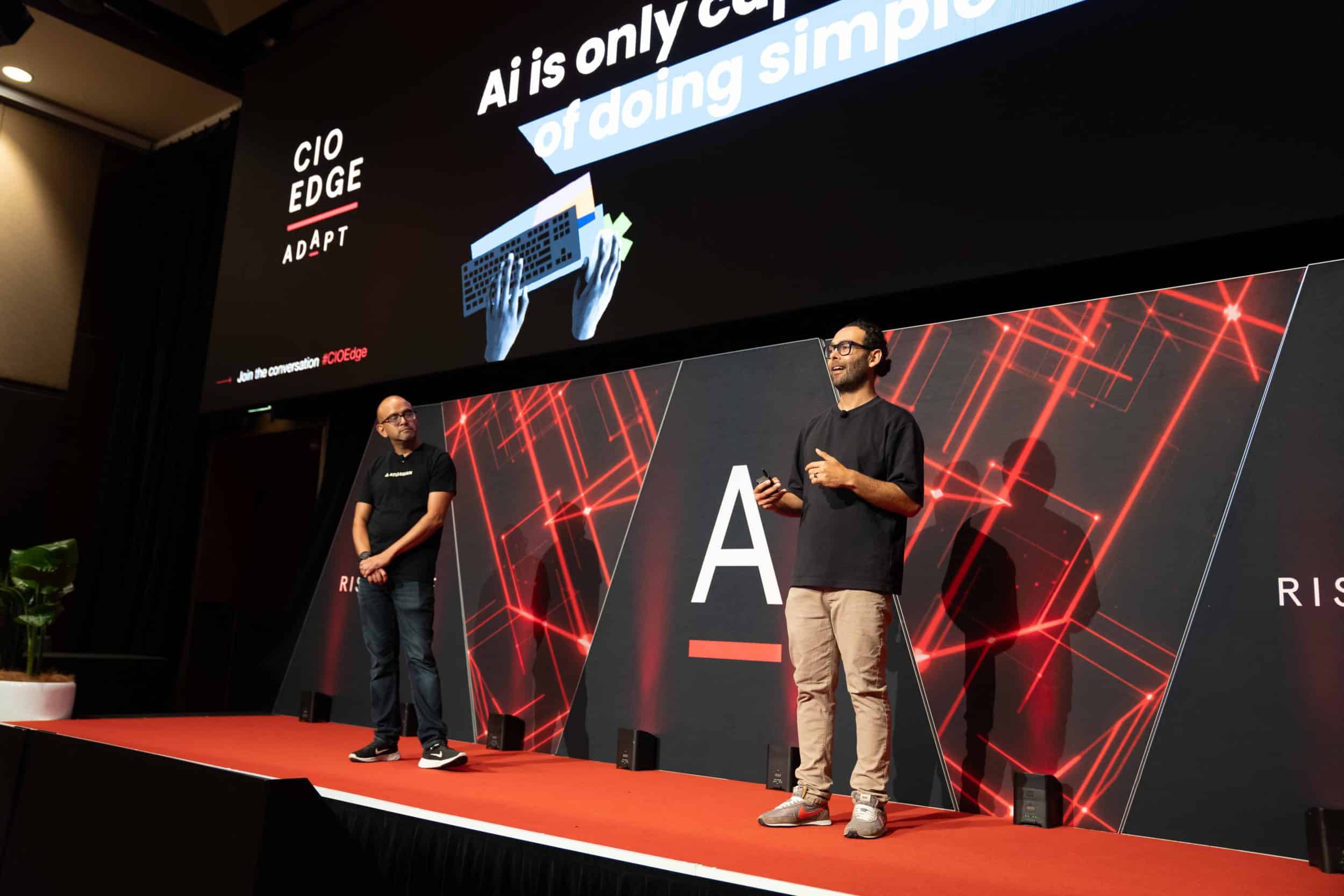


 Published Mar 2, 2026 in
Expert Presentations
Digital Transformation
Contributors
Abhik Sengupta
Sherif Mansour
Published Mar 2, 2026 in
Expert Presentations
Digital Transformation
Contributors
Abhik Sengupta
Sherif Mansour
At CIO Edge, Atlassian’s Abhik Sengupta, Principal Business Value Advisor and Sherif Mansour, Distinguished Product Manager & Head of AI at Atlassian explore some of the biggest myths surrounding AI.
Grounding their discussion in data from Atlassian’s customer base and broader market studies, they challenge the perception that there is little ROI in AI.
While individuals report meaningful productivity gains, such as a 33% increase in personal output, 45 minutes saved per employee per day, and 60% of executives expecting efficiency improvements, under 10% of organisations say they are realising transformational value.
This correlates to ADAPT data which shows, industry‑wide, AI value measurement remains underdeveloped.
This gap reflects a divide between individual‑level time savings and enterprise‑level value capture, where many organisations have not yet redesigned processes to translate time saved into measurable business outcomes.
Abhik and Sherif address the belief that AI can only handle simple tasks, showing how rapidly the technology’s capabilities have evolved from basic prompts in 2023 to multi‑step orchestration in 2024, and now to long‑running, self‑correcting agents in 2026.
Organisations are already using agentic workflows at scale, with Atlassian customers executing over 3 million such workflows in a single month.
These workflows span procurement reviews, product‑feedback pipelines, ticket deflection, accelerated ramp‑up of new staff, and engineering velocity, where internal teams have seen productivity double.
Sherif emphasises that advanced outcomes depend less on cutting‑edge models and more on strong organisational context: high‑quality data, enterprise search, permission models and connected graphs that allow AI systems to act meaningfully within business processes.
Both speakers tackle concerns about AI replacing knowledge workers, arguing that the future lies not in eliminating roles but in transforming them.
While Gartner predicts 25% of IT tasks will soon be performed by AI, the World Economic Forum estimates 70 million new jobs will emerge by 2030.
Instead of generalists replacing specialists, both argue for a hybrid skills model.
Specialists remain essential because they apply judgement, domain taste and contextual nuance that differentiate one organisation’s AI outputs from another.
They also debunk the myth that junior roles will disappear, observing that young “AI‑native” employees often adopt new tools fastest, create the most agentic workflows and have the least unlearning to do.
Organisations achieving the greatest AI value are those where leaders model experimentation, encourage rapid learning loops and begin evolving towards AI‑first operating models rather than relying on isolated pilots or co‑pilot‑only deployments.
Key takeaways:
- AI delivers clear productivity gains: Individuals reporting up to 33% higher output and teams saving 45 minutes per person per day, but fewer than 10% of organisations convert this into transformational ROI.
- The capability of AI has accelerated dramatically: With enterprises now running millions of agentic workflows per month, enabling multi‑step orchestration, process automation and significant improvements in engineering, service and onboarding performance.
- AI will reshape, not replace, the workforce: Creating new roles while elevating the importance of both specialists and AI‑native juniors; organisations that thrive will build context, strengthen data foundations and foster rapid experimentation across teams.
 Abhik Sengupta
Principal Business Value Advisor at Atlassian
Abhik Sengupta
Principal Business Value Advisor at Atlassian
Abhik is a senior leader with over 20 years of experience in consulting and corporate roles, particularly within the financial services and technology sectors. He leads Atlassian’s Value Advisory practice for the APAC region, collaborating with enterprise customers across the region to maximise the value of Atlassian’s solutions. Prior to Atlassian, Abhik held leadership roles at companies including Macquarie, NAB, AMP and Salesforce. He holds a Master of Business Administration and currently shares his expertise as an Adjunct Professor at the SP Jain School of Global Management.
 Sherif Mansour
Distinguished Product Manager & Head of AI at Atlassian
Sherif Mansour
Distinguished Product Manager & Head of AI at Atlassian
Sherif Mansour is a Distinguished Product Manager for Atlassian and Head of AI. With over 20 years of software development under his belt, Sherif has played a key role in both developing new Atlassian products, including Rovo, Atlas, Stride, Team Calendars, and Confluence Questions, and in driving existing products forward, such as Confluence, a popular content collaboration tool for teams. Sherif now spends his days solving problems across all of Atlassian’s cloud products. Based in Sydney, Australia, Sherif enjoys running, pretending to be a professional soccer coach with kids under 10, and is a wannabe cartoonist.

Join the ADAPT
Insider Community
Get the latest A/NZ market research and insights on the core trends impacting leaders.
Join the ADAPT
Insider Community
Get the latest A/NZ market research and insights on the core trends impacting leaders.