









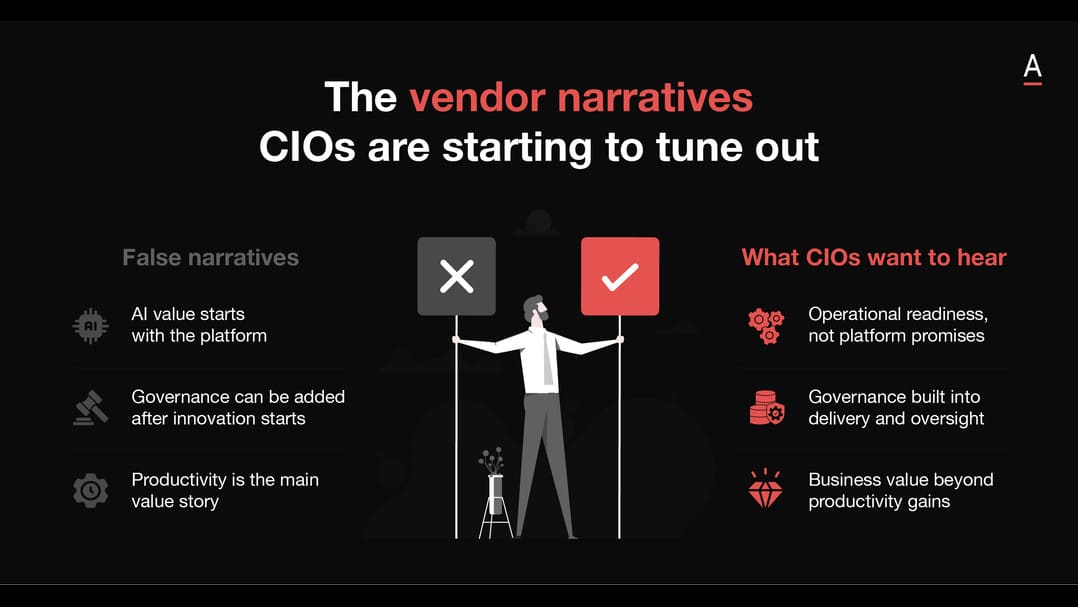





Agentic AI needs workflow redesign before it can create value
Leaders from Monash Health, Transurban and Swinburne show how workflow design, data and guardrails shape AI value in this CIO Edge panel.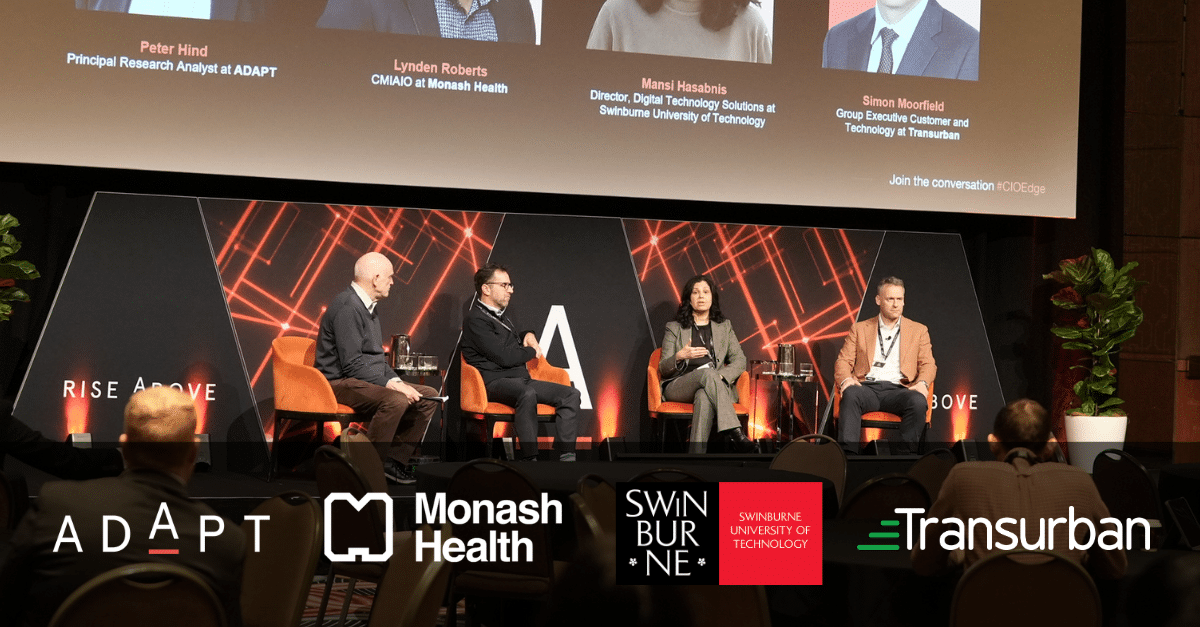


 Published Aug 21, 2026 in
Expert Presentations
Data & AI Strategy
Contributors
Lynden Roberts
Simon Moorfield
Mansi Hasabnis
Peter Hind
Published Aug 21, 2026 in
Expert Presentations
Data & AI Strategy
Contributors
Lynden Roberts
Simon Moorfield
Mansi Hasabnis
Peter Hind
Agentic systems can automate flawed processes as easily as sound ones.
Workflow design, data quality, and clear risk boundaries determine whether that autonomy improves performance or compounds existing problems.
At CIO Edge in Melbourne, Lynden Roberts, CMIAIO at Monash Health; Simon Moorfield, Group Executive, Customer and Technology at Transurban; and Mansi Hasabnis, Director, Digital Technology Solutions at Swinburne University of Technology, joined Peter Hind, Principal Research Analyst at ADAPT, to examine how organisations can redesign work, strengthen data foundations, and govern experimentation as agents take on more execution.
Key takeaways:
- Start with the value pool, then redesign the workflow: Select a clear business problem and rebuild the process around the outcome before deciding where agents should operate.
- Tie data quality to operational and commercial outcomes: Show how poor data affects decisions, customer experience, risk, retention, or revenue to strengthen the case for investment.
- Create clear boundaries for experimentation: Give teams ownership, frontline input, and permission to test while setting guardrails around risk, accountability, and autonomous action.
Start with the value pool before redesigning the workflow
Technology should enter the conversation after the business problem and desired outcome are clear.
At Monash Health, Lynden’s team targets specific value pools such as inefficient inpatient workflows, then co-develops solutions using AI and ambient technologies.
That keeps investment anchored to a measurable operational problem rather than a tool looking for a use case.
Workflow design then determines how much value the technology can create.
Simon expects the structure of work to change as models process more context and take on more complex execution.
Existing roles, hand-offs, and decision points need to change with that capability.
Mansi links poor process design directly to risk. Automating a flawed workflow allows agents to execute the same weaknesses faster and across greater volume.
Start with a small number of high-value problems, map how work and decisions move today, then redesign the workflow around the outcome required.
Data quality needs to be tied to operational consequences
Agents raise the cost of poor data because they can act on inaccurate information before a person reviews it.
Much of the work behind a seamless experience at Monash Health sits in getting data into the right shape. Lynden’s experience shows why model performance alone cannot compensate for weak foundations.
Fragmented technology estates add another layer of complexity.
Simon points to data spread across on-premise systems, cloud platforms, and SaaS applications, which makes consistent context harder to provide across workflows.
Boards need the consequences expressed in business terms.
Mansi frames data quality through operational risk and opportunity: an inaccurate report creates one level of exposure, while an autonomous agent acting on the same information can create a far greater one.
Linking data investment to outcomes such as student experience, retention, revenue, and operational risk gives leaders a clearer basis for prioritisation.
Semantic layers can also provide agents with more consistent business meaning across fragmented sources.
Guardrails should make experimentation easier to govern
Teams need room to test new ways of working and clear boundaries around autonomy, risk, and accountability.
Simon builds organisational understanding through practical use cases, then shares the results with executives and the board.
Visible evidence gives senior leaders a stronger basis for deciding where further investment and autonomy are warranted.
Frontline involvement also improves the quality of experimentation.
Lynden uses frontline champions and co-development to bring operational knowledge into solution design rather than separating technology development from the people doing the work.
At Swinburne, Mansi uses product-centric teams with clear ownership of outcomes and a safe-to-fail environment.
Employees are encouraged to surface edge cases and friction, giving the organisation more information about where controls or workflows need to improve.
Disciplined experimentation combines clear ownership, practical testing, frontline knowledge, and defined risk appetite.
Safe experimentation gives leaders the evidence to expand autonomy without losing control.
 Lynden Roberts
CMIAIO at Monash Health
Lynden Roberts
CMIAIO at Monash Health
Assoc Prof Lynden Roberts is the Chief Medical Information Officer at Monash Health where he has worked for 12 years. Lynden completed his MBBS in 1994 at University of Melbourne, his PhD at Walter & Eliza Hall Institute and his RACP Fellowship in Rheumatology & General Medicine. During his career he was worked at several Australian hospitals in a variety of medical leadership roles.
Lynden has had a long-standing research interest in health system innovation and is captivated by the potential of the various forms of ‘AI’ and analytics to transform healthcare. In 2025, he spent six months with the Australian Digital Health Research Centre (CSIRO) exploring this in depth. Lynden is driven to help ensure the significant benefits of digital technologies in healthcare are realised to improve the experience and outcomes for patients, carers, families, and staff.
Less Simon Moorfield
Group Executive, Customer and Technology at Transurban
Simon Moorfield
Group Executive, Customer and Technology at Transurban
Simon joined Transurban as Group Executive, Customer and Technology in October 2020. Prior to joining Transurban, Simon was the Executive General Manager Future Business & Technology and Chief Information Officer at AGL. He has 25 years’ experience in technology, innovation and transformation gained across roles held in Australia, the US, Europe and Asia Pacific.
Prior to AGL, Simon held several CIO and executive roles in companies including the Commonwealth Bank and GE. Simon has an extensive background in information analytics, customer engagement and mergers and acquisitions.
Less Mansi Hasabnis
Director Digital Technology Solutions at Swinburne University of Technology
Mansi Hasabnis
Director Digital Technology Solutions at Swinburne University of Technology
Mansi Hasabnis, based in Melbourne, VIC, AU, is currently a Director Digital Technology Solutions at Swinburne University of Technology. Mansi Hasabnis brings experience from previous roles at Ambulance Victoria, The Magistrates’ Court of Victoria, VicRoads and ICLP. Mansi Hasabnis holds a 2007 – 2011 Master of Business Administration (M.B.A.) @ University of Leicester. With a robust skill set that includes Business Analysis, IT Strategy, Strategy, CRM, Business Intelligence and more. Mansi Hasabnis has 3 emails on RocketReach.
Less Peter Hind
Principal Research Analyst at ADAPT
Peter Hind
Principal Research Analyst at ADAPT
Peter Hind has spent the last 25 years as an analyst and commentator on the ICT industry.
His primary areas of interest are the potential of technology to transform the way organisations operate, the change management obstacles executives encounter in realising this potential, as well as the tactics and techniques leaders have deployed to overcome these difficulties.
Peter now takes on multiple roles within ADAPT including the moderation of private events and roundtables, interviewing business executives about the strategies they are pursuing and assisting with the structuring of delegate surveys.
He also interrogates and analyses ADAPT’s treasure trove of end-user and C-suite data.
Less Join the ADAPT
 Insider Community
Get the latest A/NZ market research and insights on the core trends impacting leaders.
Join the ADAPT Insider Community
Get the latest A/NZ market research and insights on the core trends impacting leaders.