



















How technology leaders can unlock more from technology spend
TechBoosters' Samantha McIntyre and Rachael Collins share a practical view on where technology budgets leak, how leaders can recover value, and why better spend discipline creates room for stronger transformation.


 Published Apr 16, 2026 in
Articles
Strategic Business Initiatives
Contributors
Samantha McIntyre
Rachael Collins
Published Apr 16, 2026 in
Articles
Strategic Business Initiatives
Contributors
Samantha McIntyre
Rachael Collins
Technology leaders do not usually have a pure budget problem. More often, they have a visibility problem.
That is the starting point for any serious conversation about technology spend.
If leaders want to reduce waste, they need a clearer view of where money is leaking across contracts, licences, duplicate tools, telecoms, off-boarding and the long tail of supplier spend that quietly builds over time.
This is also why cost optimisation should be treated as a leadership discipline, not a cost-cutting drill.
The goal is not to strip back ambition. The goal is to remove spend that is no longer creating value and redirect it into the priorities that matter most.
As ADAPT Advisor Samantha McIntyre puts it,
“The budget conversation should not start and end with constraint. It should start with visibility, move quickly to value, and create the confidence to invest where it matters most.”
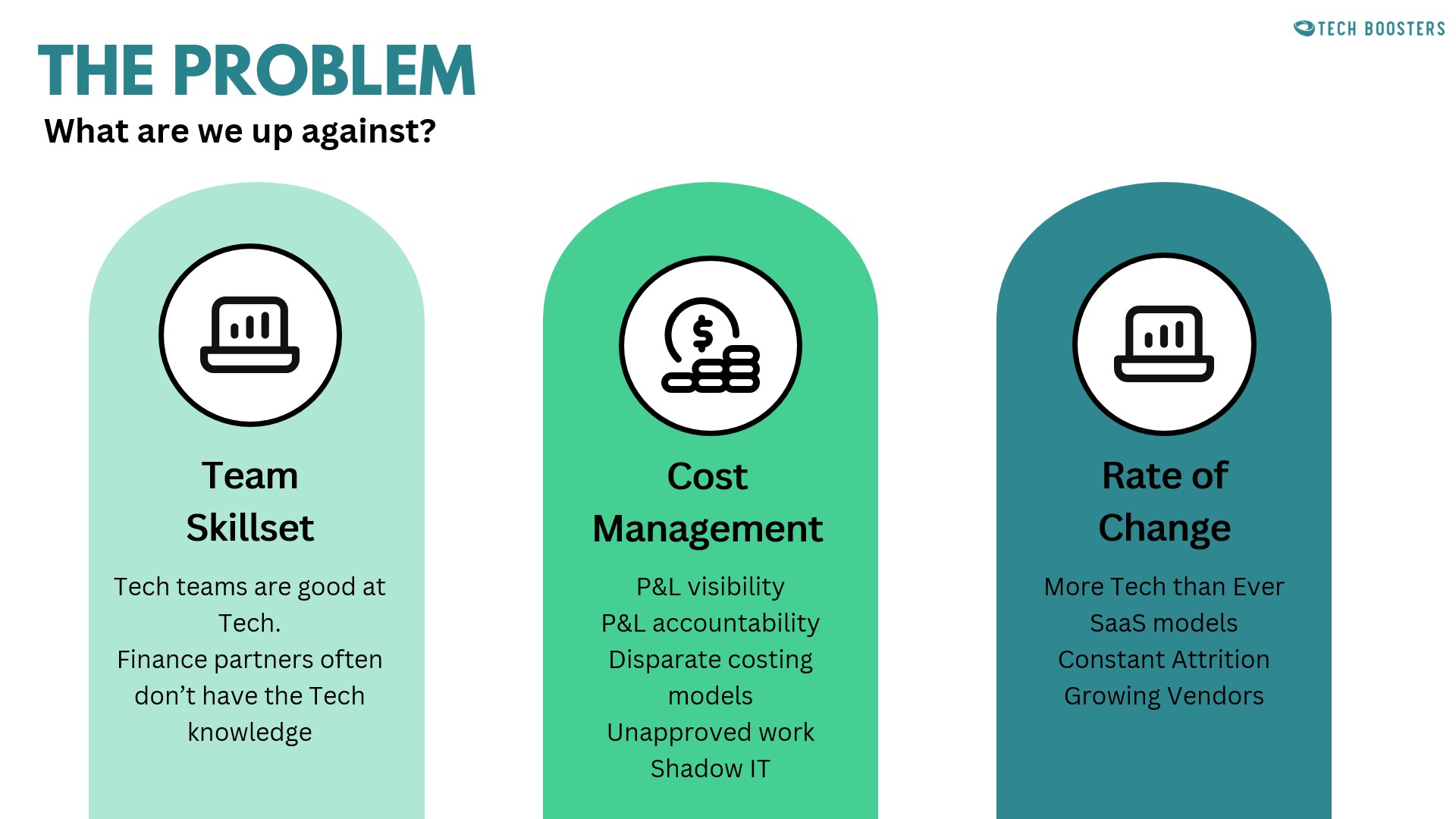
Where technology budgets commonly leak
There are a handful of places where leaders should look first.
Off-boarding is one of the most common. When employees or contractors leave without licences, access, devices or services being cleaned up properly, spend continues in the background.
Unused or underused software is another. In many organisations, tools remain active long after the original need has changed. Premium licence tiers are retained even when only a small portion of the functionality is being used.
Duplication is also a persistent issue. Sometimes it is obvious, with multiple systems doing the same job. Sometimes it is more subtle, with several platforms solving most of the same need across different teams.
Contract drift is another major source of leakage. Contracts auto-renew, notice periods are missed, and negotiations happen too late for the business to have much leverage.
Then there is billing and supplier sprawl. Invoices are not always checked closely enough against contract terms, and the long tail of smaller suppliers often continues with very little scrutiny.
These are not edge cases. They are the everyday places where technology value can quietly erode.
How CIOs can reduce technology waste
The answer is not to launch a broad cost-cutting exercise and hope for the best.
A better approach is to work through spend in a structured way:
- start with visibility across software, cloud, telecoms, devices, managed services and contractors
- confirm who owns each major spend category
- identify quick wins that can be addressed in weeks
- separate those from the bigger structural issues that need a longer roadmap
In practice, the first wins often come from basic operational discipline.
Leaders who review inactive licences, test major invoices, clean up mobile assets, and get ahead of contract renewals can usually recover value faster than expected.
The longer-term opportunity is broader. It sits in platform simplification, stronger governance, clearer ownership and better process adherence across teams.
How CIOs and CFOs can align on technology spend
This is where the conversation becomes strategic.
When technology leaders talk only about budget pressure, and finance leaders ask only for a stronger ROI story, both sides can miss the bigger opportunity. Alignment improves when the discussion becomes more concrete.
That means showing where spend is drifting, what can be recovered, and how that value could be reinvested.
It means moving the conversation away from generic requests for more funding and towards a clearer view of trade-offs, priorities and outcomes.
For CFOs, that creates confidence that spend is being challenged properly.
For CIOs, it creates a stronger basis for funding transformation, cyber uplift, simplification or AI priorities without relying only on new budget.
What leaders should review in the next 90 days
The next 90 days should focus on building enough visibility to act with confidence.
A practical review should cover:
- off-boarding for both employees and contractors
- inactive or low-usage licences
- contract renewal dates and notice periods
- top vendor invoices against contract terms
- mobile assets, telecom services and subscriptions without a current owner
- duplicated tools or overlapping functionality
From there, leaders can divide opportunities into three groups: immediate fixes, quarter-level actions and longer-term structural changes.
That matters because not every issue needs the same response.
Some areas can be cleaned up quickly. Others require change management, stakeholder buy-in and a more deliberate roadmap.
The real opportunity
The strongest leaders do not treat spend optimisation as a one-off clean-up. They treat it as part of how technology is governed.
That shift matters because the real goal is not simply to spend less. It is to spend with more intent.
When organisations improve visibility, challenge waste early and connect savings to strategic outcomes, they create room to keep moving on what matters.
That is how technology spend moves from a constraint discussion to a value discussion.
And in most organisations, that value is already there. It just needs to be uncovered.
Frequently Asked Questions
How can CIOs reduce technology waste?
CIOs can reduce technology waste by improving visibility across software, contracts, devices, suppliers and services, then prioritising quick wins such as inactive licences, billing reviews and contract clean-up.
Where do technology budgets commonly leak?
Technology budgets commonly leak through poor off-boarding, unused software, overlapping tools, contract auto-renewals, invoice issues, telecom services and smaller supplier costs that no one actively reviews.
How can CIOs and CFOs align on technology spend?
CIOs and CFOs align more effectively when the discussion moves beyond budget pressure and focuses on value: where spend is leaking, what can be recovered, and how that value will support business priorities.
What should leaders review in the next 90 days?
Leaders should review off-boarding processes, licence usage, contract renewals, notice periods, major vendor invoices, mobile and telecom assets, and duplicated tools.
 Samantha McIntyre
Founder Techboosters. Former CIO Target, Sussan Group & Loreal
Samantha McIntyre
Founder Techboosters. Former CIO Target, Sussan Group & Loreal
Samantha is a former CIO with 30+ years in tech, leading digital and IT transformations in organisations such as Tesco, Coles, and L’Oréal.
She co-founded “Tech Boosters” to help businesses scale efficiently and founded “Lady Leadership” to empower women in tech through coaching and mentoring.
– Held CIO roles at Target, L’Oréal, Simplot, and the Sussan Group.
– Led global digital and e-commerce transformation across major brands.
– Co-founder of Tech Boosters, focused on IT cost optimisation and virtual CIO services.
– Founder of Lady Leadership, empowering women in technology through coaching and education.
– Deep experience in retail, manufacturing, supply chain, and digital platforms.
– Known for building strong cultures and high-performing technology teams.
 Rachael Collins
Co-founder Tech Boosters,Expert in Transformational Technology, Strategy and Execution
Rachael Collins
Co-founder Tech Boosters,Expert in Transformational Technology, Strategy and Execution
Rachael Collins is a senior IT leader with 15+ years of experience and a talent for cutting through complexity; connecting strategy to delivery, aligning the right people around the right problems, and turning tech functions into engines of real business value.
Co-founder of Tech Boosters, Rachael works with organisations to stabilise delivery, improve selection and execution, and transform bureaucratic, bloated functions into lean, outcome-focused operations. Known for her open, collaborative approach and her ability to build trusted partnerships with clients to deliver tailored, impactful solutions.
Rachael is deeply passionate about ensuring teams have the clarity, capability, and confidence to do their best work, and that improvements stick for sustained change
Less Join the ADAPT
 Insider Community
Get the latest A/NZ market research and insights on the core trends impacting leaders.