

















Australia’s 2026 Federal Budget turns technology into an economic productivity mandate
ADAPT’s Senior Research Director Matt Boon examines what the 2026 Federal Budget signals for technology leaders, from digital ID and cyber resilience to AI, automation, and Australia’s productivity challenge.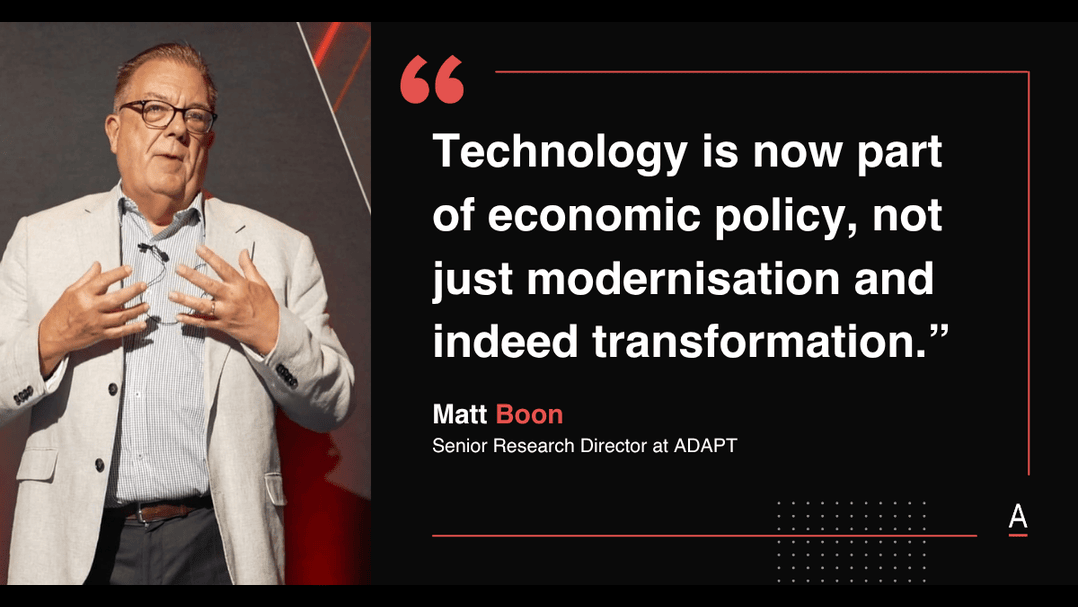


 Published May 14, 2026 in
Articles
Strategic Business Initiatives
Contributors
Matt Boon
Justina Uy
Published May 14, 2026 in
Articles
Strategic Business Initiatives
Contributors
Matt Boon
Justina Uy
The 2026 Federal Budget did not deliver a major standalone technology package, but Matt Boon, Senior Research Director at ADAPT, says technology leaders should still read it as a significant signal.
Matt frames the budget as a domestic economic reform budget shaped by fiscal constraint, sluggish productivity, cost of living pressure and weak private sector momentum.
Rather than funding technology as a separate transformation agenda, the government has embedded digital capability into its broader reform programme through cyber, AI, identity and automation.
That changes the role of technology in the budget. It is being treated less as a programme of spend and more as part of Australia’s economic operating model.
Technology is becoming part of economic policy
The direct technology allocations are meaningful, but contained.
Matt points to $654.3 million over four years for Digital ID and $89.3 million over four years for cyber capability.
The cyber figure is modest when set against the estimated annual cost of cyber incidents to Australia, which he places between $3 billion and $7 billion.
The larger signal sits in the budget’s productivity assumptions.
The government links reform to $10.2 billion a year in reduced regulatory burden and a projected $13 billion uplift to long run GDP.
Matt’s view is that those gains depend on digital systems, automation, AI and trusted identity infrastructure carrying more of the productivity burden.
For CIOs, CISOs and digital leaders, the business case for technology investment is narrowing.
Projects will need to show how they reduce friction, improve service delivery, simplify compliance, strengthen trust or lift workforce productivity.
Cyber resilience is moving into infrastructure thinking
Matt says the cyber allocation recognises the issue, but does not match the scale of national exposure.
An $89.3 million allocation over four years will not close the resilience gap on its own.
The more important shift is that cyber is moving closer to infrastructure policy.
Resilience is becoming part of operational continuity, rather than a technical uplift owned only by security teams.
That puts renewed pressure on the fundamentals, including identity controls, multi factor authentication, access governance and incident readiness.
Many organisations are still trying to advance resilience while basic controls remain inconsistent.
As cyber risk becomes more visible to boards, regulators and customers, that gap will become harder to defend.
Execution remains the constraint
Matt sees delivery capability as the main risk. The budget funds important digital foundations, but is lighter on the capabilities needed to scale them effectively.
The gaps he identifies are familiar across both government and enterprise environments:
- digital skills
- AI capability
- data maturity
- legacy replacement
- agency delivery capacity
- integration capability and
- technical execution.
These are the areas that determine whether reform becomes measurable impact.
AI governance is one of the most exposed weaknesses.
Matt notes that many leaders still lack a consistent view of what AI governance should look like.
As government expands AI use across service delivery and internal operations, regulatory expectations will tighten across sectors.
Organisations without mature governance will be forced to catch up under pressure.
Productivity will define the next phase of investment
Matt says technology leaders should treat the budget as a productivity mandate.
AI and automation need to move beyond pilots, proofs of concept and isolated efficiency gains.
The test is whether technology can create measurable economic value across the organisation.
That includes identifying where AI can improve productivity in the next 12 months, strengthening automation initiatives, reassessing identity strategy and elevating cyber as resilience infrastructure.
For vendors, the same shift changes the sales conversation.
Matt says the market is moving away from abstract digital transformation and back to the fundamentals of digital efficiency.
Technology providers will need to sell measurable efficiency, faster service delivery, trust, security, automation return on investment and operating cost reduction.
Procurement will be critical. The budget creates intent, but procurement determines whether that intent becomes real demand.
Digital ID and AI governance will test delivery speed
Matt identifies Digital ID as one of the strongest technology signals in the budget.
The $654.3 million allocation gives the programme weight, but implementation speed will determine its value.
If Digital ID scales effectively, it can create a stronger trust layer for digital transactions across Australia.
It can also reduce friction across government services, improve identity assurance and support compliance simplification.
AI governance presents a different delivery challenge.
The budget’s productivity ambition depends heavily on AI and automation, even where AI is not the headline spend.
As government adoption increases, scrutiny will follow.
Organisations will need clearer accountability, risk assessment, model monitoring and workflow integration.
Treating AI as a technology deployment will create risk. Treating it as operating model redesign will create value.
The budget is restrained, but structural
Matt reads the budget as more substantial than it first appears.
It is not a radical technology reset, but it recognises that Australia’s productivity challenge cannot be solved without stronger digital capability.
For technology leaders, that means investment cases need stronger economic discipline.
For vendors, it means value propositions must be tied to cost reduction, productivity uplift, trust, resilience and speed to value.
The budget sets the direction. Execution will determine whether digital ambition becomes economic value.
 Matt Boon
Senior Research Director at ADAPT
Matt Boon
Senior Research Director at ADAPT
Matt Boon is the Senior Director for Strategic Research at ADAPT, responsible for directing and developing research content and positions.
For over 30 years, Matt has worked in research and advisory, including senior leadership roles at Gartner as Principal Analyst, Research Director, and Managing Vice President, where his 18 year history included working with Dell, Microsoft, and many others.
Throughout his career, Matt has been a sought after and highly respected authority on the local and global IT landscape. He interacts with executives daily, bringing together groups of C-suite leaders to discuss and prepare for the challenges and opportunities they face.
At ADAPT, Matt hosts numerous industry-leading business and technology events which Matt chairs, including the yearly Security Edge conference, delivering unique market trends and white-papers, advising executives across the technology provider landscape to make informed IT decisions.
When he is not working, Matt enjoys walking the many trails of the NSW Southern Highlands, travelling and listening to music. He is also partial to a good steak and nice glass of red wine.
Less Justina Uy
Content Marketing Manager
Justina Uy
Content Marketing Manager
Justina Uy is a data-driven content marketer that thrives on democratising elite know-how to empower Australia’s underdogs.
Skilled at translating complex ideas into a compelling story across formats and channels, she shifts seamlessly between writing long-form articles, creating viral social media posts, and producing thumb-stopping videos.
Since 2015, Justina executes her vision through a sophisticated understanding of the rapidly evolving digital and business landscape to serve entertaining and educational insights to the executive community.
Less Join the ADAPT
 Insider Community
Get the latest A/NZ market research and insights on the core trends impacting leaders.
Join the ADAPT Insider Community
Get the latest A/NZ market research and insights on the core trends impacting leaders.