








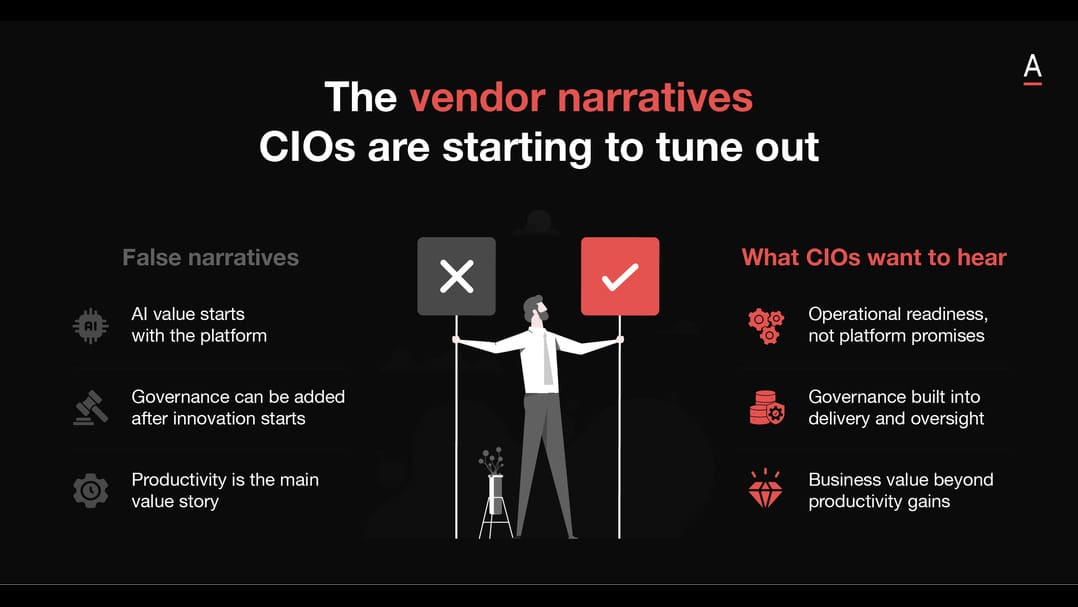





Government Edge 2026: AI gains are real, but most agencies are still bolting it on
At Government Edge, agency leaders agreed AI gains are real, yet most agencies are still layering AI onto old ways of working.


 Published Nov 24, 2026 in
Articles
Data & AI Strategy
Contributors
Byron Connolly
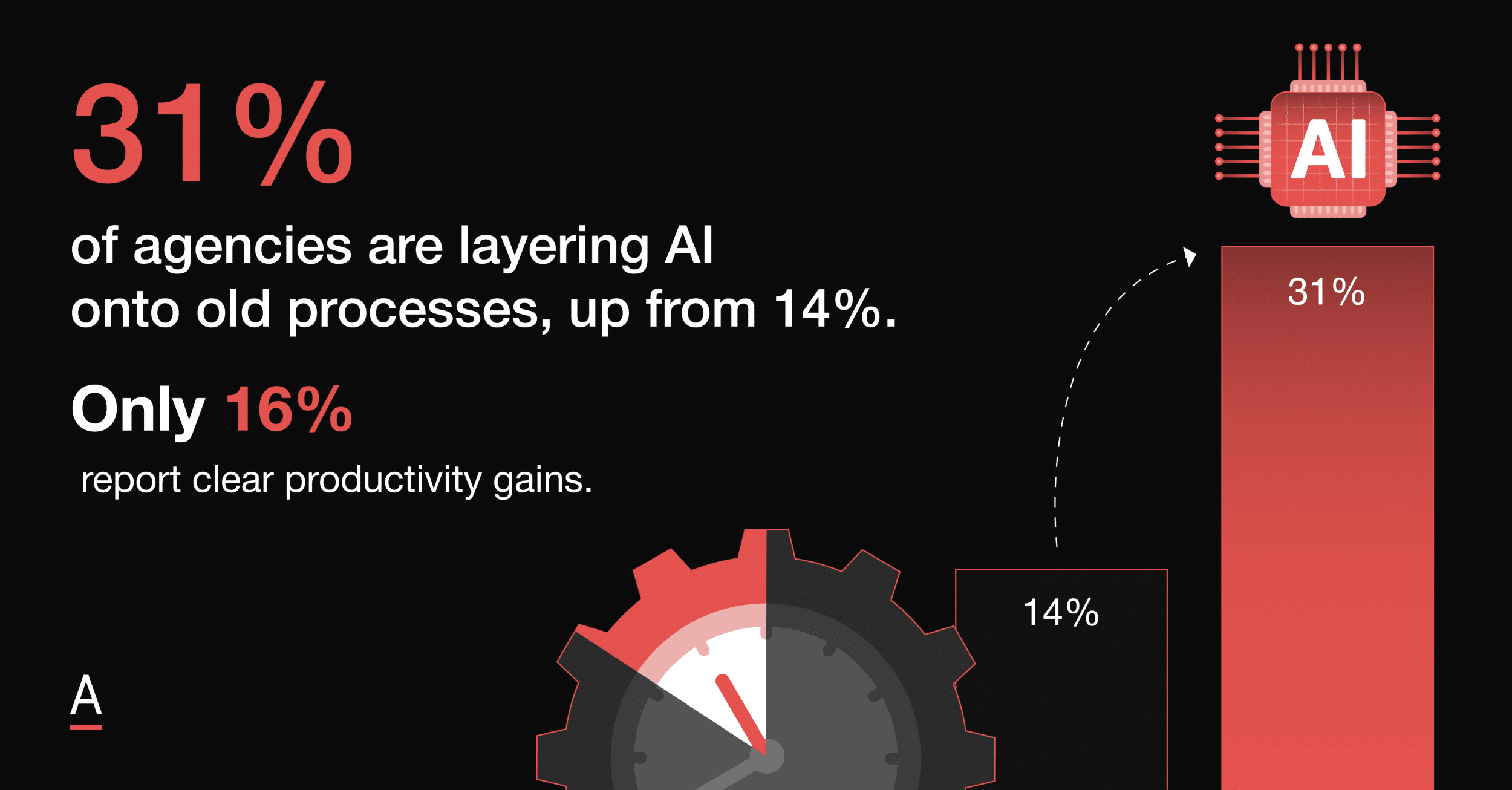
AI value is starting to show across Australia’s government agencies: one in six respondents (16%) to ADAPT’s Government Edge research, published in November, can now point to a measurable productivity gain from AI technologies.
Clearly, some agencies are making headway with these tools as deadlines for meeting AI-specific governance, risk and accountability mandates loom over the coming weeks, including the APS AI Plan’s one-year review to measure adoption, training and usage.
But adoption is not the same as value, and closing that gap is the work for the next 12 months.
Almost one-third (31%) of public sector leaders say they are just bolting or layering AI onto existing processes rather than rethinking how AI changes work.
Only 12% re-engineer work before scaling. This means that AI gains can be small.
At ADAPT’s third Government Edge in Canberra, the Australian Taxation Office’s (ATO) Chief Information Officer, Mark Sawade, told the audience that automating existing processes is the easy path and the agency expects zero ROI from giving 22,000 staff access to Copilot.
“The real value is where we’re going to re-engineer our core business processes and embed automation into the work that’s already delivering the outcomes”, he said.
The top performers bear this out. Among agencies reporting value, 30% re-engineer work before scaling, compared with 8% of other agencies.
And 60% have structured, repeatable change processes, compared with 12%.
IBM Australia’s Chief Technology Officer, Angelica Veness, said the organisation’s productivity gains came from putting HR and IT staff together to redesign the work, not from applying technology to an existing process.
“We’re often talking about what we’re learning. How often do we talk about what we’re unlearning?” she asked.
In his opening presentation, ADAPT CEO, Jim Berry, also highlighted that AI is still pointed at the paperwork as opposed to the counter or the citizen.
“Minutes are not money until someone decides where they go”, he told the audience.
Who is ahead and who is behind?
ADAPT’s data shows that 60% of agencies reporting AI value have a mature AI register with named owners, compared with 24% of other agencies.
Half are ready to explain automated decisions, compared with 27%.
AI mandates for government agencies are arriving in weeks and months, not years (see table below).
They’re close and many agencies are not ready for them.
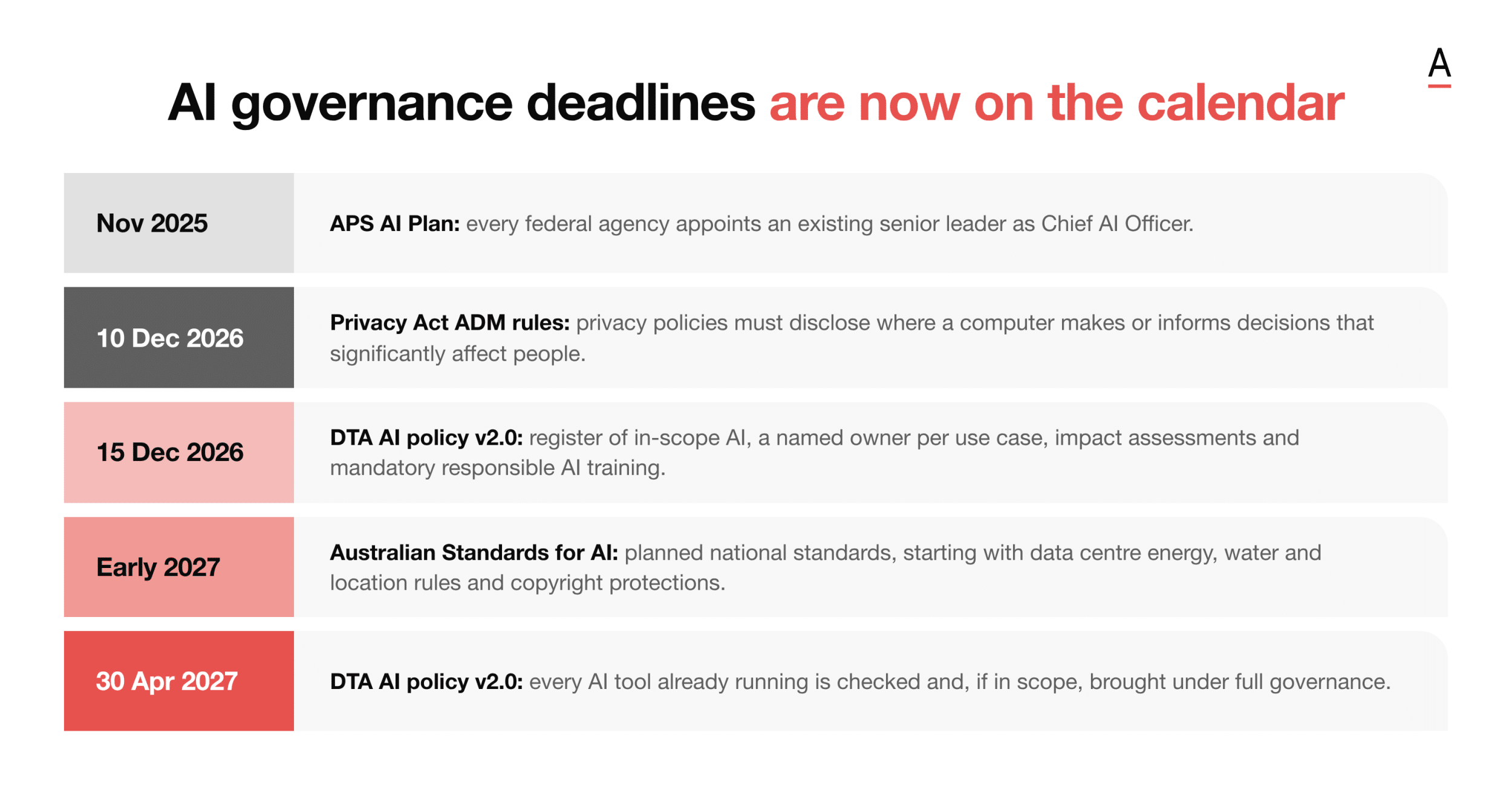
More than 110 Chief AI Officers are now in place; half of them appointed in the final fortnight before the deadline.
Meeting each of these deadlines as a compliance exercise keeps an agency in the pack, while using them to redesign work can move an agency towards an AI leadership position.
Agents are moving, but few have scaled
Meanwhile, agentic AI is gaining traction across government agencies: 35% of respondents say they are piloting or scaling AI agents, but only 14% have moved to full-scale deployments.
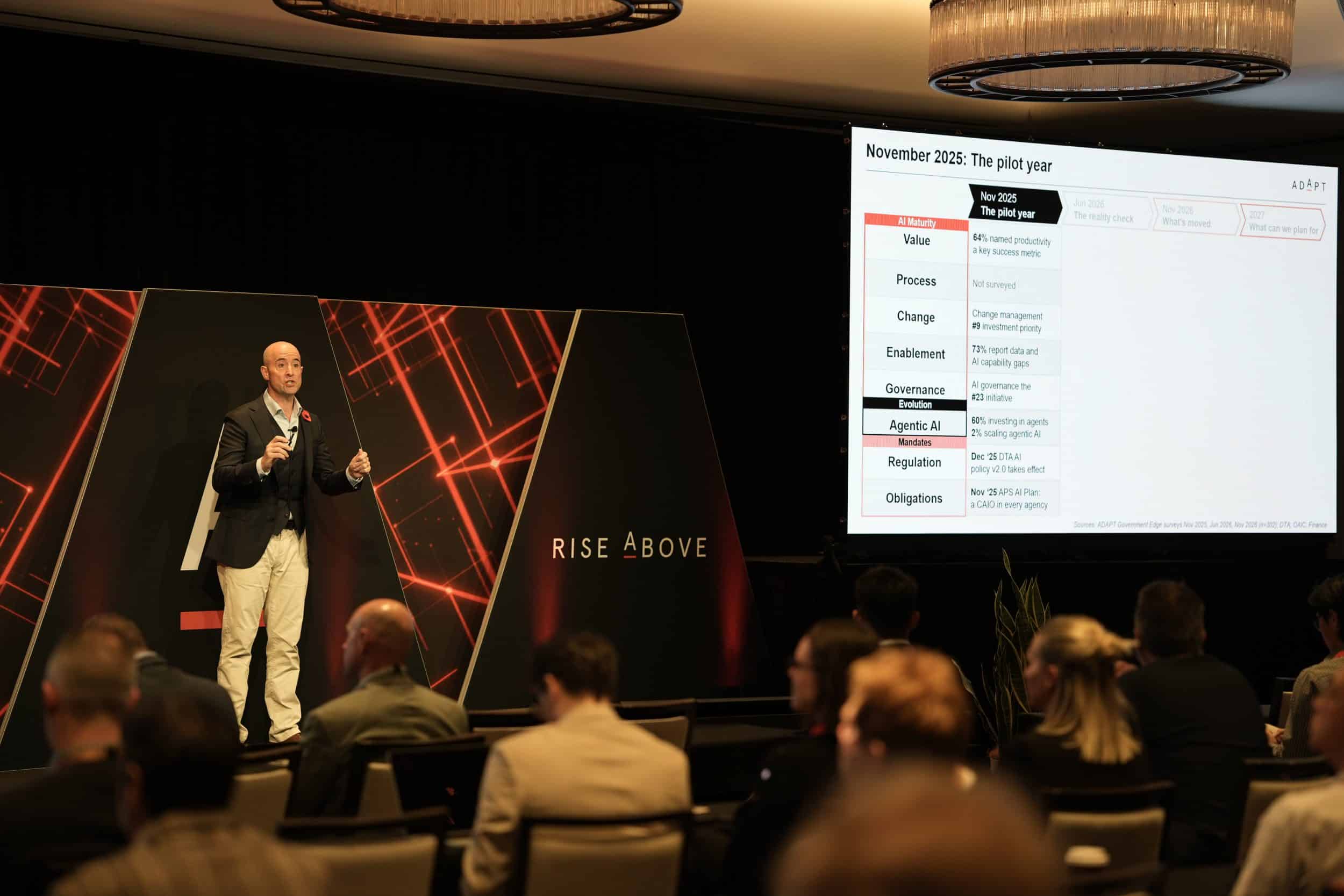
That’s a sevenfold increase from a year ago, when 2% said they were scaling agents, while 60% said they were investing in them.
So far, the gains have been concentrated in the back office. 73% of agencies expect the biggest early gains in drafting and summarising, and 49% expect gains in managing information.
Only 14% expect gains in contact centres or case management, where the potential impact on costs and citizens is greatest.
And 71% say their AI tools will need major changes or expansion within two years.
Funding, skills and change fatigue are barriers
Funding and skills remain the two biggest barriers, ahead of competing priorities, according to ADAPT’s data.
Legacy systems absorb much of the budget, while teams have limited capacity to take on more change. 56% identify AI literacy as the top skills gap to close, and 52% lack specialist AI, data and cyber skills.
The share of agencies with mandatory AI training for all staff has risen to 31%, from 24% in June, but remains below one-third.
Change is the weak link. Change fatigue has now entered the top 10 barriers to execution. Most leaders (80%) say major change succeeds only with significant friction, or worse.
The ATO’s Mark Sawade described AI investment using three dials: more output for the same input, the same output for less input, or the same output at higher quality.

“How are we going to be very deliberate and very transparent about which dials we’re turning, and when? That then tells us what we should measure”, he said.
Data and governance are holding back scale
Governance climbed from 23rd on the priority list in November 2025 to third. It is now the top blocker to scaling AI, cited by 51% of agencies.
Privacy, security and accuracy risks follow at 48%, while 43% cite unready data.
Visibility is limited: 41% of agencies have no register of the AI they use, or only an informal one, and just 8% track AI use across the agency.
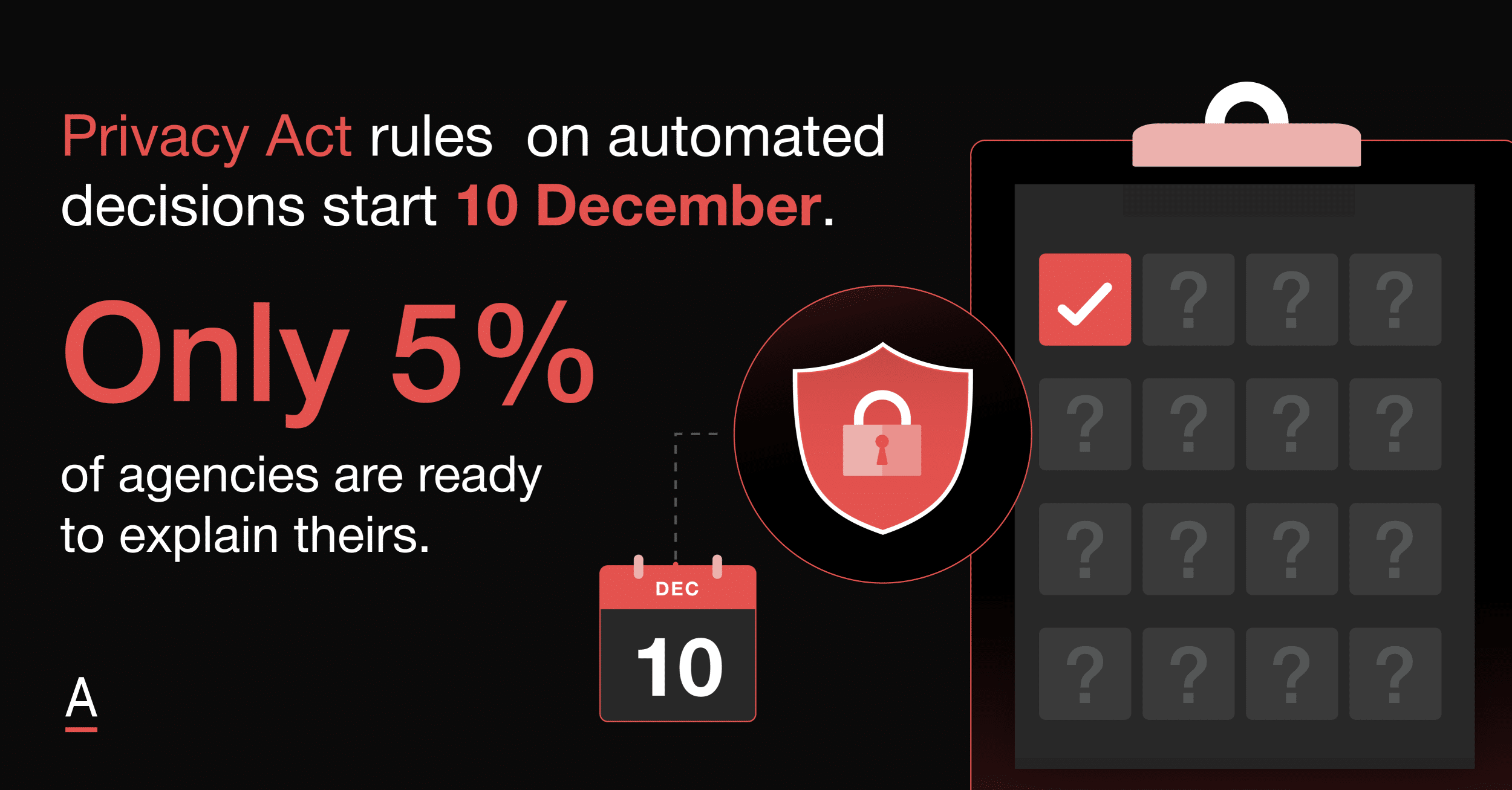
Explainability is weaker still. Only 5% of agencies are ready to explain how automated systems make decisions about people, while 58% are either unprepared or only aware of the issue.
Data sharing is held back by privacy concerns (54%) and legal uncertainty (51%).
The ATO’s Sawade said the agency is now less willing to buy a “black box”, even one that has delivered value, if it cannot explain it to taxpayers, government and its own staff.
IBM’s Angelica Veness described control as spanning ethics, risk and cost, and argued that visibility and control come first.
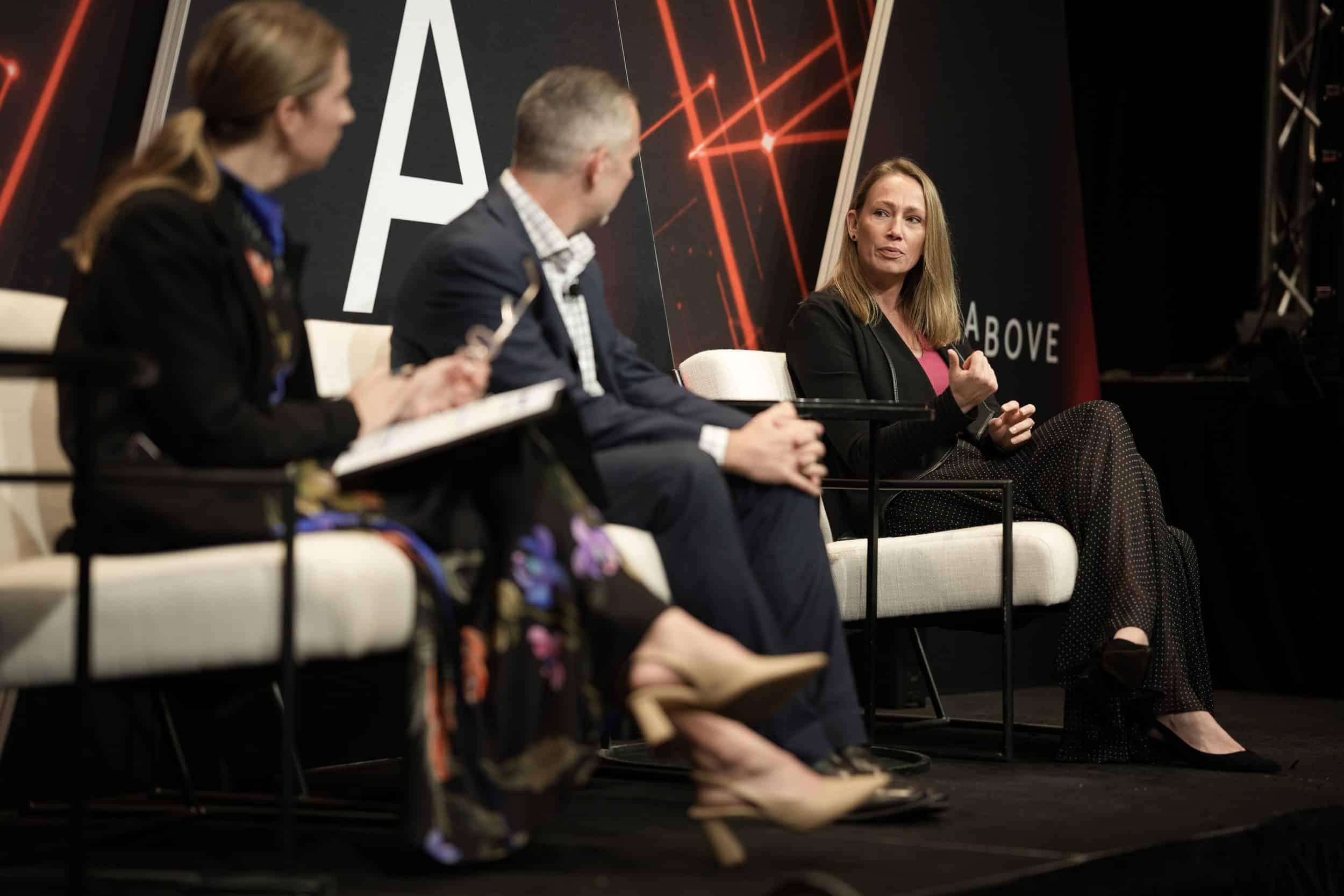
Decisions about which systems and data sets need to be sovereign follow from there.
What government tech leaders need to do now
There are three key questions that government agencies need to ask:
- Do we have a register with named owners?
- Can we explain an automated decision?
- Have we set the measure before the pilot starts?
AI leaders and followers in government face the same December deadlines; the difference is what they do with them.
Agencies already reporting value tend to be the ones with mature AI registers, named owners, structured processes, and plans to explain automated decisions.
They treat governance and work redesign as one job, not two. For the rest, the register, the impact assessments and training are a chance to work out where AI sits in their agencies, who owns it and whether or not it is improving outcomes.
That visibility is also what will help agencies move beyond AI drafting and summarising and into areas like case management and contact centres, where taxpayers and citizens will notice the difference.
 Byron Connolly
Head of Programs & Value Engagement at ADAPT
Byron is a highly experienced technology and business journalist, editor, corporate writer, and event producer.
Prior to joining ADAPT, he was the editor-in-chief at CIO Australia and associate editor at CSO Australia. He also created and led the well-known CIO50 awards program in Australia and The CIO Show podcast.
Byron creates valuable insights for our community of senior technology and business professionals that help them reach their organisational and professional goals. He has a passion for uncovering stories about the careers and personal philosophies of Australia’s top technology and digital executives.
When he is not working, Byron enjoys hot yoga, swimming, running and spending time with his family. He completed the North Face 100km ultra marathon in the NSW Blue Mountains in 2012 and 2013.
Less Join the ADAPT
Insider Community
Get the latest A/NZ market research and insights on the core trends impacting leaders.